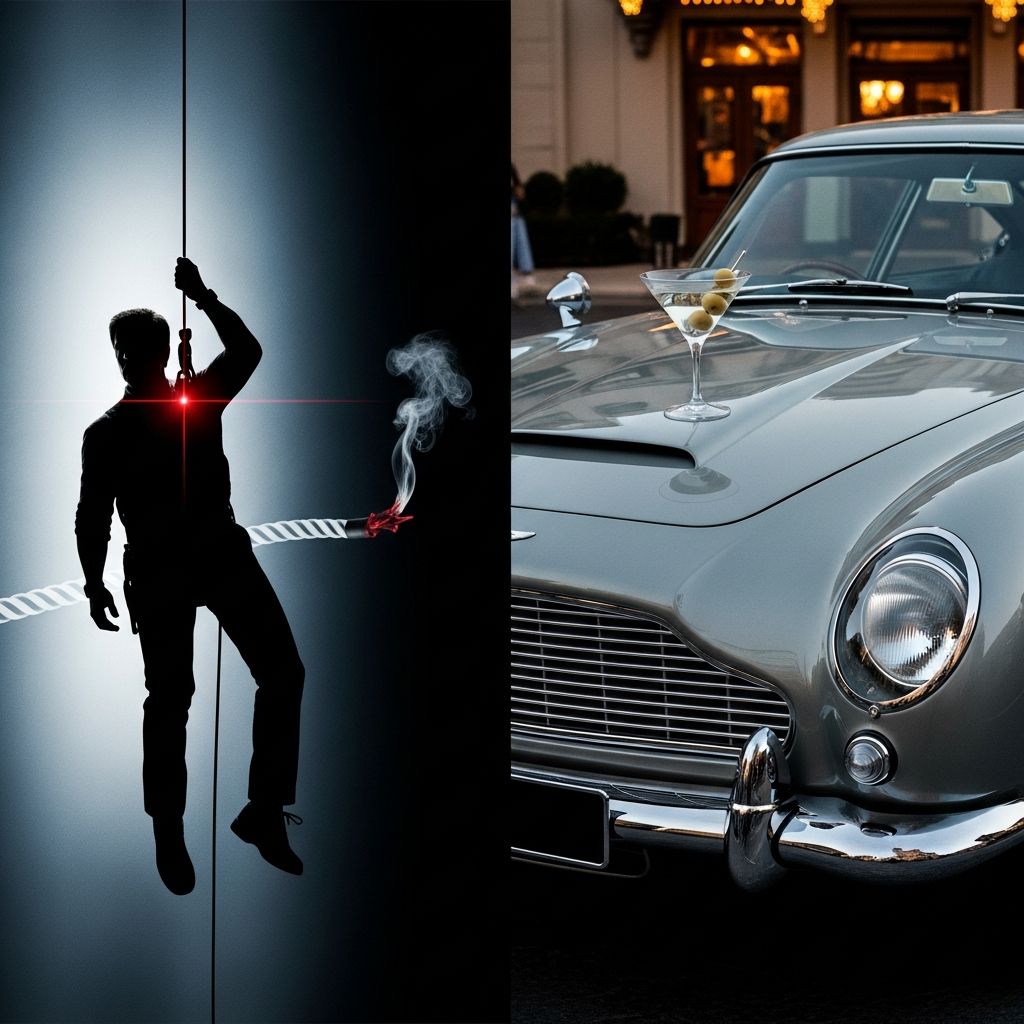
For decades, fans have argued over a single thrilling question: if you could keep only one spy franchise, would it be James Bond or Mission: Impossible? One is a 1960s icon of tuxedoed British cool; the other is a modern stunt machine led by a fearless American superspy. Both series reinvent espionage on screen, but they do it with very different flavors, priorities, and heroes.
This article compares the two franchises across multiple angles — tone, characters, gadgets, action, box office, and cultural impact — to understand not just which is “bigger,” but what each one uniquely offers to audiences.
From Page and TV to Global Blockbusters
Although they now occupy the same multiplex turf, James Bond and Mission: Impossible did not start in the same medium.
- James Bond: Originated in Ian Fleming’s novels (beginning with Casino Royale in 1953) before transitioning to film with Dr. No in 1962.
- Mission: Impossible: Debuted as a U.S. television series in 1966 on CBS, with its iconic theme and team-based missions, before being rebooted as a film series in 1996.
Today, Bond sits among the longest-running and highest-grossing franchises in film history, while Mission: Impossible has become one of Paramount’s flagship properties, with new entries routinely ranking among the year’s top earners.
Spy Archetypes: Solo Agent vs. Team Leader
At the center of each universe is a very different kind of hero.
| Aspect | James Bond | Ethan Hunt (Mission: Impossible) |
|---|---|---|
| Core role | Elite MI6 agent, usually the lone closer | IMF operative, functioning within a tight-knit team |
| Attitude | Suave, ironic, emotionally guarded | Intense, earnest, openly protective of allies |
| Relationship to authority | Officially sanctioned but often bends rules | Frequently disavowed or framed, operating off the grid |
| Signature image | Tuxedo, martini, tailored luxury | Clinging to planes, skyscrapers, and speeding trains |
Bond’s world is built around the myth of the exceptional individual: the one agent whose instincts and ruthlessness can save the realm. Ethan Hunt, by contrast, is written as the center of a functional team; his brilliance only fully shines when paired with trusted specialists in tech, field operations, and intelligence.
Gadgets and Tech: Fantasy Toys vs. Practical Tools
The gear each franchise showcases reveals a lot about its storytelling priorities.
- James Bond’s gadgets:
- Traditionally come from Q Branch, often with playful or outlandish twists.
- Range from ejector-seat Aston Martins to hidden weapons, tiny cameras, and tracking devices.
- Serve as both plot devices and visual jokes, reinforcing Bond’s heightened, almost comic-book world.
- Mission: Impossible’s tech:
- Focuses on surveillance, hacking, biometric forgeries, and of course the famous face masks.
- Often presented with a slightly more grounded tone, as tools that enable infiltration rather than magical escapes.
- Emphasizes planning and improvisation: tech is important, but human decision-making matters even more.
Bond’s devices tend to signal spectacle before it happens; Mission: Impossible’s tech is more about enabling complex, clockwork-style missions where deception and timing are key.
Action Design: Balletic Brawls vs. Death-Defying Stunts
Both franchises deliver large-scale action, but the flavor of that action has shifted in different directions over time.
- James Bond:
- Early films combined practical stunts and model work with stylized fistfights and chases.
- Modern entries, especially the Daniel Craig era, use a mix of practical effects and CGI for parkour, car flips, and collapsing buildings.
- The tone varies widely: some films lean into gritty brutality, others into almost cartoonish excess.
- Mission: Impossible:
- Built its reputation on prominently advertised, high-risk practical stunts — such as scaling the Burj Khalifa, hanging off the side of a moving plane, and HALO jumps.
- These set pieces are integrated into the narrative as centerpiece moments where Ethan must physically do the impossible.
- CGI is used, but the marketing heavily emphasizes the reality of the stunts to enhance audience immersion.
Bond pioneered the large-scale spy spectacle; Mission: Impossible has turned the one outrageous stunt per film into its core identity, especially in the 21st century.
Storytelling Tone: Escapist Fantasy vs. Escalating Paranoia
Although both series react to real-world politics, their emotional register is different.
- James Bond’s tone:
- Historically blends Cold War intrigue with glamorous fantasy — exotic locations, high-end casinos, and romantic subplots.
- Recent films place more emphasis on Bond’s psychological scars, his loyalty to M, and the cost of violence.
- Still, the brand is anchored in a recognizable formula: villainous mastermind, global stakes, and a climactic confrontation.
- Mission: Impossible’s tone:
- Often revolves around betrayal, hidden agendas, and institutional mistrust; Ethan is regularly disavowed or hunted by his own side.
- Focuses on process — break-ins, heists, and double-crosses — structured around intricate mission plans that inevitably go wrong.
- Injects humor through character interactions rather than broad camp, especially via the supporting team.
Bond is the archetype of aspirational fantasy; Mission: Impossible leans more into the anxiety of modern geopolitics and the thrill of outsmarting opaque power structures.
Supporting Casts and Villains
Neither hero operates in a vacuum; each exists within a stable of recurring allies and antagonists.
Allies
- James Bond:
- Has a semi-permanent institutional family: M, Q, Moneypenny, and occasional CIA ally Felix Leiter.
- “Bond girls” historically served as love interests, foils, or tragic figures, though recent entries aim for more agency and complexity.
- Ethan Hunt:
- Operates within a rotating but emotionally tight core team including tech specialists and field agents.
- Relationships are less romanticized and more about loyalty, sacrifice, and shared risk.
Villains
- Bond villains often embody grand ideological or megalomaniacal visions — from Cold War threats to privatized global conspiracies — with visually distinctive lairs and motifs.
- Mission: Impossible antagonists tend to be shadowy masterminds, rogue agents, or networked organizations whose exact membership and motives are revealed gradually across multiple films.
Bond’s foes feel like operatic symbols; Ethan’s enemies feel more like manifestations of systemic rot and corruption.
Box Office, Longevity, and Reach
In commercial terms, both franchises are heavyweights, but one has had a substantial head start.
- James Bond:
- Spans 25 official EON-produced films over more than 60 years, with multiple billion-dollar entries and consistently strong worldwide reach.
- Has weathered changes in lead actor, political context, and audience expectations while remaining viable.
- Mission: Impossible:
- Launched its film series in 1996 and, over fewer installments, has seen steadily rising global box office, especially in the 2010s and 2020s.
- Relies on a single star for both creative direction and marketing identity, which has so far paid off commercially.
Measured over total decades and film count, Bond holds the edge. Judged by recent momentum, Mission: Impossible has emerged as one of the most reliable blockbuster brands of the modern era.
Cultural Impact and Iconography
Popularity is one thing; cultural imprint is another. Here Bond still holds a unique place.
- Bond as a cultural shorthand:
- “Bond, James Bond,” the gun-barrel sequence, and the title songs are instantly recognizable worldwide.
- The character has inspired decades of parody, homage, and academic discussion about masculinity, imperialism, and genre.
- Numerous consumer products — from watches to cars — have used official Bond tie-ins as prestige branding tools.
- Mission: Impossible’s imprint:
- The Lalo Schifrin theme and the self-destructing mission brief are recognizable even to casual viewers, thanks to both the TV and film incarnations.
- The franchise has become synonymous with high-risk practical stunt work and the image of Tom Cruise performing them.
- While widely popular, its identity is more tightly associated with a single performer than with a flexible, recastable archetype.
Bond has effectively become its own mini-genre; Mission: Impossible is a top-tier series inside the broader action-adventure category.
How Each Franchise Handles Change
Long-running series survive by reinventing themselves without losing their core appeal.
- James Bond’s adaptability:
- Has recast its lead several times, each era adjusting tone and politics to the moment — from Cold War fantasies to post-9/11 realism.
- Periodically reboots continuity (as with Casino Royale) while maintaining familiar elements such as MI6 structure and key supporting roles.
- Mission: Impossible’s evolution:
- Shifted from a director-driven anthology style in early films to a more serialized approach with overlapping story arcs in later entries.
- Has so far maintained one central actor, raising questions about how it will transition when that anchor eventually changes.
Bond’s great strength is modularity: the role itself is bigger than any single performer. Mission: Impossible’s great strength is consistency: a unified creative and star presence has produced a remarkably coherent modern run.
Who “Wins” and What That Even Means
Choosing a winner ultimately depends on which metrics you value most:
- If you prioritize historical influence and cultural shorthand, James Bond dominates.
- If you focus on modern action craftsmanship and practical stunt spectacle, Mission: Impossible often feels like the current champion.
- If your main interest is character depth and emotional continuity, recent Bond films and the later Mission: Impossible entries both offer more internal conflict and serialized storytelling.
In practice, each franchise fills a slightly different niche. Bond is the granddaddy of cinematic espionage; Mission: Impossible is the high-octane refinement of late-20th and early-21st century action design.
Frequently Asked Questions (FAQs)
Is Mission: Impossible just copying James Bond?
Mission: Impossible draws from the same broad spy traditions as Bond, but it originated as a team-based TV series rather than a solo super-agent story. The film versions emphasize ensemble dynamics, elaborate heists, and recurring disavowal plots that feel distinct from Bond’s more aristocratic, state-sanctioned style.
Which franchise has the bigger global box office?
Across total history and film count, James Bond has earned more collectively, helped by its 1960s origin and 25 official films. Mission: Impossible, with fewer installments starting in 1996, has nonetheless become one of the most consistent global earners for its studio in the modern era.
Are the stunts in Mission: Impossible really practical?
Many of the most publicized Mission: Impossible set pieces involve substantial practical stunt work performed by Tom Cruise, augmented but not wholly replaced by digital effects. This blend is a key part of the franchise’s branding and marketing appeal.
Why does James Bond change actors while Ethan Hunt does not?
Bond was conceived from the outset as a literary and cinematic character who could outlive any one performer, allowing the series to refresh its tone over time. Mission: Impossible’s film identity, by contrast, has been built around a single star-producer, making continuity of casting a central feature rather than a flexible tool.
Which franchise is more “realistic”?
Both rely on heightened spectacle and improbable survivals. Bond leans into stylized fantasy and iconic villainy, while Mission: Impossible grounds its tone slightly more in procedural tension and practical stunt work. Neither is documentary-level realistic; each uses realism selectively to enhance thrills.
References
- James Bond films — British Film Institute. 2022-10-01. https://www.bfi.org.uk/features/james-bond-films-ranked
- Mission: Impossible (1966 TV series) — Museum of Broadcast Communications. 2017-06-15. https://www.museum.tv/eotv/m/missionim.htm
- Global box office for the Mission: Impossible film series — Box Office Mojo / IMDbPro (Paramount data). 2024-01-10. https://www.boxofficemojo.com/franchise/fr2455702021/
- The Bond movies and the evolution of action cinema — BBC Culture. 2021-10-05. https://www.bbc.com/culture/article/20211005-how-james-bond-changed-action-movies-forever