For legendary chef Jacques Pépin, the kitchen has never just been a workplace. It is a shared language, a classroom, and a place where grandparents and grandchildren discover one another in real time over simmering pots and crusty bread. His life story shows how everyday cooking can quietly become a powerful way to pass on love, culture, and confidence to the next generation.
The Kitchen as a Bridge Between Generations
Before Jacques Pépin was a television personality and cookbook author, he was a child standing beside his mother in a small French kitchen, peeling vegetables and learning how food could feed both bodies and spirits. Those early memories now echo in the way he cooks with his own grandchildren, inviting them not only to taste but to participate.
In many families, grandparents offer something uniquely valuable that parents often lack: slower time, deeper patience, and long arcs of memory. Researchers note that intergenerational connections can improve emotional well-being for both children and older adults, providing a sense of continuity and belonging. Cooking together is one of the simplest and most natural ways to build those bonds.
- Children get real tasks, real responsibility, and the immediate reward of something delicious.
- Grandparents get to share stories, skills, and traditions that might otherwise fade.
- Parents see their kids gain independence and a new kind of relationship with their elders.
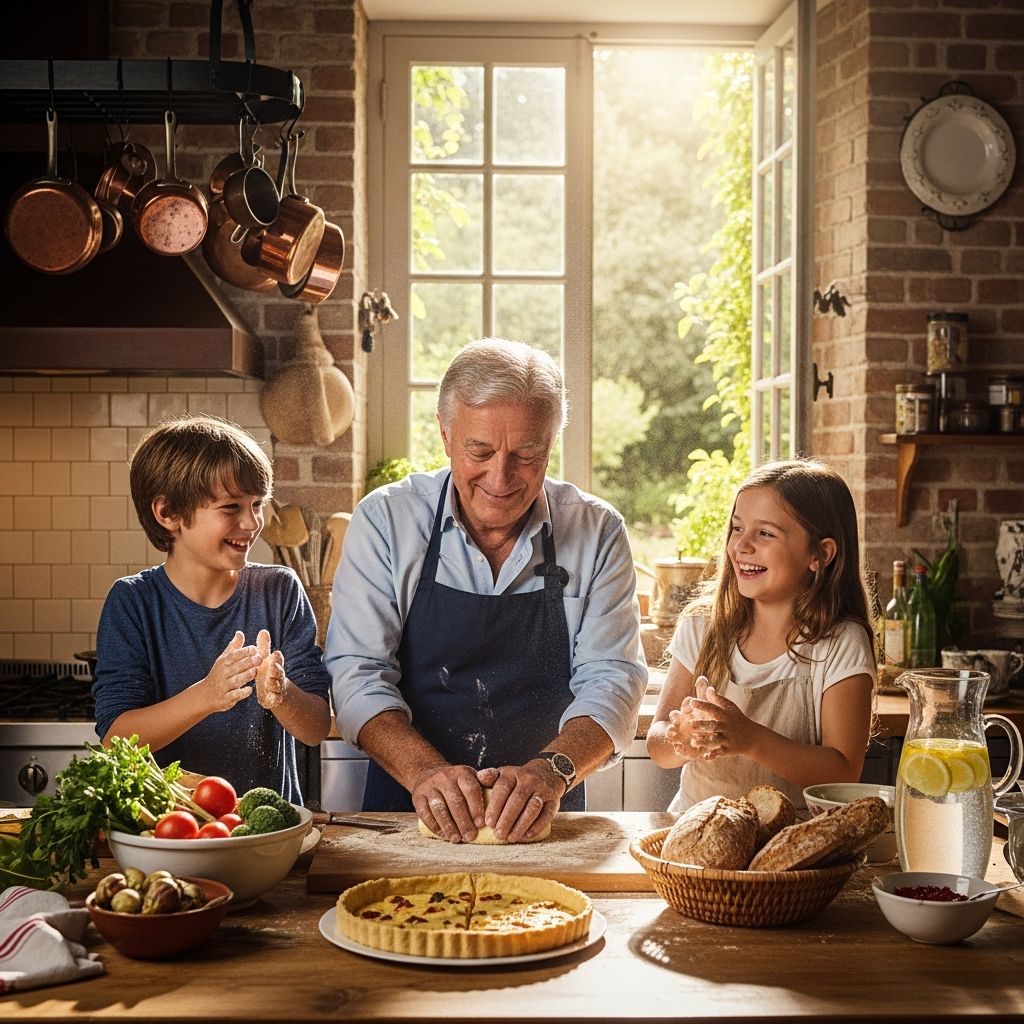
For Pépin, this bridge is not built on elaborate restaurant dishes but on simple, shared work: stirring a pot, whisking a dressing, or plating dessert together at the kitchen table.
Why Cooking With Kids Matters More Than the Recipe
When you watch Jacques Pépin with his grandchildren, the food matters, but not in the way it does in a fine-dining kitchen. Perfection is not the goal; connection is. Modern research has backed up what he seems to know instinctively: children who help prepare meals tend to eat more varied diets and feel more confident around food.
Involving kids in cooking can support:
- Motor skills through stirring, pouring, kneading, and cutting with age-appropriate tools.
- Math and science as they measure, count, and experience cause and effect (what heat does, how dough rises).
- Language and storytelling as grandparents describe old recipes, markets from their childhood, or favorite holiday meals.
- Healthy eating habits because participation in cooking is linked to higher fruit and vegetable intake in children.
What stands out about Pépin’s approach is the way he allows children to do real work. Instead of perfectly slicing every carrot himself, he lets small, imperfect pieces fall where they may. Instead of shooing kids away from the stove, he guides their hands and shows them how to stir safely. The food that emerges is a joint creation, and that ownership is what children remember.
From Haute Cuisine to Home: Dialing Down the Pressure
Jacques Pépin spent years cooking at the highest levels of French cuisine, yet his home kitchen with grandchildren is calm, cheerful, and unpretentious. That contrast offers a powerful lesson for parents and grandparents who fear they are not ‘good enough’ cooks to teach their kids.
Professional kitchens value consistency and precision. Family kitchens, by contrast, thrive on flexibility and humor. In many of his public cooking demonstrations, Pépin delights in quick, no-fuss dishes that rely on pantry staples and simple techniques, signaling that anyone can learn the basics with a bit of patience and repetition.
| Restaurant Kitchen | Grandparent Kitchen |
|---|---|
| Speed and efficiency are essential. | Time is slower; conversation shares center stage. |
| Recipes must be exact and repeatable. | Measurements are flexible; substitutions are welcome. |
| Hierarchy: chef, sous-chef, line cooks. | Collaboration: everyone, including children, has a role. |
| Outcome: satisfied paying guests. | Outcome: shared memories and full bellies. |
This shift in mindset is essential when inviting children into the kitchen. The goal is not to create a perfect tart; it is to create a moment where a child feels seen, trusted, and capable.
Small Hands, Real Tasks: How Pépin Shares His Craft
One of the striking things in footage and interviews with Jacques Pépin is how quickly he puts tools into children’s hands. Instead of treating them as spectators, he treats them as apprentices — in the gentlest possible sense of the word.
Age-appropriate ways to include grandchildren echo what you see with Pépin, yet are easy for any home cook to adopt:
- Toddlers (2–3 years): wash vegetables in a bowl of water, tear lettuce with hands, sprinkle herbs, mash soft foods with a fork.
- Preschoolers (4–5 years): whisk eggs, knead simple dough, cut soft foods with a child-safe knife, help set the table.
- Early school age (6–8 years): measure ingredients, follow short written steps, help safely stir at the stove with supervision.
- Older children (9+ years): take responsibility for one simple dish from start to finish, taste and adjust seasoning, help clean up.
Pépin’s years of teaching have honed his ability to break complex skills into manageable steps. The same approach works beautifully with children:
- Knife work becomes: hold the handle, curl your fingers, cut slowly.
- Omelets become: beat the eggs, heat the pan, watch for the right texture.
- Salads become: make the dressing, taste it, decide if it needs more acid or salt.
The deeper lesson is simple: children learn best when they are trusted with real, consequential tasks, supported by calm guidance rather than constant correction.
Stories Stirred Into the Pot
For Jacques Pépin, every dish carries a story — of his mother’s small restaurant in France, of wartime scarcity, of coming to America and learning a new food culture. As he cooks with his grandchildren, those stories flow naturally: why a dish matters, who first taught it to him, why he still makes it after so many years.
Anthropologists and sociologists have long noted that family recipes act as carriers of identity, especially for immigrant families or those with strong regional traditions. When grandparents cook with grandchildren, they are preserving more than technique. They are passing on:
- Language: names of ingredients in French and English, or any family tongue.
- Values: not wasting food, respecting farmers, being generous with guests.
- History: how the family once cooked with very little, or how a grandparent learned a dish in another country.
These stories may be told casually, almost in passing, but children absorb them deeply. Later in life, the smell of garlic sizzling in butter or the feel of bread dough under their hands can bring back a grandparent’s voice with startling clarity.
Letting Go of Perfection: Embracing the Mess
If exposure to professional cooking shows has made some adults hesitant to teach kids in the kitchen, Jacques Pépin offers the antidote. His demeanor with children is relaxed and forgiving. He wipes spills without fuss, laughs at lopsided shapes, and treats small mishaps as part of the process rather than failures.
Psychologists emphasize that allowing children to take manageable risks and make small mistakes in safe environments encourages resilience and problem-solving. Cooking is an ideal arena for this kind of learning:
- The soup is a little salty? Add water, more vegetables, or a potato.
- The cake sticks to the pan? Turn it into a trifle with whipped cream.
- The bread doesn’t rise perfectly? Call it flatbread and eat it anyway.
By modeling flexibility, Pépin teaches his grandchildren that cooking — and life — are rarely perfect, yet often still good. That message may matter more than any specific technique.
Simple Food, Deep Connection
Although Jacques Pépin is capable of the most complex classical preparations, he often returns to dishes that children can grasp: omelets, roast chicken, simple tarts, salads with bright vinaigrettes. These are foods with clear steps, visible transformations, and immediate payoffs.
What makes these meals memorable is not their complexity but their communal nature. Everyone participates; everyone eats together. Nutrition research consistently finds that frequent family meals are associated with better dietary quality, improved academic performance, and fewer risky behaviors in adolescents. When grandparents are part of those meals, children also gain:
- Another adult who listens and asks questions.
- A living link to older generations and family history.
- Additional models of coping, humor, and perspective.
Pépin’s family table shows how much richness can emerge from food that is, at heart, very simple.
Practical Tips Inspired by Jacques Pépin’s Family Cooking
You do not need professional training to bring Pépin’s spirit into your own kitchen with children or grandchildren. A few guiding principles can make the experience smoother and more rewarding for everyone.
- Start with what you eat often. Choose a familiar, low-pressure dish: scrambled eggs, pasta, vegetable soup, or a salad.
- Prepare the space. Clear a work area, have a step stool ready, and gather ingredients before inviting kids in.
- Assign roles by age. Offer jobs that are just a bit challenging but still achievable, from washing produce to handling the timer.
- Talk as you cook. Describe what you are doing, share small memories, and ask kids what they notice about textures and smells.
- Accept imperfection. Expect spills and crooked slices; treat them as normal, not as problems.
- Eat together with gratitude. Point out who did what (“You made this dressing!”), helping kids feel pride and ownership.
Over time, these small rituals accumulate into a kind of informal culinary apprenticeship — the kind Jacques Pépin began as a child and now continues as a grandfather.
Frequently Asked Questions (FAQs)
Do I need to be a skilled cook to teach my grandchildren?
No. Children benefit most from participation and attention, not culinary perfection. Basic tasks such as stirring, washing vegetables, or assembling sandwiches already teach coordination, responsibility, and confidence. As you practice together, you can learn new recipes side by side.
What if I am worried about safety in the kitchen?
Safety is crucial, but it does not mean excluding kids. Instead, match tasks to their age and maturity. Young children can handle cold tasks away from the stove, while older kids can gradually learn safe knife handling and stovetop work under close supervision. Many educators recommend teaching safe skills early, in small, guided steps, rather than avoiding them entirely.
How do I keep children engaged if they lose interest quickly?
Choose short, high-impact steps for young kids: cracking eggs, decorating a pizza, or garnishing a dish. Rotate tasks often, celebrate small successes, and allow them to step away and return. Keeping the mood light and playful — as Jacques Pépin does with his grandchildren — helps turn cooking into a game rather than a chore.
Can cooking together really improve my grandchild’s diet?
Research indicates that children who help prepare meals are more likely to try new foods and consume more fruits and vegetables. Involving them in choosing recipes, shopping for ingredients, and tasting as they cook can gently expand their preferences over time.
What if my family does not have a strong cooking tradition?
Traditions can start at any time. You do not need inherited recipes to build meaningful rituals. Pick one simple dish to repeat — perhaps a weekend breakfast or a seasonal dessert — and let it evolve. Consistency and shared effort matter more than age-old customs.
References
- Larson, N. et al., “Home food preparation and associations with diet quality and sociodemographic characteristics among U.S. adolescents.” — Public Health Nutrition (Cambridge University Press). 2014-01-01. https://doi.org/10.1017/S1368980013002273
- Lachat, C. et al., “Diet and physical activity for the prevention of noncommunicable diseases in low- and middle-income countries.” — WHO Background Paper. 2011-01-01. https://www.who.int/dietphysicalactivity/publications/facts/children/en/
- Mintz, S. W., “Tasting Food, Tasting Freedom: Excursions into Eating, Culture, and the Past.” — Beacon Press. 1996-01-01. https://www.hup.harvard.edu/books/9780807046288
- Complete Pépin video series description. — Jacques Pépin Foundation / KQED. 2020-01-01. https://jp.foundation/video-series/complete-pepin/
- Sandseter, E. B. H. & Kennair, L. E. O., “Children’s risky play from an evolutionary perspective: The anti-phobic effects of thrilling experiences.” — Evolutionary Psychology. 2011-01-01. https://doi.org/10.1177/147470491100900212