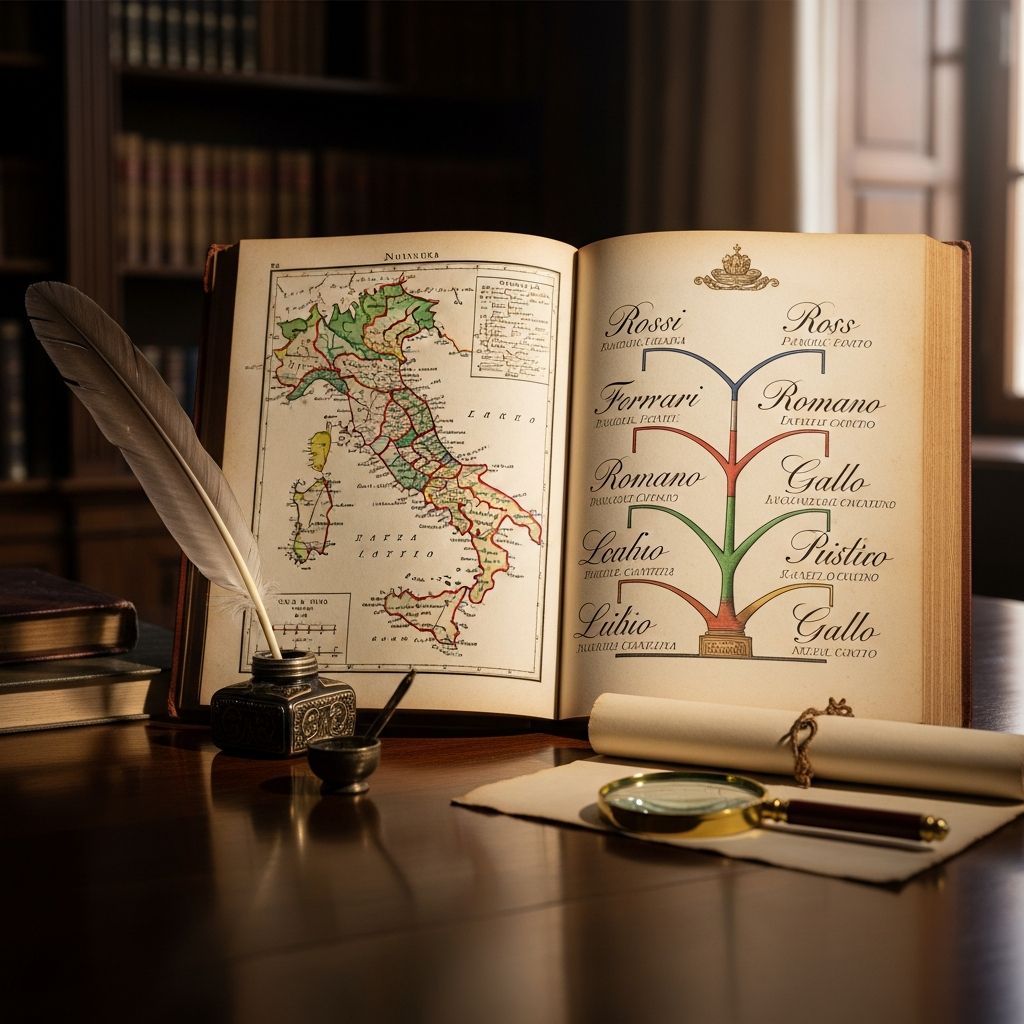
Italian last names carry centuries of history, connecting modern families to medieval villages, ancient professions, and distinctive regional cultures across the Italian peninsula.
Why Italian Last Names Matter
Italian surnames are more than identification labels; they are compact family stories that preserve language shifts, migration paths, and local customs. For people with Italian heritage, a simple last name can be the starting point for rediscovering long-lost ancestors and places.
Today, Italian last names are used worldwide as a link to identity, whether in Italy, among the Italian diaspora, or by parents drawn to Italian culture and looking for meaningful family names.
How Italian Last Names Developed
In much of Italy, hereditary surnames became common between the late Middle Ages and the early modern era, as growing populations made one given name per person insufficient for record-keeping. Over time, descriptions used to distinguish individuals—like their trade, father’s name, or birthplace—solidified into fixed family names.
Local dialects and historical rule by foreign powers left strong marks on surnames, so spelling, endings, and pronunciation often differ sharply from one region to another.
Major Types of Italian Last Names
Most Italian surnames fall into a few broad groups, each revealing a different aspect of the original bearer’s life or community. Understanding these categories can help you decode the story behind a name and form educated guesses about its origin.
1. Patronymic and family-based surnames
Patronymic surnames come from a father’s or ancestor’s given name and often signal belonging to a particular lineage. These names usually formed by adding small elements that mean “son of” or “descendant of.”
- Surnames that include Di, De, D’, or Da typically mean “of” or “from” a particular person or family line.
- Names ending in -i may indicate plural or family collective sense, implying “the family of” a certain ancestor.
2. Occupational surnames
Occupational surnames describe the work or trade that characterized the first bearer, reflecting life in craft guilds, agricultural villages, and emerging towns. These names can highlight status, such as a skilled artisan, or everyday work, like farming and herding.
- Many such names referred to crafts tied to metal, wood, cloth, or food production.
- Others came from public roles, such as local official, notary, or church-related service.
3. Geographic and toponymic surnames
Geographic surnames point to a place of origin, a village landmark, or a landscape feature near where the family once lived. These names often arose when people migrated and needed to be distinguished by where they had come from.
- Some names directly echo cities, regions, or neighboring countries.
- Others refer to fields, rivers, hills, or built features like bridges and towers.
4. Descriptive and nickname-based surnames
Descriptive surnames grow out of nicknames, physical traits, personality, or notable characteristics of an ancestor. What began as informal labels eventually hardened into official family names.
- These may describe hair color, height, strength, or perceived temperament.
- Some reflect positive traits, while others might have started as teasing or ironic labels.
5. Religious and devotional surnames
Religious surnames and those tied to saints, biblical names, or devotional expressions reflect the deep influence of Christianity in Italian communities over many centuries. Adopting such names could show personal piety or honor a patron saint.
- Some surnames come from the names of saints or religious festivals.
- Others refer indirectly to virtues and concepts important in faith traditions.
Common Language Clues in Italian Surnames
Even without speaking Italian, you can often pick up clues about a surname by looking at its small components—prefixes, suffixes, and characteristic endings. These language hints can point to geographic origin or type of meaning.
Frequent prefixes
- Di / De / D’ – typically “of” or “from,” often followed by a given name or place.
- Da / Dal / Dalla – similar to “from the” or “of the,” sometimes marking a link to a location or family estate.
- La / Lo – can echo definite articles in Italian dialects, often in southern and island regions.
Common suffixes and endings
- -i – frequently a plural or collective marker, hinting at “the family of X.”
- -o – very common masculine ending in many central and southern regions.
- -one – can suggest a large size or augmentative sense, sometimes originally a nickname.
- -ino / -etto – diminutive endings; may express smallness, youth, or affection.
Regional Flavors of Italian Last Names
Italian surnames vary dramatically from region to region, shaped by dialects, neighboring nations, and historical rule. This regional flavor reveals where a name is more likely to have arisen and which influences may have shaped it.
| Area | Typical Features | Historical Influences |
|---|---|---|
| Northern Italy | Frequent endings in -i and -o; surnames linked to trades and towns; occasional Germanic-sounding elements near the Alps. | Influence from medieval city-states, Germanic peoples, and proximity to France, Switzerland, and Austria. |
| Central Italy | Mixture of patronymic and occupational names; forms reflecting Tuscan and Umbrian dialects. | Strong urban traditions and long-lasting local dialects that shaped pronunciation and spelling. |
| Southern Italy | Many names with prefixes like Di and De; less dominance of -i endings; influences from Greek and Spanish. | Rule by various powers, including Norman, Spanish, and Bourbon dynasties, plus remnants of ancient Greek presence. |
| Sicily and Sardinia | Distinctive forms differing from standard Italian; traces of Greek, Arabic, Catalan, and local island languages. | Complex mix of conquerors, traders, and unique island cultures producing hybrid surname forms. |
Italian Last Names Outside Italy
Large waves of migration from the late nineteenth to mid-twentieth century spread Italian surnames to the Americas, Australia, and many other parts of the world. In these new contexts, many names were adapted, shortened, or respelled to fit local languages and record systems.
Descendants of migrants sometimes carry forms that differ from original Italian spellings, so tracing a family line may involve recognizing older variants and understanding how clerks, ship officials, or local authorities heard and recorded names.
Using Italian Last Names in Genealogy
When starting family history research with only an Italian last name, the key is to combine linguistic clues with historical records. Even a single surname can narrow down possible regions, suggest ancestral occupations, and guide you toward specific archives.
Practical steps for surname-based research
- Gather family information first. Talk with relatives, collect old documents, and note every spelling of the surname you encounter.
- Look for consistent spelling patterns. Identify whether the same family used variants in different decades or countries.
- Map the surname geographically. Use surname distribution tools, historical maps, and regional archives to see where the name clusters.
- Check parish and civil records. Baptism, marriage, and death registers often confirm how a surname was written in a specific locality.
- Track migration paths. Passenger lists, naturalization files, and census records can show how the surname traveled and changed abroad.
Common challenges and workarounds
- Spelling inconsistency: Accept that older records may contain multiple versions of the same name and search for phonetic variants.
- Local dialects: Learn key dialect features from your suspected region to better recognize transformed or shortened forms.
- Missing records: When records are scarce, combine DNA matches, cluster analysis of surnames, and regional history to build plausible hypotheses.
Choosing an Italian Last Name for Your Family
Some parents or couples choose Italian last names for their children, fictional characters, or blended families as a nod to cultural heritage or admiration for Italian language. This choice can feel meaningful when the surname reflects personal values or ancestral roots.
When adopting or reviving an Italian surname, consider its sound, ease of pronunciation in your community, and the story you want it to tell.
Tips for selecting a meaningful name
- Decide whether you prefer a name tied to a profession, place, or personal trait.
- Say the name aloud with your chosen first names to test rhythm and flow.
- Check for unintended meanings or associations in other languages you speak.
- Explore historical bearers of the surname to see if their legacy resonates with you.
Frequently Asked Questions About Italian Last Names
Are all Italian last names unique to Italy?
No. Many Italian surnames share roots with other Romance languages or reflect occupations and traits that appear in several cultures, so similar-looking or similar-sounding names can arise in neighboring countries. Historical border shifts also mean some names considered “Italian” today originated in areas that once belonged to other states.
Why do many Italian last names end in “-i”?
The ending “-i” is often a plural or collective marker in Italian, and in surnames it can signal “the family of” a certain ancestor. This pattern is especially common in some northern and central regions, though not universal across the country.
Can two unrelated families share the same Italian surname?
Yes. A surname based on a common trade, first name, or descriptive word can easily arise independently in different villages. To establish whether two families with the same last name are related, researchers must compare geographic origin, records over time, and, where appropriate, genetic evidence.
Why do I see several spellings of my Italian surname?
Variant spellings can result from dialect differences, low literacy in past centuries, or clerks and officials writing down what they heard. Immigration and translation into other alphabets also introduced new forms, so genealogical searches should always include near matches and phonetically similar names.
How can I find the meaning of my specific Italian last name?
To uncover a particular surname’s meaning, start by breaking it into recognizable parts, such as prefixes and suffixes, then compare those pieces with Italian vocabulary and regional place names. Combining this with local history sources, specialist surname dictionaries, and genealogical research will give you a more complete and reliable picture.
Final Thoughts on Italian Family Names
Italian last names are compact records of language, movement, and memory, connecting the present with centuries of lived experience. Whether a name speaks of an ancestor’s craft, hometown, or character, learning its story can deepen appreciation for both personal heritage and Italy’s rich cultural mosaic.