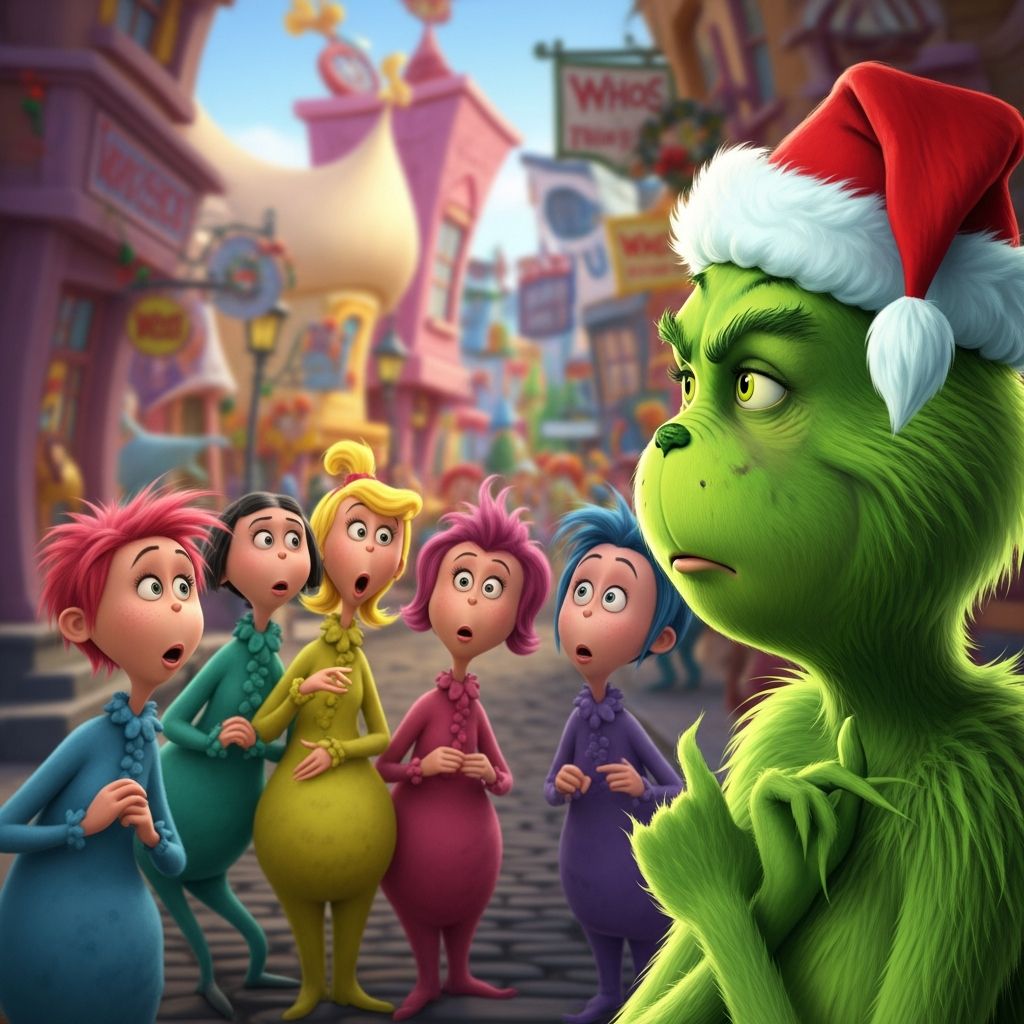
The Grinch has been called a monster, a grouch, and the ultimate Christmas hater. But what if he isn’t an outsider at all? A popular fan theory argues that the Grinch is actually one of the Whos — a misfit pushed to the margins rather than a creature from somewhere else entirely. This idea doesn’t just change how we watch the movie; it reshapes what the story is really about.
This article takes that viral idea as a starting point and builds a deeper, fully original exploration of the Grinch, Whoville, and the uncomfortable truths hiding in a cozy holiday classic.
Who (or What) Is the Grinch Supposed to Be?
Dr. Seuss first introduced the Grinch in the 1957 book How the Grinch Stole Christmas!, where he is described as a sour, green figure whose heart is “two sizes too small.” He lives alone on Mount Crumpit, looking down on the bright town of Whoville and plotting to sabotage their festivities.
Over time, the character has appeared in several forms:
- The original picture book by Dr. Seuss
- The 1966 animated TV special narrated by Boris Karloff
- The 2000 live-action film starring Jim Carrey
- The 2018 animated feature from Illumination
Across these versions, certain traits remain consistent:
- He lives on the outskirts of Whoville, physically separated from the community.
- He intensely hates noise, singing, and Christmas celebrations.
- He ultimately has a change of heart and joins the Whos’ feast.
But his species is never clearly stated in the original book. Later franchises often frame him as a separate kind of being, yet his design and story keep pulling him back toward the Whos themselves.
The Fan Theory: The Grinch as an Outcast Who
The core fan theory can be summed up in a single question: What if the Grinch is just a Who who doesn’t fit in? Rather than a separate monster, he’s a member of the same community, with differences that made him a target of ridicule and led him to withdraw.
This idea is especially prominent in the 2000 live-action adaptation, which gives the Grinch a childhood backstory. We see him as a small, eager child trying to participate in Christmas traditions, only to be mocked for his appearance and humiliated at school. This rejection pushes him up the mountain and into isolation.
Under this lens, the Grinch’s story looks less like “evil monster menaces innocent town” and more like “hurt villager lashes out at the community that failed him.” The villain then becomes a consequence of Whoville’s behavior rather than a random external threat.
Visual Clues: Does the Grinch Look Like a Who?
On screen, the line between the Whos and the Grinch is blurrier than it first seems. Consider how they’re drawn or costumed.
| Feature | Whos of Whoville | The Grinch | What It Suggests |
|---|---|---|---|
| Body shape | Short, rounded, varied | Slender but humanoid | Same basic build as a Who, just more exaggerated |
| Face structure | Human-like with whimsical noses | Similar eyes and mouth, different nose | Feels like a variant rather than a separate species |
| Social context | Live in a tight-knit town | Lives just outside, knows customs perfectly | He understands their culture as if he grew up there |
He isn’t some alien with completely foreign anatomy or customs. He knows exactly how Whoville’s decorations work, what gifts mean to them, and how to mimic their Santa traditions well enough to fool everyone on Christmas Eve.
Someone that fluent in a culture usually isn’t a stranger; they’re a former insider.
Behavioral Evidence: He Thinks Like a Who, Too
Psychological readings of the character argue that the Grinch’s traits mirror recognisable human patterns, not monstrous ones. Analysts point to several behaviors that align with a hurt, defensive person:
- Defensive superiority: He mocks the Whos as shallow and noisy, framing himself as above their joy — a classic reaction to feeling excluded or inferior.
- Isolation as armor: He chooses to live alone on Mount Crumpit, mirroring how lonely people sometimes withdraw to avoid further pain.
- Emotional repression: He minimizes feelings, avoids vulnerability, and channels hurt into sarcasm and sabotage.
In the live-action film, we see an explicit origin for this defense: childhood bullying and public humiliation. While this backstory is an adaptation choice, it reinforces what psychologists call a “corrective emotional arc” — a pattern where someone with early relational wounds changes after encountering genuine empathy and acceptance.
This isn’t the psychology of a mythical villain; it’s the psychology of a painfully human misfit.
Whoville Under the Microscope: A Perfect Town with Flaws
If the Grinch is a Who, then Whoville has to face an uncomfortable truth: they created their own monster. The town appears relentlessly cheerful, but under scrutiny, several cracks emerge.
Conformity and Pressure to Be Cheerful
Whoville prizes togetherness, music, and shared rituals. Yet nearly everyone behaves in the same way. Their style of joy is loud, public, and uniform — there’s little space for someone whose temperament or appearance doesn’t fit the mold.
- Every Who seems to celebrate in near-identical fashion.
- Dissenting voices are rare to nonexistent.
- Social acceptance appears tied to enthusiastic participation.
In psychological terms, this looks like a high-conformity culture: outward harmony that can mask exclusion of those who can’t or won’t match the group’s energy.
Bullying and Social Exclusion
Many modern adaptations lean into the idea that the Grinch was mocked when young and driven out. Bullying and ostracism are known to have long-lasting mental health effects, increasing the risk of social withdrawal, aggression, and resentment later in life.
If we accept the theory that he’s a Who child gone rogue, then the story becomes a cautionary tale: a community’s cruelty to one kid eventually comes back to haunt the entire town.
Why His Plan to “Steal Christmas” Only Works If He’s One of Them
The Grinch’s scheme is oddly intimate. He doesn’t just knock over a tree or sabotage the power lines. He impersonates Santa, crawls into homes, and takes:
- Presents and toys
- Stockings and decorations
- Even food for the feast
He knows exactly which items will hurt the most because he knows how the Whos think about Christmas. His logic is: if I remove all the material signs of the holiday, their joy will vanish. That’s a strikingly insider belief — he assumes their happiness is as fragile and conditional as his own.
When the Whos still sing after losing everything, he experiences a kind of cognitive shock. Analysts have described this as a form of cognitive dissonance: his belief (“Christmas is only about stuff”) collides with evidence (“they’re still joyful without any stuff”). That contradiction precedes his breakthrough moment.
The Heart-Growing Moment: A Change Rooted in Empathy
In all major versions, after hearing the Whos sing anyway, the Grinch’s heart “grows three sizes.” While obviously metaphorical, it maps neatly onto psychological ideas about empathy and reframing.
- Empathy: For the first time, he recognises that the Whos’ joy isn’t fake or aimed at excluding him; it’s about connection and community.
- Cognitive reframing: He revises his mental model of what Christmas and belonging mean, realizing they are not entirely tied to material displays or past hurts.
- Attachment repair: When he’s welcomed back, especially by children like Cindy Lou, it functions as a “corrective” experience that can help heal earlier rejection.
Importantly, the Whos accept him. They could treat him as a monster forever, but instead, they bring him into the feast, symbolically restoring him to the community he left. That response only makes full narrative sense if he is, at some level, one of them.
What the Theory Says About Real-Life Misfits
Seeing the Grinch as a Who changes the moral emphasis of the story:
- Instead of “don’t be greedy and grouchy,” it becomes “look at what exclusion can do to someone.”
- Instead of “evil lurks outside our town,” it becomes “pain can grow inside our own community.”
- Instead of “the hero saves the villain,” it becomes “a community helps repair the damage it helped cause.”
This resonates with broader psychological insights: long-term social isolation, especially after bullying or rejection, can fuel anger, mistrust, and antisocial behavior. The Grinch’s arc — from hurt to hateful to healed — tracks closely with stories of people who eventually reconnect after years of withdrawal when they experience genuine care and acceptance.
Counterarguments: Why Some Fans Still See Him as a True Outsider
Not everyone buys the “Grinch is a Who” interpretation. Common objections include:
- Distinct design: His green fur and exaggerated features set him apart visually from most Whos, especially in animated versions. Some viewers see this as deliberate monster coding, not just variation.
- Narrative framing: Early readings of the book treat him more like a fairy-tale ogre or goblin — an external challenge to Whoville’s goodness rather than a product of it.
- Symbolic role: As a personification of cynicism and commercialism, he arguably needs to feel “other” so that his transformation has maximum impact.
Even so, these points don’t fully erase the insider clues: his mastery of their customs, his close physical proximity, and, most of all, the way he is ultimately embraced as one of them.
Why This Theory Keeps Spreading Online
Fan theories thrive when they do two things at once:
- Fit the evidence of the original story reasonably well
- Add emotional or thematic depth that audiences find satisfying
The Grinch-as-Who idea does both. It offers a more complex way to think about holiday loneliness, bullying, and the gap between public cheer and private pain — topics that feel especially relevant as more people discuss mental health around the holidays.
It’s also just fun. Re-reading a beloved story with a new lens lets longtime fans rediscover details they missed and debate what Dr. Seuss “really meant,” even though his original text leaves plenty of room for interpretation.
How to Talk About This Theory with Kids
For parents or caregivers, this theory can be a useful tool rather than a mere internet curiosity. Watching How the Grinch Stole Christmas! becomes a springboard for meaningful conversations.
Here are simple, kid-friendly questions you can ask after the movie:
- “Do you think the Grinch was always bad, or did something make him act that way?”
- “How do you think he felt when he watched the Whos celebrate without him?”
- “Have you ever felt left out of a group the way he did?”
- “What could the Whos have done differently when he was younger?”
These questions subtly introduce ideas about empathy, kindness, and inclusion — the real foundations of the holiday spirit that the story highlights when Christmas still “comes without ribbons… tags… packages, boxes or bags.”
Frequently Asked Questions (FAQs)
Q: Did Dr. Seuss ever say the Grinch is a Who?
A: In the original book, Dr. Seuss never clearly labels the Grinch as a Who or a separate species. His origin is intentionally vague, which is part of why fan theories have so much room to grow.
Q: Is the Grinch’s green color important to this theory?
A: The green color became iconic largely because of the 1966 TV special, not the original black-and-white illustrations. Supporters of the theory argue that his appearance simply marks him as a visually exaggerated misfit, while critics see it as proof he’s something other than a Who.
Q: Why does the Grinch hate Christmas so much?
A: Analyses often link his hatred to loneliness, past rejection, and the overwhelming noise of celebrations that highlight what he lacks. When he sees that Christmas is actually about connection, not just spectacle, his attitude changes.
Q: Is the Grinch a villain or a misunderstood antihero?
A: He begins with clearly harmful intentions — stealing every material sign of Christmas — but the story frames him as wounded rather than purely evil. After his change of heart, he returns the gifts and joins the feast, making him closer to a redeemed antihero than a traditional villain.
Q: What can families learn from the Grinch’s transformation?
A: His arc reinforces that kindness, inclusion, and forgiveness can transform even deeply entrenched bitterness. It also gently suggests that communities share responsibility for how they treat their most isolated members.
References
- The Psychology of the Grinch – Understanding His Transformation — Christmas Enthusiasts. 2023-11-20. https://christmasenthusiasts.co.uk/classic-traditions/grinch-psychology-character-study-and-transformation
- The Grinch: A Christmas Character Analysis — HubPages (Entertainment). 2022-12-10. https://discover.hubpages.com/entertainment/The-Grinch-A-Christmas-Character-Analysis
- Grinch — Dr. Seuss Wiki / Seuss Fandom (Character overview). 2021-08-15. https://seuss.fandom.com/wiki/The_Grinch
- Grinch — Encyclopedia-style character entry. 2023-06-01. https://en.wikipedia.org/wiki/Grinch
- How the Grinch Stole Christmas – Character List — GradeSaver Study Guide. 2020-12-01. https://www.gradesaver.com/how-the-grinch-stole-christmas/study-guide/character-list