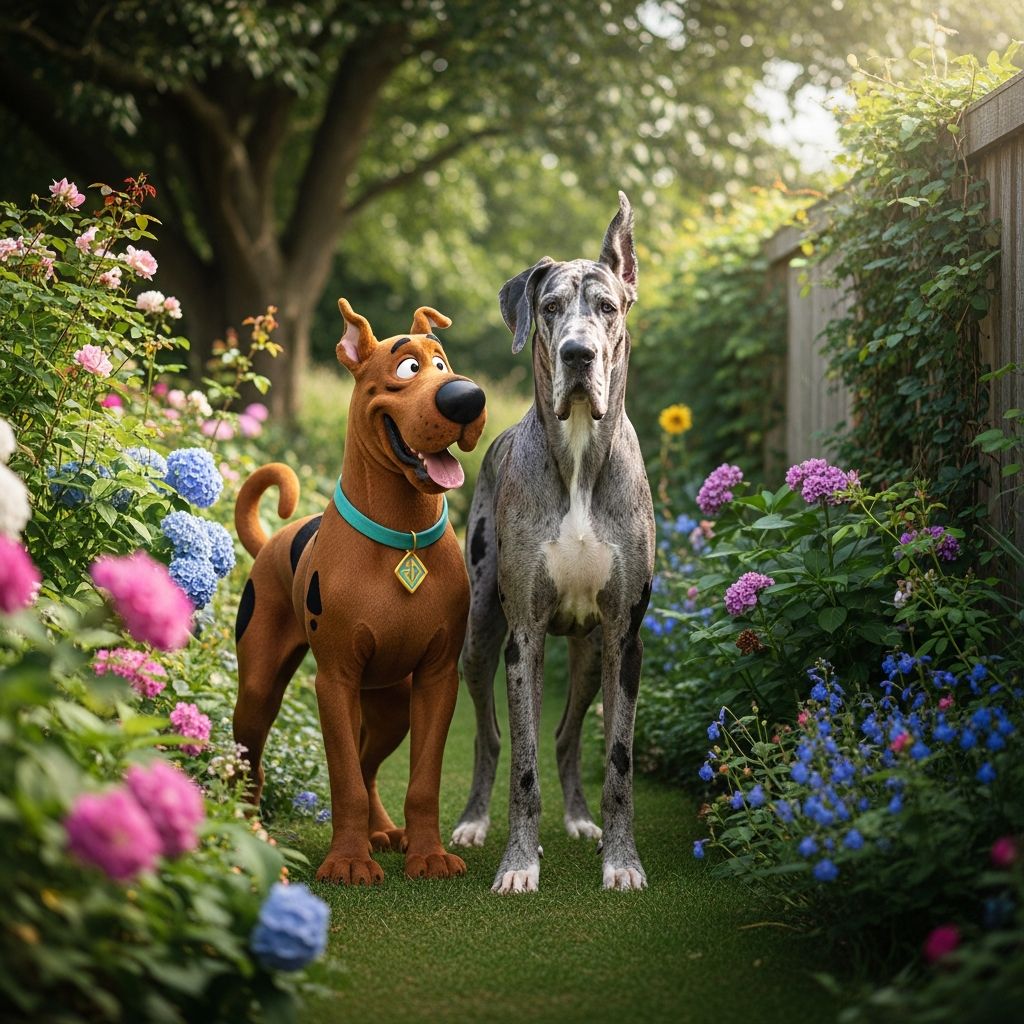
For generations, Scooby-Doo has shaped how kids imagine big dogs: goofy, scared of ghosts, always hungry, and fiercely loyal to his friends. Behind the animated slapstick, though, the character is loosely inspired by a very real dog breed: the Great Dane. If your child has ever asked, “Can we get a dog like Scooby?” it helps to understand what Great Danes are actually like in real life.
This guide walks through how closely Scooby-Doo matches the Great Dane, what the breed is truly like in terms of size, temperament, and care, and whether this gentle giant is a good fit for a busy family home.
Is Scooby-Doo Really a Great Dane?
In official franchise material and creator interviews, Scooby-Doo is usually described as a Great Dane-inspired character. But his design and personality lean heavily into cartoon exaggeration. Real Great Danes differ in several key ways.
| Trait | Scooby-Doo (Cartoon) | Real Great Dane |
|---|---|---|
| Body build | Slouchy, floppy, often drawn with a curved back | Tall, straight-backed, muscular and elegant |
| Personality | Comically cowardly, easily spooked | Historically courageous hunters and estate guardians |
| Speech & antics | Talks, walks on two legs, eats absurd amounts of snacks | Large appetite but normal dog behavior (no sandwiches) |
| Role | Comic relief and sidekick detective | Companion, watchdog, and family pet |
Scooby’s basic silhouette and size echo the Great Dane, but his posture, face shape, and personality quirks were deliberately distorted for comedy. When you meet a real Great Dane, expect something far more balanced, calm, and dignified than the Mystery Machine’s resident scaredy-dog.
Where Great Danes Really Come From
To understand the gap between fiction and reality, it helps to know the breed’s origins.
- Developed in Germany: Despite the name, Great Danes were refined in Germany several hundred years ago as powerful hunting and estate dogs.
- Boar hunters: They were used to hunt large, dangerous game such as wild boar and deer, which required strength, athleticism, and courage.
- Guardians of nobility: Over time they shifted from hunting to guarding the estates and homes of the nobility, valued for both their intimidating size and steady temperament.
Modern Great Danes are far more likely to be couch companions than boar hunters, but their history still shows in their powerful build and protective instincts.
The Great Dane Look: More Regal Than Goofy
On screen, Scooby-Doo is a loose-limbed clown. In person, a well-bred Great Dane is often described as looking like the “Apollo of dogs”—tall, athletic, and well-proportioned.
Size and Build
- Height: Males typically reach about 30–32 inches at the shoulder, females about 28–30 inches.
- Weight: Large males may weigh 140–170 pounds, females often 110–140 pounds.
- Proportions: Long, straight front legs, a deep chest, a strong, arching neck, and a long, muscular body give them a striking silhouette.
Coat and Colors
- Coat: Short, smooth, and sleek, easy to groom but sheds moderately throughout the year.
- Common colors: Fawn, brindle, black, blue, harlequin (white with black patches), mantle (black “blanket” pattern), among others.
For families thinking “Scooby, but real,” remember that this is a giant breed that will tower over young children and take up serious physical space in the home.
Temperament: Gentle Giant, Not Ghost-Fearing Sleuth
Scooby-Doo’s nervousness is played for laughs, but real Great Danes are most famous for being affectionate and even-tempered. Many experts and owners use the same phrase: gentle giant.
Everyday Personality
- Affectionate and people-oriented: Great Danes typically thrive on human contact, enjoy leaning on their people, and often see themselves as oversized lap dogs.
- Good with children: When well socialized, they are usually patient and kind with kids, though their size alone can be a risk around very small children.
- Moderate energy: They like walks, playtime, and games, but many are content with moderate exercise and a lot of relaxation once they reach adulthood.
- Watchdog potential: Their size and bark make them natural deterrents, and many will alert to strangers, but unnecessary aggression is not typical for the breed.
Training and Socialization
- Trainable but sometimes stubborn: Most Great Danes respond well to consistent, reward-based training, although some can be slow or independent learners.
- Early socialization is critical: Exposure to varied people, dogs, sounds, and environments during puppyhood helps prevent fear and anxiety in such a large adult dog.
- Manners matter more because of size: Jumping, pulling on leash, or rough play can be dangerous simply due to their weight and strength, so early obedience work is non-negotiable.
Where Scooby tends to bolt at the first sign of trouble, a well-socialized Great Dane is usually calm and confident, more likely to stand by your side than dive into a barrel of snacks.
Life at Home With a Great Dane
Having a cartoon Great Dane is easy: just press play. Living with a real Great Dane requires space, routine, and a realistic understanding of costs and limitations.
Space and Lifestyle Needs
- Indoor companion: Despite their size, Great Danes are typically house dogs that want to be near their people, not left in the yard.
- Room to move: Apartments can work if there is enough indoor space and access to daily walks, but narrow staircases and cramped hallways can be challenging for such a tall dog.
- Exercise: Many adults do well with two solid walks per day plus some play and mental enrichment, such as training, puzzle toys, or low-impact games.
- Fragile tails and coffee tables: A wag from a Great Dane tail can knock over décor, drinks, or a toddler, so some rearranging of furniture is often needed.
Feeding and Basic Care
- Large food intake: Great Danes can eat several cups of high-quality dog food per day, and feeding costs can be substantial over their lifetime.
- Balanced nutrition: Because they grow rapidly, especially in the first year, appropriate large-breed puppy and adult diets help support healthy bone and joint development.
- Grooming: Their short coat is relatively low-maintenance: regular brushing, nail trims, dental care, and ear cleaning usually suffice.
Health Realities: The Part Cartoons Leave Out
One of the toughest differences between Scooby-Doo and real Great Danes is lifespan and health. Like many giant breeds, Great Danes live shorter lives and are prone to specific medical issues.
Lifespan
- Average life expectancy: Many sources list Great Dane lifespans around 7–10 years; some note an average closer to 8 years.
This shorter lifespan can be emotionally difficult for families, especially children who grow deeply attached to a big, gentle dog. It is an important factor to consider before choosing the breed.
Common Health Concerns
Not every Great Dane will face serious health problems, but the breed as a whole is at higher risk for several conditions:
- Bloat / Gastric Dilatation-Volvulus (GDV): A life-threatening emergency in which the stomach fills with gas and may twist, cutting off blood flow. Great Danes, with their deep chests, are among the breeds at highest risk.
• Symptoms can include restlessness, a swollen or tight abdomen, unproductive retching, drooling, or signs of pain.
• Immediate veterinary care is crucial; some dogs undergo preventive surgery (gastropexy) to reduce the risk. - Orthopedic issues: Hip dysplasia and other joint problems can appear in large and giant breeds because of their size and rapid growth.
- Heart disease: Great Danes are predisposed to certain cardiac conditions, such as dilated cardiomyopathy, which may require monitoring and treatment by a veterinarian.
Regular veterinary checkups, appropriate diet, weight management, and awareness of emergency signs can all help families support a Great Dane’s health over what is, unfortunately, a relatively short lifespan.
Are Great Danes Good Family Dogs?
Many families discover that a well-bred and well-trained Great Dane is an extraordinary companion. But this is not a casual or low-maintenance breed. Before bringing home a “real-life Scooby,” consider the following.
Pros of Great Danes in Family Homes
- Affectionate and loyal: Form strong bonds with their humans and often show obvious attachment and protectiveness.
- Generally sociable: With proper socialization, they usually get along with other dogs and can often coexist with other pets.
- Moderate exercise needs: They typically do not require marathon-level activity, which may suit families who can provide daily walks but not intense sports.
- Impressive but usually gentle presence: Their size can make them feel like furry bodyguards while still being soft and cuddly at home.
Challenges Families Should Weigh
- Very large size: Even a friendly, well-meaning Great Dane can unintentionally knock down small children or elderly relatives.
- Higher costs: Food, veterinary care, medications, and equipment (beds, crates, harnesses) all cost more for giant breeds.
- Shorter lifespan: Children may experience the loss of a beloved dog earlier than they would with many smaller breeds.
- Need for time and training: Obedience work, socialization, and daily interaction are non-optional if you want a safe, well-mannered giant dog.
Helping Kids Understand the Difference
If your child loves Scooby-Doo, a Great Dane might seem like the perfect real-world equivalent. Use that enthusiasm as a teaching moment.
- Talk about fiction vs. reality: Explain that Scooby can talk, eat cartoonish meals, and never ages, while real dogs have needs and feelings and grow old.
- Visit real Great Danes: If possible, meet the breed at responsible breeders, shows, or adoption events so kids can see their true size and behavior.
- Discuss responsibility: Emphasize daily care—feeding, walking, training, and cleaning up—as part of any decision to get a big dog.
- Consider alternatives: If your home or budget isn’t suited to a Great Dane, talk about other friendly large breeds or mixed-breed dogs that might fit better.
Frequently Asked Questions (FAQs)
Q: What breed of dog is Scooby-Doo supposed to be?
A: Scooby-Doo is generally described as a Great Dane–inspired character. His exaggerated features and behavior are designed for comedy, but his basic size and shape loosely echo this giant breed.
Q: Are real Great Danes as scared as Scooby-Doo?
A: No. Historically, Great Danes were used for hunting large game and guarding estates, which required courage and steadiness. Individual dogs can be shy or anxious without proper socialization, but fearfulness is not the ideal for the breed.
Q: Do Great Danes get along with children?
A: When socialized and trained, Great Danes are often very gentle with children and are considered good family dogs. However, all interactions with young kids should be supervised due to the dog’s size and strength.
Q: How much exercise does a Great Dane need?
A: Most adult Great Danes need at least two daily walks plus some play and mental stimulation. Growing puppies should avoid intense jumping and forced running to protect their joints.
Q: What is the biggest health risk for Great Danes?
A: One of the most serious risks is gastric dilatation-volvulus (bloat), a life-threatening emergency where the stomach fills with gas and may twist. Owners should learn the signs and seek immediate veterinary care if they suspect it.
Q: Is a Great Dane a good first dog for families?
A: It can be, if the family is prepared for the breed’s size, costs, shorter lifespan, and commitment to training and socialization. New dog owners should work closely with veterinarians, trainers, and, if applicable, reputable breeders or rescues.
References
- What to Know About Great Danes — WebMD. 2021-08-12. https://www.webmd.com/pets/dogs/what-to-know-great-danes
- Great Dane Breed Guide: History, Characteristics, and Care — Pawlicy Advisor. 2022-04-05. https://www.pawlicy.com/blog/great-dane-breed-guide/
- Great Dane Dog Breed — Hill’s Pet Nutrition. 2020-06-15. https://www.hillspet.com/dog-care/dog-breeds/great-dane
- Great Dane — Encyclopaedia Britannica. 2023-03-28. https://www.britannica.com/animal/Great-Dane
- Great Dane — American Kennel Club. 2022-11-10. https://www.akc.org/dog-breeds/great-dane/
- Great Dane Dog Breed Health and Care — PetMD. 2022-07-19. https://www.petmd.com/dog/breeds/great-dane
- Great Dane — International Encyclopedia of Dogs (summary via academic and breed references). 2019-01-01. https://www.ncbi.nlm.nih.gov/pmc/articles/PMC3959951/