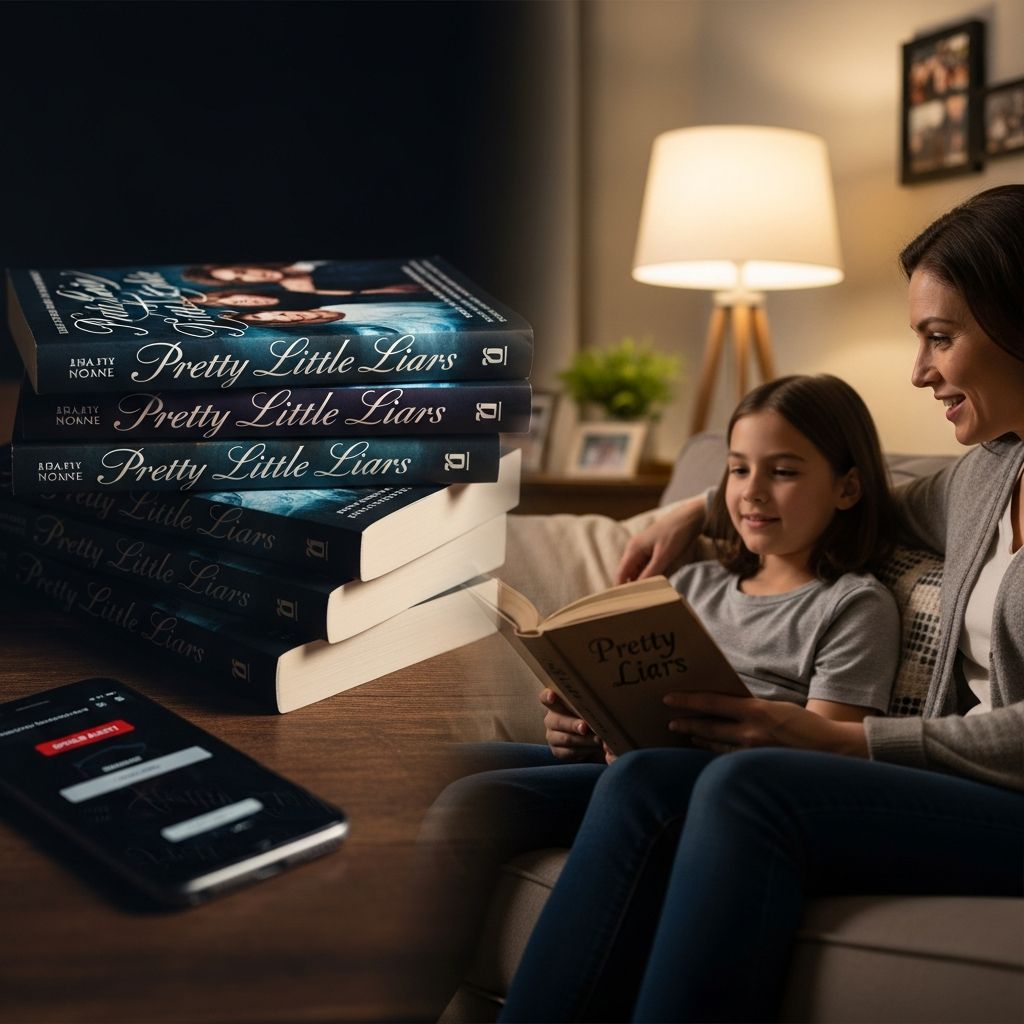
The Pretty Little Liars novels by Sara Shepard are hugely popular with young readers, especially fans of the TV show. Many tweens are drawn to the glamorous covers, the mystery, and the famous name. For parents and caregivers, the question quickly follows: Is this series actually appropriate for my tween?
This guide offers a spoiler-light overview of what is in the books, how the content compares with typical tween and teen reading levels, and how you might approach a thoughtful decision for your family. It is based on the book series itself, on publisher guidance, and on general research about media and child development.
1. Understanding the Pretty Little Liars Book Series
Pretty Little Liars is a long-running young adult (YA) mystery/thriller series about four girls living in the wealthy, fictional town of Rosewood, Pennsylvania. The girls are bound together by a missing former friend and by dangerous secrets that someone is determined to expose.
| Aspect | Details (Spoiler-Light) |
|---|---|
| Author | Sara Shepard, a U.S. author known for twisty YA thrillers. |
| Genre | Young adult mystery, suspense, psychological drama. |
| Setting | Affluent suburb (Rosewood), with a focus on school life, families, and social circles. |
| Core Premise | Four girls receive anonymous messages from someone who knows their secrets and calls themselves “A”. |
| Intended Audience | Marketed primarily to teens; many retailers and librarians note it as suitable for roughly ages 12–14+. |
There are multiple books in the main story arc—well over a dozen—and the tone becomes increasingly dark and complicated as the series goes on.
2. What Age Group Are the Books Aimed At?
Book retailers and reading platforms typically list Pretty Little Liars as a young adult series appropriate for readers about 12 and up, sometimes tagged as 12–14+. That lines up loosely with early high school or mature middle school readers.
However, age labels are only one piece of the puzzle. Research on media and children suggests that developmental readiness varies widely, and chronological age alone does not reliably predict how a given child will respond to complex or intense content. Some 11-year-olds can handle nuanced, suspenseful plots; others may find them overwhelming or confusing.
To decide whether this series fits your tween, consider:
- Reading comprehension – Can your tween follow multi-book storylines, subplots, and shifting relationships?
- Emotional sensitivity – Do they get very distressed by suspense, cruelty, or unfair treatment of characters?
- Real-world exposure – Have they already encountered discussions of dating, crushes, sexuality, substance use, or bullying in other books or media?
- Family values and boundaries – What topics are you comfortable seeing explored in more detail in their reading?
3. Main Themes Parents Should Know About
Without revealing major twists, the series returns often to a few central themes. These can be either concerning or productive, depending on how they are handled in conversation at home.
3.1 Friendship and Loyalty
Friendship is at the core of the series. The girls’ relationships are messy, often conditional, and at times deeply flawed. Rather than an idealized friendship group, the books show:
- Friends who keep serious secrets from one another
- Loyalty tested by fear, jealousy, and romantic entanglements
- Moments of support alongside betrayal and manipulation
This can open the door to rich discussions about healthy friendship behaviors, emotional safety, and what real support should look like.
3.2 Secrets, Lies, and Consequences
As the title suggests, lying is constant. Characters hide things from parents, peers, and each other; the anonymous figure “A” weaponizes those secrets.
Key ideas:
- Lies tend to compound, leading to bigger and more dangerous situations.
- Even relatively small deceptions can be used for blackmail.
- Shame often keeps characters from seeking help when they need it most.
Recent child mental health research emphasizes the importance of open parent–child communication and trusted adults for navigating stress and risky situations. These books can provide vivid (if dramatized) examples of what happens when characters feel unable to tell the truth.
3.3 Appearance, Popularity, and Social Pressure
The characters live in a world where social status, physical appearance, and material wealth are overtly important. There is frequent focus on:
- Clothes, makeup, and body image
- Parties, popularity, and social hierarchies at school
- Pressure to project a “perfect” image, online and offline
Studies have linked idealized media portrayals and appearance-focused content to increased body dissatisfaction and internalization of thin ideals in young people, especially girls. That does not mean this series is uniquely harmful, but it does mean that critical discussion about media images and beauty standards is helpful if your tween reads it.
4. Sensitive Content: What Specifically Appears?
The books are not explicit in a graphic, adult sense, but they are also not “clean middle-grade” stories. They include mature topics that some families will consider too intense for tweens, while others may consider them manageable with context.
4.1 Romance and Sexual Content
Readers can expect:
- Crushes, dating, and kissing
- Implied or referenced sexual activity between teens
- Questioning of sexual orientation and same-sex attraction
Explicit detail is generally limited, but the emotional and social consequences of relationships—jealousy, secrecy, heartbreak—are significant throughout the series.
4.2 Bullying and Psychological Harassment
Bullying is a major thread: the anonymous “A” stalks, threatens, blackmails, and humiliates the main characters using their secrets.
Expect to see:
- Text messages and notes that are intrusive and threatening
- Social exclusion, rumors, and reputation damage
- Characters feeling constantly watched or unsafe
Research from organizations such as the U.S. Department of Health and Human Services notes that bullying, especially when combined with social isolation, is associated with increased anxiety, depressive symptoms, and school problems. The books show extreme, suspenseful versions of this, which can be intense for sensitive readers.
4.3 Crime, Risky Behavior, and Violence (Moderate)
The series is a mystery: there is a missing person case at its core and other crimes woven through the plot.
While the level of detail is not on par with adult thrillers, there are scenes involving:
- Threats and danger to the main characters
- Some physical confrontations and property damage
- References to past traumatic events
There are also instances of underage drinking and other risky behaviors typical of many YA titles (parties, sneaking out, etc.).
5. How the Books Compare to the TV Series
Many tweens come to the books after seeing (or hearing about) the Pretty Little Liars TV adaptation. The show is rated for an older teen audience and is often described as more visually intense and at times darker than the early books.
Important points of comparison:
- Rating and format – The TV series is designed for an older teen/young adult audience, with on-screen violence and more stylized suspense. Books rely on the reader’s imagination; this can be either less intense or more haunting, depending on the child.
- Story differences – Major plotlines, relationships, and even character personalities diverge between the show and books after a point.
- Exposure level – A tween who has already watched multiple seasons of the show may not find the books particularly shocking; a child who has never seen the series may experience the books as much more intense.
It is worth clarifying with your tween whether they are interested in the books, the show, or both, and making separate decisions for each medium.
6. Questions to Ask Before Saying Yes
Because maturity varies so widely, it can help to think through specific, concrete questions rather than searching for a single “correct” age recommendation.
6.1 Your Tween’s Readiness Checklist
You might lean toward “yes, we can try it” if your tween:
- Already reads other YA titles with similar themes (for example, realistic high school dramas or mysteries).
- Shows good judgment and is willing to discuss confusing or upsetting content with you.
- Understands the difference between fictional drama and real-life expectations for friendships and relationships.
- Is not prone to significant anxiety from suspenseful or threatening scenarios.
You might lean toward “not yet” if your tween:
- Is very distressed by bullying, stalking, or social exclusion in stories.
- Has difficulty sleeping after suspenseful or scary media.
- Is just beginning to encounter topics like crushes, sexuality, and alcohol and needs gentler introductions.
- Tends to imitate risky behaviors they see in media without much reflection.
7. Ways to Read the Series More Safely with Tweens
If you decide to allow some or all of the series, you can still shape how your tween reads it. Media literacy and shared reading strategies can help kids process complex stories more constructively.
7.1 Read in Stages, Not All at Once
The first book in the series can serve as a trial run. You do not need to commit to the entire reading order immediately.
- Start with book one and check in at the halfway point.
- Talk about any confusing or distressing scenes before moving on.
- After finishing the first book, pause and ask whether your tween wants to continue and whether you feel comfortable with that.
7.2 Co-Reading or Buddy Reading
Many parents find it helpful to read the same book (or at least skim it) while their tween is reading. This allows you to:
- Answer questions without guessing about what happens.
- Gently correct misconceptions—for example, about what healthy relationships should look like.
- Spot scenes that may need extra discussion: bullying, substance use, or moments when characters are unsafe.
7.3 Use the Story as a Conversation Starter
Instead of only asking, “Do you like the book?” try questions that build reflection:
- “Which character’s choices made you most frustrated? Why?”
- “Was there a moment when a character could have asked an adult for help but didn’t?”
- “What would you want a real friend to do in that situation?”
- “Do the consequences in the book feel realistic to you?”
Open-ended questions support critical thinking, which can help counteract some of the glamorization or exaggeration typical of YA drama.
8. Alternatives and Compromises
If you feel your tween is not ready for the entire series, there are several middle paths:
- Delay the series – Suggest they revisit it in a year or two, when they are closer to the marketed age range.
- Try only the first book – Allow book one as a stand-alone experience before continuing further.
- Watch together, read later (or vice versa) – Depending on your comfort level, you might choose one format first and wait longer for the other.
- Offer similar but slightly gentler mysteries – There are numerous middle-grade and younger YA mysteries with lower levels of romance or bullying that can satisfy the appetite for suspense while you wait.
9. Quick Comparison: Tweens, Early Teens, and the Series
| Age/Stage | How PLL Might Fit |
|---|---|
| 10–11 (younger tweens) | Often early for the full series; some may manage with strong guidance, but many families will prefer to wait. |
| 12–13 (older tweens/younger teens) | Closer to the marketed range; suitability depends heavily on individual maturity and prior media exposure. |
| 14+ | Most readers in this group will have encountered similar themes in other YA media, though parental guidance can still be valuable. |
Frequently Asked Questions (FAQs)
Is the Pretty Little Liars book series appropriate for 11-year-olds?
Many publishers and retailers list the series as suitable for around 12–14+, which suggests that 11 is on the younger side of the range. Some advanced or less sensitive 11-year-olds may manage it, but parents should consider reading ahead, starting with just the first book, and having regular check-ins.
Are the books more or less intense than the TV show?
The intensity is different rather than strictly higher or lower. The TV show includes visual suspense and stylized scenes aimed at older teens, while the books rely on imagination and internal monologue. Some tweens find reading less frightening; others may dwell more on what they imagine than what they see on screen.
Do the Pretty Little Liars books have a lot of bad language?
There is some strong language typical of YA fiction, but not on every page. More prominent than swearing are the lies, betrayals, and bullying behaviors, which are central to the plot and may be more significant from a parenting standpoint.
Are there LGBTQ+ themes in the series?
Yes. At least one central character explores same-sex attraction and relationships over the course of the series, and this is treated as part of the character’s emotional life. For many families this is a positive aspect; others may want to be aware so they can discuss it in line with their values.
How can I support my tween if they are already reading the books with friends?
Rather than only trying to restrict access, it often helps to invite conversation: ask what they like about the books, which scenes bothered them, and whether any situations mirror things they see at school. Encouraging open, nonjudgmental dialogue helps tweens feel safe sharing concerns or confusion, which research identifies as protective for mental health.
References
- All the Pretty Little Liars Books in Order — Toppsta. 2023-05-01. https://toppsta.com/books/series/3957/pretty-little-liars
- Pretty Little Liars (Book series) — Fandom / Community Wiki Summary. 2022-08-15. https://prettylittleliars.fandom.com/wiki/Pretty_Little_Liars_(Book_series)
- Pretty Little Liars Series — Goodreads Overview. 2022-09-10. https://www.goodreads.com/series/44031-pretty-little-liars
- Pretty Little Liars Books Series Order — Hey, I’m Reading. 2021-11-12. https://heyimreading.com/2021/11/12/pretty-little-liars-books-in-order/
- Preventing Bullying — U.S. Department of Health and Human Services, StopBullying.gov. 2023-02-15. https://www.stopbullying.gov/prevention/how-to-prevent-bullying
- Media and Young Minds — Council on Communications and Media, American Academy of Pediatrics. Pediatrics, 138(5). 2016-11-01. https://doi.org/10.1542/peds.2016-2591
- Media Exposure, Body Image and Disordered Eating — Grabe, Ward, & Hyde, Psychological Bulletin, 134(3). 2008-05-01. https://doi.org/10.1037/0033-2909.134.3.460