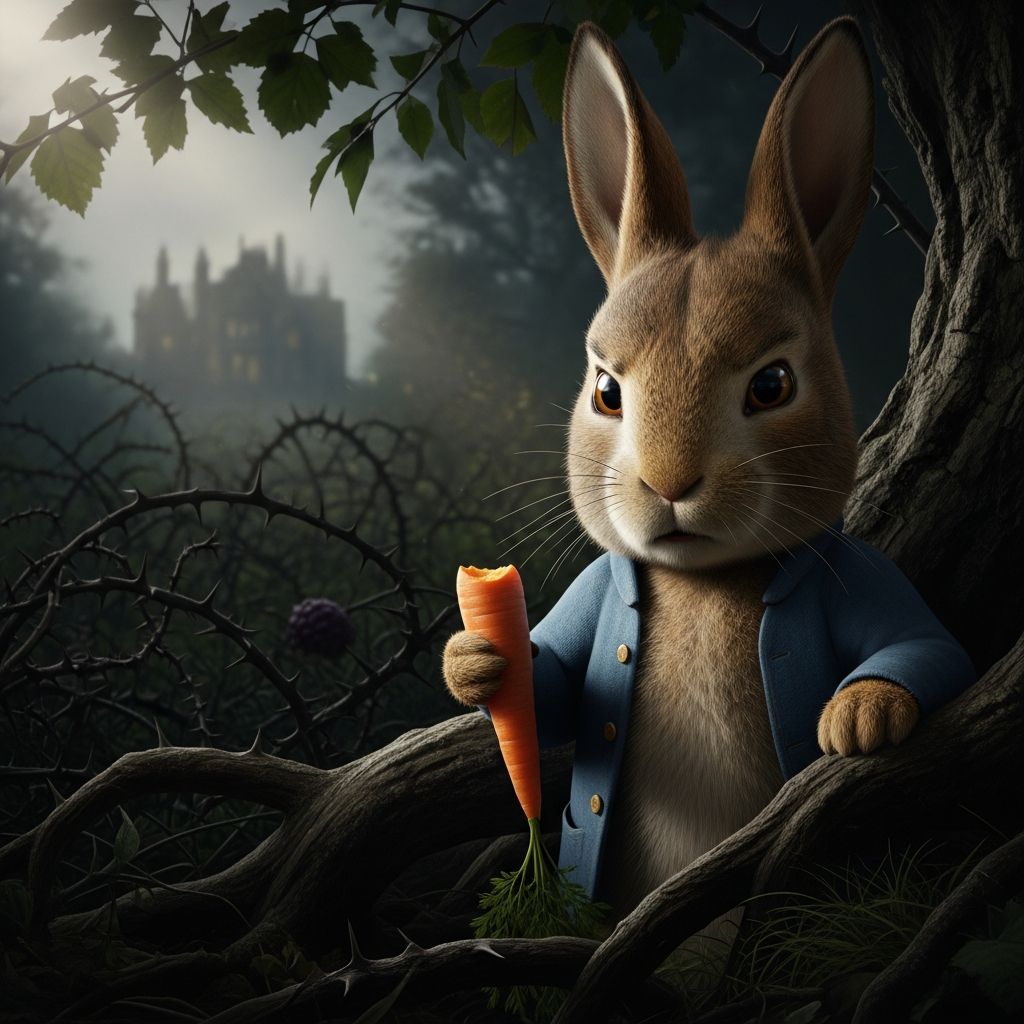
Beatrix Potter’s The Tale of Peter Rabbit has charmed generations, yet many modern parents are startled when they notice just how much danger, loss, and implied violence hides beneath its sweet watercolor illustrations.[web:1][web:2] The story begins with a dead rabbit father, a forbidden garden, and a child hero who is nearly killed after ignoring his mother’s warning, which can make the book feel surprisingly intense for a bedtime read.[web:2]
Instead of treating Peter Rabbit as harmless nostalgia or banning it outright, caregivers can use the book as a lens for thinking about what children are ready for, and how to turn darker story moments into chances to talk about fear, safety, and empathy.[web:1][web:2] When approached thoughtfully, even a risky little rabbit can help kids understand consequences while still feeling secure and supported.[web:1]
Peter Rabbit in a Modern Living Room
Many adults remember Peter Rabbit as a gentle picture book without recalling the specific moments that might unsettle a sensitive child.[web:2] Reading it aloud again as a parent often highlights how explicitly the story acknowledges danger, from a father baked into a pie to a frantic chase through the garden.[web:1][web:2]
- Implied death and threat. The casual mention of Peter’s father being turned into a pie reveals that the world of the story includes very real harm.[web:1][web:2]
- Relentless pursuit. Mr. McGregor’s chase puts Peter in constant jeopardy, with repeated moments in which he could be caught or killed.[web:1]
- Emotional distress. Peter experiences panic, exhaustion, and hopelessness before finally making it home, which mirrors how children can feel when they are overwhelmed.[web:2]
These elements can be powerful because they acknowledge that bad things happen, but they can also feel jarring when compared with gentler contemporary picture books that often soften or avoid such threats.[web:1][web:3]
Why Classic Stories Often Feel Harsher
Children’s stories written in the late nineteenth and early twentieth centuries frequently deal more directly with hunger, danger, punishment, and death than many mainstream children’s books published today.[web:1] Authors expected stories to both entertain and instruct, using vivid consequences to warn children about disobedience, carelessness, or greed.[web:2]
- Moral lessons through fear. The risk of being caught and eaten functions as a stark warning about ignoring rules meant to keep children safe.[web:1][web:2]
- Everyday hazards. Gardens, farms, and wild spaces were familiar settings where real accidents and injuries occurred, making the story’s threats feel grounded rather than fantastical.[web:1]
- Thin protection for characters. Unlike some modern media, classic tales do not always guarantee that sympathetic characters are safe, which increases tension but also realism.[web:2]
From this historical angle, Peter Rabbit is less an outlier and more a reflection of the anxieties and parenting priorities of its time, when vivid cautionary tales were a common tool.[web:1]
What Today’s Parents Notice — And Worry About
Contemporary parents often approach children’s media with heightened awareness about mental health, anxiety, and age-appropriate exposure to violence.[web:3] As a result, moments that older generations brushed off can now trigger genuine discomfort or thoughtful concern.[web:2][web:3]
- Fear of nightmares. Caregivers may worry that scenes of pursuit, entrapment, or implied death will surface later in children’s dreams or nighttime fears.[web:2]
- Normalization of harm. Some adults question whether frequent exposure to characters in danger might make violence feel ordinary rather than shocking.[web:3]
- Identity and empathy. Kids often identify with small, vulnerable characters like Peter, so seeing him hunted can feel personal and intense.[web:2]
These worries are not a sign that parents are overreacting; they highlight a genuine shift in cultural expectations around what early childhood stories should do and how they should feel.[web:1]
Fear in Stories: Danger or Development Tool?
Not all fear in children’s media is harmful. When handled carefully, brief, manageable tension can help kids practice coping with big feelings in a safe context, especially when the story resolves with safety and care.[web:1] Classic fairy tales and animal fables often use danger as a device to teach caution, resilience, and discernment.[web:2]
| Story Element | Potential Risk | Potential Benefit |
|---|---|---|
| Chase scenes and narrow escapes | May overwhelm very sensitive children or those with existing anxiety.[web:2] | Offer a controlled way to experience excitement and relief when the hero survives.[web:1] |
| Implied or historical death | Can prompt difficult questions if a child has recently faced loss.[web:2] | Opens gentle conversations about mortality, safety, and family support.[web:1] |
| Consequences for disobedience | Might feel harsh or shaming if presented without empathy.[web:2] | Helps children understand that rules exist to protect them, not simply control them.[web:1] |
The key is not eliminating fear from all stories but ensuring that children feel held, guided, and reassured while they encounter it.[web:1]
Is Peter Rabbit Actually Violent?
Peter Rabbit’s world includes predators, hunting, and the possibility of being turned into food, yet most of the violence remains implied rather than depicted graphically on the page.[web:1][web:2] The tension comes less from detailed description and more from the constant threat that Peter will share his father’s fate.[web:1]
- Psychological stress over gore. Young readers rarely see explicit injury; instead, they absorb Peter’s frantic emotions as he hides, runs, and ultimately breaks down in tears.[web:2]
- Punishment without cruelty at home. Peter’s mother does not hurt him when he returns; she simply recognizes that his misadventure has consequences and prescribes rest and soothing chamomile tea.[web:1]
From a modern perspective, the book might feel less like a violent spectacle and more like a high-stress adventure that brushes close to real danger, then pulls back into domestic safety.[web:1]
How Different Children Respond
Not all kids react the same way to Peter Rabbit. Some treat it as a thrilling chase, while others focus intensely on the threat to Peter’s life or the loss of his father.[web:2] Individual temperament, age, and life experiences all shape how a child receives the story.[web:1]
- Bold thrill-seekers. Children who enjoy fast-paced cartoons or action scenes may find Peter’s escape exciting and satisfying.[web:3]
- Highly sensitive readers. Kids who empathize deeply with characters may worry about Peter long after the book ends or fixate on the baked-into-a-pie reference.[web:2]
- Children with trauma or grief. Those who have recently lost a loved one or experienced frightening events may find the early mention of Peter’s father especially upsetting.[web:1]
Knowing a child’s personality helps parents decide whether to read the original story, adapt it, or wait until the child is older and better equipped to handle those themes.[web:1]
Reading Peter Rabbit Thoughtfully with Kids
For families who do choose to share Peter Rabbit, a few intentional strategies can help transform potentially upsetting scenes into constructive conversations.[web:1][web:2] Reading slowly, pausing for questions, and checking in on feelings can turn a tense tale into an exercise in emotional literacy.
- Preview the story yourself. Read it alone first so you know which pages might need extra explanation or gentle framing.[web:1]
- Set expectations. Before starting, let your child know that Peter makes some unsafe choices but eventually comes home.[web:2]
- Pause at intense moments. Ask open questions like, “How do you think Peter feels right now?” or “What would you want him to do next?”[web:2]
- Offer physical reassurance. Sitting close, using a calm voice, or holding a hand can ground children during tense scenes.[web:1]
- Revisit the ending. Emphasize that Peter is safe, loved, and cared for, even after a big mistake.[web:1]
These small adjustments help children process what they are seeing and feeling, instead of silently absorbing fear or confusion.[web:2]
Turning the Story into a Safety Conversation
Peter Rabbit’s misadventure offers a concrete way to talk about rules, boundaries, and risky behavior without singling out a real child’s mistake.[web:1] Because the danger centers on a fictional rabbit, many children can explore safety concepts with a bit more emotional distance.[web:2]
- Discuss why rules exist. Ask, “Why did Peter’s mother tell him not to go to the garden?” to link family rules with protection, not punishment.[web:1]
- Connect to real-life boundaries. Bridge the story to situations like staying out of the street, not wandering off in a store, or asking before using tools.[web:2]
- Brainstorm better choices. Invite kids to imagine safer alternatives Peter could have chosen, reinforcing problem-solving skills.[web:1]
By focusing on decisions and outcomes rather than shame, parents can help children learn from Peter’s mistakes without feeling attacked or judged.[web:2]
If the Book Feels Like “Too Much”
It is perfectly reasonable for some families to decide that Peter Rabbit is not a good fit right now, especially for very young or anxious children.[web:2] Choosing to wait or to skip certain stories does not mean shielding kids from all difficulty; it simply reflects respect for their current developmental stage.[web:1]
- Use adapted versions. Some retellings soften the more intense details or emphasize humor and mischief over threat.[web:1]
- Start with lighter tales. Selecting stories where the danger is clearly imaginary or quickly resolved can build a child’s tolerance before they tackle darker classics.[web:3]
- Return later. A story that feels overwhelming at age three may be enjoyable and thought-provoking at age six or seven.[web:1]
Trusting your own read of your child, rather than feeling locked into any one canon of “must-read” books, allows you to build a family library that supports rather than stresses your kids.[web:2]
Balancing Comfort and Challenge in Kids’ Stories
Peter Rabbit sits at an interesting crossroads between cozy nursery décor icon and genuinely perilous protagonist.[web:1] That tension mirrors a larger parenting challenge: offering children enough safety to feel secure while not hiding the existence of risk and consequence.[web:2]
- Comfort stories give children predictable rhythms, gentle stakes, and guaranteed happy endings.
- Challenge stories introduce uncertainty, complexity, and sometimes sadness or fear, in doses that can strengthen emotional resilience.[web:1]
Families who think intentionally about how much of each category they share – and at what ages – can curate reading experiences that support both emotional safety and growth.[web:2]
Frequently Asked Questions
What age is Peter Rabbit appropriate for?
Many publishers market Peter Rabbit toward preschoolers, but emotional readiness varies widely; some three-year-olds enjoy the chase, while others find it upsetting.[web:1] Parents may want to introduce it closer to ages four to six, when children better understand fiction and can talk about fear and consequences more clearly.[web:2]
Is Peter Rabbit too violent compared to modern cartoons?
Some contemporary animated shows feature more on-screen collisions and slapstick, yet the stakes can feel lower because characters rarely appear at risk of permanent harm.[web:3] Peter Rabbit’s implied possibility of death gives it a more serious emotional weight, even though it shows less physical impact directly on the page.[web:1]
How can I tell if my child is scared by the story?
Signs include turning away from certain pictures, asking to stop, clinging more tightly than usual, or revisiting the same worrying question after the book is over.[web:2] If a child seems withdrawn or unusually agitated after reading, it can help to name their feelings, reassure them that Peter is safe, and switch to a calmer story for a while.[web:1]
Should I skip the part about Peter’s father being baked into a pie?
Some parents choose to paraphrase or omit that line for very young listeners, especially if death has been a recent topic in the family.[web:2] Others keep it but pause to explain that it is a story about why Peter’s mother is extra careful, making sure children know they can ask questions and share their reactions.[web:1]
What if grandparents love Peter Rabbit but I’m unsure?
It can help to explain your concerns respectfully, suggesting that they read the story together with you present the first time so you can support your child if needed.[web:1] You might also propose alternating Peter Rabbit with gentler books, creating shared traditions that honor the classic without overwhelming your child.[web:2]
Seeing Peter Rabbit with Clear Eyes
Peter Rabbit is neither a harmless nursery decoration nor a corrupting force that must be banished from every bookshelf; it is a lively, sometimes unsettling story that reflects an older view of how best to teach children about risk.[web:1][web:2] Whether it fits your home right now depends on your child’s temperament, your values, and your willingness to read it with care, conversation, and comfort close at hand.[web:1]