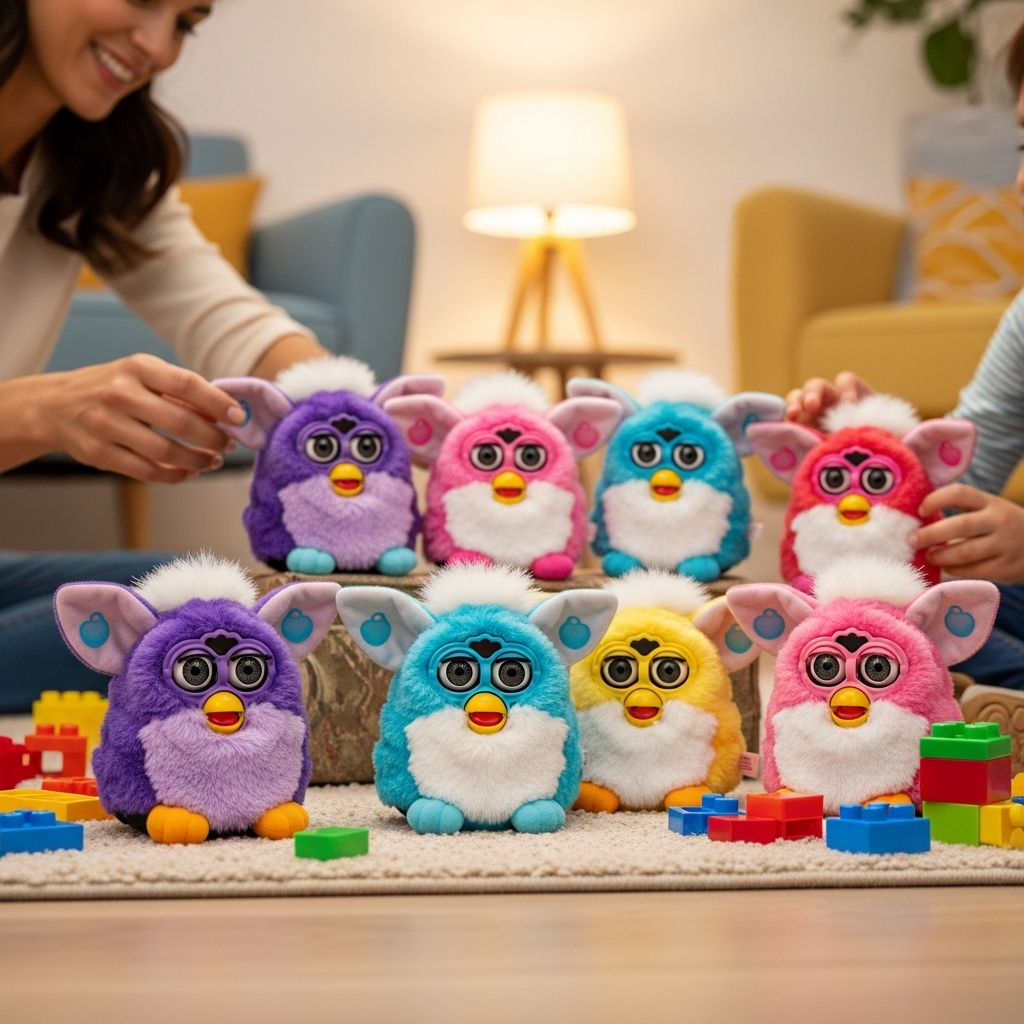
The modern Furby is back on store shelves and your child has probably noticed. This fuzzy, blinking, endlessly chatty toy is a mix of plush comfort and interactive tech, designed to respond to voice, touch and movement with jokes, songs and silly phrases. If you are wondering whether it belongs in your house, this guide walks through what Furby can do, how kids use it, and what parents should consider before buying.
What Exactly Is a Modern Furby?
The latest Furby is an interactive electronic plush aimed at children around age 6 and up. It combines:
- Soft, colorful fur and oversized ears
- Animated eyes (printed or digital, depending on version)
- Built-in speaker and microphone for sounds and voice activation
- Sensors that respond to touch, movement and sound
Unlike some earlier models, the current generation is designed to work without connecting to the internet or other devices, which removes some common privacy worries for parents.
Core Features Kids Notice First
When children meet Furby for the first time, a few things stand out immediately.
- Lively Personality: Furby talks in a mix of English and its own invented language (often called Furbish), cracks jokes, and reacts with sound effects.
- Over 600 reactions: Hasbro advertises hundreds of phrases, songs and responses, which makes the toy feel less repetitive over time.
- Voice-activated play: Kids say a special wake phrase and then choose among several command words to trigger different modes.
- Physical interaction: Patting its head, tickling, shaking, or pretending to feed it with included accessories all trigger different behaviors.
- Bright visual effects: The large ears can light up in different patterns, turning the toy into a tiny light show.
Furby’s Main Play Modes Explained
The newest Furbies typically include five core voice-activated modes that structure most of the play.
| Mode | What It Does | How Kids Use It |
|---|---|---|
| Dance / Dance Party | Plays upbeat music while Furby wiggles, bops and swings its ears. | Kids dance along, treat it like a mini DJ, or use it as background music during play. |
| Copy Cat | Records short bursts of a child’s voice and replays them with silly sound effects. | Children experiment with different words, funny noises and secret codes. |
| Tell My Fortune | Acts like a playful, toy-version fortune teller, giving goofy answers to child questions. | Kids ask lighthearted questions and giggle over the responses. |
| Let’s Chill | Guides kids through simple breathing and relaxation with calm music and affirmations. | Parents sometimes lean on this mode as a wind-down tool or during big feelings. |
| Light Show | Turns Furby’s ears into a color-changing light display for several minutes. | Children use this as a mini night-light or as ambiance during play. |
How Furby Responds to Kids
Under the fur, Furby is essentially a compact robotics project geared for children. Sensors help it detect and respond to different types of input.
- Touch Sensors: In the head, tummy and sometimes back, allowing Furby to react when hugged, patted or tickled.
- Motion Detection: Shaking or picking it up triggers different phrases or reactions.
- Microphone: Listens for the wake phrase and commands, then responds with stored phrases or songs.
- Light / Sound Sensitivity: Some models respond when the environment gets louder or brighter, adding variety to their reactions.
From a child’s perspective, these responses make Furby feel somewhat alive: it “wakes up” when they approach, quiets down when ignored for long enough, and appears to remember repeated interaction patterns.
Learning Value: What, If Anything, Do Kids Learn?
Furby is not an educational toy in the school-sense of the word, but it supports a few kinds of development that child development experts associate with pretend play and social interaction.
- Language and communication: Children naturally talk to animated toys, practice conversation turns, and experiment with new vocabulary. Research on social robots and interactive toys shows that children often treat them like social partners, which can support language practice and perspective taking.
- Imaginative play: A responsive toy can become a character in a child’s invented stories, encouraging narrative thinking and role-play.
- Responsibility and caregiving: Kids sometimes “feed,” comfort, and put Furby to bed, similar to how they care for dolls or stuffed animals. This kind of nurturing play is linked with empathy development in early childhood.
- Emotional regulation: The relaxation mode with breathing prompts may help some children practice basic self-regulation skills, especially if parents co-use the toy during calm-down routines.
These benefits depend heavily on how the toy is used and how much adults stay involved in guiding play. The American Academy of Pediatrics emphasizes that digital or electronic toys should ideally complement, not replace, caregiver interaction and traditional pretend play.
What Parents Tend to Love
From a parent’s point of view, Furby has a few standout positives.
- No Wi-Fi or app required: Recent generations are designed to work offline, limiting data concerns and app-based distractions.
- Instant play out of the box: Once batteries are in, children can start interacting immediately without account setup or pairing.
- Lots of variety: With many responses and modes, Furby does not feel “done” after the first day.
- Sibling and friend play: Two Furbies can interact with each other, adding a social, cooperative element to playtime.
- Accessories with offline play value: Items like combs, beads and pretend food work with or without the electronics switched on, giving younger kids something to manipulate.
Common Parent Complaints and Annoyances
For all its charm, Furby can be a polarizing presence in a quiet home. Before you commit, consider these frequent pain points reported with interactive toys.
- Noise level: Because Furby talks, sings and plays music, it can be overwhelming in small spaces. There is usually no true whisper mode.
- Persistence: Some models react easily to sound or movement, which means they may wake unexpectedly if left in active mode.
- Battery use: With frequent play, you can expect to replace batteries, something many electronic-toy-owning parents already know too well.
- Potential for overstimulation: Lights, movement and noise can be too much for sensory-sensitive children or for late-evening play.
- Disagreements over bedtime :Children may want to sleep with the toy, but its sounds and lights are not always sleep-friendly.
Many of these issues can be managed with household rules around when Furby can be turned on, where it can be played with, and where it sleeps at night.
Age Suitability and Safety Considerations
Hasbro typically markets the current Furby to ages 6 and up, aligning with the level of interaction and small accessory pieces included.
- For preschoolers (3–5): Younger siblings are often fascinated by the lights and voice, but may not fully understand the commands or modes. Small accessories should be kept out of reach of children under 3 because of choking risks, consistent with general toy safety guidelines.
- For early elementary (6–8): This is the sweet spot for Furby. Kids can remember voice commands, explore different modes and use the toy in imaginative play.
- For older kids (9+): Some will still enjoy the humor and collectible aspect, while others may quickly move on to more sophisticated tech or hobbies.
Parents should also consider sensory sensitivities. Children sensitive to loud noises or flashing lights may find Furby overwhelming, and it may be worth testing it in short bursts at first.
Screen-Free Tech Play: How Furby Fits In
Many parents look for ways to introduce technology without adding more screens to their child’s day. Electronic toys like Furby land in that middle ground. Because it does not require a phone or tablet, the toy may offer a form of screen-free interactive tech play.
Research on children and digital toys suggests that when electronics emphasize conversation, imagination and social interaction rather than solo, screen-based engagement, they can be more supportive of healthy development. Furby’s design leans toward talk, movement and pretend play, but as with any tech toy, moderation and parental involvement are still important.
Practical Buying Tips for Parents
If you decide a Furby might fit your family, a few practical choices can make the experience smoother.
- Budget for batteries: Check the package for battery type and consider buying rechargeable batteries if your household uses many interactive toys.
- Consider color and style: Furbies come in various color combinations. Letting your child help choose can make them feel more connected to the toy.
- Plan a storage spot: Decide in advance where Furby will live when not in use (a basket, shelf, or toy bin) to prevent it from constantly activating at random.
- Set “quiet hours” rules: Establish family rules about when noisy toys are off-limits (for example, before school and after bedtime).
- Talk about expectations: Before unboxing, explain that Furby is fun, but it also needs rest and can be switched off when the family needs quiet.
Is Furby the Right Toy for Your Child?
To help decide, reflect on your child’s personality and interests. Furby may be a good fit if your child:
- Enjoys talkative, character-driven toys
- Likes music, dancing and silly voices
- Frequently plays pretend with dolls, stuffed animals or action figures
- Is curious about gadgets and how things work
On the other hand, Furby may not be the best choice if your child:
- Is sensitive to loud sounds or flashing lights
- Gets overstimulated by nonstop activity
- Prefers quiet, solo building or puzzle activities
In many households, Furby ends up as the “party friend” of the toy box—great in short bursts, a big hit during playdates, but better off switched off when the house needs calm.
Frequently Asked Questions (FAQs)
Does Furby connect to Wi-Fi or collect personal data?
Current models are designed to work completely offline and do not require Wi-Fi, apps or an account to play. They still use a microphone to listen for voice commands, but they are not meant to upload or store data in the cloud.
How do I turn Furby off?
Exact steps vary by model, but generally you can either press and hold a specific button or simply leave it unused for a while so it goes into sleep mode. Many parents also remove or loosen the batteries for long-term storage.
Is Furby too scary or intense for younger kids?
Some preschoolers adore Furby; others are startled by the sudden movement, eyes and sound. Introduce it slowly, at a distance, and give the child control over when it speaks or dances. Respect their cues if they seem uncomfortable.
Can more than one Furby play together?
Yes. If your home has two Furbies, they can be paired so they appear to “talk” or react to each other for additional play value. This can be especially fun for siblings or friends.
How long will kids stay interested?
Interest tends to be highest in the first days or weeks, then settles into occasional bursts, especially during playdates or special occasions. Children who enjoy caring for toys or inventing stories often stay engaged longer.
References
- Furby Makes a Comeback for a New Generation — The Toy Insider. 2023-06-22. https://thetoyinsider.com/furby-review/
- Furby is Back – ’90s Nostalgia Reimagined for Today’s Generation! — Mum Central. 2023-07-05. https://mumcentral.com.au/furby-review-2023/
- Furby Facts for Kids — Kiddle. 2023-12-05. https://kids.kiddle.co/Furby
- Furby — ROBOTS: Your Guide to the World of Robotics (Carnegie Mellon University Robotics Institute). 2023-10-01. https://robotsguide.com/robots/furby
- Behind an Interactive Toy Phenomenon: What Makes Furbies Tick — Global Toy News. 2023-06-26. https://globaltoynews.com/2023/06/26/behind-an-interactive-toy-phenomenon-what-makes-furbies-tick/