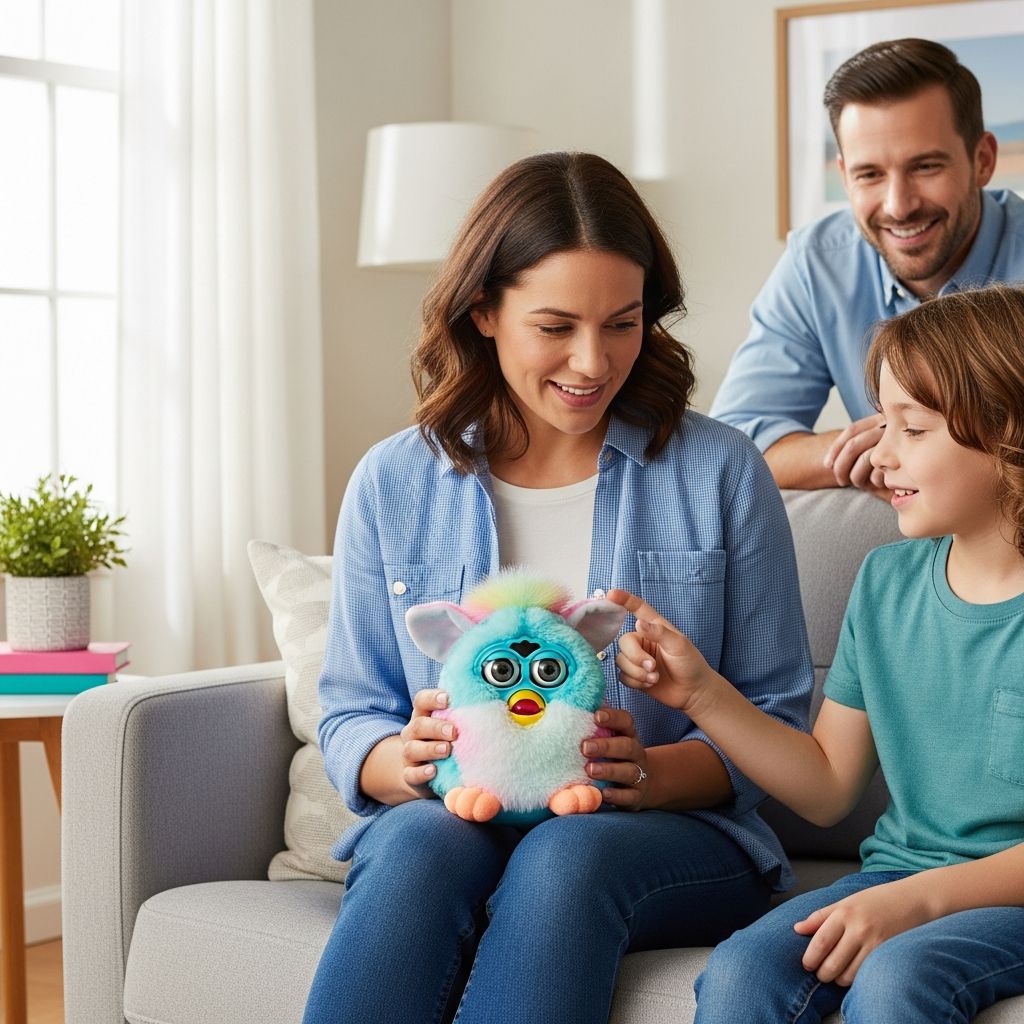
Furby has made multiple comebacks since its late-90s debut, evolving from a novelty electronic pet into a fully interactive toy that talks, sings, and reacts to your child’s touch and voice. For many parents, it lands somewhere between “delightfully imaginative companion” and “how is this thing still talking at 6 a.m.?”
What Exactly Is a Furby Today?
Modern Furbies are plush robotic toys with expressive eyes, moving ears and mouth, and a built-in personality that responds to kids through sound and touch. They chatter in a mix of their own invented language and simple English phrases, gradually using more recognizable words as children interact with them.
Unlike app-dependent gadgets, contemporary versions typically function as standalone toys that don’t require constant connectivity, which appeals to parents looking to limit screen time. They combine electronic features with pretend play, creating a hybrid between a stuffed animal and a robot.
Key Features Parents Actually Notice
Product boxes are full of buzzwords, but daily life with a Furby comes down to a handful of very noticeable behaviors. These are the aspects that tend to matter most for families once the novelty wears off and the toy becomes part of the household routine.
- Constant chatter: Furby talks, sings, hums, and occasionally lets out startling shrieks or giggles.
- Responsive sensors: It reacts when kids pet its head, tickle its tummy, pick it up, or sometimes even walk past it.
- Light and sound awareness: Changes in the room’s noise or light can wake it up or shift its mood.
- Quirky personality shifts: Over time, it may act silly, dramatic, or mellow depending on how children treat it.
- Limited parental control: Unlike a tablet, there are usually no detailed settings for volume schedules or quiet hours.
Age Range and Play Styles
On packaging, Furby is typically marketed for elementary-school kids, but real-life use tends to extend on either side of that range. Younger siblings often want to interact with it, while older kids may approach it as more of a gag toy or nostalgic collectible.
The way children play with Furby shifts noticeably by age, which can help you decide whether your child is likely to enjoy it for more than a weekend.
| Age Group | Common Play Style | Parental Considerations |
|---|---|---|
| 3–4 years (below suggested age) | Simple petting, giggling at sounds, treating Furby like a plush animal. | Close supervision needed; may find sudden noises scary or overstimulating. |
| 5–7 years | Conversational play, pretending Furby has feelings, including it in doll or action-figure scenes. | Peak enjoyment; ideal age for imaginative interaction and make-believe. |
| 8–10 years | Experimenting with responses, testing phrases, setting up “pranks” with Furby. | Interest may be intense but brief; humor and curiosity drive use more than nurturing. |
| 11+ years | Occasional play, collection, or tinkering; using Furby as a conversation piece. | More of a novelty item or nostalgic toy than a daily companion. |
The Charm: Why Kids Fall in Love with Furby
Part of Furby’s enduring appeal is that it feels less predictable than most toys. Instead of repeating the same canned phrase when a button is pressed, it seems to “decide” how to respond, which gives children the impression that it has preferences and moods.
This unpredictability can be magical for kids who enjoy caring for something that appears to have its own little personality. They often project emotions onto Furby—comforting it when it “cries,” celebrating when it “dances,” and imagining rich backstories that fuel creative play.
- Furby rewards repeated interaction, so kids who return to it throughout the day feel like they are building a relationship.
- Its gibberish language and evolving phrases make kids feel like they are learning to communicate with a secret friend.
- Its exaggerated facial movements and sounds make emotional cues easy to interpret, even for younger children.
The Noise Factor: How Loud Is It Really?
The number-one complaint from many households is not about the toy’s complexity but about its volume and persistence. Furby doesn’t always stay quiet just because everyone else in the room is ready for some peace.
Expect bursts of sound when it wakes up, when it senses movement, or simply when it “feels like” chatting. The toy may also react dramatically to being ignored, which can be funny for kids and mildly infuriating for tired parents.
Practical Noise-Management Tips
- Establish a parking spot: Choose a specific shelf, basket, or toy bin where Furby “sleeps” during quiet hours.
- Store it away from bedrooms: Keep it out of kids’ sleeping spaces to prevent middle-of-the-night chatter.
- Explain a bedtime ritual: Let your child formally say goodnight and help turn Furby off or put it away.
- Mind the batteries: If the toy acts erratically loud or won’t settle, low batteries may be contributing.
Educational and Developmental Upsides
Though Furby is marketed more as entertainment than education, it can still support several useful skills. The key is to treat it as a springboard for conversation and pretend play rather than a digital babysitter.
Parents often notice that kids naturally slip into caretaking roles and social storytelling when they play with Furby, which can open doors for learning opportunities.
- Language and communication: Children practice speaking clearly, taking conversational turns, and improvising dialogue.
- Social-emotional learning: Interpreting Furby’s “moods” helps kids talk about feelings and empathy in a low-stakes way.
- Responsibility: “Feeding,” grooming, and checking on Furby teaches simple routines, even though no real care is needed.
- Imaginative play: Kids often build entire stories and worlds around the toy, strengthening creativity.
Common Frustrations Parents Should Expect
For every giggle, there is usually at least one eye-roll from an adult in the house. Being prepared for Furby’s quirks can reduce conflict and help you decide whether it’s worth the trade-offs.
The frustrations typically fall into three categories: noise, unpredictability, and longevity of interest.
- Inconsistent reactions: Kids may repeat the same phrase expecting a specific behavior, only to see Furby “ignore” them or respond differently.
- Startle factor: The toy can suddenly shout or sing while someone is working, on a call, or trying to relax.
- Short attention span: Some children play intensively for a week, then abandon it once the novelty fades.
- Sibling disputes: Because Furby reacts to whoever is handling it, fights can erupt over whose “friend” it really is.
Furby vs. Other Interactive Toys
Parents often compare Furby with other popular interactive pets and talking toys when trying to choose one big gift. The right choice depends on whether you care more about realism, quietness, or long-term play value.
The following table offers a general sense of how Furby stacks up against typical alternatives like talking dolls and robotic pets.
| Toy Type | Noise Level | Screen Use | Play Style | Best For |
|---|---|---|---|---|
| Furby | High; frequent chatter and songs. | Usually none; standalone toy. | Imaginative conversation, goofy reactions, pretend caretaking. | Kids who love expressive, silly companions. |
| Talking doll or figure | Moderate; limited phrases. | Rarely; mostly button-triggered sounds. | Scripted responses, role-play aligned with specific characters. | Fans of a particular show or movie. |
| Robotic pet (e.g., robot dog) | Moderate; mechanical sounds and barks. | Sometimes uses an app or remote. | More movement-focused, with tricks and commands. | Children who want lifelike motions and “training.” |
| Simple plush with sound | Low; minimal sound effects. | None. | Comfort object, quiet cuddling, basic pretend play. | Kids who are easily overstimulated or sensitive to noise. |
Is Furby Right for Your Household?
Before you commit to a furry roommate with an endless supply of one-liners, it helps to consider your family’s unique preferences and routines. Some homes embrace chaotic, noisy play; others prize calm evenings and minimalist toy closets.
Use the checklist below as a quick gut-check before buying.
Furby Might Be a Good Fit If…
- Your child loves expressive and slightly chaotic toys that react dramatically.
- You are looking for a screen-free interactive gift with longer novelty than a simple plush.
- Your household tolerates background noise and sudden outbursts of sound.
- You enjoy toys that invite storytelling, skits, and imaginative dialogue.
You May Want to Skip or Delay If…
- You or your child are sensitive to noise or easily startled by sudden sounds.
- You prefer toys that can be fully muted or controlled via detailed settings.
- Your child tends to lose interest quickly in toys that don’t involve building, crafting, or screens.
- There is a baby or light sleeper sharing close quarters with the child’s play area.
Buying and Maintenance Tips
Once you decide Furby belongs in your life, a few simple choices can improve your experience. Planning ahead for batteries, storage, and expectations can prevent those “why is it yelling again?” moments.
Even though Furby doesn’t require complex setup, treating it more like a small appliance than a basic stuffed animal will make daily life smoother.
- Check for an off switch or sleep mode: Before wrapping it as a gift, learn how to quiet it quickly.
- Stock up on batteries (or charger): Interactive toys drain power faster than passive ones.
- Set ground rules: Decide ahead of time where Furby may “live” and when it needs to rest.
- Consider storage solutions: A lidded bin or cabinet can protect it and also muffle noise when not in use.
- Label it as a shared or personal toy: Clarify ownership to reduce sibling conflicts.
Frequently Asked Questions About Furby
Does Furby listen to everything in the house?
Furby uses a simple microphone to detect sound and basic speech so it knows when to react, but it is not designed as a high-tech listening device. Its audio recognition is limited to toy-level commands and responses, and it does not store meaningful conversations or function like a smart speaker.
Can you make Furby completely quiet?
Most versions offer some combination of off switch, sleep mode, or auto-shutoff after inactivity, but the toy will remain noisy whenever it is awake and sensing interaction. The most reliable way to guarantee silence is to turn it fully off or remove the batteries when you absolutely need quiet.
Is Furby too scary for younger kids?
Reactions vary widely: some preschoolers adore Furby’s exaggerated expressions, while others are frightened when it suddenly shouts or moves. If your child tends to be cautious around noise and new toys, consider introducing it gradually in daylight, with the option to put it away quickly.
How long do kids usually play with it?
For many families, Furby’s peak excitement lasts from a few days to a few weeks, followed by periodic returns as kids rediscover it. Children who naturally enjoy role-playing, performing, and talking to toys often keep using it longer than those who prefer building sets or video games.
Is Furby a good gift for holidays or birthdays?
Furby can be a memorable “wow” gift because it feels alive the moment the box is opened and batteries are installed. As long as parents are comfortable with the noise level and expectations are set about when it can and cannot talk, it often becomes one of the most talked-about presents of the season—for better or worse.