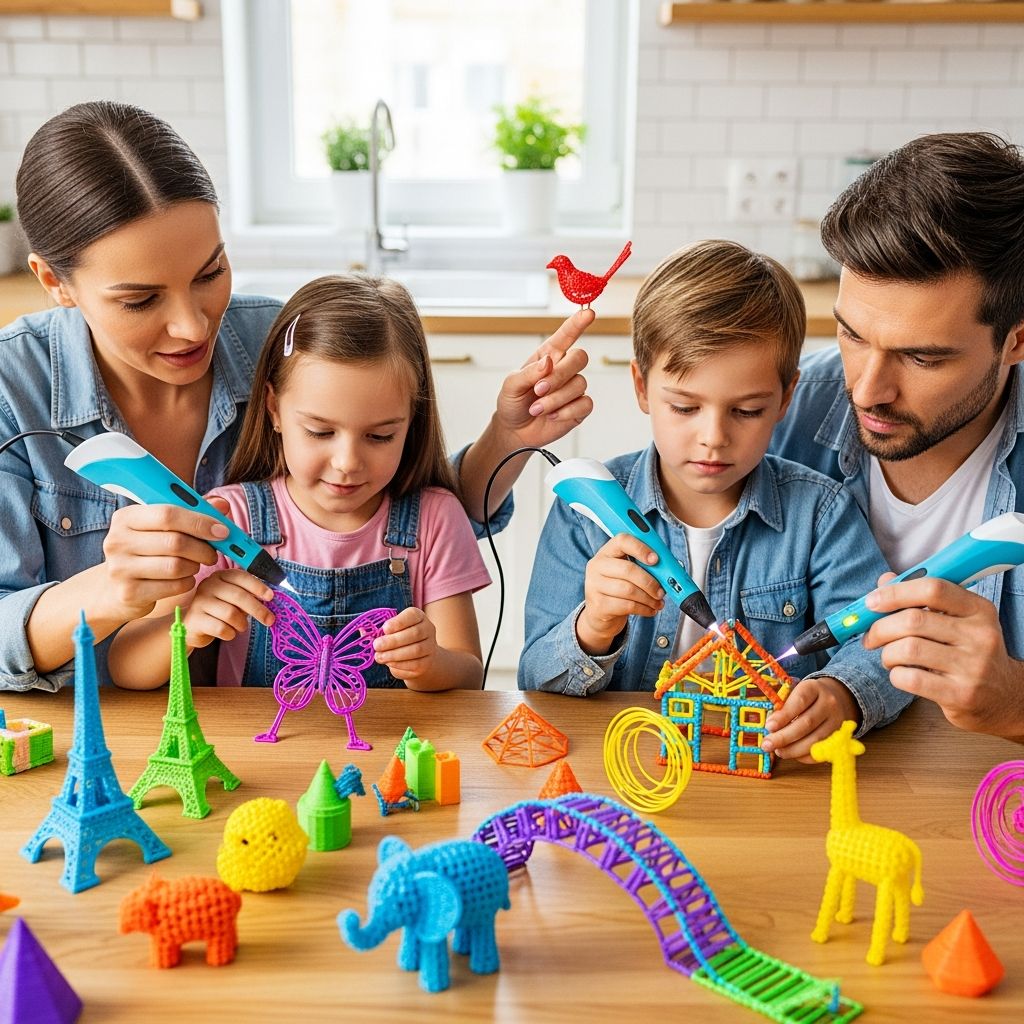
3D printing pens have moved from gadget blogs to kids’ wish lists, and many parents now wonder whether a pen like the 3Doodler is a smart purchase or just another pricey toy destined for the closet. This guide walks through what 3D pens actually do, how real families tend to use them, and the pros, cons, and practical considerations before you buy.
What Exactly Is a 3D Printing Pen?
A 3D printing pen is a handheld device that heats plastic filament and extrudes it through a small nozzle, allowing the user to “draw” lines that harden into three-dimensional shapes. Unlike a traditional 3D printer, there is no computer, software, or design file involved—your hand and imagination provide the motion and shapes.
In practice, a 3D pen feels a bit like combining a glue gun, a marker, and modeling clay into one tool. You hold it like a thick pen, squeeze or press a button to feed plastic through, and then move slowly to trace lines, outline shapes, or layer strands into sculptures.
Who Are 3D Pens Really For?
Although the marketing often shows young children happily “drawing in the air,” 3D pens usually make the most sense for older kids, teens, and adults who already enjoy crafts, building, or drawing. There is a learning curve for coordination, patience, and safe handling.
Think about buying a 3D pen for a child who:
- Already spends focused time on LEGO builds, model kits, or detailed crafts.
- Shows interest in inventing, repairing, or modifying objects around the house.
- Is old enough to understand heat safety rules and follow them consistently.
How a 3D Pen Fits Into Family Life
To decide whether a pen like the 3Doodler makes sense for your family, imagine how it would actually be used on a normal week. A 3D pen is not usually an everyday toy; it’s more like a special project tool that comes out for weekend sessions, rainy days, or school projects.
Families who get the most from a 3D pen tend to treat it like shared equipment, stored with craft supplies and brought to the table when someone has a specific idea—fixing a broken plastic part, making a custom accessory, or adding dimension to a school presentation.
Benefits of a 3D Pen for Kids and Parents
A well-used 3D printing pen can offer more than a short-lived novelty. It can support creative thinking, introduce basic engineering concepts, and encourage perseverance in a hands-on way that screens often can’t match.
Here are some of the strongest potential benefits:
- Creative problem solving: Kids learn to think in layers and supports, figuring out how to reinforce parts and connect shapes.
- Spatial reasoning: Turning a flat drawing into a 3D object builds understanding of height, depth, and structure.
- STEM tie-ins: You can casually introduce ideas like prototyping, design iterations, and material properties.
- Fine motor practice: Slow, controlled movement of the pen builds hand strength and coordination.
- Parent–child collaboration: Many projects work best as a team effort, with an adult helping plan, trace, or stabilize parts.
Common Drawbacks and Frustrations
On the other side of the equation, 3D pens also bring some real-world frustrations that are easy to overlook in polished product photos. Understanding these ahead of time can prevent disappointment and help you set expectations with your child.
Families often run into the following issues:
- Steep early learning curve: The first hour often produces lumpy blobs, not Pinterest-ready sculptures.
- Consumable costs: The plastic filament refills add up over time, especially if multiple kids use the pen.
- Noise and smell: Some pens hum or click while running and may emit a faint plastic odor while heating.
- Maintenance: Clogs, jams, and broken strands happen and require patience to fix.
- Time-limited sessions: Because of heat and attention span, most kids use the pen in short bursts rather than hours at a time.
Practical Buying Considerations
Not all 3D pens are equal, and it helps to focus on a few key questions instead of getting lost in marketing jargon. Before you buy, take a moment to think about the following factors.
Age and Skill Match
Manufacturers often list an age range that assumes careful adult supervision at the lower end. For many families, a realistic minimum solo-use age is closer to the preteen years, with younger kids participating as helpers under watchful eyes.
If your child still struggles to keep fingers away from hot glue guns or stovetops, a 3D pen should only be operated with an adult’s hands on or very close to the device.
Filament Type and Ongoing Cost
Different pens take different plastic types, and some require proprietary refills while others work with generic spools or strands. This matters because the cost of filament over months or years can easily exceed the cost of the pen itself.
When comparing options, check:
- Price per unit of filament, not just price per pack.
- Whether you can buy mixed-color sets or only single-color refills.
- How quickly a typical project uses up a strand or spool.
Heat, Safety, and Supervision Needs
3D pens rely on heat to melt plastic, so the nozzle and freshly extruded filament can be hot. Some pens use lower-temperature plastics, but “cool” is still warm enough to warrant caution and clear rules.
Look for safety-conscious design details like insulated tips, clear indicator lights, automatic shutoff timers, and stable stands or cradles for setting the pen down safely between strokes.
Ease of Use and Reliability
Parents are most likely to regret a 3D pen that is difficult to feed, jams constantly, or has confusing controls. Simpler models with fewer buttons and preset modes are often better for family environments than professional-grade pens packed with advanced settings.
Whenever possible, favor models that include a basic troubleshooting guide, a cleaning tool, and straightforward controls for speed and flow.
At-a-Glance: Pros and Cons of a 3D Pen for Families
| Aspect | Advantages | Drawbacks |
|---|---|---|
| Creativity | Encourages open-ended building, experimentation, and imaginative play. | Some kids lose interest quickly if early attempts don’t match expectations. |
| Learning Value | Introduces basic design, structure, and iteration concepts in a tangible way. | Without guidance, kids may stick to simple shapes and miss deeper learning. |
| Cost | Entry-level pens are cheaper than full 3D printers and need no software. | Ongoing filament purchases add recurring expense over time. |
| Safety & Mess | Less messy than paint or clay, easy to store in a small box. | Heated tip requires supervision; stray strands can clutter the workspace. |
| Family Use | Can be shared across ages and used for school, hobbies, and repairs. | Only one person can use a single pen at a time; may cause sibling conflict. |
Project Ideas That Actually Get Used
The best way to avoid a once-and-done gadget is to have realistic, appealing project ideas in mind before you buy. Think of the pen as a “3D glue stick” that can either build from scratch or enhance things you already own.
Here are project categories that tend to see repeat use:
- Repairs and fixes: Reinforce cracked plastic, replace a missing hook, or patch a broken toy with custom-formed plastic.
- Custom accessories: Create keychains, charms, bag tags, or simple jewelry that kids can actually wear or use.
- School projects: Add raised labels, models of molecules, or tiny props for history dioramas.
- Board game upgrades: Make replacement tokens, miniatures, or custom stands for cards and tiles.
- Holiday and birthday decor: Trace stencils for ornaments, cake toppers, or name signs.
Tips for a Smooth First Week With a 3D Pen
The first days with a new 3D pen largely determine whether it becomes a beloved tool or a forgotten gadget. A small amount of preparation and a few house rules can make a big difference.
Consider the following strategies:
- Start with flat designs: Have kids trace outlines on paper or a mat before attempting to build vertical structures.
- Limit the first session: Keep the first use to 20–30 minutes so hands and patience don’t get overwhelmed.
- Model safe handling: Adults should demonstrate how to hold the pen, where not to touch, and how to park it safely.
- Use scrap first: Expect a few strands of practice lines and doodles as everyone gets used to the speed and flow.
- Store supplies together: Keep the pen, power cable, and extra filament in one labeled container so it’s easy to set up and put away.
Signs a 3D Pen Is a Good Fit for Your Family
Because every family is different, there is no universal “yes” or “no.” Instead, look for patterns in your home that suggest a 3D pen will earn its place among your limited storage and budget.
A 3D pen is more likely to be a good investment if:
- Your child naturally gravitates toward intricate building and crafting projects.
- You have a suitable, stable workspace where a hot tool can be used safely.
- You are comfortable supervising early sessions and helping troubleshoot minor issues.
- You already own or plan to buy creative toys (like building sets, craft kits, or simple robots) and see this as part of that ecosystem.
When You Might Want to Skip It (For Now)
On the other hand, there are situations where holding off may make more sense. Waiting six months or a year can mean the difference between a frustrating experience and a rewarding one.
Consider postponing a 3D pen purchase if:
- Your child is still working on basic tool safety and impulse control.
- Most craft or STEM kits in your home are used once and then abandoned.
- You are not in a position to supervise early sessions or manage a heated tool.
- Your budget is tight and ongoing refill costs would cause stress.
FAQs About 3D Pens Like the 3Doodler
Do 3D pens replace a full 3D printer?
No. A 3D pen is more like a freehand sculpting tool than a replacement for a precision 3D printer. It is great for artistic, one-of-a-kind pieces, quick repairs, and simple prototypes, but it cannot match the accuracy, repeatability, or automation of a dedicated printer.
How long does a typical filament pack last?
Usage varies widely, but in most families, a small mixed-color pack is enough for a handful of small projects or several short practice sessions. Kids who enjoy filling in stencils or tracing outlines may stretch supplies further than those attempting large, solid structures.
Is it safe for younger kids to use?
With close adult supervision, younger children can participate by choosing colors, holding templates, or suggesting designs, while an adult or older sibling handles the hot pen. Independent operation is best reserved for kids old enough to reliably follow safety rules and respect heat-based tools.
How messy is it compared to other crafts?
3D pen projects produce less liquid mess than paint or glue but do create small curls and snippets of plastic. A tray, mat, or large sheet of paper under the work area makes cleanup as simple as gathering and discarding leftover strands.
What if my child isn’t very artistic?
Artistic drawing skills are helpful but not required. Many kids enjoy following stencils, tracing printed shapes, or building simple geometric forms. Over time, they often discover that engineering-style builds—bridges, stands, supports—can be just as satisfying as detailed sculptures.
Will the novelty wear off quickly?
The novelty factor is highest in the first few days, and usage typically settles into occasional, purposeful sessions. Pen longevity in your home depends on whether you keep introducing fresh project ideas and encourage using the pen as a practical tool for repairs and schoolwork, not just as a one-time experiment.
Making Your Final Decision
A 3D printing pen like the 3Doodler can be an inspiring, worthwhile tool in the right home: one that values tinkering, can support safe use, and is prepared for the learning curve and refill costs. For other families, it may be better as a future purchase once kids are older or more consistently engaged in hands-on projects.
If you decide to bring one home, treat it as a shared family tool rather than a toy, plan a few realistic starter projects, and set clear safety rules from day one. Under those conditions, a 3D pen can turn occasional weekend afternoons into memorable, three-dimensional creativity—without becoming yet another unused device in the bottom of the toy bin.