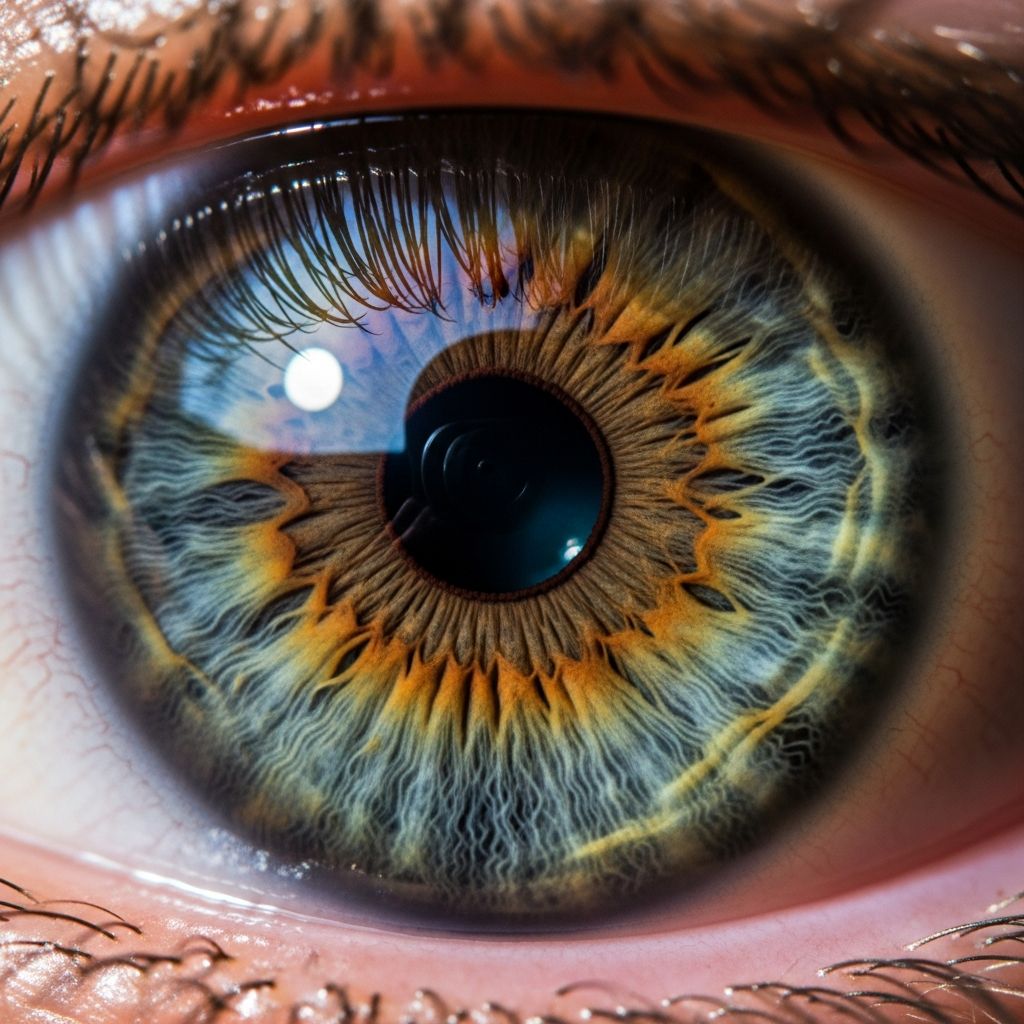
The iris is the bright, colorful circle you see when you look into someone’s eyes. More than just a pretty ring of color, it works like a tiny, automatic door that controls how much light goes into your eye so you can see clearly in bright sunshine and in dim light.
Getting to Know the Iris
The iris is the colored part of the eye that surrounds the dark center opening called the pupil. It sits behind the clear front window of the eye (the cornea) and in front of the lens. Even though it looks flat and simple, it is made of special muscles, blood vessels, and pigment cells that all work together.
- Shape: Usually a flat, round ring with a hole in the middle (the pupil).
- Location: Behind the cornea and in front of the lens.
- Main job: Adjusts pupil size to control how much light enters the eye.
- Bonus job: Gives your eyes their color.
Where the Iris Sits Inside the Eye
To understand the iris, it helps to see where it fits in the eye’s “team.” Your eyeball has several layers, almost like an onion, and the iris is one of the front layers.
| Eye Part | Where It Is | What It Does |
|---|---|---|
| Cornea | Clear dome on the very front of the eye | Bends (refracts) light and protects the eye. |
| Iris | Behind the cornea, in front of the lens | Controls how much light enters by changing pupil size. |
| Pupil | Opening at the center of the iris | Lets light pass deeper into the eye. |
| Lens | Behind the iris and pupil | Focuses light onto the retina so you can see clearly. |
| Retina | Inner lining at the back of the eye | Turns light into signals that travel to your brain. |
The iris sits in the middle of this pathway. Light must pass through the cornea, iris opening (pupil), and lens before reaching the retina.
How the Iris Controls Light
The most important job of the iris is to control the amount of light that reaches the back of your eye. It does this by making the pupil bigger or smaller, a bit like a camera adjusting its opening.
The Iris as a Tiny Muscle Machine
Inside the iris are two main sheets of smooth muscle that pull in opposite ways.
- Sphincter muscle: A circular band around the pupil that tightens to make the pupil smaller in bright light.
- Dilator muscle: A set of fibers that pull outward to make the pupil larger in dim light.
These muscles are controlled automatically by your nervous system. You do not need to think about it. When the light changes, your brain and eyes respond within seconds.
What Happens in Bright vs. Dim Light
- In bright light: The iris muscles tighten around the pupil and make it smaller, so less light comes in and your eyes are protected.
- In dim light or darkness: The iris muscles pull the pupil open wider so more light can enter, helping you see better.
This constant adjustment keeps the light level just right for the retina, so you can see details without being dazzled or left in the dark.
Eye Color and the Iris
The iris is also what gives your eyes their color — such as brown, blue, green, hazel, or gray. This color mostly depends on how much melanin, a natural pigment, is stored in cells of the iris and on specific genes you inherit from your parents.
- More melanin: Usually leads to brown or darker eye colors.
- Less melanin: Often leads to blue, green, or lighter eye colors.
Even though many people have brown eyes, the exact pattern and shade of each iris is unique, much like a fingerprint. Tiny lines, dots, and specks of color are arranged differently in every person. That is one reason your eyes look like yours and nobody else’s.
Can Eye Color Change?
For many babies, the iris color can change during the first months or years of life as more melanin is produced. After childhood, eye color usually stays the same, though it may appear a little different depending on lighting or the colors around you.
How the Iris Helps You See Clearly
Good vision depends on just the right amount of light reaching the retina. The iris works together with other eye parts to make that happen.
- The cornea bends incoming light and helps focus it.
- The iris adjusts the pupil size to set how much light can enter.
- The lens fine-tunes focus so the picture is sharp on the retina.
- The retina senses light and sends messages through the optic nerve to the brain, where the image is formed.
When you move from a dark room into bright sunlight, you may notice a brief moment where things seem too bright. That is your irises shrinking the pupils down to a safer size. When you go from bright outside light into a dim room, it might feel hard to see; your irises are slowly opening the pupils wider so you can adjust.
Everyday Ways You Can See Your Iris Working
You can observe your iris in action with simple, safe activities:
- Stand in front of a mirror in a room with dim light, then turn on a brighter lamp. Watch how the dark center spot (the pupil) becomes smaller within seconds.
- Walk from the bright outdoors into a darker hallway. Notice how it takes a moment before you can see clearly — that is your pupils widening under the control of your iris.
- Take a close look at a friend’s eyes (without shining lights directly into them). You can see the colorful iris ring and the dark pupil in the center.
Always be careful not to shine bright flashlights directly into someone’s eyes and do not stare at the sun. Strong light can damage eye structures.
When the Iris Needs Help
Like any body part, the iris can sometimes have problems or be affected by disease or injury. If the iris cannot control the pupil correctly, it may be harder for the eye to handle bright or dim light comfortably.
Eye doctors use careful eye exams and special instruments to look closely at the iris, pupil, and other parts of the eye. If you ever have pain, very red eyes, bad light sensitivity, or changes in how your eyes look, it is important to tell an adult and see an eye care professional.
Keeping Your Iris and Eyes Healthy
Most of the time, you do not have to think about your iris at all — it simply works. You can, however, protect it and the rest of your eye by taking basic eye-care steps.
- Wear sunglasses that block strong sunlight when you are outdoors, especially near water, snow, or sand.
- Use protective eyewear for sports or activities where something might hit your eye.
- Avoid rubbing your eyes hard, especially if they feel itchy or irritated.
- Tell an adult if your eyes hurt, feel very sensitive to light, or you notice changes in eye color or pupil shape.
- Get regular eye checkups if your doctor recommends them, so eye issues can be found early.
Fun Facts About the Iris
- Your two irises may not be exactly the same color. Some people naturally have slightly different shades in each eye.
- The tiny patterns on your iris are formed before you are born and stay with you throughout life.
- In bright light, your pupils can become much smaller than in darkness; the iris is constantly adjusting them through the day.
Frequently Asked Questions About the Iris
Is the iris the same thing as the pupil?
No. The iris is the colored ring of tissue, while the pupil is the dark opening in the middle of the iris that lets light into the eye.
Why do pupils change size?
Pupils change size because the iris muscles tighten or relax. In bright light, the iris makes the pupil smaller to protect the eye; in dim light, it makes the pupil larger so more light can enter.
What decides my eye color?
Your eye color mainly depends on how much melanin is in your iris and on genes passed down from your biological parents. More melanin usually means darker eye colors.
Does the iris help me focus on things?
The iris does not focus images itself. Instead, it sets how much light reaches the lens and retina. The cornea and lens do most of the focusing work, but they depend on the iris to keep light levels comfortable.
Can I change my eye color naturally?
No. Your natural eye color comes from melanin and genes, and it usually stays the same after early childhood. Colored contact lenses can change how your eyes look, but they must be prescribed and fitted by an eye professional to be safe.
Why do my eyes hurt in bright sunlight sometimes?
If there is sudden or very strong light, your iris needs a moment to shrink the pupil. During that time, you may feel discomfort or squint. Sunglasses and caps with brims can help protect your eyes while your iris adjusts.
References
- Iris | Eye, Structure, Anatomy, & Function — Encyclopaedia Britannica. 2025-10-13. https://www.britannica.com/science/iris-eye
- Iris of the Eye: Definition, Anatomy & Function — Cleveland Clinic. 2022-09-08. https://my.clevelandclinic.org/health/body/22502-iris
- Eye anatomy and function — AboutKidsHealth (The Hospital for Sick Children). 2021-04-01. https://www.aboutkidshealth.ca/eye-anatomy-and-function
- About the Eye (for Kids) — National Eye Institute. 2023-05-10. https://www.nei.nih.gov/learn-about-eye-health/nei-for-kids/about-eye
- Anatomy of the Eye — American Association for Pediatric Ophthalmology and Strabismus (AAPOS). 2020-06-15. https://www.aapos.org/glossary/anatomy-of-the-eye
- Anatomy of the Eye — Children’s Wisconsin. 2019-11-20. https://childrenswi.org/find-care/eye-program/anatomy-of-the-eye