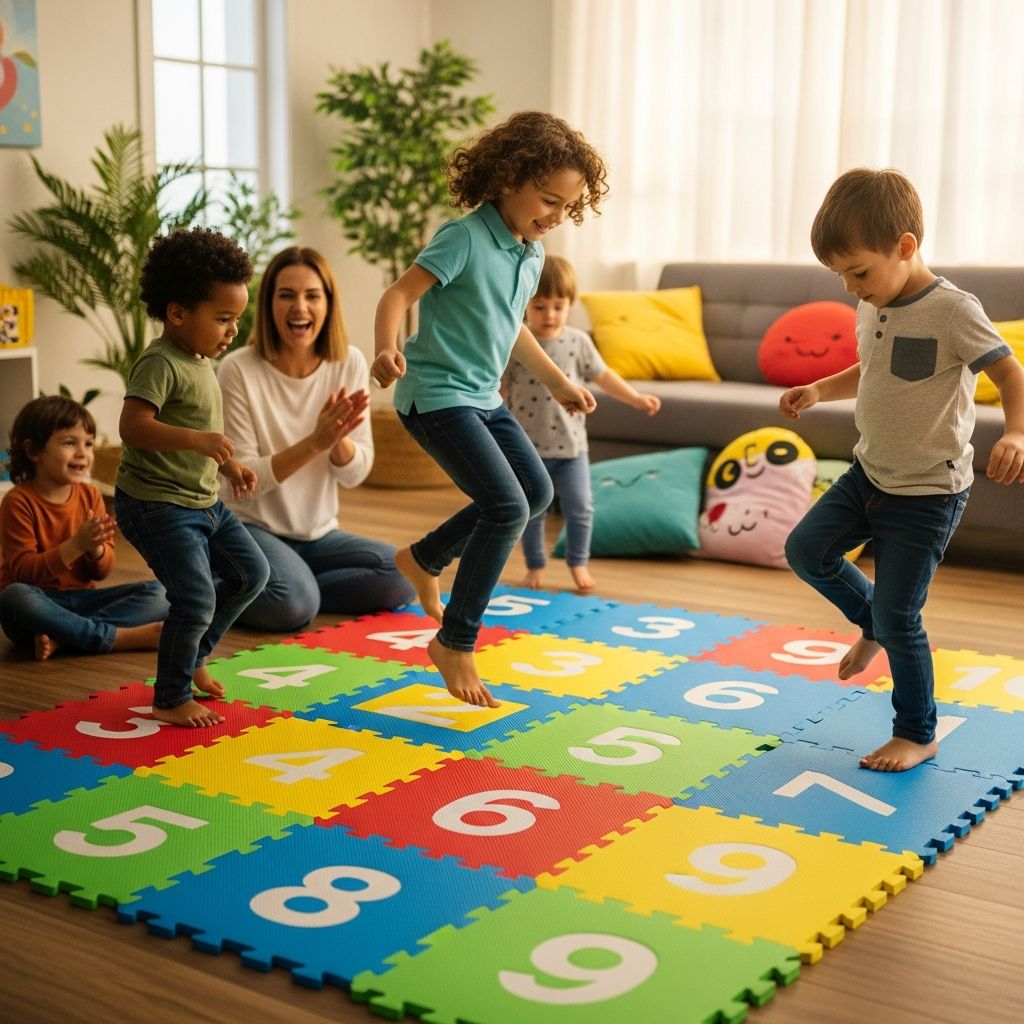
Indoor hopscotch is an easy way to turn an ordinary floor into a playful path of numbers, shapes, and laughter. With a roll of tape and a few household items, you can create a game that keeps kids moving, learning, and entertained, even when outdoor play is not an option.
This guide walks you through how to set up an indoor hopscotch course, adapt it for different ages, and add creative twists that support physical, cognitive, and social development.
Why Hopscotch Works So Well Indoors
Hopscotch might look like a simple jumping game, but it offers a rich mix of movement and problem-solving that benefits growing bodies and brains.
- Physical skills – Jumping, balancing, and landing help build coordination, strength, and balance, all of which support motor development in young children.
- Brain and learning – Remembering patterns, following rules, and planning the next move support executive function and attention.
- Social and emotional growth – Taking turns, coping with mistakes, and cheering for others build resilience and cooperation.
- Indoor-friendly energy outlet – Short bursts of jumping and movement help children regulate energy and improve focus later in the day.
Because you can scale the difficulty up or down, hopscotch works for toddlers, preschoolers, and big kids, and can even turn into a light workout for adults.
What You Need to Get Started
You do not need special equipment to create a hopscotch path indoors. Most families can gather the basics in a few minutes.
- Safe floor space – Hallways, living rooms, or open kitchen areas with hard floors work best.
- Low-tack tape – Painter’s tape or masking tape is gentle on most floors and easy to remove.
- Marker objects – Small, soft items such as a beanbag, rolled-up sock, sponge, or soft toy are safer than hard objects.
- Numbers or symbols – You can write directly on the tape, use sticky notes, or place paper cards in each square.
- Optional extras – Foam mats, colored paper, or sticky dots for added color and texture.
Designing Your Indoor Hopscotch Layout
There is no single “right” shape for hopscotch. Indoors, you can customize the layout to fit your space and your child’s ability.
Basic Number Path
For a classic feel, create a straight path with single and double spaces.
- Lay out single squares for one-foot hops.
- Add side-by-side squares for two-foot jumps.
- Label each square with numbers (for example, 1 through 8) to help practice counting and number recognition.
Creative Shapes for Small Spaces
If you have a narrow hallway or a small living room, use more compact designs.
- Zigzag path – Slightly angle each square so kids turn their bodies as they hop.
- Shape trail – Alternate between circles, squares, and triangles made with tape.
- Loop layout – Arrange squares in an oval so players end where they started.
Sample Layout Comparison
| Layout Type | Best For | Space Needed | Movement Focus |
|---|---|---|---|
| Straight Number Line | Preschool & early elementary | Medium to long hallway | Balance, forward jumps |
| Zigzag Path | Older preschool & big kids | Moderate, flexible | Direction changes, core strength |
| Loop or Oval | Mixed ages & group play | Open living room | Endurance, continuous motion |
Step-by-Step: How to Play Indoor Hopscotch
Once the course is down, explain the rules in simple steps. Adjust the number of rules for your child’s age and attention span.
Core Gameplay Rules
- Stand at the start behind the first square.
- Toss the marker into a square. If it lands on a line or outside the path, the turn ends.
- Hop the course on one foot for single squares and on two feet when squares are side by side.
- Skip the marker square as you hop through. Players must avoid stepping on the square with the object.
- Turn at the far end and come back through the path, again skipping the marker square.
- Pick up the marker when you reach the square just before it, keeping your balance.
- Finish at the start line to complete the turn.
For younger children, you may want to start without the tossed marker and simply practice hopping through the pattern.
Gentle Adaptations for Toddlers
- Let them walk instead of hop between squares.
- Use bigger, wider squares for easier landings.
- Focus on naming colors, shapes, or numbers instead of strict rules.
Educational Twists: Learning While You Hop
With a few small changes, indoor hopscotch can become an engaging way to practice early academic skills. Movement-based learning has been linked to improved attention, memory, and classroom readiness in young children.
Number and Counting Games
- Count out loud as children land on each square.
- Ask players to hop to a certain number you call out instead of going in order.
- Use simple math: “Start on 2 and jump to 2 more. Where did you land?”
Letters and Sounds Path
- Write letters instead of numbers in each square.
- Have kids say the letter name or its sound when they land.
- Challenge older kids to spell short words by hopping letter to letter.
Vocabulary and Categories
- Assign each square a category such as animals, foods, or places.
- When kids land, they must name an example from that category.
- Increase difficulty by avoiding repeats or using more specific categories, like “ocean animals” or “green vegetables.”
Fun Variations for Every Mood
Once kids understand the basic rules, you can keep the game fresh with new challenges.
Speed and Challenge Modes
- Beat the clock – Use a timer and see if players can complete a round before time runs out.
- Backward hops – Ask kids to move through the path in reverse, carefully looking over their shoulders.
- One-leg challenge – For older kids, see if they can complete the course using only one chosen leg.
Movement Mix-Up
- Action squares – Add a quick instruction on certain squares: clap, spin, reach up high, or touch the floor.
- Animal hops – Assign each square a movement like frog jumps, bunny hops, or tiptoeing like a cat.
- Balance pause – Mark a few squares as “freeze spots” where kids must hold a pose for three seconds.
Cooperative and Group Play
- Team relay – Create two identical paths and let teams take turns completing one lap each.
- Designers and players – One child builds a new path with tape while another tests it out, then switch roles.
- Story hopscotch – As kids move along the path, they add one sentence to a shared story when they land on a marked square.
Safety Tips for Indoor Hopping
With a bit of planning, indoor hopscotch can stay both fun and safe.
- Clear the area – Move chairs, toys, and small tables out of the hopping zone.
- Check the floor – Avoid slippery surfaces; socks with grips or bare feet are often safer than smooth socks.
- Use gentle tape – Painter’s tape is less likely to leave residue or damage some floor finishes than stronger tapes.
- Match difficulty to age – Reduce the number of squares or remove the tossed marker rule for very young children to minimize falls.
- Supervise early attempts – Stay close when toddlers and preschoolers are learning to hop and balance.
Making Hopscotch Part of Your Routine
Because it requires almost no setup once the pattern is taped down, hopscotch is easy to weave into daily life.
- Morning energy reset – A quick game before school can help kids wake up their bodies and brains.
- Rainy day fallback – Keep a roll of tape handy and create a path whenever outdoor play is not possible.
- Study breaks – Short bursts of movement between homework tasks can improve concentration and mood.
- Family challenge nights – Invite everyone to create one new rule or variation and test them together.
Frequently Asked Questions (FAQs)
What age can children start playing indoor hopscotch?
Many toddlers enjoy walking along a taped path by age two or three, while most preschoolers can try simple hopping. Older children can handle the full rules, including tossing a marker and balancing on one foot.
How long should a hopscotch course be indoors?
For small spaces, 6–8 squares are enough. In larger rooms or hallways, you might create 10–12 spaces. The priority is having enough room for safe landings and turns, not a specific number of squares.
Can hopscotch help with school readiness?
Yes. Hopscotch can support number recognition, counting, letter knowledge, self-control, and turn-taking, all of which are part of broader school readiness skills.
What if I do not have tape that is safe for my floors?
You can use foam play mats, folded towels, or sheets of paper as movable “stepping stones.” Arrange them on the floor to create the path and remove them when playtime is over.
How can I keep the game interesting over time?
Invite your child to redesign the layout, change the symbols in the squares, or invent new rules. Giving kids creative control keeps the game fresh and strengthens their planning and problem-solving skills.
References
- Physical Activity Guidelines for School-Aged Children and Adolescents — U.S. Department of Health and Human Services. 2018-11-01. https://health.gov/sites/default/files/2019-09/Physical_Activity_Guidelines_2nd_edition.pdf
- How to Play Hopscotch: Rules, Variations, and Fun Benefits — Milwaukee With Kids. 2025-01-10. https://www.mkewithkids.com/post/how-to-play-old-school-hopscotch-it-s-not-the-way-you-think/
- Indoor Hopscotch — Playworks Game Library. 2016-05-12. https://www.playworks.org/game-library/indoor-hopscotch/
- How to Play Hopscotch: With Fun Variations for All Ages — Childhood 101. 2022-03-15. https://childhood101.com/how-to-play-hopscotch/