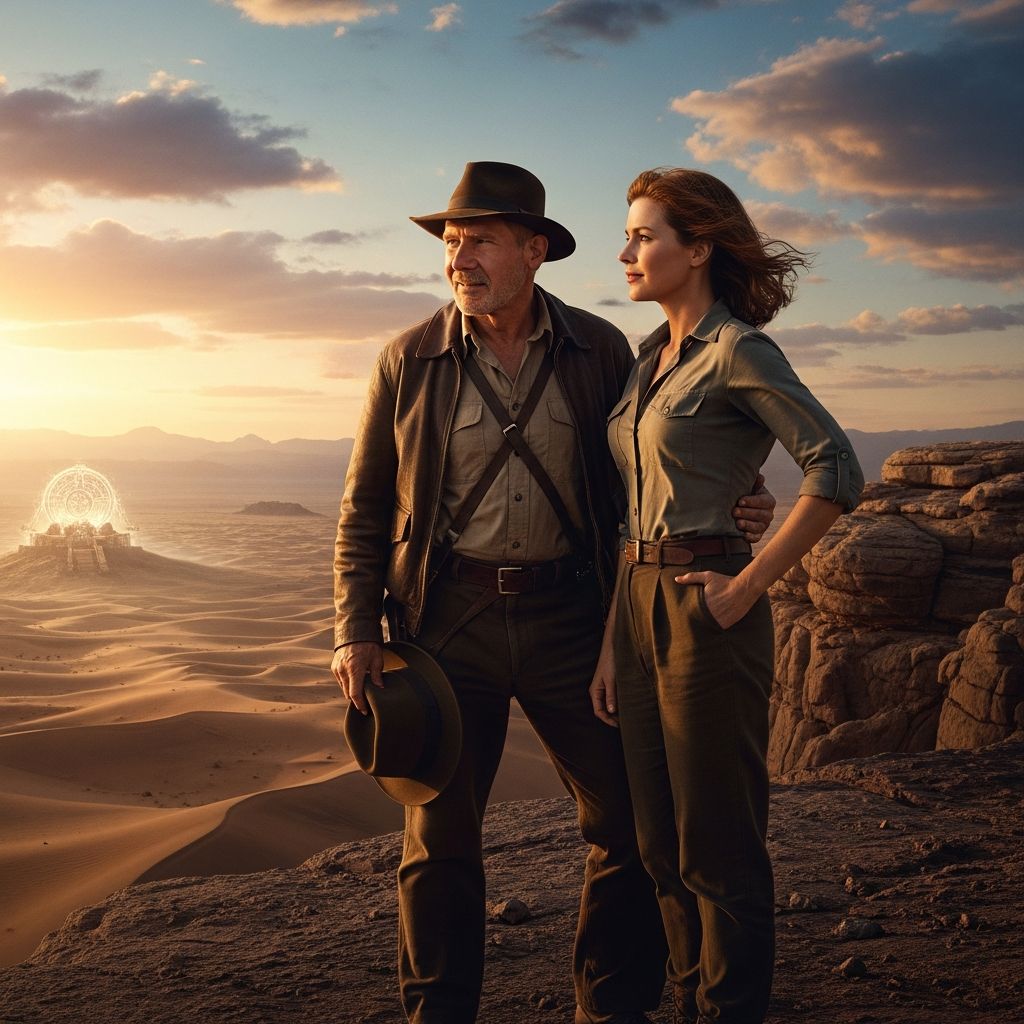
“Indiana Jones and the Dial of Destiny” closes not just a single adventure, but an entire film legacy that began in 1981. Instead of ending with Indy riding off into the sunset alone, the film circles back to something smaller, more intimate, and unexpectedly emotional: a wounded archaeologist in his New York apartment, reunited with Marion Ravenwood and forced to finally face his grief.
This article unpacks how the ending works, why Marion’s return matters, and how the film reframes Indiana Jones’ story as one about aging, regret, and the impossibility of rewriting the past.
The Road to the Finale: An Aging Hero and a Broken Marriage
By the time the story reaches its final scenes, Indiana Jones is not the swashbuckling professor audiences first met in “Raiders of the Lost Ark.” He is older, exhausted, and emotionally hollowed out. Official materials and interviews around the film emphasize that “Dial of Destiny” is consciously set in the late 1960s to foreground questions of aging, cultural change, and the end of old heroic myths.
Indy’s Life Before the Last Adventure
Early in the film, we learn that much has changed since “Kingdom of the Crystal Skull”:
- Mutt Williams (Henry “Mutt” Jones III) has died, killed in action after enlisting to fight in the Vietnam War, a historically accurate backdrop for American casualties that deeply scarred many families of the era.
- Indy and Marion have separated, unable to survive the shared trauma of losing their son. The film suggests that Indy retreated into work and bitterness instead of helping Marion carry the grief.
- Indy’s career is fading; the students no longer idolize him, his lectures feel out of step with the times, and he is on the verge of retirement he did not ask for.
The adventure with the Antikythera device—loosely inspired by the real ancient mechanical calculator discovered in a shipwreck off the Greek island of Antikythera—gives Indy purpose again. But the key emotional arc is not about scientific discovery; it is about whether he can find a reason to live in the present instead of hiding in the past.
The Time-Fissure Climax: Temptation to Stay Behind
The film’s big genre swing is its time-travel climax. Using the completed Dial, the villain Jürgen Voller attempts to navigate a temporal fissure and alter World War II. Instead, miscalculations send the plane back to the Siege of Syracuse in 212 BC, a historical battle between Roman and Greek forces in which Archimedes himself plays a role.
Indy’s Choice in Ancient Syracuse
On the battlefield, Indy is badly wounded and confronted with a seductive idea: staying in the past. Here, the script taps into something deeply human and psychologically recognizable—after shattering loss, people often idealize earlier eras or obsess over “if only” scenarios instead of accepting what cannot be changed, a tendency that clinical psychology has linked to complicated grief and prolonged mourning.
In Syracuse, Indy:
- Meets Archimedes and sees tangible proof that his life’s work as an archaeologist was not in vain.
- Stands inside history, in a time period he has spent his life studying from afar.
- Feels he has nothing to return to: no son, no marriage, no meaningful place in late-1960s America.
When he tells Helena he wants to stay, it is less a romantic fantasy than a kind of slow-motion suicide. Remaining in the past would mean abandoning the people who still care about him and refusing to do the hard work of grieving honestly.
Helena’s Intervention
Helena Shaw recognizes that Indy’s desire to remain is not noble sacrifice but escape. She bluntly refuses to let him make that choice and knocks him out, forcing his return to his proper time. Dramatically, this does three things at once:
- It reasserts the series’ long-running theme that no artifact, no matter how wondrous, is worth a human soul.
- It inverts the old dynamic where Indy saves the younger sidekick; here, the younger generation drags an older hero back to life.
- It prevents the film from using time travel as emotional wish fulfillment, insisting instead on a bittersweet realism.
Back in New York: A Smaller, More Human Ending
After the grand, fiery spectacle over ancient waters, the epilogue relocates to something disarmingly ordinary: Indy’s modest New York apartment. This quiet change in scale is deliberate. Rather than a giant crowd scene or an academic triumph, the film’s closing movement is about one broken relationship in a small kitchen.
Who’s in the Room at the End?
When Indy wakes up back in his own time, Helena and her young accomplice Teddy are present, along with Sallah and his family. They are the closest thing Indy has to a chosen family. The reunion underlines that, despite his isolation, he has not been entirely abandoned.
Yet the most important arrival is still to come: Marion.
Marion Ravenwood’s Return: Why It Matters
Marion Ravenwood, introduced in “Raiders of the Lost Ark” as a tough, independent bar owner who could drink mercenaries under the table, has long been one of the franchise’s most beloved characters. Over the decades, critics and scholars have argued that she stands out among 1980s adventure heroines as unusually capable, assertive, and emotionally complex.
The Off-Screen Collapse of Their Marriage
“Dial of Destiny” reveals that the death of their son shattered Marion and Indy’s marriage. According to the film’s backstory, Indy could not face his own grief or help Marion carry hers, and she eventually asked for a separation.
This choice aligns with real-world research on bereavement, which shows that the death of a child is one of the most severe stressors a couple can face, often straining communication and increasing the risk of relationship breakdown if partners grieve in isolation instead of together.
The Kitchen Scene and the Callback to Raiders
When Marion appears in the apartment, the film does something quietly daring: it revisits a specific emotional beat from “Raiders of the Lost Ark” without merely repeating it. Years earlier, Marion and Indy shared a tender, slightly playful moment where she tended to his wounds and asked where it hurt—a rare pause in all the chaos that revealed the depth of their connection.
In “Dial of Destiny,” a similar exchange unfolds, but under the weight of everything they have lost. The gestures and lines are echoed with subtle differences, transforming nostalgia into emotional commentary. The callback works on multiple levels:
- For longtime viewers, it activates decades of memory and affection for these characters.
- For the story, it dramatizes that Marion and Indy still speak a shared emotional language, even after separation.
- For Indy himself, it marks the first time we truly see him own his grief aloud, acknowledging what Mutt’s death did to him and to Marion.
Thematic Table: Then vs. Now
| Element | Raiders of the Lost Ark | Dial of Destiny Ending |
|---|---|---|
| Indiana’s Physical State | Younger, cocky, bouncing back from injury | Older, visibly frail, healing slowly |
| Marion’s Role | Fiery partner and love interest, asserting equality | Estranged spouse, returning as a co-griever and healer |
| Tone of Their Intimacy | Playful, flirtatious, full of possibility | Soft, aching, grounded in shared history and loss |
| What the Scene Says About the Future | Adventure and romance lie ahead, undefined | No new globe-trotting promised, but a chance at emotional repair |
Can the Past Be Fixed? What the Dial Really Represents
The Antikythera device is presented as a fantastical extension of a real ancient artifact, but thematically it is less about physics and more about regret.
Two Ways to Use Time
- Voller wants to weaponize time, rewriting history to change the outcome of World War II and install a different future.
- Indy is tempted to retreat into time, using the past as a sanctuary from unbearable present pain.
Both are ultimately rejected. The time fissure does not lead where Voller expects, and Helena prevents Indy from staying. The universe of “Indiana Jones” remains morally consistent: people cannot be trusted with reality-altering power, and any tool that appears to offer an escape from consequences will be neutralized or lost
In that sense, the Dial of Destiny functions like the Ark of the Covenant, the Sankara Stones, the Holy Grail, and the crystal skull: a mirror that exposes what characters most desire and whether they are willing to let go of it when the cost is too high.
Why Bring Marion Back at All?
From a purely nostalgic angle, reintroducing Marion in the final minutes is a crowd-pleasing move. But narratively, it has a sharper purpose: to deny Indy an easy, solitary legend ending. Instead of dying heroically in the past, he must live with his pain and attempt reconciliation in the present.
Emotional and Story Payoff
Marion’s appearance accomplishes several things:
- Closes a decades-long character arc: The half-century of starts and stops between them finally yields a scene of honest mutual recognition.
- Confirms Helena’s unseen efforts: She clearly contacted Marion off-screen, proving that Helena cares about Indy as a person, not just as a legendary figure to exploit.
- Humanizes the franchise’s farewell: Instead of a museum ceremony or an academic honor, the last image of Indy’s saga is a private, domestic moment.
Helena, Teddy, and the Future Without More Sequels
Some viewers speculated that Helena or Teddy might be soft-launch replacements for Indy, but the ending avoids overt franchise handoff. There is no explicit promise of “Helena Shaw and the Something of Something.” Instead, the film hints that life continues for these younger characters while allowing Indy to rest.
Helena’s role in the ending is especially important:
- She refuses to romanticize Indy’s self-destruction, calling him out and physically preventing him from staying in the past.
- She acts as a bridge between Indy and Marion, doing what he cannot yet do: reach out and ask for help.
- She embodies a more skeptical, 1960s-flavored view of heroism, interrogating the myth of Indiana Jones while still clearly loving the man himself.
Legacy and Final Image
The last shot of the film (before the credits roll fully) lingers on Indy’s hat, a symbol that has defined him as much as the whip or the fedora silhouette on a movie poster. The implication is that, while the world will always know Indiana Jones as the great adventuring archaeologist, the man beneath the hat still has private, unfinished chapters.
By ending with reconciliation rather than spectacle, “Dial of Destiny” suggests that the bravest thing this particular hero can do at the end of his life is not to cheat time or fight Nazis in another century, but to sit with someone he hurt, admit his failings, and try again.
Frequently Asked Questions (FAQs)
Q: Why did Indiana Jones want to stay in the past in Dial of Destiny?
Indy’s desire to remain in ancient Syracuse is driven by despair, not pure academic curiosity. With his son dead and his marriage in ruins, the past looks like an escape from pain and from a present where he feels obsolete. The film frames this as a dangerously seductive form of giving up, which Helena refuses to allow.
Q: How did Mutt Williams die and how does it affect the story?
Within the film’s backstory, Mutt enlisted to fight in the Vietnam War and was killed in action. This off-screen tragedy is the emotional engine of the plot: it fractures Indy and Marion’s marriage, fuels Indy’s sense of meaninglessness, and gives real weight to his temptation to abandon his own era.
Q: Why is Marion’s return at the end so important?
Marion’s reappearance transforms the ending from a tale about time travel into a story about emotional repair. She embodies Indy’s unresolved past—not just old romance, but shared grief. Their final scene echoes a moment from Raiders of the Lost Ark while showing how much both characters have aged, hurt, and grown.
Q: Does the ending set up a new Indiana Jones-style series with Helena?
The film leaves Helena alive, active, and clearly capable, but it stops short of announcing a direct continuation. Instead, it treats her as the person who drags an old hero back to life and ensures he does not die in the past. Any future adventures she might have are left to the audience’s imagination.
Q: What does the Dial of Destiny symbolize in the larger Indiana Jones saga?
Like the Ark, the Grail, and other artifacts, the Dial represents the danger of trying to control forces beyond human responsibility. In this story, it is specifically a metaphor for the fantasy of rewriting history. The ending insists that healing comes not from changing the past but from facing it and choosing how to live with its consequences.
References
- Marion Ravenwood — Wikipedia Contributors. 2024-08-25. https://en.wikipedia.org/wiki/Marion_Ravenwood
- Nobody Did It Better Than This Indy Girl — Collider / Rachel Leishman. 2021-06-12. https://collider.com/indiana-jones-raiders-of-the-lost-ark-karen-allen/
- The Antikythera Mechanism: The First Mechanical Computer — National Museum of American History, Smithsonian Institution. 2011-06-30. https://americanhistory.si.edu/collections/search/object/nmah_690508
- Bereavement and Grief: The Role of Social Support — Center for Disease Control and Prevention (CDC). 2023-04-10. https://www.cdc.gov/mentalhealth/learn/grief/index.htm
- Marion Ravenwood, the Unsung Hero of “Raiders of the Lost Ark” — Incluvie / Gabrielle Aikins. 2021-07-28. https://www.incluvie.com/articles/marion-ravenwood-the-unsung-hero-of-raiders-of-the-lost-ark
- Feminist Film Icons: Marion Ravenwood — Nerds That Geek / John Bernardy. 2016-03-08. https://nerdsthatgeek.com/film/feminist-film-icons-marion-ravenwood