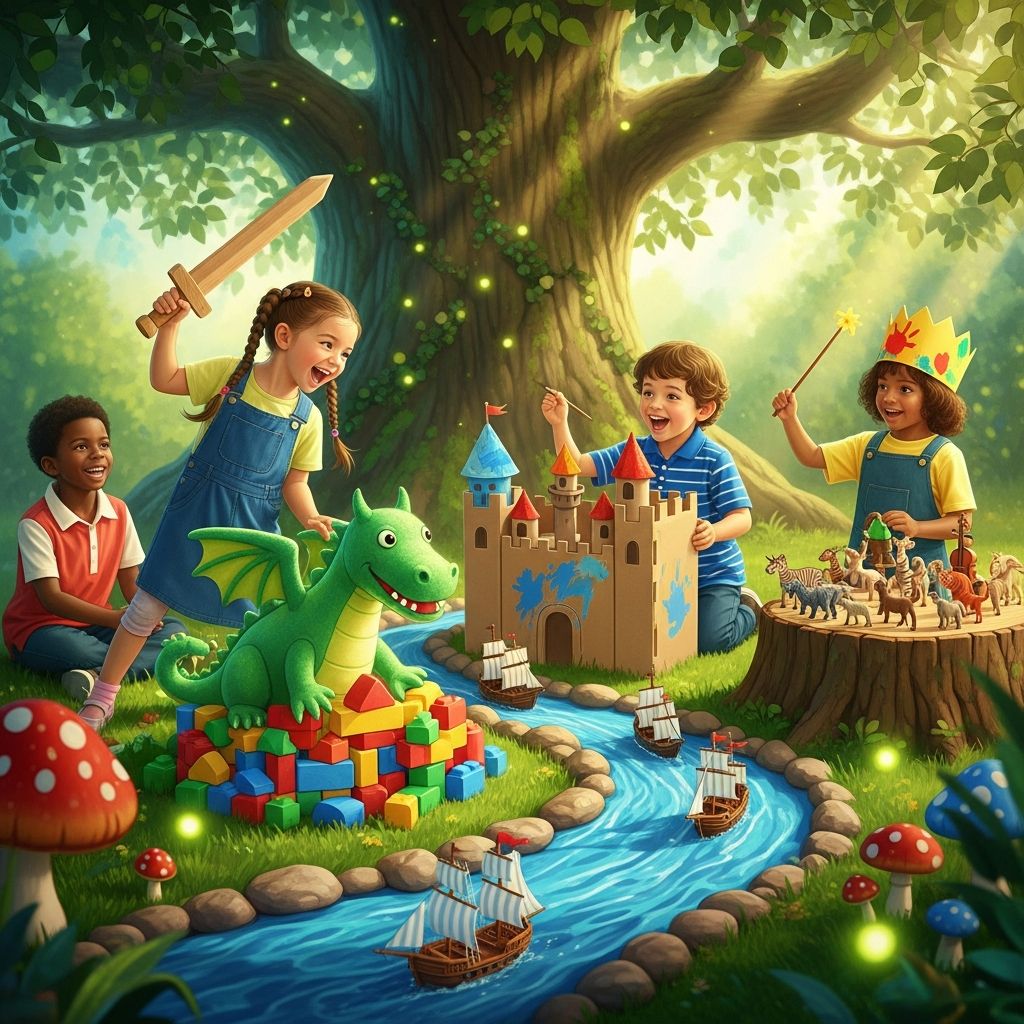
Imaginative play, often seen as simple child’s fun, serves as a cornerstone for comprehensive growth in young minds. Children transform everyday objects into tools for adventure, stepping into roles that mirror real life or fantastical worlds. This type of unstructured activity builds essential skills across multiple domains, from brainpower to social savvy.
Boosting Brainpower: Cognitive Gains from Make-Believe
One of the standout advantages of imaginative play lies in its power to sharpen cognitive functions. When kids invent scenarios—like running a pretend shop or exploring outer space—they engage higher-order thinking. They plan sequences, organize props, and make snap decisions, all while flexing executive function skills vital for school and beyond.
Research highlights how this play enhances problem-solving. A child figuring out how to ‘fix’ a toy car or negotiate a storyline twist practices logical reasoning in a low-stakes environment. It also introduces symbolic thinking, where a stick becomes a sword, laying groundwork for abstract concepts in math and science.
- Planning elaborate play setups strengthens memory and sequencing abilities.
- Improvising during play hones adaptability and creative ideation.
- Integrating real-world elements, like counting play money, embeds early numeracy.
These cognitive boosts extend long-term. Studies link early pretend activities to improved executive function and perspective-taking, skills that persist into later childhood and support academic readiness.
Building Social Bridges: Fostering Connections and Empathy
Imaginative play shines in developing social competencies. Group scenarios require kids to collaborate, share ideas, and resolve conflicts—key for building friendships. Taking on roles like teacher or firefighter teaches perspective-switching, nurturing empathy as children ‘feel’ others’ viewpoints.
In playgroups, negotiation naturally arises: “You be the chef, I’ll be the customer.” This mirrors adult teamwork, teaching turn-taking and compromise. Such interactions cultivate emotional intelligence, helping kids read cues and manage group dynamics.
| Play Scenario | Social Skill Developed | Real-Life Application |
|---|---|---|
| Superhero team-up | Teamwork and leadership | Group projects at school |
| Family role-play | Empathy and role understanding | Family interactions |
| Store keeper game | Negotiation and communication | Peer conflicts resolution |
These experiences create resilient socializers, equipped to navigate diverse relationships with confidence.
Emotional Mastery: Processing Feelings Through Fantasy
Pretend play acts as a safe outlet for emotional exploration. Children rehearse challenging situations—like a doctor’s visit or welcoming a new baby—gaining control over fears. This ‘practice’ builds resilience, allowing them to express complex feelings without real-world consequences.
By embodying characters, kids discover their identities, preferences, and boundaries. A shy child playing a bold explorer might uncover inner strengths, boosting self-esteem. Play also helps process transitions, such as parental separation, through symbolic reenactments that foster coping strategies.
- Role-playing scary events reduces anxiety by familiarizing outcomes.
- Expressing joy or frustration in play enhances emotional vocabulary.
- Navigating play conflicts teaches self-regulation techniques.
Language Explosion: Words Come Alive in Play
Imaginative sessions supercharge verbal skills. Kids narrate stories, mimic adult phrases, and invent dialogue, expanding vocabulary and grammar intuitively. Hearing parents echo their words reinforces language power, bridging spoken to written forms—a precursor to reading.
Symbolic substitutions, like using a banana as a phone, advance cognitive-linguistic links. Group play demands clear communication, refining articulation and listening. Over time, this play correlates with advanced language milestones, from first words to complex sentences.
Body in Motion: Physical Perks of Active Imagination
Beyond mental gains, pretend play promotes physical health. Chasing ‘monsters,’ dancing at imaginary balls, or crafting props engages gross and fine motor skills. These movements build coordination, balance, and strength essential for sports and daily tasks.
Hand-eye precision sharpens during activities like buttoning dress-up clothes or stacking blocks as towers. Bilateral coordination improves through cross-body actions, like reaching across in pretend sword fights. Active play counters sedentary habits, supporting overall fitness.
Practical Strategies: Sparking Imaginative Play at Home
Parents can ignite creativity with minimal setup. Provide open-ended props: boxes for forts, scarves for capes, or kitchen items for shops. Follow the child’s lead, joining without directing to preserve autonomy.
Link play to daily life—recreate park visits or grocery runs. Rotate toys to sustain novelty, and designate a ‘play zone’ free from screens. Praise process over product: “What a clever castle!” encourages persistence.
- Gather recyclables for building adventures.
- Set up themed corners like a vet clinic.
- Extend outings into play reenactments.
- Limit interventions to let imagination flourish.
For varying ages, adapt: Toddlers enjoy solo object substitution; preschoolers thrive in peer ensembles.
Long-Term Impacts: Play’s Lasting Legacy
The ripples of early imaginative play endure. It primes neural pathways for focused learning, refining psychological tools like self-control and innovation. Children with robust play histories show superior adaptability, creativity, and interpersonal prowess into adulthood.
In an era of structured schedules, prioritizing unstructured play is crucial. It equips kids not just to succeed, but to thrive innovatively in a complex world.
Frequently Asked Questions About Imaginative Play
What age do children start imaginative play?
Typically around 18-24 months, with simple actions like feeding a doll, evolving to complex stories by age 3-5.
Is solo pretend play as beneficial as group play?
Yes, solo play builds independence and self-awareness, while group enhances social skills—both are vital.
How much daily play is ideal?
Aim for 1-2 hours of unstructured play, balancing with rest and routines for optimal development.
What if my child prefers screens over play?
Gently introduce props tied to their interests, model play, and set screen limits to redirect energy.
Can imaginative play help with behavioral issues?
Often yes, by providing outlets for emotions and practicing responses, reducing real-life outbursts.
References
- Pretend Play: Ways Children Can Exercise Their Imagination — American Academy of Pediatrics HealthyChildren.org. 2023-10-01. https://www.healthychildren.org/English/family-life/power-of-play/Pages/pretend-play-ways-children-can-exercise-their-imagination.aspx
- Why is Pretend Play Important? — Bright Horizons. 2024-05-15. https://www.brighthorizons.com/article/parenting/why-is-pretend-play-important
- Play it Forward: Lasting Effects of Pretend Play in Early Childhood — Florida Atlantic University News. 2023-11-20. https://www.fau.edu/newsdesk/articles/pretend-play-early-childhood
- Top Three Benefits of Imaginative Play — KidsPlay Children’s Museum. 2024-02-10. https://kidsplaymuseum.org/top-three-benefits-of-imaginative-play/
- The Physical Benefits of Pretend Play — Maileg USA. 2023-08-05. https://www.mailegusa.com/blogs/press/the-gift-of-pretend-play-physical
- The Importance of Pretend Play — Scholastic Parents. 2024-01-12. https://www.scholastic.com/parents/kids-activities-and-printables/activities-for-kids/arts-and-craft-ideas/importance-pretend-play.html