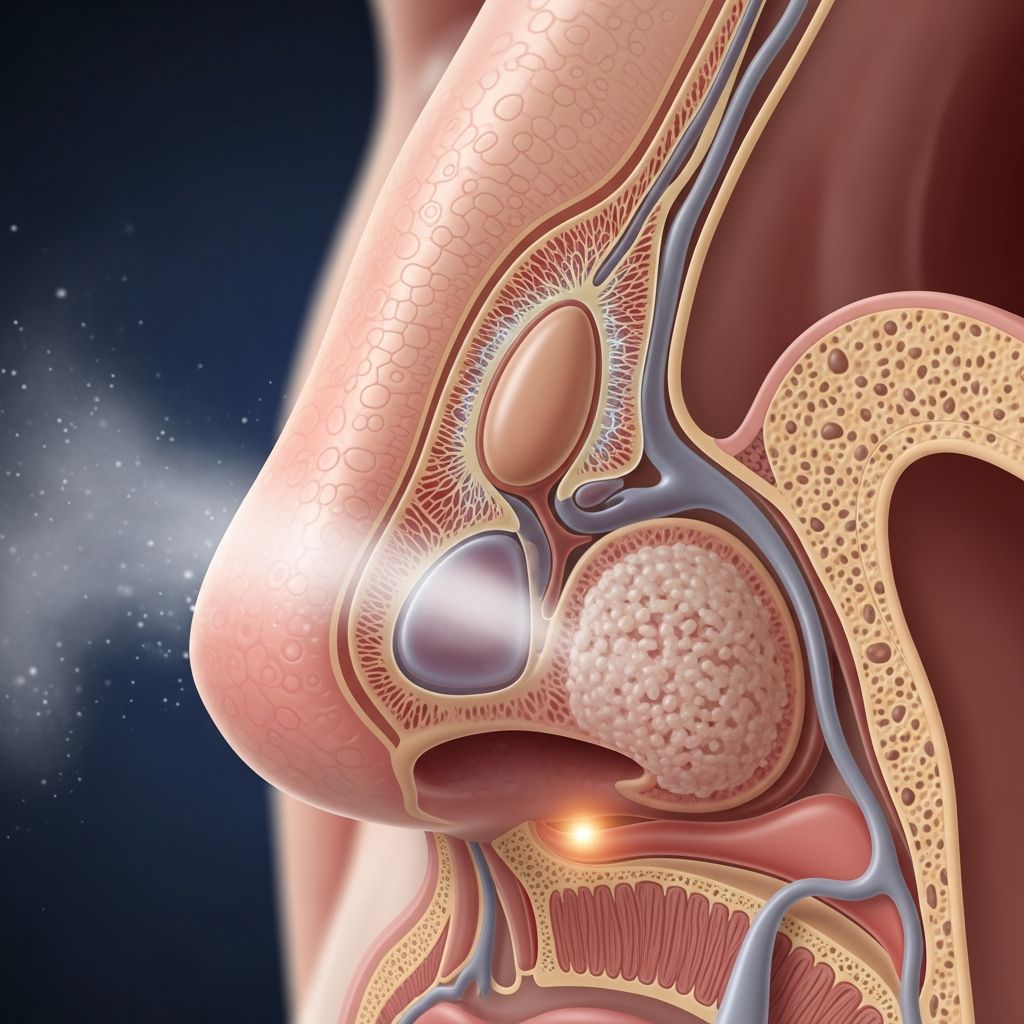
Your nose might look simple on the outside, but inside it is a busy, powerful organ that helps you breathe, smell, speak clearly, and fight germs every moment of the day.
Getting to Know Your Nose From the Outside In
When you look in the mirror, you only see the tip of what your nose can do. Most of the nose is actually hidden inside your head, connected to your throat and lungs.
The outside parts you can see
On the outside, your nose has features that shape your face and guide air inside:
- Nostrils – the two openings where air enters and leaves your nose.
- Nose bridge – the firm upper part made mostly of bone, which helps give your nose shape.
- Cartilage tip and sides – the softer, bendable part that lets your nose flex a little without breaking.
The hidden parts inside your nose
Behind your nostrils lies a hollow space called the nasal cavity that is divided into left and right sides by a wall.
- Nasal septum – the wall of cartilage and bone that separates the two sides of your nose.
- Nasal passages – channels lined with tiny hairs and a moist coating that air flows through.
- Turbinates – curved, shelf-like structures on the sides of the nasal cavity that help swirl and slow the air so it can be warmed and cleaned.
How Your Nose Helps You Breathe
Your nose is the main doorway for air to enter your body. It does important work before that air ever reaches your lungs.
Step-by-step air journey through the nose
- Air enters through the nostrils.
- It passes the small hairs at the front of the nose that trap bigger dust and particles.
- The air moves through the nasal passages, where it is warmed, moistened, and filtered.
- The cleaned air travels back into the throat and then down into the lungs.
How your nose prepares the air
- Warming – Tiny blood vessels in the lining of your nose heat the air so it is close to your body temperature, which helps protect your lungs.
- Moistening – The moist surface and mucus add water to the air so it does not dry out your airways.
- Filtering – Cilia (tiny hairs) and sticky mucus catch dust, pollen, and germs before they reach your lungs.
Meet Mucus, Cilia, and Boogers
The inside of your nose is coated with mucus and lined with tiny hairs called cilia. Together, they act like a cleaning crew for every breath.
What mucus does
- Keeps the inside of your nose moist and comfortable.
- Traps dust, bacteria, and other particles floating in the air.
- Helps warm and humidify the air you breathe.
When mucus dries around trapped particles, it can form the crusts and clumps you know as boogers. Gross, but also proof that your nose is doing its job.
How cilia clean things up
- Cilia are tiny hair-like structures that line the nasal passages and move in waves.
- They slowly push mucus, along with trapped germs and dust, toward the back of your throat.
- You usually swallow this mucus without noticing, and your stomach acid helps break down many of the germs.
Your Sense of Smell: How Your Nose Detects Odors
Your nose is also your main smelling organ. At the very top of your nasal cavity is a small special zone that helps you recognize thousands of different smells.
The smelling zone
- Olfactory region – an area high inside the nose that holds smell receptors.
- Olfactory receptors – special nerve cells that are triggered by odor molecules in the air.
- When you sniff, more air (and more odor molecules) are pulled into this area, making smells easier to notice.
From smells to signals in your brain
- Odor molecules float into your nose with the air you breathe.
- They dissolve in the thin layer of fluid covering the smell receptors.
- Receptors send electrical signals along nerves to the part of the brain that processes smell.
- Your brain compares this pattern to memories and tells you what you are smelling.
Smell works closely with taste. Together, they help you enjoy food, notice spoiled items, and even sense danger like smoke or gas.
Sinuses: The Air Pockets Around Your Nose
Surrounding your nasal cavity are several air-filled spaces in the bones of your face and skull called sinuses.
| Sinus | Location | When it usually develops |
|---|---|---|
| Ethmoid | Between the eyes, near the bridge of the nose | Present at birth, grows as you grow |
| Maxillary | In the cheek area on both sides of the nose | Present at birth, also enlarges with age |
| Frontal | In the forehead above the eyes | Usually appears around age 7 |
| Sphenoid | Deep behind the nose in the center of the head | Typically develops in the teen years |
What sinuses do
- Lighten the weight of your skull by filling it with air instead of solid bone.
- Help warm and moisten the air as it passes near them.
- Add resonance (a fuller sound) to your voice.
- Drain mucus into the nasal cavity through small openings so it can be cleared away.
Sneezing, Sniffling, and Other Nose Reactions
Your nose is always on the lookout for irritants and dangers. When something bothers the inside of your nose, it can trigger quick reactions.
Sneezing
- Happens when the lining of your nose is irritated by dust, pepper, pollen, cold air, or infection.
- Your brain sends a signal that causes a big, sudden blast of air out through your nose and mouth.
- This forceful burst helps clear irritants and extra mucus out of the nose.
Sniffling and runny noses
- When you have a cold or allergies, your nose often makes extra mucus.
- This mucus can drip out the front (a runny nose) or down the back of your throat (postnasal drip).
- Sniffling pulls the mucus back inside, while blowing your nose helps remove it.
How Your Nose Helps With Talking and Tasting
Even though you might not think about it, your nose also plays a role in how you speak and taste.
Helping you taste food
- Your tongue mainly senses basic tastes like sweet, salty, sour, bitter, and umami.
- Most of the flavor of food comes from smell, which travels up from your mouth into your nasal cavity while you chew.
- That is why food seems bland when your nose is stuffy.
Shaping your voice
- As you speak, sound waves from your voice box travel through your throat, mouth, and nasal cavity.
- The open spaces in your nose and sinuses help give your voice its special tone or resonance.
- When your nose is blocked, your voice may sound more nasal or “stuffy.”
Keeping Your Nose Healthy
Your nose is always working, so taking good care of it helps you breathe easier and feel better.
Everyday nose-care tips
- Gently blow your nose instead of sniffing a lot of mucus back in.
- Use a soft tissue and avoid rubbing the skin around your nostrils too hard.
- Wash your hands often to keep germs away from your nose and face.
- Try not to put fingers or objects into your nose to prevent injury and infection.
- Stay hydrated so the lining of your nose does not get too dry.
When your nose needs extra help
Sometimes nose problems need a visit with a parent, caregiver, or healthcare professional, especially if you notice:
- Very frequent nosebleeds or bleeding that will not stop.
- A nose that stays blocked for many days even without a cold.
- Pain in your face or around your eyes along with thick mucus, which might be a sign of sinus infection.
- Strong trouble smelling, or suddenly losing your sense of smell.
Fun Nose Facts for Curious Kids
- Most people breathe mainly through one nostril at a time; the active side slowly switches during the day as part of the normal “nasal cycle.”
- Smell is closely linked to memory, which is why certain odors can bring back strong memories from years ago.
- Some animals have a much stronger sense of smell than humans, but humans can still tell apart many thousands of different odors.
Frequently Asked Questions (FAQs) About Your Nose
Why do we have two nostrils instead of one big one?
Having two nostrils and a septum in between helps guide and control airflow through your nasal passages. This setup improves how well the air is filtered, warmed, and moistened, and it also supports your sense of smell by directing air toward the smelling region high in the nose.
Is breathing through my nose better than breathing through my mouth?
Breathing through your nose is usually better because the nose warms, humidifies, and filters the air before it reaches your lungs, while mouth breathing skips these helpful steps and can leave your throat drier and less protected.
Why does my nose run when I cry?
Tears from your eyes drain through tiny tubes into your nose. When you cry a lot, more tears move into your nasal passages, mix with mucus, and flow out as a runny nose.
What causes nosebleeds in kids?
The front part of the nasal septum has many tiny blood vessels close to the surface, so it can bleed easily if the nose is picked, rubbed too hard, very dry, or bumped during sports or play.
Why does food taste different when I am congested?
When your nose is stuffy, fewer smell signals reach the special smelling area inside your nasal cavity. Because smell is a big part of flavor, foods can seem bland or tasteless until your nose clears up.
References
- Anatomy, Head and Neck, Nasal Cavity — Burns D, Patel V. StatPearls Publishing. 2023-07-24. https://www.ncbi.nlm.nih.gov/books/NBK544232/
- Nose Anatomy — Kenny Pang, ENT Surgeon. Accessed 2025. https://drkennypang.com/nose-anatomy/
- Anatomy and Physiology of the Nose and Throat — Nationwide Children’s Hospital. Updated 2023. https://www.nationwidechildrens.org/conditions/health-library/anatomy-and-physiology-of-the-nose-and-throat
- Nose — Britannica Kids. Accessed 2025. https://kids.britannica.com/kids/article/nose/353546
- Nose: Anatomy, Function & Related Conditions — Cleveland Clinic. 2022-08-04. https://my.clevelandclinic.org/health/body/21778-nose