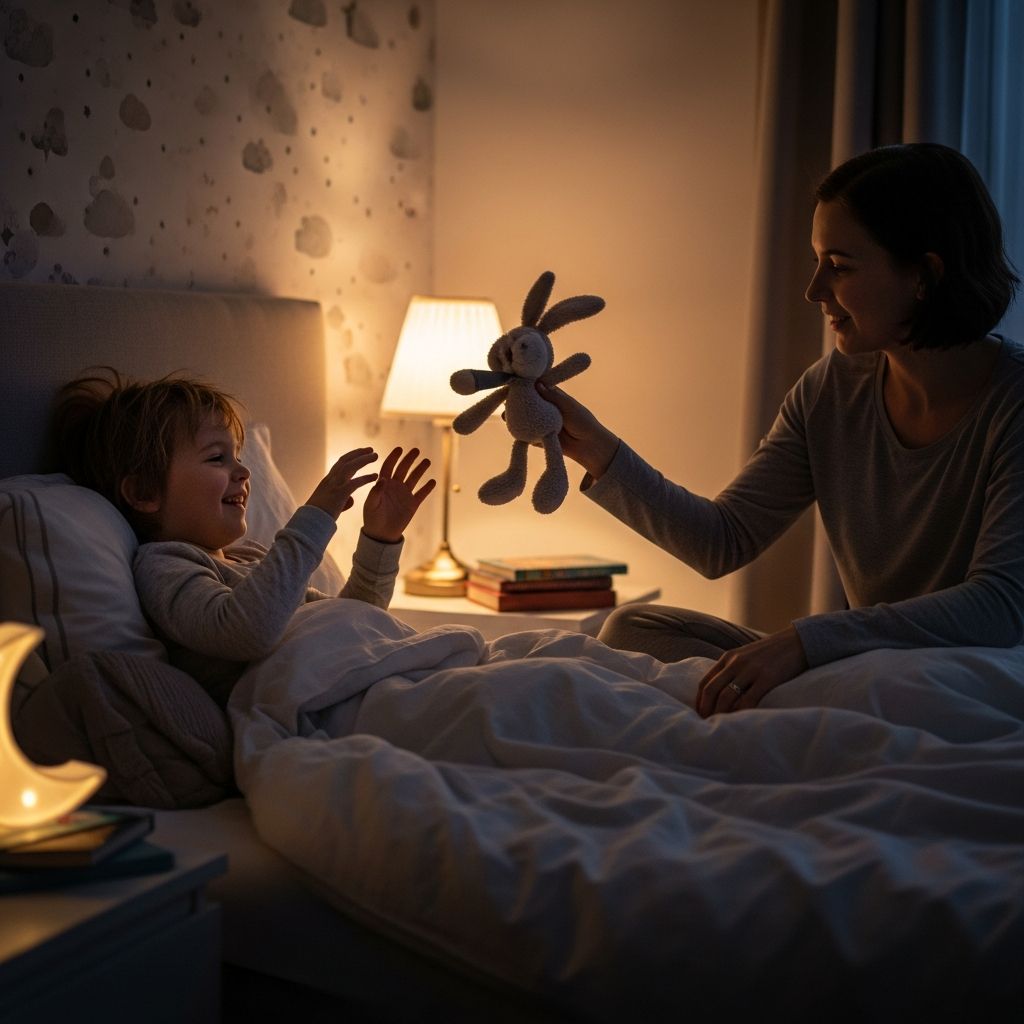
Many parents discover that the quickest way to get a reluctant child upstairs at night is not another reminder or threat, but a game: you growl, they shriek, and suddenly they are racing for the stairs like their life depends on it. What looks chaotic from the outside can become a powerful bedtime tool when you understand how to shape that chaos into a ritual.
This article explores how to turn fast-paced games like a nightly “Mr. Fox” chase into a predictable, connecting path toward sleep—without winding kids up so much that bedtime derails.
Why Kids Crave One Last Burst of Energy Before Bed
To adults, pre-bedtime may feel like a natural time to slow down. For many children, it is exactly the opposite. As soon as you say “time for bed”, their bodies and brains seem to hit the gas.
Several factors explain this evening burst:
- Body clock and hormones: Melatonin typically rises in the evening to encourage sleep, but many kids experience a brief period of increased alertness beforehand, often called the “forbidden zone” for sleep.
- Emotional separation: Going to sleep means separating from you for the night. Children often use last-minute silliness, requests, or games to stay connected a bit longer.
- Unspent energy: If the day has included long stretches of sitting—school, car rides, screens—kids often have pent-up physical energy that seeks a way out before they can relax.
- Need for control: Bedtime is full of adult-driven instructions. A chase game flips the script: the child suddenly feels powerful, fast, and in charge of the outcome.
Understanding these forces helps you work with your child’s biology and emotions rather than fighting against them.
The Secret Power of Rough-and-Tumble Play
Games like a parent-as-fox chase count as rough-and-tumble play: energetic, physical, often roaring-with-laughter games that still follow rules and boundaries. Far from being meaningless chaos, rough-and-tumble play has well-documented benefits.
- Social and emotional learning: Research on parent–child play shows that physical play can help kids learn self-control, reading of social cues, and emotional regulation when adults keep it safe and responsive.
- Stress relief: Active play can reduce physiological stress responses and improve mood, especially when kids feel safe and supported during the game.
- Attachment and connection: Shared laughter, inside jokes, and pretend threats (“I’m going to catch you!”) strengthen the emotional bond, which in turn makes separation at bedtime feel less threatening.
- Body awareness and motor skills: Running, dodging, and climbing stairs at speed all help develop coordination, balance, and strength.
When handled thoughtfully, a wild chase becomes more than a way to get pajamas on; it becomes a daily dose of closeness and skills practice.
Designing a Bedtime Chase Game That Actually Leads to Sleep
The key to using chase games before bed is to treat them like a structured routine, not a free-for-all. You want a clear beginning, middle, and end that your child can count on.
Core Principles for a Sleep-Friendly Chase Game
- Predictable start: Begin the game at the same point each night—after dinner, after bath, or after teeth brushing. Predictability helps kids feel secure.
- Short and focused: Aim for about 5–10 minutes. Too long, and children can become overtired or dysregulated.
- Clear rules: Simple rules such as “no tackling,” “no closing doors,” and “keep feet on the floor” keep everyone safe.
- Gradual wind-down: Design the game so that the last minute becomes slower and quieter, bridging into story time or lights-out.
- Same closing ritual: End the game the same way every night—perhaps with a caught-hug and a whispered line, like “The fox is full; now it’s time to rest.”
Example Flow: From Chase to Calm
| Phase | What Happens | Energy Level | Goal |
|---|---|---|---|
| 1. Signal | Parent uses a line or sound (e.g., “I smell a little rabbit!”) | Medium | Mark the start; get attention |
| 2. Chase | Child runs toward target (bedroom, bathroom) with parent in pursuit | High | Burn energy; create fun |
| 3. Safe Zones | Pre-agreed places where the child is temporarily “safe” (bed, bath mat) | Medium | Practice rules; give control |
| 4. Catch & Cuddle | Game ends when the parent gently “catches” the child in bed | Low | Transition from thrill to closeness |
| 5. Calm Cue | Repeat a calming phrase or song as breathing slows | Very Low | Signal that play is over and rest begins |
Creating Your Own “Mr. Fox”-Style Game
You can borrow the spirit of a nighttime fox chase while tailoring details to your space, your child’s temperament, and your own energy.
Step-by-Step Setup
- 1. Choose your character. Many kids love the idea of a sneaky or hungry creature—fox, dragon, dinosaur, or even a giant sleepy cat. Pick one that feels playful rather than truly scary for your child.
- 2. Define the path. Decide which route the chase will take: from living room to stairs, down the hallway, or in a circle that ends at the bed. Remove tripping hazards in advance.
- 3. Set the “safe” destination. The chase should always end at a bedtime-related place: the bed, bathroom sink, or reading chair. This keeps the game connected to the routine.
- 4. Agree on signals. Have a fun sound to start the game (a howl, a snuffle, a whisper) and a clear sound or phrase to end it (“Fox is done,” “Dragon is sleepy”).
- 5. Practice the ending first. Before you play at full speed, walk through the ending: the child climbs into bed, you “catch” them with a gentle pounce or hug, and then you both take a deep breath together.
Optional Variations to Keep It Fresh
- Slow-motion chase: Everyone moves in exaggerated slow motion, which can be silly and calming.
- Tiptoe fox: The fox can only move if the child is making noise; when the child is silent, the fox “freezes.” This encourages self-control.
- Pillow island: Scatter a few pillows that count as “islands” where the fox cannot step. This keeps movement contained.
- Reverse roles: Let your child be the fox sometimes. Chasing a slower-moving parent still burns energy and gives them an empowering role.
Keeping Everyone Safe and Regulated
High-energy fun is only helpful at bedtime if it does not lead to injuries or emotional meltdowns. A few safeguards protect both bodies and feelings.
Physical Safety Basics
- Clear the route of toys, cords, and loose rugs before you start.
- Limit stair running for very young children or insist on handrails and slower speed.
- Agree that there is no pushing, grabbing clothing, or slamming doors.
- Keep pets in another room if they are likely to get underfoot.
Emotional Safety and Consent
- Check-in words: Create a special word or gesture that instantly pauses the game if someone feels uncomfortable or overwhelmed.
- Respect “stop”: If your child says stop, the game stops. This helps them trust that playful threats are truly safe.
- Watch cues: If laughter shifts to tears or frantic squeals, or if your child seems disoriented, slow the game or end it and offer a hug.
- No surprise jump-scares: Some kids love being startled; others don’t. When in doubt, keep surprises gentle and predictable.
Matching the Game to Your Child’s Temperament
Not every child responds to chase games in the same way. A bedtime ritual should fit your child’s nervous system, not just your own preferences.
| Child Style | How They May React | Adjustments to Try |
|---|---|---|
| High-energy, thrill-seeking | Gets louder and faster; may resist stopping | Shorter chase, longer wind-down, clear time limits |
| Sensitive, easily startled | Laughs but then cries or hides | Softer voice, slower speed, more control given to child |
| Rule-focused, cautious | Asks many questions about “how” to play | Explain rules upfront, keep route simple and repetitive |
| Imaginative, dramatic | Embellishes story; may act out being scared | Channel drama into storytelling after the chase in bed |
Turning the Final Catch Into Calm Connection
The moment the chase ends is your bridge from high arousal to rest. If you rush through it, your child’s body may stay keyed up. If you dwell in it, their system gets the message that it is now safe to relax.
Simple Post-Game Calming Ideas
- Breathing together: After the “catch,” place a hand on your child’s back and take three slow breaths together, matching your exhale to theirs.
- Body scan in kid language: While they lie in bed, quietly guide them to “melt” different body parts (“Let your fox paws go floppy”). Relaxation techniques like these can shorten sleep onset.
- Mini check-in: Ask one gentle question: “What was your favorite part of tonight’s game?” This shifts from movement to reflection.
- Predictable phrase: End with the same short sentence every night, such as “The chase is over; dreams are next.” Repetition helps the brain link that phrase with winding down.
When the Game Backfires (and How to Fix It)
Even a well-designed chase ritual can sometimes go wrong. The goal is not perfection, but the ability to adjust.
Common Pitfalls
- Overstimulation: Your child is too excited to listen or settle in bed.
- Boundary testing: They use the game to stall—”Again!” “Just one more time!”
- Sibling conflict: Competing for your attention or space leads to tears.
- Parent exhaustion: You are too tired for a nightly sprint but feel trapped in the ritual.
Practical Adjustments
- Set a visible limit (e.g., “When this song ends, the chase ends”), so it is not up for argument.
- Gradually shorten the chase over a week if you notice your child staying revved up for too long afterward.
- Offer turn-taking rules for siblings or alternate who is the fox each night.
- If you are exhausted, keep the story of the fox but change the movement (e.g., crawling instead of running, or playing “slow-motion fox” only).
Integrating the Game Into a Healthy Overall Bedtime Routine
Sleep experts consistently recommend a consistent, calming bedtime routine that lasts 20–45 minutes and follows the same steps each night. Your chase game can be one part of that sequence.
- Ideal order example:
1) Light snack and water
2) Bath or wash-up
3) Pajamas and teeth
4) Short chase game ending in bed
5) Story, songs, or quiet talk
6) Lights out and goodnight phrase - Keep lights predictable: Bright light suppresses melatonin, so dimming lights 30–60 minutes before sleep supports natural drowsiness.
- Limit screens before the game: Blue light and stimulating content close to bedtime can delay sleep onset and make kids harder to settle.
Frequently Asked Questions (FAQs)
Q: Won’t running around before bed make my child too hyper to sleep?
A: It depends on how you structure it. A short, predictable game with a clear calming finish can help release pent-up energy and ease emotional tension. If your child consistently struggles to settle afterward, shorten the game, slow it down, or move it earlier in the routine.
Q: How late in the evening is too late for a chase game?
A: Many families find that ending active play at least 20–30 minutes before lights-out works well, leaving time for quieter steps. Children vary, so watch how long it takes yours to return to a calmer state and adjust the timing accordingly.
Q: What if my child gets scared by the pretend fox or monster?
A: Dial down the intensity. Use a sillier character (like a tickle-bunny), keep your voice gentle, and let your child decide the distance between you. Some kids prefer to be the chaser instead; that role reversal can transform fear into confidence.
Q: Can I still use this kind of game with more than one child?
A: Yes, but clear rules matter even more. Decide who runs where, make sure no one blocks doorways or pushes, and rotate special roles so each child feels included. When sibling competition runs high, consider separate mini chases, one child at a time.
Q: What if I don’t enjoy rough play but my child loves it?
A: You do not need to ignore your own limits. Shorten the high-energy portion, lean on slower versions (like tiptoeing or crawling), or assign a different adult to lead the chase when possible. Kids benefit from genuine, joyful engagement more than from long sessions with a drained parent.
References
- Healthy Sleep Habits: How Much Sleep Do Children Need? — Centers for Disease Control and Prevention. 2024-03-11. https://www.cdc.gov/sleep/about_sleep/how_much_sleep.html
- Bedtime Routines for Young Children: A Dose-Dependent Association with Sleep Outcomes — Mindell JA et al., Sleep. 2015-03-01. https://academic.oup.com/sleep/article/38/5/717/2416915
- Rough-and-Tumble Play from Childhood through Adolescence: Development and Possible Functions — Pellegrini AD, Smith PK., Current Directions in Psychological Science. 2005-10-01. https://doi.org/10.1111/j.0963-7214.2005.00343.x
- Physical Activity, Fitness, and Children’s Sleep — Dworak M et al., Sleep Medicine Reviews. 2008-12-01. https://doi.org/10.1016/j.smrv.2007.10.002
- Relaxation Training and Cued Recall in the Treatment of Childhood Insomnia — Blampied NM, Bootzin RR., Journal of Child Psychology and Psychiatry. 2013-06-01. https://doi.org/10.1111/jcpp.12046