Establishing the Foundation for Soccer Excellence
Soccer juggling represents far more than a flashy display of skill at the park. This fundamental practice serves as a cornerstone for developing young athletes who possess superior ball control, enhanced coordination, and the confidence necessary to perform under pressure during competitive matches. When children master the art of keeping a soccer ball aloft using various parts of their body, they simultaneously develop multiple physical and mental attributes that extend far beyond the pitch.
The importance of introducing juggling to young soccer players cannot be overstated. Through consistent practice with juggling drills, children develop an intuitive understanding of how the ball responds to different striking techniques and body surfaces. This intimate connection with the ball transforms them from players who merely chase the sphere into athletes who manipulate it with precision and intent. Parents and coaches who invest time in teaching proper juggling mechanics provide their young athletes with tools that will serve them throughout their soccer careers.
Understanding the Physical and Mental Benefits
When young soccer players engage in regular juggling practice, they experience improvements across multiple dimensions of athletic development. The physical benefits include enhanced balance, increased agility, and improved overall coordination. These attributes directly translate to superior performance on the field, allowing children to maintain possession during challenging situations and execute technical movements with greater efficiency.
Beyond the physical realm, juggling develops crucial mental attributes that characterize exceptional soccer players. Children who practice juggling cultivate focus and concentration, as maintaining a rhythm requires sustained attention to the ball’s position and trajectory. They also develop patience and resilience, learning that mastery comes through repetition and that occasional mistakes represent opportunities for improvement rather than failures. The psychological confidence gained from successfully executing juggling sequences transfers to other aspects of their game, making children more willing to take on defensive challenges and attempt creative plays during matches.
Preparing Young Athletes: Pre-Training Fundamentals
Before introducing young children to juggling techniques, proper preparation ensures they approach the skill with the right physical conditioning and mental mindset. Dynamic warm-up routines activate the muscles and joints that will be engaged during juggling practice, reducing injury risk and enhancing performance.
An effective warm-up routine should include:
- Ankle mobility work consisting of ten circles in each direction on both ankles to increase range of motion
- High-knee running for two 20-second intervals, which activates the hip flexors and core muscles essential for maintaining balance
- Hamstring activation through standing sweeps, performed by hinging at the hips while keeping legs relatively straight, allowing gentle forward momentum
- General light jogging to elevate heart rate and prepare the cardiovascular system
These preparatory movements prime the neuromuscular system and establish the proper mental state for focused skill development. Young athletes who complete warm-up routines demonstrate improved coordination and reduced error rates during subsequent practice sessions.
The Seated Foundation: Building Confidence Through Stability
Introducing juggling while seated represents the most effective starting point for young learners. This controlled environment removes variables related to balance and lower body stability, allowing children to focus entirely on developing proper striking mechanics with their feet. The seated position also reduces the distance between hands and feet, increasing the likelihood of successful catches and building the confidence necessary to progress to more challenging variations.
During the seated phase, young athletes should sit with knees bent and feet flat on the ground, holding the soccer ball at waist level. The instruction focuses on the mechanics of striking the ball with the shoelace region of the foot—the area where the laces contact the shoe. Children must maintain extended toes and locked ankles throughout contact with the ball, creating a firm surface that imparts clean, predictable energy to the sphere.
The proper striking technique involves lifting the foot toward the ball rather than swinging from the hip. This controlled motion, driven primarily by the knee joint, allows young players to regulate the height and direction of their kick with greater accuracy. The ball should travel straight upward, reaching approximately waist-height before descending back toward their hands. Once young athletes consistently catch the ball after striking it, they should practice alternating feet, ensuring balanced development on both sides of their body.
Transitioning to Standing Position: Progressive Skill Building
Once young players demonstrate proficiency with seated juggling, transitioning to a standing position introduces the balance and coordination demands that characterize actual game situations. This progression maintains the fundamental striking mechanics established during seated practice while gradually increasing complexity.
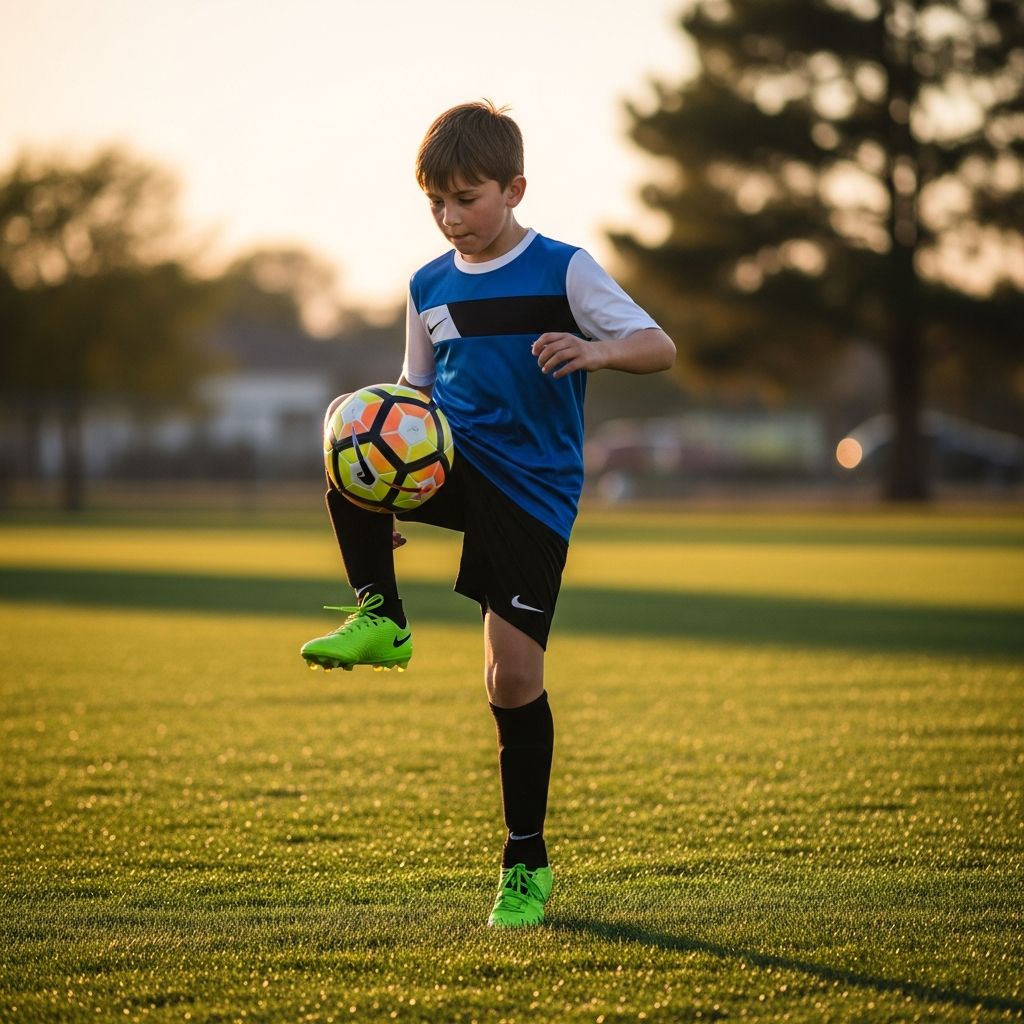
Standing juggling begins with the athlete holding the ball near waist level, dropping it smoothly, and striking it upward with the shoelace region. The initial touches should land in the hands, allowing young players to maintain success while introducing the demands of balancing on their feet. As confidence builds, children should practice alternating feet, ensuring each foot delivers the same quality strike.
A critical emphasis during standing practice involves controlling ball height. Young athletes who keep the ball between knee-height and waist-height experience significantly easier juggling sequences compared to those attempting to manage balls that rise too high. This height management principle, sometimes described as the “cheat code” for easier juggling, represents perhaps the single most important concept for young learners to internalize. When the ball remains within this zone, all subsequent touches become more manageable and predictable.
Advancing Beyond Single Touches: Multiple Consecutive Contacts
The transition from single touches followed by hand catches to multiple consecutive touches without hand intervention represents a critical milestone in juggling development. This phase requires young athletes to maintain focus, control ball height, and execute smooth alternating strikes with both feet.
Young players progressing to multiple-touch juggling should keep their knees slightly bent, maintain a relaxed upper body posture, and focus their eyes on the bottom of the ball rather than tracking it at eye level. These postural adjustments promote smoother, more controlled movements and reduce the tension that often causes errors. Children should initially attempt patterns such as left-right-catch, then progress to left-right-left-right-catch, gradually expanding their streak length as control improves.
An effective progression strategy involves returning to hand catches whenever control becomes challenging. This approach prevents young athletes from developing frustration while maintaining their confidence. By systematically extending the number of consecutive touches before catching, children gradually build the consistency and rhythm necessary for extended juggling sequences. Starting streaks on opposite sides ensures balanced development and prevents ingrained habits that favor one foot over the other.
Incorporating Body Diversity: Beyond Foot Strikes
Expanding juggling practice to include different body surfaces develops versatility and game-specific ball control that translates directly to improved performance. Young athletes who juggle exclusively with their feet develop limitations in their overall touch and control. By introducing thighs, chest, shoulders, and head into juggling routines, children build familiarity with ball contact across their entire body.
Thigh juggling begins with dropping the ball to a point just above the knee and tapping it upward with the top of the thigh. This technique requires precise timing and develops the soft touch necessary for receiving elevated passes during matches. The “ladder” technique progressively incorporates multiple body surfaces, beginning with foot strikes, transitioning to thigh taps, continuing to head touches, and reversing back down through the sequence. This comprehensive approach ensures well-rounded skill development.
Ground-based pickups develop the problem-solving skills and adaptability that characterize elite young players. Young athletes roll the ball backward using the sole of their foot, then position their toes underneath the ball to scoop it upward. This skill proves invaluable during matches when the ball arrives at unexpected angles or speeds.
Advanced Technique Development and Challenge Variations
Once young players establish proficiency with fundamental juggling sequences, introducing challenge variations maintains motivation while developing advanced skills that enhance match performance. These advanced techniques should only be introduced after young athletes demonstrate consistent control with basic juggling patterns.
The “around the world” technique involves tapping the ball with one foot, then circling that same foot rapidly around the sphere to meet it with another tap. Young players can practice both inside-to-outside and outside-to-inside circular variations, developing proprioception and foot speed. This technique requires coordination that extends beyond basic juggling but provides substantial benefits for overall skill development.
The “moving juggle” introduces real-game complexity by requiring young athletes to maintain juggling sequences while navigating around obstacles. Placing four cones in a small square pattern and asking children to drift one step at a time while juggling with alternating feet simulates the demands of maintaining possession during active play. This variation ensures that juggling practice translates into enhanced performance during competitive situations rather than remaining an isolated skill.
Building Effective Practice Routines and Tracking Progress
Consistent, purposeful practice yields far superior results compared to sporadic, unfocused sessions. Young athletes benefit from structured practice routines that emphasize quality over quantity and incorporate systematic progression.
| Practice Phase | Focus Area | Suggested Duration |
|---|---|---|
| Warm-up | Dynamic mobility and ankle activation | 5-10 minutes |
| Technical Foundation | Seated single-touch strikes and mechanics | 10-15 minutes |
| Skill Progression | Standing alternating touches and rhythm development | 15-20 minutes |
| Advanced Variation | Multiple body surfaces and challenge drills | 10-15 minutes |
| Cool Down | Light activity and gentle stretching | 5 minutes |
Young athletes should train both feet equally during every practice session, consistently adding repetitions to their weaker side. Recording video footage of juggling sessions allows children to review their technique and identify specific mechanical issues. When control deteriorates during a session, analyzing what occurred—did the ankle become loose, did contact happen off-center, was timing premature—provides specific guidance for correction. This analytical approach transforms mistakes into learning opportunities.
Identifying and Correcting Common Technical Errors
Young players learning to juggle frequently encounter specific mechanical errors that impede progress. Understanding these common mistakes and knowing how to address them accelerates skill development and prevents frustration.
Striking the ball with the toe rather than the shoelace region produces inconsistent contact and unpredictable ball flight. Coaching young athletes to maintain an extended foot with locked ankle ensures the proper striking surface contacts the ball bottom-center, producing straight vertical trajectories. Premature striking—contacting the ball before it descends to knee-height—disrupts rhythm and control. Young players must learn patience, waiting for the appropriate moment to strike rather than reacting too quickly. Hip-driven movement rather than knee-driven motion introduces unnecessary body rotation that sends the ball off-target. Emphasizing small, controlled movements generated by the knee rather than the hip keeps the ball’s path vertical and predictable.
Creating Motivation Through Skill-Based Challenges
Structured challenges that reward improvement rather than only celebrating perfection maintain young athletes’ motivation and engagement throughout their juggling development. These challenges should progress in difficulty as skills advance, ensuring continued challenge without overwhelming young learners.
Initial challenges might involve achieving five consecutive single-touch catches on each foot or ten alternating touches before requiring a hand catch. As skills develop, challenges progress to longer consecutive-touch streaks, juggling while moving around cones, or incorporating different body surfaces into sequences. Pattern-based drills that mix the order of touches between feet, thighs, head, chest, and shoulders develop creative thinking while practicing technique. Young athletes who design their own drill patterns demonstrate increased engagement and ownership of their development.
Frequently Asked Questions
At what age should children begin learning soccer ball juggling?
Children as young as five or six can begin introductory juggling practice, though formal skill development typically progresses more effectively with children aged eight and older who possess better focus and body control.
How often should young players practice juggling to see measurable improvement?
Three to four 20-30 minute sessions per week provides adequate stimulus for noticeable skill development. Daily practice accelerates progress but should only be introduced once young athletes demonstrate genuine interest and maintain proper form.
What should parents do if their child becomes frustrated during juggling practice?
Returning to earlier progression phases eliminates frustration while maintaining momentum. Celebrating incremental improvements rather than focusing on maximum streak length maintains motivation and prevents discouragement.
Can juggling practice improve a player’s performance in actual matches?
Yes, the ball control, confidence, and body coordination developed through juggling directly improve a player’s ability to receive passes, maintain possession under pressure, and execute technical movements during competition.
Should young players practice juggling on different surfaces, or should they stick to grass?
Practicing on multiple surfaces—grass, artificial turf, and hard courts—develops adaptability. Different surfaces affect ball bounce and require technique adjustments that enhance overall control and problem-solving abilities.
References
- How To Juggle A Soccer Ball — Adidas. 2024. https://www.adidas.com/us/blog/865374-how-to-juggle-a-soccer-ball
- Juggling a Soccer Ball for Beginners – Tutorial — YouTube. 2024. https://www.youtube.com/watch?v=krSBbunxdUg
- How To ACTUALLY Juggle A FOOTBALL For Beginners — YouTube. 2024. https://www.youtube.com/watch?v=5PQgz2SUPdk