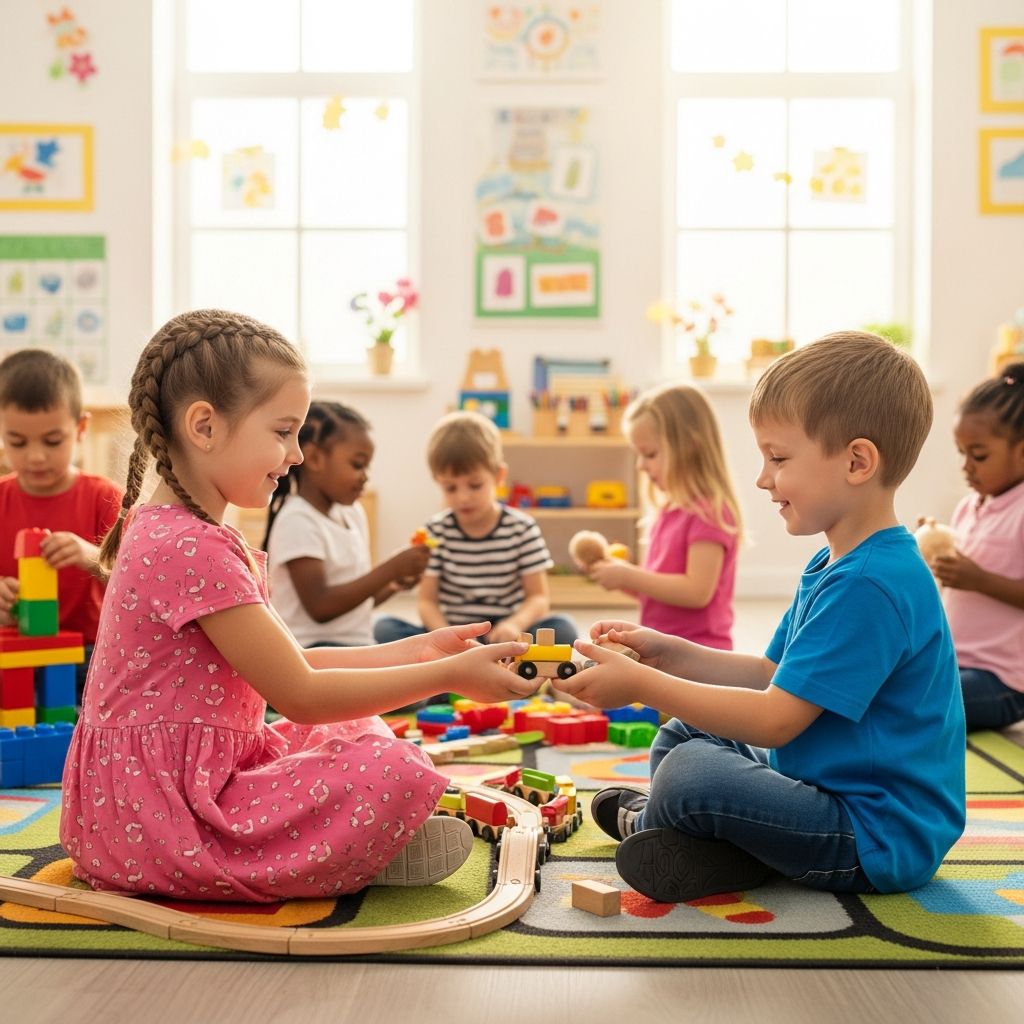
When a 4-year-old clutches a toy and shouts “Mine!” it can feel rude or selfish, especially in front of other parents. Yet for most preschoolers, resisting sharing is a normal part of development, not a sign that anything is wrong.
This guide explains what is happening inside your child’s brain, why traditional pressure tactics backfire, and how to teach sharing and turn-taking in a way that protects your child’s confidence and strengthens your relationship.
1. What “Sharing” Really Means at Age Four
Adults often use the word sharing to mean generous, calm, and fair. For a preschooler, it usually means something very different: losing a treasured object when they are not ready to give it up yet.
From a developmental standpoint, sharing requires several advanced skills:
- Self–other awareness – realizing that other people have separate thoughts, needs, and feelings.
- Empathy – caring about how someone else feels when they are disappointed or excluded.
- Impulse control – stopping themselves from grabbing or holding on when they really want something.
- Perspective-taking – understanding that a friend will also get a turn, even if they have to wait.
Research shows that consistent, voluntary sharing usually begins to emerge around ages 4 to 5 and continues to develop into the early school years, often not becoming solid until around age 7 or 8.
Typical Sharing Milestones
| Age | What You Might See |
|---|---|
| 2–3 years | Understands “mine”; may share briefly with adult support; frequent grabbing and tears. |
| 3–4 years | Can learn turn-taking with guidance; wants to follow rules but still very self-focused. |
| 4–5 years | Begins to share more often, especially when reminded; still struggles with prized items. |
| 6–8 years | Grasps fairness more fully; sharing becomes easier and more spontaneous for most children. |
2. Why Your 4-Year-Old Resists Sharing
Behind the “mine!” there is usually a mix of strong feelings and immature skills. Understanding the reasons can make it easier to respond calmly.
Common Reasons 4-Year-Olds Struggle
- Fear of loss: Your child may believe that if they give up a toy, they will not get it back, or that their play will be ruined.
- Intense attachment: Certain objects feel like part of their identity or their safety, especially comfort items or brand-new toys.
- Developing empathy: Preschoolers can talk about feelings, but in the moment they still prioritize their own desires.
- Limited self-regulation: The brain areas that control impulses are still under construction in early childhood.
- Testing boundaries: Children experiment with saying “no” to see how adults respond and to feel their own power.
Neuroscience and developmental research emphasize that young children often know they are supposed to share, but lack the “cognitive toolbox” to act on that knowledge consistently under emotional pressure.
3. What Not to Do: Common Sharing Traps
Well-meaning adults sometimes use strategies that seem effective in the moment but create more resistance or shame over time.
- Forcing immediate sharing
Grabbing a toy from your child to “be fair” teaches that stronger people can take things and that their feelings are less important. - Shaming or comparing
Statements like “You’re selfish” or “Look how nicely your cousin shares” can damage self-esteem and create resentment rather than generosity. - Using threats or bribes
“Share or we’re going home” or “If you share, you’ll get candy” may get quick compliance but shifts the focus away from empathy and connection. - Labeling the child
Calling a child “bad sharer” or “greedy” can become a story they believe about themselves.
Children learn most about sharing from how we treat them: when adults respect their boundaries, they are more likely to respect other people’s later.
4. A Gentle, Effective Approach to Teaching Sharing
Instead of demanding instant generosity, focus on building skills: turn-taking, waiting, empathy, and problem-solving.
Step 1: Prepare Before Playdates
Prevent conflict by planning ahead with your child:
- Let them choose a few special toys that do not need to be shared; put these away before guests arrive.
- Explain that the toys left out are for everyone to use while friends are visiting.
- Rehearse simple phrases: “Can I have a turn when you’re done?” or “You can have it next.”
Step 2: Teach Turn-Taking Instead of Forced Sharing
Turn-taking helps children feel that their needs matter and that they will not lose their toy forever.
- Use clear language: “You are using the truck. When you’re finished, it will be Sam’s turn.”
- If needed, use a visual timer so both children can see when a turn ends.
- Allow the current child to finish a short play sequence so sharing feels less like a sudden loss.
Guides from pediatric and early childhood organizations emphasize that turn-taking and cooperative play are core social skills developed in the preschool years, supporting later friendships and emotional regulation.
Step 3: Coach Through Conflicts Calmly
When a conflict breaks out, aim to be a calm helper rather than a judge.
- Describe what you see: “You both want the same toy.”
- Validate feelings: “It’s hard to wait when you really want it.”
- Restate the plan: “Right now it’s Maya’s turn. Leo, you may choose another toy or wait, and then it will be your turn.”
- Offer choices: “Do you want to wait here and watch, or play with the blocks while you wait?”
Step 4: Notice and Name Generous Moments
Children repeat behaviors that earn warm attention.
- Offer specific praise: “You waited for the puzzle so patiently. That was kind and helped your friend feel good.”
- Highlight impact: “When you let Sam use the car, he smiled. You helped him feel happy.”
- Revisit later: At bedtime, briefly recall one sharing moment from the day.
5. Using Play to Build Sharing Skills
Play is the most natural classroom for social skills. You do not need elaborate activities; simple games can teach powerful lessons.
Easy Everyday Games
- Passing games
Sit in a circle and pass a ball while singing or counting. Emphasize waiting, watching, and noticing whose turn it is. - Cooperative building
Work together to build one tower, road, or pretend city. Talk out loud about taking turns with pieces and deciding together. - Art with limited supplies
Offer only one container of markers or glue and gently guide taking turns and asking politely.
Storytelling and Role-Play
Stories help children explore feelings at a safe distance.
- Make up short stories about characters who want the same toy and ask: “What could they do?”
- Use puppets to act out grabbing vs. waiting, and invite your child to show a better solution.
- Pause during picture books to ask how each character might feel when someone will or will not share.
Studies on early prosocial behavior indicate that even toddlers begin to share when adults clearly communicate another’s need, and this sensitivity can be nurtured through conversation and guided play.
6. Respecting Ownership While Teaching Generosity
It is possible to both protect your child’s sense of ownership and encourage kindness toward others.
House Rules That Balance Both
- Special items are protected: Comfort objects and a few cherished toys are not required to be shared.
- Shared spaces have shared toys: Items in the living room or playroom are usually available to guests.
- We ask, we don’t grab: Everyone, including adults, asks before taking something from someone’s hands.
Preschool social-development guidance notes that children at this age are learning to distinguish between what is “mine,” “yours,” and “ours,” and clear, consistent rules support that learning.
7. When to Wonder About Deeper Concerns
Most 4-year-olds have frequent conflicts over toys, and this alone is not a red flag. However, it can be helpful to consult a professional if you notice patterns such as:
- Persistent aggression or physical harm over toys (hitting, biting, or severe tantrums).
- Very limited interest in playing with other children across many settings.
- Ongoing difficulty understanding simple social rules despite consistent, gentle teaching.
- Concerns in other areas of development (language delays, very rigid behavior, or sensory issues).
Your pediatrician or an early childhood specialist can help you understand whether your child’s behavior fits within the wide range of typical development and suggest tailored strategies.
Frequently Asked Questions (FAQs)
Q: At what age should my child be able to share?
A: Most children begin to share more consistently between ages 4 and 5, but truly reliable, flexible sharing often appears closer to early school age. Some children need more time, especially with favorite items.
Q: Should I make my 4-year-old share every toy?
A: No. Protecting a few special belongings teaches healthy boundaries. Focus on turn-taking for most toys, and let your child keep certain comfort items or treasured objects just for themselves.
Q: What do I say when my child refuses to share during a playdate?
A: Stay calm and neutral: “You’re playing with the truck right now. When you’re finished, it will be Alex’s turn. Alex, would you like to choose another toy while you wait?” This respects both children and teaches a clear, fair process.
Q: How can I help my child cope when others don’t share with them?
A: Acknowledge their feelings—“You’re disappointed; you really wanted that toy”—then support problem-solving: “What could we play with instead while we wait?” Over time, this builds resilience and emotional regulation.
Q: Does refusing to share mean my child will be selfish later?
A: No. Early reluctance to share is developmentally normal. Warm relationships, respectful limits, and many chances to practice generosity are what most strongly shape later kindness and cooperation.
References
- To share or not to share: When do toddlers respond to another’s needs? — Brownell, Celia A. et al., Developmental Psychology. 2009-05-01. https://www.ncbi.nlm.nih.gov/pmc/articles/PMC3359011/
- Sharing — Tools for Your Child’s Success (Washington Office of Superintendent of Public Instruction). 2023-01-01. https://toolsforyourchildssuccess.org/tools/4-years-old/sharing/
- How to Teach Your Child About Sharing and Cooperation — Kids First Children’s Services. 2023-06-15. https://www.kidsfirstservices.com/first-insights/how-to-teach-your-child-about-sharing-and-cooperation
- Learning how to share & take turns — Lovevery. 2022-08-01. https://blog.lovevery.com/skills-stages/sharing-taking-turns/
- Why Is Your Preschooler Not Sharing? — Greater Good Science Center, University of California, Berkeley. 2018-04-10. https://greatergood.berkeley.edu/article/item/why_is_your_preschooler_not_sharing
- Helping Young Children With Sharing — ZERO TO THREE. 2016-09-01. https://www.zerotothree.org/resource/helping-young-children-with-sharing/
- Social Development in Preschoolers: Learning How to Share and Take Turns — HealthyChildren.org (American Academy of Pediatrics). 2015-02-01. https://www.healthychildren.org/English/ages-stages/preschool/Pages/Social-Development-in-Preschoolers.aspx