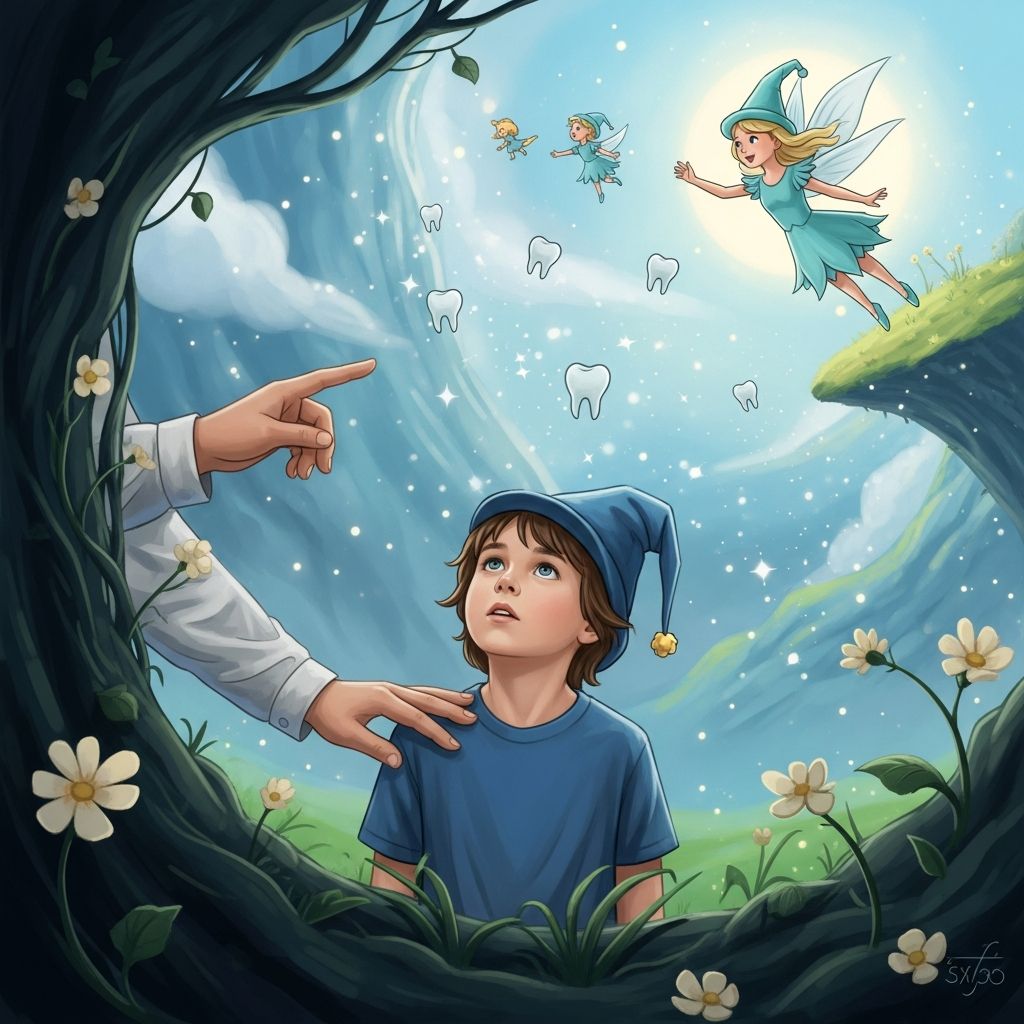
Childhood myths like the Tooth Fairy, Santa Claus, and the Easter Bunny can be a source of joy, mystery, and family bonding. They can also raise real questions for parents about honesty, trust, and when to tell the truth. This guide explores how to approach these stories in an age-appropriate, emotionally healthy way that honors both your child’s wonder and your family’s values.
Why Myths Matter in Childhood
Stories about magical visitors are more than cute traditions; they are early experiences of imagination, culture, and meaning. They can help children make sense of new or scary experiences, like losing teeth or facing the dark, by wrapping them in play and ritual.
At the same time, these myths become a child’s first opportunity to notice inconsistencies, ask skeptical questions, and practice distinguishing fantasy from reality. How adults respond in these moments strongly influences a child’s sense of trust and emotional security.
The Developmental View: How Children Think About Fantasy
Children’s understanding of what is real and what is pretend does not appear overnight. It unfolds gradually, and the way they relate to myths changes as their thinking develops.
- Preschool years (around 3–5): Many children joyfully accept magical explanations without needing everything to be logical. They can know something is pretend and still enjoy playing along.
- Early school years (around 6–8): Children begin to notice inconsistencies and ask more probing questions, such as how a fairy fits under a pillow or how gifts appear in locked houses.
- Later childhood (around 9+): Many children either no longer believe or are consciously choosing to play along. The focus shifts from literal belief to shared tradition and family fun.
These ages are approximate and vary by child, culture, and family conversations. What matters most is not a specific birthday but whether your approach fits your child’s personality, questions, and emotional needs.
Emotional Benefits of Magical Traditions
Handled thoughtfully, myths can support important aspects of emotional development and resilience. They can create rituals around transitions and help children practice coping with change.
- Comfort around change: The Tooth Fairy can turn the unsettling experience of losing a tooth into a moment of excitement and pride.
- Joy and anticipation: Waiting for a fairy, bunny, or Santa can add sparkle to everyday routines and build positive family memories.
- Imagination and creativity: Pretend play with mythical characters lets children explore different possibilities and create their own versions of the story.
However, the benefits depend on how adults use the myth. When the story is used to control or shame a child, it can undermine trust rather than build it.
Potential Pitfalls: When Myths Backfire
Parents often worry less about whether a child believes in a fairy and more about what happens when that belief shifts. Concerns usually fall into a few predictable areas.
- Fear of loss of trust: Some children feel upset if they discover that adults actively pretended something was real without being honest when questioned directly.
- Embarrassment with peers: Older children who continue to believe literally may feel humiliated if teased by classmates or siblings.
- Power struggles: Using myths as threats (for example, “The Tooth Fairy won’t come unless…”) can leave children anxious and less cooperative.
Awareness of these risks allows parents to lean more on play and connection and less on manipulation or deception.
Age-Responsive Strategies for Talking About the Tooth Fairy
There is no universal “correct” age to talk about whether the Tooth Fairy is real. Instead, parents can pay attention to the kinds of questions children ask and respond in ways that match their stage of development.
Early Years: Protecting Wonder Without Over-Explaining
For very young children, the goal is often to channel excitement and ease anxiety, not to offer detailed explanations. Short, simple answers are enough, with room for the child’s own imagination.
- If a child asks, “Who is the Tooth Fairy?” a simple reply such as, “A special helper who comes when kids lose a tooth,” may feel satisfying.
- When they wonder, “How does she know?” you can invite participation: “What do you think? Everyone has their own version of the story.”
- Emphasize that losing a tooth is a normal, healthy step in growing up, and the fairy is part of a family celebration of that milestone.
This stage is less about factual accuracy and more about emotional safety and positive associations with the new experience.
Middle Childhood: Listening Closely to the Question Behind the Question
As children approach early school age, their questions become more specific and skeptical. How you answer can either shut down honest conversation or model respectful curiosity.
- When a child asks, “Is the Tooth Fairy really real?” consider responding first with a question: “What made you wonder?” or “What do you think?”
- If they clearly suspect the truth but want reassurance about your honesty, it can be more respectful to acknowledge the pretend aspect while highlighting the fun of the tradition.
- You might explain that grown-ups sometimes join in make-believe to make childhood more magical, and that this is different from lying to hurt or deceive.
Children at this age are often ready to be partners in the secret, especially if they have younger siblings to “help” keep the game going.
Older Children: Transitioning from Belief to Tradition
By later childhood, many children no longer believe in myths literally, but they may still want the ritual. At this point, the focus shifts from confirming or denying existence to co-creating family traditions.
- Invite older children to help plan the Tooth Fairy “visits” for younger siblings, such as writing tiny notes or designing “receipts” for teeth.
- Talk openly about how traditions can evolve over time and still matter, even when everyone knows they are symbolic.
- Use the conversation as an opening to discuss other cultural or religious stories and how families find meaning in them.
Making children collaborators reinforces their maturity and shows that growing up does not mean losing all sense of magic; it means engaging with it in a new way.
Honesty, Trust, and the Role of the Parent
One of the biggest ethical questions parents face is whether encouraging belief in myths counts as “lying.” Many families resolve this tension by being attentive to tone, intent, and responsiveness to questions.
- Intent matters: Joining a child’s imaginative world to delight them is different from deliberately misleading them about issues of safety or well-being.
- Consent evolves: As soon as a child signals that they want truthful answers, most parents choose to shift from full pretense to a more metaphorical explanation.
- Repair is possible: If a child feels upset about “being tricked,” parents can validate those feelings, apologize for any hurt, and emphasize the original desire to create joy.
The long-term strength of your relationship comes less from whether you ever mentioned a fairy and more from whether your child experiences you as emotionally available, responsive, and honest when it truly counts.
Myths Beyond the Tooth Fairy: Santa, Easter Bunny, and More
Many families juggle several myths at once. While the specifics differ, the underlying principles for handling them are remarkably similar across traditions.
| Myth or Character | Typical Age of Strongest Belief | Main Emotional or Social Function |
|---|---|---|
| Tooth Fairy | Roughly 4–8 years | Softens anxiety about losing teeth; marks growth milestones; encourages dental care. |
| Santa Claus | Roughly 3–8 years | Builds anticipation; connects generosity, giving, and family or cultural celebration. |
| Easter Bunny | Roughly 3–7 years | Adds play and surprise to seasonal or religious holidays; fosters outdoor exploration and games. |
| Other local figures | Varies by culture | Reinforces cultural identity, shared stories, and community values. |
Parents can use similar guidelines for each character: tune in to the child’s questions, avoid using the myth as a threat, and be ready to shift to more honest explanations as the child’s understanding develops.
Practical Tips for Handling Questions in the Moment
When a child suddenly asks, “Is the Tooth Fairy real?” in the car or just before bed, it can feel like a pop quiz in parenting. Having a few guiding principles in mind makes it easier to respond calmly.
- Pause before answering: A brief silence lets you notice your own feelings and choose a response consistent with your values.
- Start with curiosity: Ask, “What made you think of that?” or “What do you think?” to gauge whether they are testing a theory, repeating something a friend said, or expressing worry.
- Match your answer to their readiness: Some children just want reassurance that the world is still magical; others clearly want a straightforward explanation.
- Keep the door open: End with something like, “You can always ask me more about this. I like talking with you about things that matter to you.”
The aim is not the perfect script but the ongoing message that questions are welcome and you can handle them together.
Respecting Different Family and Cultural Traditions
Not all families use the same myths, and some choose to skip them entirely for philosophical, religious, or personal reasons. Children benefit when adults speak respectfully about these differences.
- Explain that different families celebrate in different ways and that there is no single “correct” tradition.
- Coach children not to “spoil” other kids’ beliefs without permission, emphasizing kindness over being “right.”
- Encourage children to share their own family customs with pride while staying curious about others’ practices.
This approach helps children learn that diversity in stories and rituals is normal and enriching, not something to mock or fear.
Using Myths to Support Positive Behaviors (Without Manipulation)
Many parents wonder whether it is acceptable to link myths to behavior. The key distinction is between playful motivation and pressure that triggers fear or shame.
- It can be helpful to associate the Tooth Fairy with good dental habits in a gentle way, such as leaving a note praising brushing and flossing, rather than threatening no visit for imperfect behavior.
- Parents can use holiday traditions to model generosity, gratitude, and kindness, making the story a springboard for values rather than a surveillance tool.
- When children struggle with behavior, it is more effective to address those challenges directly than to outsource discipline to a mythical character.
Framing myths as encouraging allies rather than judges preserves both the fun of the story and the child’s sense of being accepted even when they make mistakes.
When a Child Feels Hurt or Betrayed
Despite parents’ best intentions, some children feel deeply upset when they discover that the Tooth Fairy or another character is not literally real. This reaction is an opportunity for connection and emotional learning.
- Validate the feeling first: acknowledge that it can feel confusing or painful to find out that adults pretended.
- Differentiate between playful secrets designed to bring joy and harmful lies that are meant to mislead or control.
- Invite the child to help decide how your family will handle similar traditions going forward, giving them a sense of agency.
Handled with empathy, even a painful discovery can deepen mutual understanding and demonstrate that difficult conversations are safe in your relationship.
Creating Your Family’s Approach to Myths
Ultimately, there is no single right way to handle the Tooth Fairy or any other myth. What matters is building a coherent approach that fits your values and your child’s temperament. Parents can benefit from explicit reflection and, if possible, agreement with co-parents or other caregivers.
- Clarify your goals: Are you using the myth primarily for fun, for easing anxiety, for cultural continuity, or all of the above?
- Decide in advance how you want to respond when your child asks direct questions, so you are less likely to react impulsively.
- Be willing to revise your approach as your child grows, learns, and reveals more of who they are.
When myths are guided by clear intentions—joy, connection, and respect for the child’s emerging sense of truth—they can enrich family life without undermining trust.
Frequently Asked Questions
What if my child never asks whether the Tooth Fairy is real?
Some children are naturally skeptical and ask early; others quietly figure it out and choose not to bring it up. If your child seems content and the tradition does not cause distress or embarrassment, there is no rule that you must initiate a “big reveal” at a specific age. You can stay attentive to nonverbal signs—eye rolls, knowing smiles—and shift into treating the myth more like a shared joke when that feels right.
Should I correct my child if they repeat magical stories as facts to others?
For very young children, there is usually no harm in letting them tell the story as they understand it. As they get older, you can gently introduce the idea that some people see these figures as pretend and that it is kind to ask before revealing family secrets. This helps them balance enthusiasm with social awareness.
Is it better to skip myths altogether to avoid lying?
Many families choose not to present myths as literally real and still enjoy them as stories, games, and cultural symbols. What children need most is consistency between your words and your values. If you decide to treat myths purely as pretend, you can still create special rituals around teeth, holidays, and other milestones without introducing a hidden “truth” to be uncovered later.
How do I handle siblings at different ages?
Older children can feel powerful or conflicted when they know more than a younger sibling. Invite them into the “grown-up” role of helping maintain the magic in ways that feel playful but not deceptive. At the same time, make it clear that teasing or deliberately spoiling the story is unkind and not acceptable.
What if another child tells mine that the Tooth Fairy is fake?
This situation is common and can actually open up rich conversations. You might say that some kids and parents treat the Tooth Fairy as a story, some take it more literally, and families get to decide for themselves. Then follow your child’s lead: if they want the truth, give it gently; if they prefer to keep wondering, you can support that curious middle ground while staying prepared to answer more directly when they are ready.
Using the Tooth Fairy and other myths thoughtfully allows parents to nurture both wonder and wisdom. With a focus on empathy, honesty, and connection, these childhood stories can become foundations for deeper trust and enduring family memories rather than sources of confusion or hurt.