Supporting Your Preschooler’s Drive to Discover
Between ages three and five, children enter a remarkably formative period where their natural instinct to explore becomes the foundation for learning and development. During these preschool years, your child’s curiosity transforms from simple observation into active investigation of their environment. This innate drive to ask questions, touch objects, and test boundaries is not merely entertainment The Input provided is already valid JSON, except that the content includes many HTML tags and newlines.
Understanding how to channel and support this exploratory phase helps you create an environment where learning happens naturally through play and discovery. Rather than viewing endless questions as interruptions, recognizing them as signs of intellectual development empowers you to become a more effective guide in your child’s growth journey.
The Foundation: Why Exploration Matters in Early Development
Research in child development demonstrates that preschoolers who engage in regular exploration show enhanced problem-solving abilities, improved motor skills, and stronger emotional resilience. When children interact with their surroundings through touch, movement, and investigation, they build neural pathways that support learning across all developmental domains.
The preschool years are particularly critical because approximately 90% of brain development occurs by age five. The experiences children have during this window—including opportunities to explore, manipulate objects, and interact with others—directly shape their cognitive capabilities, emotional regulation, and physical abilities. This makes creating an exploration-rich environment one of your most important parenting responsibilities.
Exploration also builds confidence and independence. When children are allowed to investigate safely, they develop trust in their own abilities and learn that their actions produce meaningful results. This sense of agency contributes to healthy self-esteem and motivation for continued learning.
Creating an Environment That Invites Discovery
A preschooler-friendly environment balances safety with opportunity, allowing children to investigate while protecting them from genuine hazards. This doesn’t mean creating a sterile, completely controlled space; rather, it involves thoughtful organization that makes exploration rewarding and manageable.
Begin by making materials and activities accessible at your child’s eye level and within their reach. Low shelves with containers of safe objects—wooden spoons, plastic bowls, fabric scraps, safe kitchen tools—invite independent investigation without requiring adult assistance for every interaction. Rotating these materials periodically maintains novelty and sustains interest.
Outdoor spaces deserve special attention as exploration venues. Natural environments offer unparalleled sensory experiences: textures of bark and grass, the movement of leaves and insects, and the variations in light and shadow. Even small outdoor spaces like patios or neighborhood parks provide rich opportunities for hands-on learning that cannot be replicated indoors.
Consider dedicating specific spaces for different types of exploration:
- A sensory station with materials of varied textures, temperatures, and weights
- An arts area where messy creation is encouraged and expected
- A construction zone with blocks, boxes, and building materials
- An outdoor exploration area with gardening tools scaled for small hands
- A quiet observation space for focused investigation of specific items
Supporting Physical Exploration and Gross Motor Development
Preschoolers acquire increasingly sophisticated physical abilities during ages three to five, progressing from basic running and jumping to more complex movements like hopping on one foot and catching bounced balls. Physical exploration—climbing, jumping, balancing, and moving through space—develops gross motor skills while simultaneously building confidence and body awareness.
Rather than constraining movement to structured activities, create multiple opportunities throughout your day for active exploration. Climbing structures at parks, stairs in your home, slopes in your yard, and open spaces for running all invite the physical investigation that preschoolers crave.
Tricycle riding deserves mention as a particularly valuable exploration activity. This skill, typically emerging around age three and improving significantly by age four, combines physical coordination with independence and environmental awareness. A child on a tricycle can cover greater distances and observe their neighborhood from a new perspective, expanding their world quite literally.
As your child’s physical abilities expand, introduce gentle challenges that stretch capabilities without overwhelming them. A slightly higher step, a ball that’s challenging but not impossible to catch, or a climbing structure with varied difficulty levels all provide scaffolding for growth.
Cognitive Growth Through Hands-On Investigation
Cognitive development during the preschool years involves dramatic expansion in thinking abilities, from understanding basic concepts like counting and colors to engaging in imaginative storytelling and symbolic play. Children learn these concepts most effectively through direct manipulation and investigation of materials rather than passive instruction.
Exploration with everyday objects builds foundational mathematical and scientific thinking. A child unscrewing jar lids learns about cause and effect, develops hand strength, and understands rotational mechanics. Turning doorknobs, opening drawers, and manipulating containers all contribute to both fine motor development and cognitive understanding of how the physical world operates.
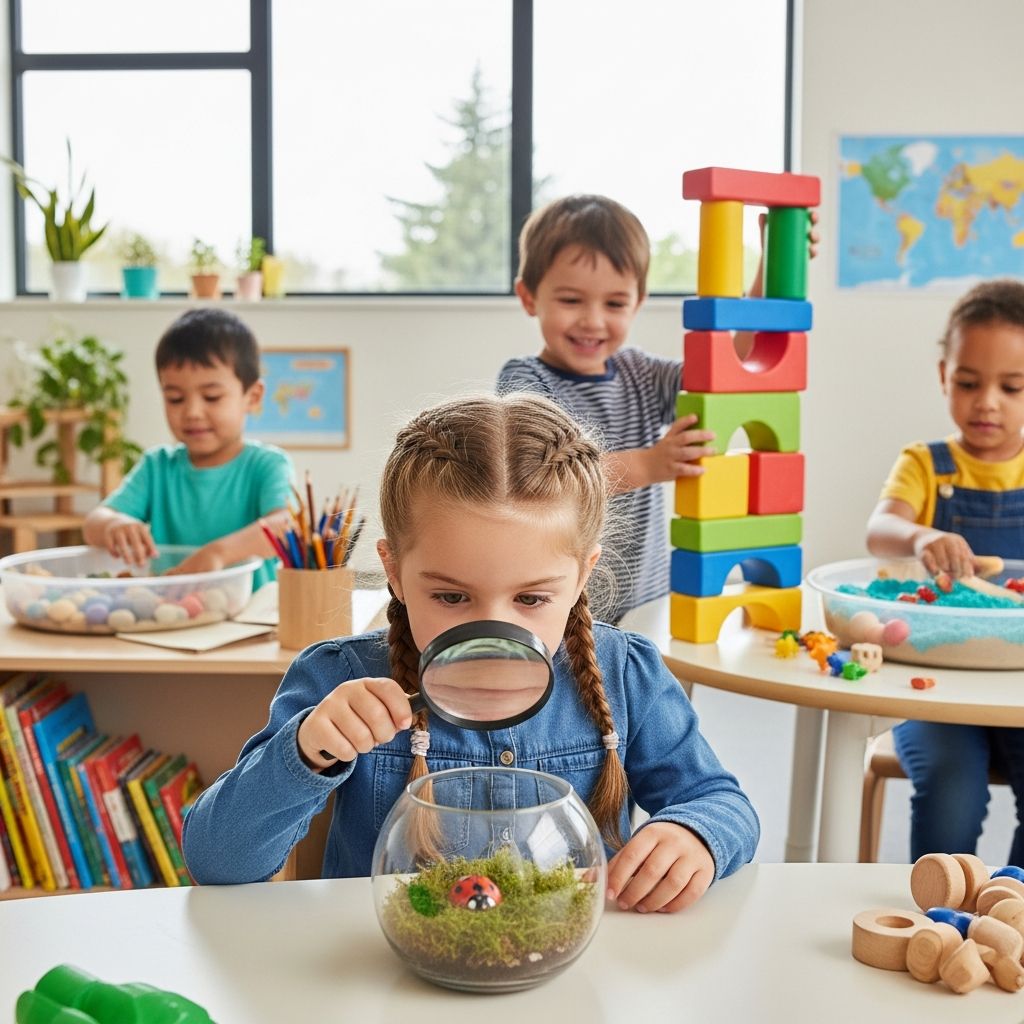
Sensory exploration—experiencing materials through touch, taste, smell, sight, and sound—builds neural connections and develops cognitive categories. When children investigate water through pouring, splashing, and observing floating objects, they’re developing concepts about physics, volume, and buoyancy that will support later academic learning.
Creative exploration through art materials supports cognitive development in ways that might not be immediately obvious. Drawing, painting, arranging materials, and creating constructions all involve problem-solving, spatial reasoning, and the ability to envision and execute ideas. The process matters far more than the product during preschool years.
Language Development Through Shared Exploration
Children’s vocabulary and language abilities expand dramatically during the preschool years, with most four-year-olds using three-word sentences and understanding increasingly complex instructions. Exploration provides the context that makes language learning meaningful and memorable.
When you explore alongside your child, you naturally provide language input tied to concrete experiences. Describing what you both observe—the texture of bark, the movement of water, the colors appearing as you paint—supplies vocabulary anchored to immediate sensory experience. This context-embedded language learning is far more effective than isolated word instruction.
Your child’s questions during exploration deserve thoughtful responses that invite further investigation rather than simply providing answers. When your preschooler asks “Why is the grass wet?” responding with “Let’s observe it together and discover what caused that” extends the learning opportunity and models curiosity as a valued approach to understanding the world.
Story-telling grows naturally from exploration experiences. A child who has climbed a challenging structure, investigated insects in the garden, or created an elaborate block construction will naturally narrate their experiences, developing narrative abilities and language complexity through play.
Emotional and Social Development Through Play-Based Exploration
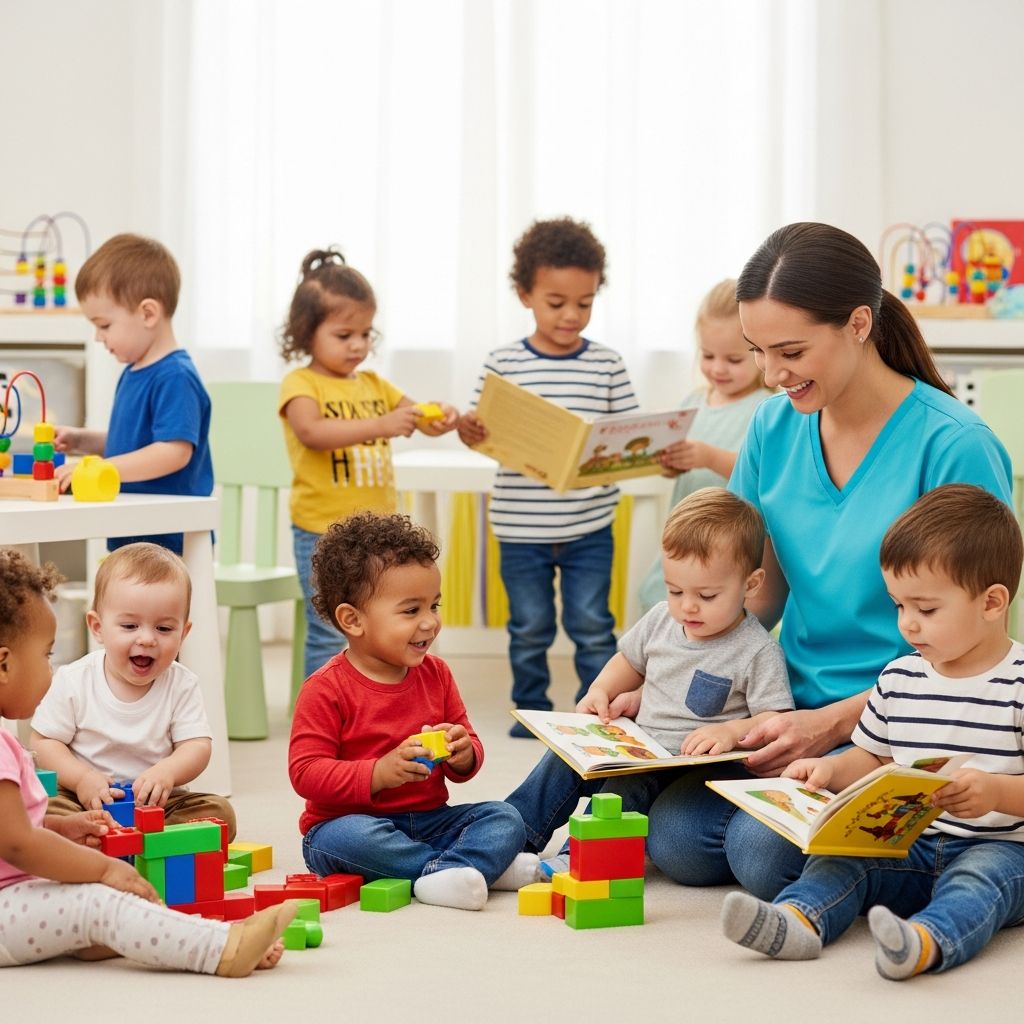
Preschool exploration isn’t solitary; it increasingly involves interaction with peers and adults. These social contexts during exploration build emotional regulation, cooperative abilities, and social understanding. When children explore together—building with blocks, creating art projects, or investigating outdoor environments—they learn to negotiate, share, and collaborate.
Role-play and imaginative exploration deserve particular emphasis as developers of emotional intelligence. When children engage in pretend play, taking on different roles and scenarios, they’re practicing emotional expression, considering others’ perspectives, and processing experiences. A child playing “doctor” while investigating toy medical equipment is simultaneously developing social understanding and managing feelings about healthcare experiences.
Exploration that involves some element of challenge builds emotional resilience. When your child attempts to catch a ball and misses repeatedly, discovers that their block tower topples, or finds that their current climbing ability doesn’t quite reach that high branch, they’re developing persistence and learning that setbacks are part of the learning process. Your supportive response—acknowledging effort rather than requiring success—teaches that exploration involves both accomplishment and productive struggle.
Developmental Milestones: What to Expect During Preschool Years
Understanding typical developmental progression helps you provide appropriately challenging exploration opportunities and recognize when consultation with healthcare providers might be helpful.
| Age Range | Physical Abilities | Cognitive Milestones | Language Development | Social-Emotional Skills |
|---|---|---|---|---|
| 3 Years | Runs easily, pedals tricycle, climbs stairs with support, catches bounced ball occasionally | Understands counting concept, names some colors, engages in imaginative play, follows two-part commands | Uses three-word sentences, speaks 75% understandably to strangers, knows own name, understands simple prepositions | Cooperates with other children, dresses and undresses self partially, plays pretend games, shows affection |
| 4 Years | Hops on one foot, stands on one foot 2+ seconds, throws overhand, climbs confidently, pedals tricycle well | Counts to 4, names colors, understands size relationships, recalls parts of stories, approaches problems from single viewpoint | Uses correct grammar including “he” and “she”, tells simple stories, sings songs from memory, speaks clearly | Increasingly inventive fantasy play, negotiates conflict solutions, shows initiative and curiosity, develops sense of right and wrong |
| 5 Years | Stands on one foot 5+ seconds, catches bounced ball easily, climbs and swings, heel-toe walks, balances well | Counts 10+ items, copies geometric shapes, draws person with 6+ body parts, understands time concepts, engages in elaborate storytelling | Speaks very clearly, uses future tense, states name and address, tells longer stories, uses words appropriately in context | Cooperates in group activities, understands rules and follows them, manages emotions better, shows pride in accomplishments |
Choosing Exploration Activities by Developmental Stage
Matching exploration opportunities to your child’s current abilities maintains the optimal balance of challenge and success. Activities that are too simple become boring; those that are too difficult create frustration rather than productive learning.
For three-year-olds, focus on sensory exploration and basic cause-and-effect activities. Water play, sand investigation, exploring containers and lids, and physical climbing all provide appropriate challenge. These children benefit from simple, concrete exploration with minimal rules.
For four-year-olds, introduce more complex materials and activities requiring sustained attention. Building with specific goals, searching for items in natural environments, basic cooking activities with adult supervision, and exploring how objects work all match emerging abilities. These children can follow more complex instructions and sustain interest in activities requiring multiple steps.
For five-year-olds, support exploration that involves planning and prediction. Simple science investigations, more elaborate building projects, collecting and sorting activities, and exploration requiring careful observation and documentation all suit their expanding cognitive abilities. These children can articulate what they’re learning and explain their processes.
Safety Considerations in Supporting Exploration
Encouraging exploration requires balancing freedom with protection. A completely unrestricted environment creates genuine hazards; an overly restricted environment inhibits learning. Effective safety involves removing serious dangers while tolerating minor risks that build competence and confidence.
Remove or secure items that pose serious injury risks: toxic substances, sharp objects, small choking hazards, and unstable furniture. However, allow exploration with items that pose minimal risks: bumping into soft furniture, falling from heights under three feet onto safe surfaces, getting dirty, and experiencing natural consequences of their actions within reason.
Supervise exploration appropriate to the activity and your child’s abilities. Your child investigating a sandbox requires less intensive monitoring than exploration involving water deep enough to pose drowning risk. As your child’s judgment and abilities develop, you can gradually reduce supervision while maintaining awareness of their activities.
Teach safety through instruction and modeling. Explaining why certain items aren’t available for exploration, demonstrating safe handling techniques, and acknowledging when your child makes safe choices all build internalized safety understanding.
When to Seek Professional Input
While typical development varies considerably, certain patterns warrant conversation with your child’s healthcare provider. These include significant delays in physical skills expected for your child’s age, limited engagement with activities or people, difficulty understanding simple language or following basic instructions, and behaviors that concern you relative to your child’s developmental stage.
Early identification of developmental concerns allows for timely support that can significantly impact outcomes. Your observations of your child’s exploration patterns, abilities, and interests provide valuable information for these conversations.
Frequently Asked Questions About Preschool Exploration
Q: How much unstructured exploration time does my preschooler need daily?
A: Most developmental experts recommend at least one to two hours of unstructured play and exploration daily, distributed throughout the day. This can be indoors or outdoors, with or without your direct participation, though your involvement enriches the experience.
Q: Is it okay to feel frustrated when my child asks endless questions?
A: Yes, feeling frustrated is normal; managing it productively is the goal. Brief explanations, inviting your child to investigate further, or suggesting you’ll explore together later all acknowledge your limits while honoring their curiosity.
Q: How do I encourage exploration if my child seems to prefer structured activities?
A: Some children are naturally more cautious. Gradually introduce open-ended exploration in safe, familiar environments. Your calm, interested participation models that exploration is valued and safe, gradually building your child’s confidence.
Q: What should I do when my child gets messy during exploration?
A: Mess is integral to exploration. Contain it practically with art smocks, newspaper, or outdoor spaces, but embrace it as evidence of meaningful engagement. The learning that happens through sensory exploration is worth the cleanup time.
Q: Can exploration happen during cold or rainy weather?
A: Absolutely. Puddles, rain sounds, seasonal changes, and cold-weather textures all provide rich exploration opportunities. Proper clothing enables year-round outdoor engagement that develops resilience and adaptability.
Q: How do I balance exploration with necessary structure and rules?
A: Structure and exploration coexist. Establish clear, consistent expectations while providing substantial time within those boundaries for self-directed investigation. Knowing the rules creates safety that actually enables more confident exploration.
References
- Development & Milestones for Pre-K Children (4-5 years) — Michigan Department of Health and Human Services. 2024. https://www.michigan.gov/mikidsmatter/parents/pre-k/milestones
- Preschooler development — MedlinePlus Medical Encyclopedia, U.S. National Library of Medicine. 2024. https://medlineplus.gov/ency/article/002013.htm
- Developmental Milestones: 3 to 4 Year Olds — American Academy of Pediatrics. 2024. https://www.healthychildren.org/English/ages-stages/preschool/Pages/Developmental-Milestones-3-to-4-Year-Olds.aspx
- Growth & Development: 3-5 Years — Riley Children’s Health, Indiana University. 2024. https://www.rileychildrens.org/health-info/growth-development-3-5-years
- Developmental Milestones by Year — Illinois Cares for Kids. 2024. https://www.illinoiscaresforkids.org/preschool-en/child-development/milestones-by-year
- Developmental Milestones for Preschoolers — Ages and Stages Questionnaires. 2024. https://agesandstages.com/developmental-milestones-articles/developmental-milestones-for-preschoolers/