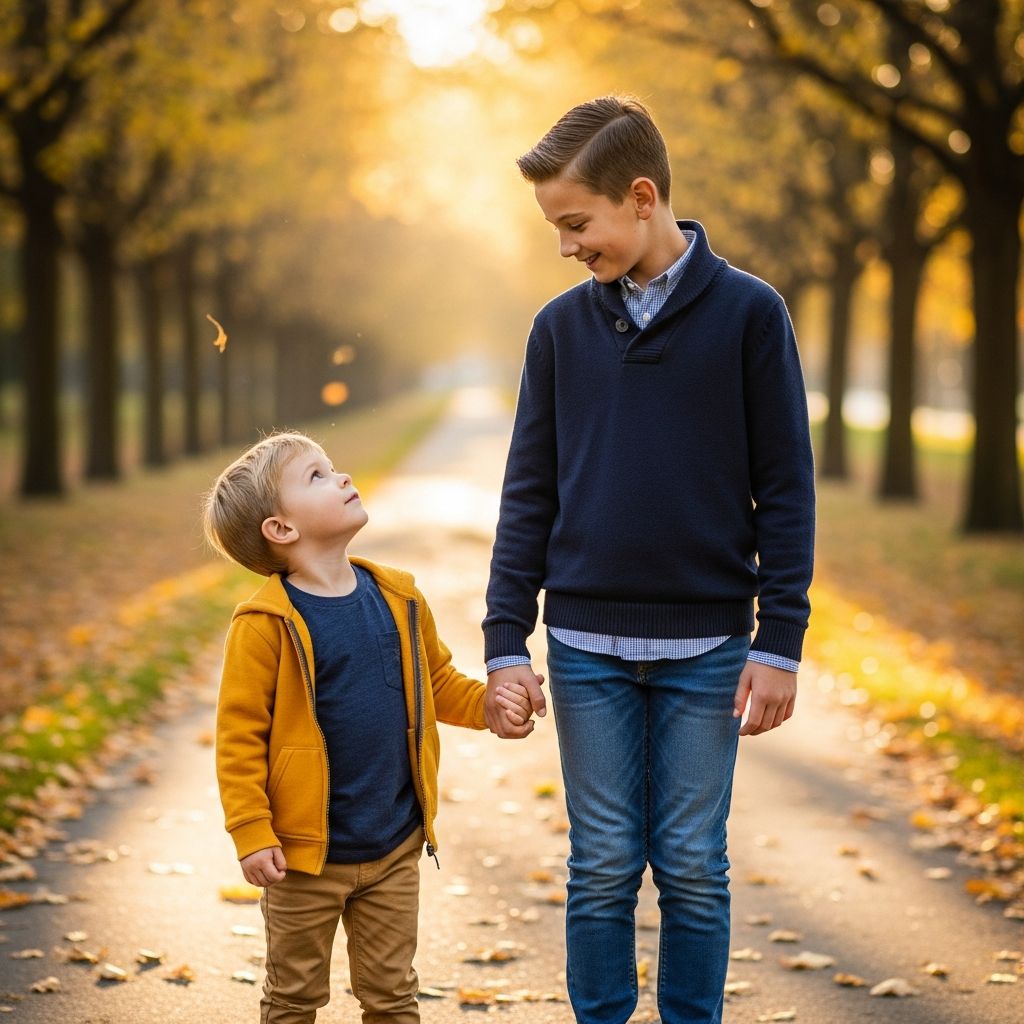
Brothers can be each other’s fiercest rivals and also one another’s strongest allies. As a parent, you cannot choose how your sons will feel about each other, but you can shape the environment that makes warm, supportive sibling relationships far more likely to grow and last.
This article offers a research-informed, practical guide to helping brothers move from competition and conflict toward cooperation, respect, and lifelong connection.
Why Sibling Bonds Matter More Than We Think
Many parents focus on their relationship with each child and underestimate how powerful the sibling bond is. Developmental research shows that siblings are among the most influential people in a child’s life, second only to parents.
- Emotional development: Siblings help each other learn about emotions, perspective-taking, and empathy during everyday interactions and conflicts.
- Social skills: Warm sibling relationships are linked with better peer acceptance, social competence, and conflict resolution skills.
- Mental health and resilience: Supportive siblings can buffer the effects of stress, such as bullying or parental conflict, and are associated with improved well-being across the lifespan.
- Life-long impact: Sibling relationships often last longer than relationships with parents or partners and can influence physical and psychological health into older age.
For brothers, who may be socialized to compete, be tough, or hide vulnerability, parental guidance is especially important to tilt their bond toward warmth rather than rivalry.
Understanding Brothers: Connection, Competition, and Identity
To effectively support your sons’ relationship, it helps to understand what is happening beneath the surface when they clash or pull away from each other.
Different Roles, Shared Parents
Brothers share the same parents and home, but their experiences inside the family are not identical. Research on sibling dynamics shows that children carve out different “niches” in the family system to feel special and valued.
- One brother may become the easy, responsible child; another, the funny or rebellious one.
- These roles can reduce direct competition, but they can also lock children into identities that limit them.
- Perceived parental favoritism or repeated comparison can sharpen rivalry and increase conflict.
Why Brothers Compete So Intensely
From a child’s viewpoint, a sibling is a competitor for their most scarce and precious resources: parental time, attention, and affection.
Common triggers for rivalry include:
- Close age spacing: Brothers near in age often compete in the same areas (sports, academics, peers).
- Overlapping interests: The more similar their interests and abilities, the easier it is for comparison to creep in.
- Perceived unfairness: If boys feel one brother is consistently favored, they are more likely to direct anger toward each other rather than toward the situation.
- Developmental changes: In adolescence, growing independence can either deepen the bond or intensify distance, depending on how conflict is handled.
| Common Challenge | What Brothers May Feel | Helpful Parental Response |
|---|---|---|
| One brother excels, the other struggles | Inadequacy, jealousy, shame | De-emphasize comparison, focus on effort and unique strengths |
| Frequent teasing & name-calling | Hurt, insecurity, confusion about boundaries | Set clear limits; label behavior, not child; coach repair |
| Physical fights | Overwhelm, anger, lack of skills for self-control | Ensure safety first; later, teach calming and problem-solving |
| One brother withdraws | Feeling overshadowed, hopeless, or unheard | Offer 1:1 connection; validate experience; give voice in decisions |
The Parent’s Role: From Referee to Relationship Coach
Parents cannot force affection, but they can create the emotional climate and daily habits that help affection grow. Research suggests that sibling dynamics are strongly shaped by parenting practices and the overall family environment.
1. Invest in One-on-One Time
When each brother feels deeply connected to you, he is less likely to see his sibling as a threat.
- Schedule regular individual time with each child, even 10–15 minutes a day.
- Let the child choose the activity, with no agenda beyond enjoyment.
- During that time, avoid criticism, correction, or multitasking; your undivided attention is the point.
2. Replace Comparison with Individualized Support
Even positive comparisons (“You’re the smart one”) can fuel competition and pressure. Instead:
- Notice and comment on effort, strategies, and kindness, rather than traits or rankings.
- Avoid phrases that pit brothers against each other (for example, “Why can’t you be more like your brother?”).
- Help each child discover and develop strengths in different domains, so they do not feel forced to compete in the same lane.
3. Set Non-Negotiable Limits on Harm
Warmth and closeness grow best when everyone feels safe. Teasing and roughhousing are common among brothers, but there must be a clear line:
- State family rules simply: no hitting, no cruel words, no destroying each other’s belongings.
- Hold the limit firmly and calmly. Separate children if needed, then return later to problem-solve.
- Teach the difference between playful teasing (which both enjoy) and hurtful comments.
4. Shift from Blame to Problem-Solving
Constantly deciding “who started it” tends to increase resentment. A more effective approach is to act as a coach helping them learn skills they will use for life.
When a conflict erupts, you can:
- Describe what you see without taking sides: “I hear yelling. It sounds like you both want the same toy.”
- Help them name feelings: “You’re furious because he grabbed it. You’re frustrated because you felt left out.”
- Guide them to brainstorm options: taking turns, trading, or choosing a new activity.
- Invite them to agree on a solution, rather than imposing one immediately.
Studies of sibling-focused interventions show that when children are taught emotion regulation and conflict resolution skills, their relationships improve and problem behaviors decrease.
Practical Tools to Reduce Rivalry and Build Connection
Below are concrete strategies you can begin using today to help your sons relate more respectfully and warmly.
Use Language That Connects Brothers to Each Other
- Frequently name them as a team: “You two are finding a solution together,” “My favorite brothers are in the kitchen.”
- Point out moments of kindness: “I noticed you waited for your brother before starting the game. That was thoughtful.”
- Tell positive stories about their cooperation or shared adventures, so they build a joint identity that is not only about conflict.
Plan for Shared Joy, Not Just Shared Space
Being under the same roof is not enough to create closeness. Help your sons build good memories together.
- Create simple weekly rituals: a game night, a shared walk, or a special Saturday breakfast.
- Encourage collaborative projects: building something, cooking together, or co-creating a story or video.
- Rotate leadership: sometimes the older brother guides; other times the younger chooses the activity.
Support Healthy Autonomy
Too much forced togetherness can backfire. Each brother also needs space to develop his own identity.
- Respect differences in temperament and interests; do not insist they like all the same things.
- Allow friendships and activities that are unique to each child.
- Protect personal possessions and privacy to reduce everyday friction.
When One Child Has Extra Needs
If one brother has a medical condition, learning difficulty, or behavior challenge, he may receive more attention from adults. The other brother may silently feel invisible or overburdened.
- Explain, in age-appropriate language, why some supports are necessary, without idealizing or vilifying either child.
- Build in dedicated time with the sibling who gets less obvious attention, even if only in small pockets.
- Invite that child’s feelings: “It’s okay to be annoyed that we spend so much time at appointments. I want to hear how this is for you.”
Growing Up Together: Brothers Across the Ages
Sibling relationships evolve over time. Understanding typical patterns can help you respond with more compassion and less panic when things shift.
Early Childhood: Intense Emotions and Fast Learning
- Young brothers may swing rapidly between affection and aggression.
- Their conflicts are powerful opportunities to learn sharing, turn-taking, and empathy.
- They need adults close by to supervise, protect safety, and narrate feelings and solutions.
Middle Childhood: Negotiation and Fairness
- School-age brothers become more sensitive to fairness and comparison.
- Rules, games, and shared chores can either become battlefields or arenas for practicing cooperation.
- They benefit from learning negotiation skills and from being included in family decision-making.
Adolescence: Distance, Identity, and New Respect
- Teen brothers may pull away from family as they invest more in peers.
- Older brothers can become role models—positive or negative—especially around risk behaviors and academic engagement.
- Parents can foster respect by treating teens more like partners in problem-solving and by honoring confidentiality.
Adulthood and Beyond: From Shared Childhood to Lifelong Ally
As parental authority recedes, brothers’ relationships become more voluntary. Research shows that contact, support, and feelings of closeness in sibling relationships are linked to better psychological and physical health in later life.
- Early patterns of mutual support can lay the groundwork for brothers to remain reliable allies in adulthood.
- Even strained sibling relationships can sometimes be repaired later, especially when family crises highlight the value of connection.
Frequently Asked Questions (FAQs)
Q1: Is sibling rivalry between brothers always a bad sign?
A moderate level of conflict is normal and can even help brothers practice negotiation, perspective-taking, and self-control. What matters is whether conflicts are resolved, whether there is an overall sense of warmth and safety, and whether children are learning more constructive ways to handle disagreements over time.
Q2: How do I know when to step in and when to let them work it out?
Step in immediately if there is any risk of physical or emotional harm (for example, hitting, threats, or repeated insults). In lower-intensity conflicts, you can stay nearby and coach from the sidelines—helping them name feelings and brainstorm solutions—without deciding everything for them. As they gain skills, you can gradually give them more room to solve problems on their own.
Q3: What if one brother always seems to be the aggressor?
Look beneath the behavior. A child who frequently lashes out is usually overwhelmed by big feelings or unmet needs. Meet privately with that child to understand what is driving the behavior, teach calming strategies, and set firm limits on hurtful actions. At the same time, avoid labeling him as the “mean” or “problem” brother, which can reinforce the role and damage self-esteem.
Q4: Can brothers who constantly fight as kids ever become close adults?
Yes. Many adults report that their relationships with siblings improved dramatically once they left home, matured, or resolved earlier hurts. Patterns built in childhood are influential but not destiny. Modeling repair, apology, and honest conversation now increases the chances that your sons can rebuild and deepen their bond later in life.
Q5: How can I help my older son welcome a new baby brother?
Involve the older child early—talk about the baby as “our” baby, show his baby pictures, and emphasize that your love for him is unchangeable. After the baby arrives, protect daily one-on-one time with the older brother, acknowledge mixed feelings (“Part of you likes being a big brother, part of you misses how it used to be”), and give him meaningful, age-appropriate ways to help that do not turn him into a second parent.
References
- Theoretical Perspectives on Sibling Relationships — Kim, J. Y., McHale, S. M., Crouter, A. C. 2011-06-01. https://pmc.ncbi.nlm.nih.gov/articles/PMC3127252/
- Sibling Relationships and Influences in Childhood and Adolescence — McHale, S. M., Updegraff, K. A., Whiteman, S. D. 2012-02-01. https://pmc.ncbi.nlm.nih.gov/articles/PMC3956653/
- Sibling Relations and Their Impact on Children’s Development — Howe, N., Recchia, H. 2014-01-01. Encyclopedia on Early Childhood Development. https://www.child-encyclopedia.com/peer-relations/according-experts/sibling-relations-and-their-impact-childrens-development
- Improving Sibling Relationships — Azar, B. American Psychological Association Monitor on Psychology. 2022-03-01. https://www.apa.org/monitor/2022/03/feature-sibling-relationships
- Positive Sibling Relationships — University of New Hampshire, Sexual Assault & Rape Awareness Program. 2020-01-01. https://www.unh.edu/saara/our-work/positive-sibling-relationships
- Sibling Relationships — EBSCO Research Starters. 2019-01-01. https://www.ebsco.com/research-starters/health-and-medicine/sibling-relationships