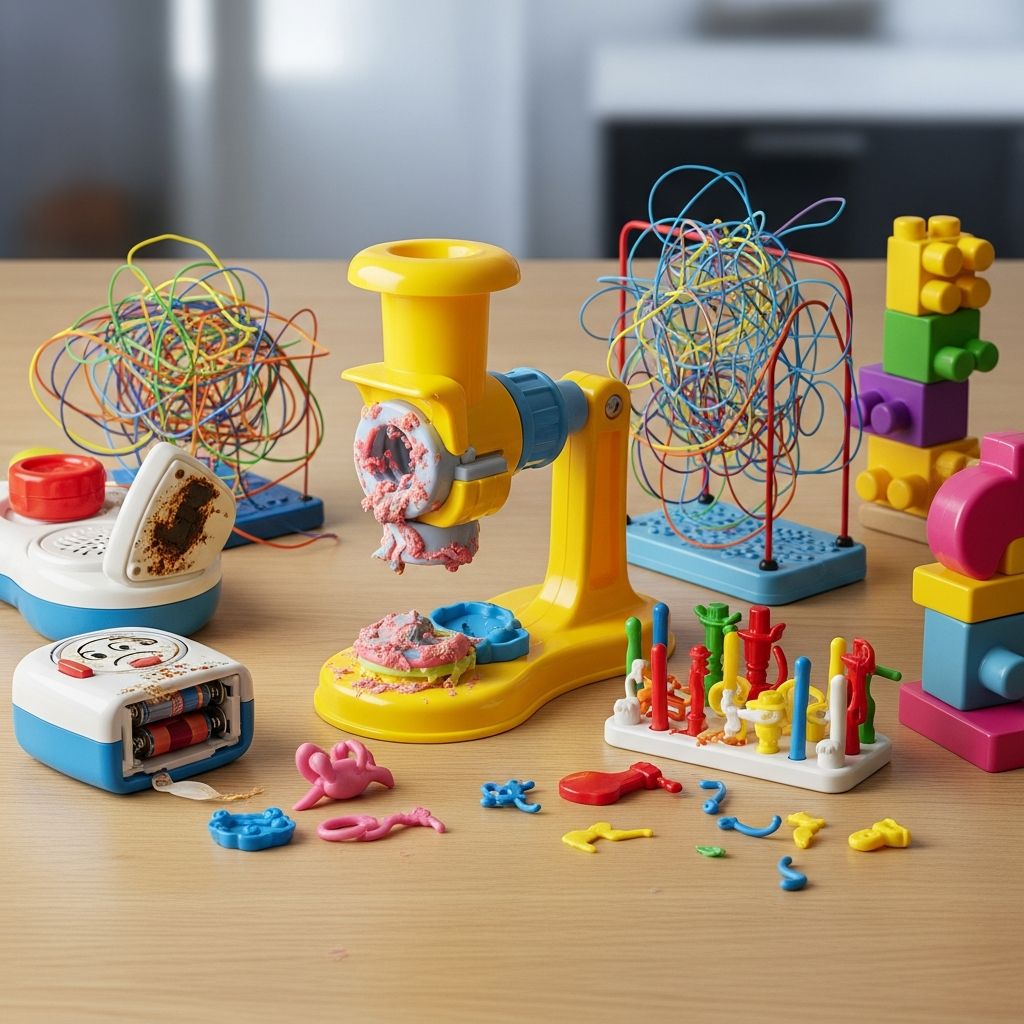
Every holiday season and birthday party brings a new wave of toys into your home, and not all of them deserve a spot on your living room floor. Some toys are noisy nightmares, others break in a weekend, and a surprising number seem designed to entertain no one except the marketing department. This anti-gift playbook is here to help you spot the worst kinds of children’s toys before they invade your closets and your sanity.
Why Some Toys Feel Like Regrets With Price Tags
Bad toys are not just mild annoyances; they waste money, clutter your space, and sometimes even get in the way of the kind of open-ended, imaginative play kids actually need. They dazzle at the store shelf, but disappoint at home when batteries die, tiny parts disappear, or your child abandons them after five minutes. Understanding why certain toys fail helps you recognize the red flags hidden behind the shiny packaging.
When toys are purchased as reflex gifts rather than thoughtful choices, they tend to prioritize gimmicks, noise, and trends over child development and real enjoyment. Shifting the goal from “What looks impressive to give?” to “What will my child actually use and love?” is the foundation of a smart anti-gift strategy.
Red Flags: How To Spot a Terrible Toy in Seconds
Some of the worst toys share the same warning signs, no matter the brand or age range. Learning these patterns lets you quickly filter out bad buys while browsing online or wandering down crowded toy aisles. Use this checklist as your internal alarm system.
- It relies almost entirely on lights, sound, and movement, leaving your child nothing meaningful to do.
- The toy has a single very specific script or way to play, and no obvious room for imagination.
- The packaging shows more fun than the toy can actually deliver once opened.
- There are dozens of tiny detachable parts that look doomed for the vacuum cleaner.
- Everything about it screams “novelty” instead of “play value.”
Category One: The Button-Mashing Noise Machines
Noise-machine toys look high-tech and educational, but often reduce your child’s role to pressing the same button again and again. They shout the alphabet, blast songs, and repeat the same phrases until the adults in the house start Googling how to remove the batteries without breaking the toy. The problem is not technology itself—it’s that the toy does all the work.
Kids benefit far more from toys that invite them to create sounds, rhythms, and stories, not just trigger a pre-recorded jingle. When a toy’s main appeal is the ability to shriek at 120 decibels in three languages, you have every right to quietly retire it to the top shelf.
- Common warning labels: “Plays 50 songs!” and “Lights and sounds!” with no mention of what your child actually does.
- Likely outcomes: Rapid boredom for kids, slow rage for adults, and a quick trip to the donation box.
- Better alternative: Simple instruments, magnetic tiles, building blocks, art supplies, and toys that respond differently depending on how your child uses them.
Category Two: Hyper-Gendered, Stereotype-Heavy Toys
Certain aisles still divide toys into pink “domestic helper” sets and dark, aggressive “action” toys, subtly telling kids what is meant for them and what is not. Hyper-gendered toys can limit the kinds of stories children tell and the skills they feel invited to explore. The issue is not a single doll or a single superhero; it is when the entire toy collection sends the same narrow message.
When every toy aimed at girls is about grooming, caretaking, and appearance, and toys marketed to boys are all about combat, chaos, and danger, both groups lose opportunities. Kids benefit most from a mix of nurturing, building, creative, and adventurous play options regardless of the colors on the box.
- Signs to watch: Only one style of play is being encouraged, like constant beauty rituals or non-stop battles.
- Why to skip: These toys can reinforce limiting ideas about what kids should like or who they should be.
- Better alternative: Neutral building sets, science kits, craft materials, pretend play props, and dolls or figures that represent diverse characters and roles.
Category Three: Toys That Need Constant Adult Operation
Some toys look fantastic but secretly cast parents as unpaid stage crew. They require complicated assembly every time, finicky resetting, or a grown-up to stand there and make the magic happen. The child’s role becomes waiting while an exhausted adult fixes, charges, reboots, or reconfigures the toy, often multiple times per play session.
A toy your child cannot use independently is more like a fragile prop than an actual plaything. The more a toy depends on an adult to run it, reload it, or interpret it, the less likely it is to become a true favorite. Independence and repeat play should be built in, not bolted on.
- Common culprits: Overly complex craft sets, mechanical gadgets that jam easily, toys with multiple locked modes or apps to manage.
- Stress test: Ask, “Could my child play with this on the floor while I drink coffee, or will I constantly be troubleshooting?”
- Better alternative: Open-ended sets where kids can set up, modify, and clean up on their own with minimal help.
Category Four: Disposable Trend Toys and Collectible Clutter
Trend toys rely on hype, unboxing videos, and peer pressure more than genuine play value. They arrive in flashy packaging, release in endless series, and encourage your child to “collect them all,” even though each piece does very little. After the initial excitement fades, parents are left stepping on tiny figurines, shells, or plastic accessories with no clear purpose.
These collections grow fast and offer surprisingly little in return. While a few favorite pieces may be loved, the rest drift into junk-drawer status. If a toy line is mainly about collecting, trading, or displaying, with very little imaginative play built in, it is likely to wind up in a donation box by spring.
- Red flag: The packaging emphasizes rarity, mystery blind bags, or lots of series numbers instead of what kids can actually do with the toy.
- Hidden cost: Repeated small purchases that collectively exceed the price of one great, versatile toy.
- Better alternative: A single, sturdy play set or building system that can be used in many ways instead of dozens of tiny, nearly identical trinkets.
Category Five: Toys That Try Too Hard to Be “Educational”
There is nothing wrong with wanting toys to support learning, but some products slap “STEM,” “brain-boosting,” or “genius” onto the box without offering genuine depth. These toys may drill facts or skills in a narrow way, using screens, flashcards, or rigid tasks masquerading as play. They often underestimate what children can learn through simple, unstructured exploration.
True learning toys respect a child’s curiosity and invite questions, experiments, and creativity. The most powerful “educational” toys are often deceptively simple: blocks, puzzles, pretend kitchen sets, magnifying glasses, cardboard, or art materials. When you strip away the marketing buzzwords, you start to see which toys actually help kids think for themselves.
- Marketing tell: Long lists of academic claims on the box but very few ways to use the toy beyond one activity.
- Kid test: Does your child light up with ideas, or just tap the same button to move to the next level?
- Better alternative: Tools and kits that your child can use in many ways: building sets, science experiment kits, open-ended puzzles, and materials for making and inventing.
A Quick Reference Table for Parents in the Aisle
Use this simple table as a mental shortcut when you are facing an overwhelming toy section or scrolling through pages of online options. It highlights what typically makes a toy frustrating or short-lived and what tends to make it worth the space it takes up.
| Problem Toy Pattern | Why It Fails | What to Look for Instead |
|---|---|---|
| Noise-only button toys | Kids press buttons but do not create or imagine much. | Toys that respond differently based on how they are used: building sets, instruments, pretend props. |
| Overly gendered sets | They funnel kids into narrow roles and storylines. | Neutral, flexible toys that support a wide range of interests for any child. |
| Adult-operated gadgets | Require constant help, quickly exhausting parents and kids. | Toys kids can set up and reset alone with minimal instructions. |
| Collectible mini-trinkets | Create clutter and offer little deep play. | Single, high-quality sets that grow with your child. |
| Buzzword-heavy “learning” toys | Drill skills but limit creativity and open-ended exploration. | Tools and materials that spark curiosity and experimentation. |
Practical Rules for Smarter Toy Shopping
Once you can recognize bad-toy patterns, the next step is building simple rules that guide your buying decisions. These rules help you say no quickly, avoid guilt, and stay focused on what truly benefits your child. They also provide a helpful script when relatives ask what to buy.
- The “One Year” Rule: Ask whether this toy could still be interesting a year from now. If the answer is no, think twice.
- The “Many Ways to Play” Rule: Avoid toys that only do one trick. Prioritize items that can be used differently as your child grows.
- The “Quiet Test” Rule: Picture this toy with no batteries. If it no longer seems fun, skip it.
- The “Storage Space” Rule: Decide where the toy will live before buying. If there is no space, it may not be worth it.
- The “Real Interest” Rule: Choose toys that match the way your child already plays instead of how you wish they would play.
Talking to Well-Meaning Gift-Givers Without Sounding Ungrateful
Friends and relatives often love giving toys, but they do not always see the clutter or chaos those toys create in your home. A gentle, proactive conversation can guide them toward gifts that fit your family’s values and space. Framing your preferences as positive options rather than a list of banned items usually works best.
Instead of simply saying “no noisy plastic toys,” try suggesting categories you would love to receive. Offering specific ideas makes it easier for others to support your approach while still feeling included in your child’s joy and milestones.
- Share a short wish list or registry featuring books, building toys, or art supplies.
- Encourage experience gifts like museum passes, zoo trips, or classes.
- Mention your child’s genuine interests: trains, animals, drawing, building, nature.
- Offer to keep a shared list updated so relatives always have a few safe options.
When Bad Toys Sneak In Anyway
Even with the best intentions, questionable toys will appear—party favors, prize boxes, random gifts from well-meaning neighbors. You do not have to keep every item that enters your house. Part of the anti-gift mindset is recognizing that your job is to curate your child’s environment, not preserve every object forever.
It is helpful to quietly rotate or retire toys that are broken, overly loud, or consistently ignored. You can involve older children in the decluttering process, teaching them how to evaluate what they truly use and love. This turns the conversation from “getting rid of toys” into “making space for better play.”
- Keep a donation box accessible for toys your child has outgrown or lost interest in.
- Institute occasional “toy vacations,” where crowded items are stored away to see if they are actually missed.
- Encourage kids to choose a toy to donate when a new one comes in, reinforcing the idea of mindful ownership.
Frequently Asked Questions About Bad Toys
Are electronic toys always a bad idea?
Not necessarily. Electronic toys can be valuable if they truly expand what kids can create or explore rather than just entertain passively. The key is whether your child is an active participant—making choices, building, experimenting—or just a spectator to flashing lights and songs.
How many toys does a child really need?
There is no universal number, but most children thrive with fewer, better toys. A smaller selection of high-quality, open-ended items usually leads to deeper play, less overwhelm, and easier clean-up than an overflowing room of random gadgets and trinkets.
Is it okay to donate toys my child still occasionally plays with?
Yes, if a toy consistently causes frustration, chaos, or conflict, it is reasonable to let it go even if it gets rare use. Consider whether that playtime is meaningful or just a brief distraction, and whether something else in your home already meets the same need more effectively.
What if my child begs for a specific toy I dislike?
Compromise options include borrowing the item from a friend, choosing a smaller version, or setting clear expectations about where and when it can be used. You can also pair a trend toy with a more timeless option, balancing your child’s wishes with your long-term goals for your home and budget.
How can I involve my child in choosing better toys?
Talk openly about what makes a toy fun over time rather than just fun on the first day. Invite your child to notice which toys they return to again and again, and use that insight together when making new choices. This builds early financial awareness and strengthens their ability to evaluate quality and purpose.
From Anti-Gift to Pro-Play
Calling this an anti-gift guide does not mean being against presents or joy; it means being firmly against clutter, waste, and toys that ignore what kids actually need from play. Once you start evaluating toys through the lens of long-term value, independence, creativity, and storytelling potential, your shopping habits begin to shift.
The goal is a home where toys earn their place: fewer plastic regrets, more well-loved favorites, and a play space that reflects your child’s personality instead of the latest advertising campaign. Saying no to bad toys is really about saying a bigger yes to meaningful, imaginative, and genuinely fun play.