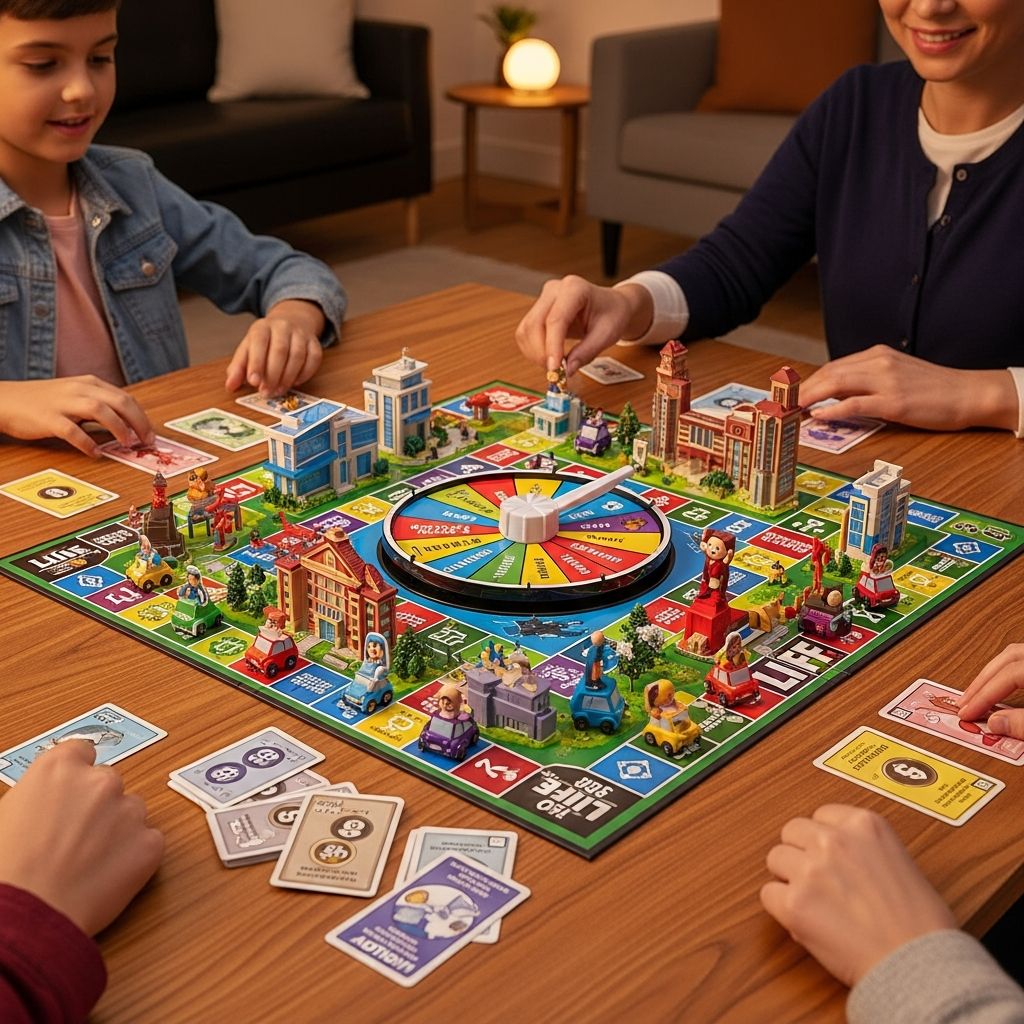
The Game of Life is a staple of family game closets, but the default rules can feel a little shallow, a little outdated, and sometimes over-focused on money. Many families sense that the game could be more strategic, more inclusive, and more meaningful without losing its silly charm. This article offers a fresh, fully original approach to reimagining The Game of Life with new house rules, story twists, and play ideas that fit today’s kids and parents.
Think of this as a complete makeover: you will keep the board and basic flow, but customize almost everything else—goals, choices, conversations, and even what “winning” means. The goal is to turn a light roll-and-move game into a playful tool for connection, critical thinking, and real-world reflection.
Why Bother Upgrading The Game of Life?
Many families enjoy the game at first, then realize that most decisions barely matter, and whoever earns the highest salary almost always wins. That can unintentionally send the message that success is only about money and that luck is more important than thoughtful choices. Updating the game can balance those messages and make it more engaging for everyone.
By adding simple house rules, you can give players more real decisions, explore multiple paths to success, and let kids test ideas about careers, education, relationships, and risk in a low-stakes, funny, cardboard world. It becomes less of a race to be the richest and more of a conversation about what kind of “life” each player wants to build.
Core Design Goals for Your House Rules
Before changing anything, decide what you want the upgraded game to emphasize. Clarifying a few guiding principles helps keep your tweaks coherent instead of random. Below are some common goals that work well together.
- More meaningful choices: Players should feel that decisions about education, family, and spending actually affect their outcome.
- Multiple ways to succeed: Money can still matter, but it should share the spotlight with happiness, generosity, and experiences.
- Modern values: Reflect today’s families by including flexible careers, diverse households, and shared responsibilities.
- Conversation and reflection: Use events in the game as prompts to talk about priorities, trade-offs, and what “a good life” means.
Redefining What It Means to Win
The original game typically declares the winner as whoever has the most money at the end. That rule is easy but narrow. Consider transforming the victory conditions into something richer that sparks conversation instead of quiet math.
One approach is to count several types of “life points” at the end: money, relationships, and experiences. Each category can be tracked with simple tokens or small tally marks on a scratch sheet.
A Three-Pillar Scoring Model
Try this scoring system to keep things simple yet meaningful:
- Wealth points: Every fixed amount of in-game money (for example, 100,000 units) equals 1 wealth point.
- Relationship points: Partners, kids, friends, pets, or community ties each give points.
- Experience points: Travel, hobbies, creative projects, and acts of kindness also add points.
At the end of the game, add up the three pillars. If you want a single “winner,” crown whoever has the highest combined total—but also talk about who had the strongest relationships, who took the boldest risks, and who created the most interesting story.
Optional Scoring Framework
Use the following example table as a starting template. You can adjust the numbers to fit your family’s preferences and your version of the game.
| Category | Example Elements | Suggested Value |
|---|---|---|
| Wealth | Money, houses, investments at end of game | 1 point per 100,000 currency units |
| Relationships | Partner, each child, long-term friend, pet | 2 points per relationship token |
| Experiences | Trips, community projects, hobbies, creative risks | 1 point per experience card or marker |
| Giving Back | Charity, mentoring, helping other players | 1–3 bonus points per act, agreed by table |
Revamping Career and Education Choices
Many versions of The Game of Life present a fairly simple fork: go to college and earn more, or skip it and start earlier. Real life, of course, is more complicated. You can capture a bit of that nuance without turning the game into a spreadsheet.
Consider designing a more flexible career deck that lets players change direction, add skills, or mix passion projects with income-generating work. The aim is to let kids experiment with different models of “work” instead of assuming one track fits everyone.
Ideas for Career House Rules
- Multiple on-ramps: Allow players to enter school or training later in the game in exchange for temporary debt or time costs.
- Dual careers: Give players the option to hold a primary job plus a “side quest” occupation that yields experiences or relationship points rather than just cash.
- Skill tokens: When players land on learning-related spaces, award tokens that slightly improve future payouts or reduce certain penalties.
Making Risk and Reward More Interesting
In many families’ experience, some spaces in the game feel like trivial fees or small bonuses that rarely change the story. You can raise the stakes by turning risk into a central theme: players choose between safer, slower routes and bolder, swingy gambles.
Introduce clearly labeled “cautious” and “adventurous” paths whenever the board offers a fork. On the cautious path, gains and losses are mild; on the adventurous path, players can either leap ahead or fall behind in dramatic fashion. This adds suspense and lets players discuss how risk feels to them.
Sample Risk Options to Add
- Startup gamble: Pay a large fee now and roll a die; high rolls generate big payouts later, low rolls mean the business fizzles.
- Safe savings: Skip a risky opportunity to place a token in a “savings” area that yields modest, guaranteed returns near the end.
- Community project: Invest time and money in a neighborhood initiative that yields fewer wealth points but multiple relationship and experience points.
Updating Family and Relationship Storylines
Older versions of the game often assume a single type of household. Modern families are far more varied, and kids notice when their reality is missing. You can gently refresh the relationship and family aspects to be more inclusive and less scripted while keeping the tone light.
Think broadly about relationships: friends who share a hobby, mentors, beloved neighbors, or cousins can matter as much as partners or kids. Each connection can be represented by a peg, card, or token that carries relationship points.
Flexible Family House Rules
- Choose your household: When reaching key life-milestone spaces, allow each player to describe briefly what their household looks like, rather than forcing a single model.
- Friendship spaces: Add spaces where players gain a long-term friend who boosts experience or relationship points later in the game.
- Shared decisions: If two players are “partners,” allow them to decide together how to handle big choices and share some resources.
Turning Money Into a Tool, Not the Point
Instead of treating money as the sole measure of success, position it as a resource that supports the life a player wants to build. Ask players to decide how they want to budget: higher housing costs for more experience points, smaller incomes but more free time, charitable giving that reduces wealth but increases other scores.
You can even introduce a light budgeting mechanic. Allow players to maintain a simple three-way split of income: essentials, fun, and giving. When a player chooses how to allocate a windfall, discuss why they picked that split. The conversation may be more valuable than the points.
Quick-Start Variant: Life Stories Edition
If your family is not ready for a full rules overhaul, try this contained variant. You keep most of the normal rules, but give players a story objective at the start of the game. The objective nudges how they interpret events and what choices they make.
Write a few short objectives on index cards and deal one to each player. Examples include “Build a life centered on creativity,” “Focus on helping others,” or “Seek adventure and travel.” Players still earn money as usual, but at the end, everyone votes on whose story best matched their objective.
Sample Story Objectives
- Become someone who tries new things and collects memorable experiences rather than the biggest paycheck.
- Put relationships first by choosing actions that help family, friends, and community whenever possible.
- Balance financial stability with personal passions so that work supports, rather than replaces, your interests.
Conversation Prompts to Use During Play
To turn the game into a springboard for reflection without making it feel like homework, weave in casual, open-ended questions. Keep them light, respect each child’s comfort level, and model that there are no “right” answers.
- “If this event happened in real life, how would you feel about it?”
- “Would you make the same decision if this were not a game? Why or why not?”
- “What’s one non-money reason you might choose this option?”
- “If you could redesign this space on the board, what would you make it do?”
Age-Based Tweaks for Different Players
Mixed-age groups can struggle when younger kids feel left behind by complex decisions. Tweak your house rules based on who is playing so that everyone can participate at their own level. Think of it as offering difficulty settings, like a video game.
Below is a simple suggestion list you can adapt for your household.
| Age Group | Suggested Adjustments |
|---|---|
| Young kids (6–8) | Fewer options per turn, simplified scoring, and extra help with money math from older players. |
| Tweens (9–12) | Full choice options, story objectives, and light budgeting or skill tokens. |
| Teens & adults | All house rules, riskier paths, debates about scoring and values, and self-designed career or life cards. |
Designing Your Own Event Cards
One of the fastest ways to refresh The Game of Life is to create your own deck of event cards. Use index cards or small pieces of paper. Each card can describe a scenario and its consequences in terms of money, relationships, and experiences.
Encourage everyone at the table—including kids—to contribute ideas. Events can be serious, silly, or somewhere in between. The shared creativity becomes part of the fun, and kids feel a sense of ownership over the game world.
Tips for Homemade Event Cards
- Give each card a small trade-off: gain something in one area while sacrificing a bit in another.
- Mix realistic events (changing jobs, moving cities) with imaginative ones (adopting a dragon, opening a space bakery).
- Include a short question on some cards, such as “Would you accept this opportunity in real life?” to spark quick discussion.
Keeping Game Night Fun, Not Preachy
With all these new layers, there is a risk of turning game night into a lecture. Guard against that by preserving silliness and unpredictability. Allow for wild cards, lucky breaks, and ridiculous mishaps so that the tone stays playful.
Focus on curiosity over judgment. When kids make surprising choices in the game, invite them to explain their thinking, then thank them for sharing. The aim is not to steer them toward a particular life script, but to give them a safe sandbox in which to experiment.
Frequently Asked Questions
How many house rules should we add at once?
Start small. Choose two or three major changes—such as new scoring, a riskier path, and homemade event cards—and test them for one full game. If everyone enjoys the result, add more tweaks in future sessions. Layering changes gradually makes them easier to remember and refine.
What if our kids like the original money-focused rules?
You do not need to remove money from the game; simply add new ways to feel successful. Try awarding small prizes for “best life story,” “most surprising comeback,” or “kindest player,” even if the official winner is still whoever has the most cash. Over time, many kids naturally begin to care about more than the final balance.
Can these ideas work with older or alternative editions of the game?
Yes. The specific board spaces may differ, but the concepts—multiple victory conditions, more meaningful choices, and custom events—apply across versions. Adjust the details to fit your board while keeping your core goals in mind.
How long will a game take with these upgrades?
Expect your first custom game to run longer than usual as everyone learns the new rules and talks through decisions. After a round or two, your family will find its rhythm. You can always shorten play by setting a time limit and scoring everyone when the timer ends, regardless of where they are on the board.
What if we disagree about the “best” life at the end?
Lean into the disagreement. Invite each player to defend why their life path feels meaningful to them, and listen without trying to settle the debate. Those conversations are what turn a simple board game into a truly memorable shared experience.