Siblings can be best friends or bitter rivals—often in the same afternoon. This guide shows how to reduce conflict, handle big emotions, and nurture strong, respectful bonds between your children using connection-based parenting strategies.
Why Sibling Relationships Matter More Than You Think
Siblings are the people your children will likely know longer than almost anyone else in their lives. The way they learn to treat each other becomes a template for how they later handle intimacy, conflict, and cooperation in friendships, partnerships, and workplaces. When parents invest in helping children relate kindly and respectfully at home, they are not just ending today’s shouting match; they are shaping social and emotional skills that last for decades.
Far from being just background noise, sibling dynamics influence confidence, empathy, problem-solving, and even how safe a child feels in their own family. A home where children can argue, repair, and reconnect teaches that relationships can survive strong feelings. A home where conflict is met with shame, comparison, or punishment often leaves lingering resentment—between siblings and toward parents.
Common Myths That Keep Rivalry Stuck
Parents often feel helpless in the face of sibling fighting because of unhelpful beliefs passed down over generations. Questioning these myths is a first step toward creating a calmer home. When adults see conflict as a sign of failure, they miss the chance to coach, guide, and connect.
- Myth 1: “They’ll grow out of it on their own.” Rivalry does not automatically transform into closeness. Patterns of name-calling, exclusion, or physical aggression can harden over time if no one teaches alternative skills.
- Myth 2: “If I stay out of it, they’ll learn to solve it.” While over-involvement can inflame tensions, total withdrawal often leaves children stuck with more power on one side and more pain on the other. They need a calm adult to model fairness, empathy, and repair.
- Myth 3: “Competition is good for them.” Healthy motivation is useful, but feeling eternally compared and ranked erodes self-worth and damages sibling trust. Children who feel like they are always losing rarely feel like cooperating.
- Myth 4: “Punishment is the only way they’ll learn.” Forced apologies, sending kids away together until they ‘work it out,’ or assigning blame usually sparks more bitterness. Children learn much more from guided problem-solving than from humiliation or fear.
What Drives Sibling Conflict Beneath the Surface
Siblings do not fight only because they are close in age or share a room. Most battles are fueled by deeper emotional needs—especially the need to feel seen, safe, and valued. When those needs are not met, almost anything can become a trigger: who got more cereal, who sat in the front seat, or who touched whose toy first.
| What you see | What your child may feel | What they may need |
|---|---|---|
| Constant tattling on a sibling | Worried about fairness, craving validation | Reassurance that their perspective matters and rules are consistent |
| Grabbing toys from younger sibling | Fear of losing possessions, loss of control | Support in sharing, clear turns, and a sense of ownership |
| Older child mocking a younger one | Jealous, displaced, or overlooked | One-on-one connection and acknowledgment of their maturity |
| Younger child clinging or whining when older sibling is busy | Lonely, left out, anxious about bond | Predictable connection time and alternative play options |
| Explosive meltdowns “out of nowhere” | Overstimulated, overwhelmed by past slights | Calm presence, help naming feelings, time to reset |
When parents learn to look under the surface, they stop treating every conflict as a crisis and start seeing it as communication. That shift creates room for curiosity: “What is this fight really about?” From there, solutions become gentler and more effective.
The Parent’s Role: Referee, Coach, or Anchor?
Parents often feel pushed into the role of judge: who started it, who is right, who is wrong. That position is exhausting and usually satisfies no one. A more sustainable and healing role is that of an anchor and coach, not a courtroom authority. Instead of handing out verdicts, adults create conditions where everyone can be heard and guided toward resolution.
Being an anchor means staying steadier than the storm: grounding yourself first so you can respond instead of react. When tempers flare, children borrow your nervous system. If you can slow your breathing, lower your voice, and convey, “We can handle this,” you are teaching self-regulation by example.
Preventing Rivalry Before It Starts
While not all conflict can be prevented, much of the daily friction can be softened by thoughtful routines and proactive connection. Prevention is not about controlling children; it is about designing the environment and the emotional climate so competition has less fuel.
Practical Prevention Strategies
- Invest in one-on-one time. Even 10–15 minutes of undivided attention per child, several times a week, lowers jealousy. Let the child lead the activity and avoid using this time for teaching or correcting.
- Avoid comparing siblings. Swap phrases like “Why can’t you be more like your brother?” for comments that focus on the individual child: “You worked so hard on that puzzle.”
- Honor differences in temperament and pace. One child may need more quiet, another more movement. Allowing them to be different reduces competition over who is “better.”
- Create clear family rules about respect. For example: “In this family, we do not hit” and “We speak to each other with respect.” Keep rules short, positive, and enforced consistently.
- Plan for known flashpoints. If after-school time is chaotic, build in a snack, a brief rest, or separate play before expecting cooperative tasks.
Handling Fights in the Heat of the Moment
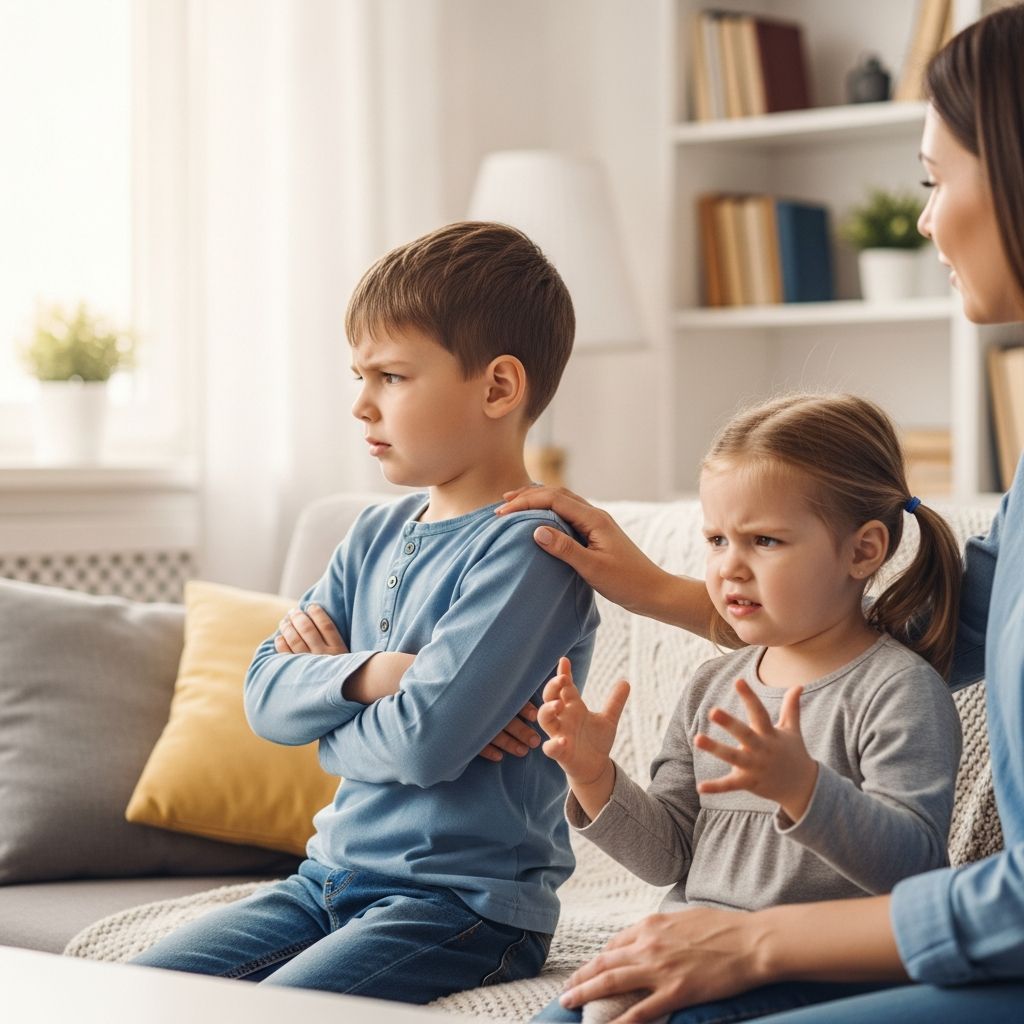
Even in the most peaceful homes, siblings will clash. The goal is not a conflict-free household, but a family that knows how to navigate conflict without hurting each other. Think of yourself as a calm facilitator who keeps everyone safe while supporting problem-solving.
Step-by-Step Response to Sibling Clashes
- Check safety first. If there is hitting, kicking, or serious risk, gently separate the children. Use as little physical intervention as possible, but do intervene promptly.
- Regulate before you educate. Children in a full meltdown cannot absorb lectures. Take a moment to breathe, lower your tone, and help them settle by acknowledging feelings: “You are both really upset right now.”
- Listen to each side briefly. Give each child a short turn to talk without interruption. Even two sentences can help them feel heard.
- Reflect and name emotions. Simple reflections like “You wanted that toy and felt left out” help children feel understood and build emotional vocabulary.
- Guide them toward solutions. Instead of dictating, ask, “What ideas do you have so both of you can enjoy this?” Offer suggestions only if they are stuck.
- Reinforce repair. Support genuine attempts to make amends—returning a toy, checking if the other is okay, or offering a hug—without forcing insincere apologies.
Coaching Sharing, Turn-Taking, and Personal Space
Many sibling conflicts revolve around objects and territory. Children are not born knowing how to share; they learn it over years of supported practice. Treat these moments as chances to teach skills rather than opportunities to punish.
Concrete Tools for Daily Use
- Use clear turns. If a toy is in hot demand, set a visible timer. One child plays while the other waits with a different activity. When time is up, the toy changes hands without debate.
- Protect special items. Allow each child a small number of possessions that are not required to be shared. This helps them feel secure and more open to generosity with the rest.
- Practice asking instead of grabbing. Role-play phrases such as “Can I have a turn when you’re done?” or “Can we play together?” so they have language ready in the moment.
- Respect the need for space. If an older child asks to play alone for a while, honor that when possible and offer alternatives to the younger one.
- Model compromise. Let them see adults negotiate and trade off—who chooses the movie tonight, who picks the weekend activity—so cooperation feels normal.
Supporting the Older Child When a New Baby Arrives
The birth of a sibling is one of the biggest emotional earthquakes in a child’s early life. Overnight, the older child shifts from being the center of attention to sharing parents with a helpless newcomer. Regression, clinginess, aggression, and meltdowns are common signs of adjustment, not bad behavior.
Preparing and supporting an older child requires steady reassurance that their place in the family is secure. Small, repeated signals that say, “You still matter just as much” can do more to ease jealousy than any grand gesture.
Gentle Ways to Ease the Transition
- Involve the older child in baby care in small, optional ways (fetching a diaper, choosing an outfit) so they feel important, not replaced.
- Protect short daily rituals that belong only to the older child—bedtime stories, a walk, or a quick game.
- Allow mixed feelings. If they say, “I hate the baby,” stay calm and acknowledge the emotion: “You’re really frustrated. It’s hard to share me so much.”
- Avoid labeling them as the “big one” in ways that deny their own needs. Being older doesn’t erase their need for cuddles, comfort, or help.
- Watch your language around others; avoid praising the baby at the older child’s expense or joking that the baby is “the favorite.”
Encouraging Siblings to See Themselves as a Team
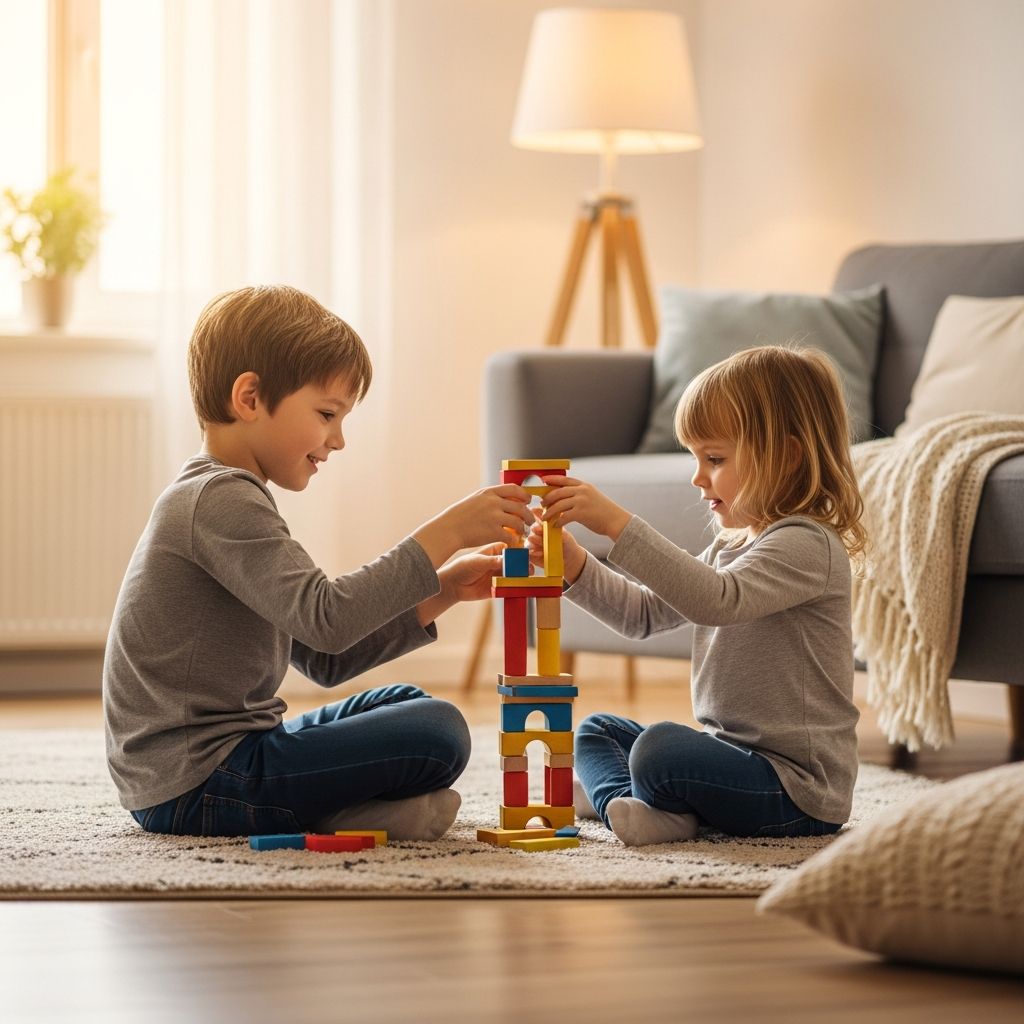
One of the most powerful shifts in a family is moving siblings from “rivals competing for resources” to “teammates on the same side.” This does not mean they always agree. It means that underneath disagreements, there is a sense of shared belonging and loyalty.
Everyday Practices That Build Team Spirit
- Use inclusive language. Say “you two,” “all three of you,” or “our family team,” reinforcing that they are part of a unit.
- Create joint projects. Let them collaborate on building a fort, baking, or caring for a plant or pet. Shared accomplishments foster pride and connection.
- Celebrate cooperation out loud. Notice when they help each other or play well and describe what you see: “You both worked together to clean up the blocks. That made it so much faster.”
- Keep private feedback private. Correct or guide each child individually rather than criticizing one in front of the other, which invites comparison and embarrassment.
- Tell stories of sibling kindness. At meals or bedtime, briefly highlight past moments when they supported each other to strengthen a positive family narrative.
When Sibling Conflict Seems Extreme
All families experience squabbles, but persistent cruelty, intense fear between siblings, or repeated physical harm are signs that additional support is needed. No parent should feel they must face serious aggression alone or dismiss it as “just a phase.”
In these situations, it helps to pause and look at the broader picture: stressors in the home, recent changes, school or peer issues, and the child’s overall emotional state. Gentle, consistent boundaries combined with professional guidance (such as family counseling or child therapy) can transform entrenched patterns in ways that punishment never could.
Sample Daily Rhythm for a More Peaceful Sibling Climate
Parents often understand the principles but struggle to weave them into busy days. The following sample rhythm is not a rigid schedule but an example of how connection and structure can coexist to reduce friction.
| Time | Focus | Sibling Support Idea |
|---|---|---|
| Morning | Getting ready | Assign small shared jobs (one sets bowls, one pours milk) to foster cooperation. |
| After school | Transition home | Offer snack and 10 minutes of calm play before tackling homework to lower irritability. |
| Late afternoon | Play time | Rotate between joint play and short separate activities to balance connection and space. |
| Evening | Family tasks | Invite siblings to work as a team on one small chore and praise their teamwork. |
| Bedtime | Wind-down | Share one brief “favorite thing your sibling did today” to end on a note of appreciation. |
Frequently Asked Questions About Sibling Rivalry
Is it normal for siblings to say they hate each other?
Children often use extreme language when overwhelmed, especially if they lack more precise words for complex emotions like jealousy, hurt, or fear. Hearing “I hate you” can be painful for parents, but the phrase usually signals a child’s struggle to manage big feelings rather than a fixed truth about the relationship.
Instead of scolding for the words alone, focus on the underlying emotion: acknowledge how upset they are, set limits on hurtful behavior, and later, when calm, teach more accurate language. Over time, as children feel safer expressing feelings, their words become less extreme.
Should I always treat my children exactly the same?
Children need to feel equally valued, but they do not need identical treatment in every situation. Equal is not always fair, because each child’s age, temperament, and needs differ. A toddler and a teenager, for example, require very different kinds of support and limits.
What matters most is that children trust that parents are fundamentally fair. Being transparent about decisions—“Your bedtime is earlier because your body is still growing and needs more sleep”—helps siblings understand differences without automatically feeling wronged.
What if one child is always the aggressor?
When one child consistently hits, mocks, or intimidates, it is important to protect the targeted sibling while staying curious about the aggressor’s internal world. Persistent aggression often masks anxiety, frustration, or a sense of displacement, especially after big life changes.
Offer firm boundaries—“I will not let you hurt your brother”—while seeking moments to connect with the aggressive child one-on-one. If patterns do not improve or worsen over time, consider consulting a child development professional for tailored guidance.
How can I stop feeling like a failure when my kids fight?
Frequent conflict can trigger deep self-doubt in parents, especially if they grew up in tense or chaotic homes themselves. It helps to remember that conflict is not proof of failure; it is a normal part of living closely with other humans.
What defines the emotional climate of a family is not the absence of arguments but how people reconnect afterward. Each time you stay grounded, listen, and guide your children toward repair, you are quietly reshaping what family conflict looks and feels like—for them and for the next generation.
Bringing It All Together
Raising peaceful siblings is not about perfection or eliminating every outburst. It is about gradually replacing patterns of blame, comparison, and control with connection, curiosity, and coaching. Over time, these small shifts accumulate into a home where children learn that closeness and conflict can coexist without destroying love.
As parents practice staying steady, protecting each child’s dignity, and inviting them to work as a team, siblings slowly build a shared history of surviving hard moments together. That history becomes the foundation for lifelong relationships in which they know, deep down, that they are not each other’s enemies, but each other’s allies.