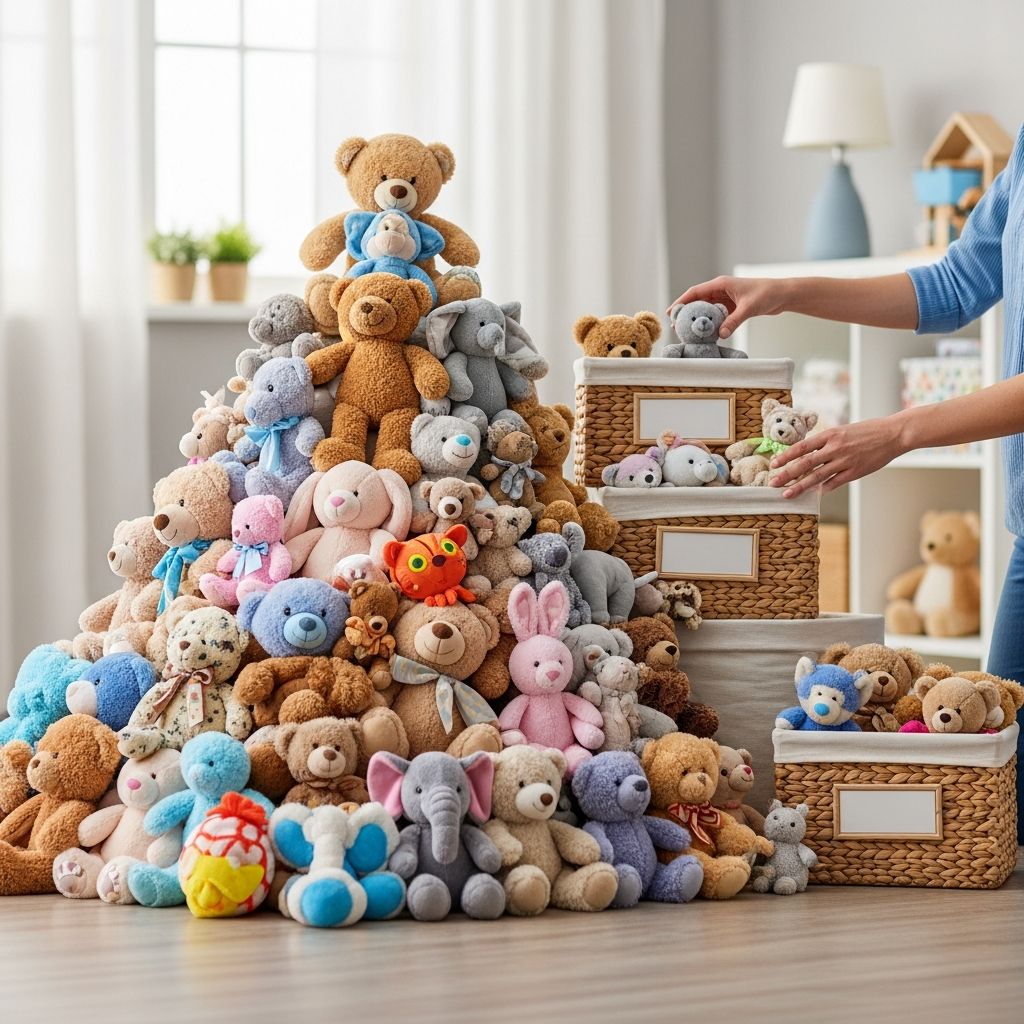
Stuffed animals are soft, sentimental, and sneaky. One day there are five, and suddenly there are fifty, all staring at you from the floor, the bed, and every shelf in sight. Organizing them is not just about storage; it is about balancing your child’s attachment, your home’s space, and everyone’s sanity.
This guide offers family-friendly, realistic strategies to sort, store, and maintain collections of stuffed animals without constant battles or complicated systems. You will find options for tiny apartments, big playrooms, and everything in between, plus ideas to help kids actually put their toys away.
Why Stuffed Animals Take Over So Quickly
Unlike puzzles or building sets, stuffed animals do not have obvious limits. There are no missing pieces to force a decision to toss them, and they rarely break. They keep arriving as gifts, prizes, and impulse buys, and each one often carries a story or memory.
Because these toys are soft and squishy, they also tend to get tossed on beds, chairs, and floors instead of put into containers. Over time, they become visual clutter, making rooms feel messier and harder to clean—even when everything else is put away.
Step One: Define the Stuffed Animal Boundaries
Any organizing project works better with clear limits, and stuffed animals are no exception. Before buying containers, decide how much space you are actually willing to dedicate to plush toys.
- Choose a maximum number of containers or shelves, then commit that the collection must fit within those boundaries.
- Talk with your child about how space works: when the storage is full, it is time to choose what stays and what goes.
- Consider separate limits for different areas (for example, a few favorites in the bedroom and the rest in the playroom).
Gentle Decluttering: Keeping the Love, Not the Overflow
Letting go of stuffed animals can feel emotional for both parents and kids. Instead of forcing a big purge, approach decluttering as a regular conversation and a shared decision-making process.
- Ask your child to pick “most loved friends” that always stay. Set a number appropriate to your space.
- Create a “thinking about it” box where less-played-with animals can rest for a few weeks before deciding whether to donate them.
- Offer simple choices: “Would you like to keep this one, or share it with another child who doesn’t have many toys?”
- Be realistic: you do not have to get to a minimal collection overnight; small, consistent edits are easier to accept.
Choosing the Right Storage Style for Your Family
There is no single correct way to organize stuffed animals. The best system is the one your child can use independently and you can maintain in a few minutes a day. Think about how your kids actually play, not how you wish they played.
- If your child loves “big dumps” of toys on the floor, large open bins will be more realistic than precise compartments.
- If they like displaying favorites, wall storage, shelves, or hanging solutions might be best.
- If your space doubles as a shared living area, hideaway or multi-purpose storage will help the room look adult-friendly at night.
Floor, Wall, or Hidden? Storage Types Explained
To choose smart containers, it helps to categorize storage into three main types: floor-based, wall-mounted, and hidden or multi-purpose. Each has strengths and trade-offs depending on your space and your child’s age.
| Storage Type | Best For | Pros | Cons |
|---|---|---|---|
| Floor bins & baskets | Toddlers & preschoolers | Very easy to reach; quick clean-up; flexible placement. | Take up floor space; can look messy if overfilled. |
| Wall nets, hammocks, racks | Displaying collections; older kids | Free up floor space; doubles as decor. | Needs installation; not ideal for daily in-and-out play. |
| Over-door or hanging organizers | Small rooms & closets | Uses vertical space; good for medium-size animals. | Limited capacity; may not hold very large plush toys. |
| Hidden / furniture storage | Shared living rooms, small homes | Conceals visual clutter; multi-purpose furniture. | Access can be slower; kids may need help opening/closing. |
Simple Systems for Very Young Kids
For toddlers and young preschoolers, ease of use beats aesthetics. The goal is to create a system simple enough that they can help clean up with minimal direction. Low, open storage works best at this age.
- Use one or two large, lightweight baskets on the floor instead of many small containers.
- Skip lids; removing a lid is surprisingly big friction for a tired child at the end of the day.
- Add a picture label on the basket showing a stuffed animal so even non-readers understand where things go.
Options for School-Age Kids and Big Collections
Older kids tend to have larger collections and stronger opinions about which plush toys to display. They can also handle slightly more complex systems and participate in designing their own storage.
- Offer two zones: a “spotlight” area for favorites and bulk storage for the rest.
- Use medium bins or cubbies so categories are obvious but not overly specific; think “animals,” not “unicorns only.”
- Invite them to choose colors or labels to increase buy-in, especially for shared spaces like a playroom.
Bedroom-Friendly Storage Ideas
Bedroom storage needs to balance coziness and calm. Too many stuffed animals piled on the bed can interfere with sleep and make changing sheets a chore. The trick is to highlight a few special toys while giving the rest a designated home nearby.
- Limit the bed to a small number of “sleep buddies” and move others to a nearby basket or shelf.
- Use under-bed drawers or low rolling bins for overflow plush, especially in smaller rooms.
- Place a narrow bookcase or wall ledge within arm’s reach of the bed for a rotating lineup of favorites.
Playroom Storage That Survives Real Life
In a dedicated playroom, stuffed animals are part of the larger toy ecosystem. Systems need to survive enthusiastic play, visiting friends, and the occasional rushed clean-up before guests arrive.
- Choose durable containers that can handle being sat on, pushed, and dragged across the floor.
- Group stuffed animals broadly by size or use (for example, “big snuggle buddies” versus “small pretend play friends”).
- Keep the main stuffed animal containers in the same zone as pretend play items so kids can naturally integrate them into games.
Small Space and Apartment-Friendly Ideas
In compact homes, stuffed animals compete with closets, workspaces, and walkways. The key is to take advantage of vertical space and furniture that can hide clutter when the room needs to shift functions.
- Use the back of doors with hanging organizers or pocket-style storage for small and medium plush.
- Choose ottomans or benches with storage compartments to double as seating and toy containment.
- Consider one designated “plush corner” rather than scattering stuffed animals throughout multiple rooms.
Display Versus Deep Storage: Finding the Balance
Not every stuffed animal needs to be fully visible all the time. A hybrid approach—some toys on display, some tucked away—keeps rooms calmer while still honoring special favorites and collections.
- Reserve eye-level shelves for the plush toys your child wants to see every day.
- Use higher shelves or upper wall storage for keepsakes and fragile or sentimental items that are not part of daily play.
- Rotate animals between display and deeper storage to keep the collection feeling new without constant new purchases.
Safety and Cleaning Considerations
When organizing stuffed animals, safety and cleanliness matter as much as aesthetics. Dust, allergens, and tipping hazards are real concerns, especially for very young children and those with allergies.
- Keep heavy or oversized stuffed animals on lower shelves or the floor to prevent them from falling.
- Avoid overloading high wall nets or racks, and follow weight recommendations on mounting hardware.
- Plan for regular washing or vacuuming of frequently used plush, and avoid storing them directly on dusty surfaces.
Labeling That Kids Actually Use
Labels are not just for you; they are tools to help kids remember where things go. The more intuitive the labels, the more likely children are to help with clean-up and maintain the system.
- Use photo labels or simple drawings for non-readers (for example, a picture of a teddy bear on bins for plush toys).
- Combine words and images on labels so kids can learn to associate text with items over time.
- Keep labels broad and forgiving; avoid categories so narrow that a toy “doesn’t fit” anywhere.
Creating a Quick-End-of-Day Reset Routine
Even the best storage will fail without a simple daily reset. A short, predictable clean-up ritual at the same time every day can drastically reduce chaos and make mornings easier.
- Set a five-minute timer and challenge the family to see how many plush toys they can return to their “homes.”
- Pair the reset with an existing anchor, like just before dinner or screen time, so it becomes automatic.
- Use music or a silly game (such as “the floor is lava for stuffed animals”) to keep younger kids engaged.
Teaching Kids to Make Decisions About Their Stuff
Organizing stuffed animals is a chance to practice decision-making skills. When children learn to choose what to keep, where to put it, and when to share, they gain confidence and respect for their belongings.
- Invite them to decide which animals belong in the “everyday play” group versus “special keepsakes.”
- Encourage them to pick a few toys to donate before birthdays or holidays to make room for new arrivals.
- Validate their feelings about special items, even if ultimately the toy must go due to damage or safety concerns.
Special Situations: Gifts, Souvenirs, and Sentimental Plush
Some stuffed animals carry extra meaning: a first birthday gift, a vacation souvenir, or a reminder of a loved one. These may need to be treated differently than everyday toys, especially if they are not regularly played with.
- Designate a small display shelf or memory box specifically for sentimental plush that are not part of daily play.
- Consider taking photos of meaningful animals before donating them so their memory lives on without the physical bulk.
- Be honest with yourself about whose attachment is stronger—yours or your child’s—and organize accordingly.
Frequently Asked Questions
How many stuffed animals is “too many”?
There is no universal ideal number; “too many” is when the collection no longer fits comfortably in the space you are willing to devote to it. If stuffed animals spill into walkways, make cleaning difficult, or constantly cause stress, that is a sign to set clearer boundaries and declutter.
Should I involve my child in deciding what to donate?
Whenever possible, yes. Involving your child teaches respect for their belongings and helps them build decision-making skills. For very young children, you can narrow the options to a small group and let them choose a few to give away, rather than making every decision alone or forcing a surprise purge.
What if my child never wants to let go of any stuffed animal?
Start by creating a holding area rather than insisting on immediate goodbyes. Place rarely used plush in a separate container or out-of-the-way spot for a set period. If your child does not ask for them during that time, you can gently revisit the idea of donating, reminding them that those toys could make another child very happy.
How often should I reorganize the stuffed animals?
A light reset every day or two keeps things manageable, while a deeper review every few months is usually enough. Good times for a more thorough reorganization include before birthdays, major holidays, or a room rearrange, when new items are likely to arrive or spaces are already in flux.
What can I do with damaged or overly worn plush toys?
If a toy is torn, leaking stuffing, or no longer safe, it may be time to say goodbye, even if it is beloved. You can honor its importance with a small goodbye ritual or a photo before disposal, which helps children learn that safety and health sometimes require letting things go.
Bringing It All Together
Stuffed animals add warmth and personality to a home, but they do not have to dominate every surface. With a few clear boundaries, simple storage choices, and kid-friendly routines, you can respect your child’s attachments while still enjoying tidy, breathable rooms.
Start small: choose one zone to tackle, pick containers that match how your family actually lives, and involve your kids in each step. Over time, the plush mountain will feel less like an avalanche waiting to happen and more like a cozy, curated part of your home.