Understanding Axillary Temperature Measurement in Children
Temperature assessment is one of the most fundamental aspects of pediatric care, whether at home or in clinical settings. The axillary method—measuring temperature in the armpit—has become increasingly popular among parents and healthcare providers because it offers a non-invasive, accessible approach to monitoring a child’s health status. Unlike techniques that require insertion into body cavities or placement in the mouth, the armpit method simply requires positioning a thermometer against the skin surface. This accessibility makes it particularly valuable for very young children, infants, or any child who may have difficulty cooperating with other temperature measurement techniques.
The axillary route represents a practical compromise between convenience and clinical utility. While healthcare professionals understand that this method has certain limitations in terms of accuracy compared to core temperature measurements, it remains the standard recommendation for routine temperature monitoring in infants and young children in many healthcare systems. Understanding how to properly perform this measurement, recognize its limitations, and interpret results appropriately is essential for any caregiver responsible for a child’s health assessment.
The Anatomy and Science Behind Underarm Temperature Reading
The axilla—the anatomical term for the armpit—is a region rich with blood vessels positioned close to the skin surface. When a thermometer is placed in this area and held securely against bare skin, it can detect the temperature of blood flowing through these vessels. However, since the thermometer tip remains external to the body rather than measuring core temperature directly, the reading represents a peripheral or shell temperature rather than the true internal temperature. This distinction explains why axillary readings consistently register lower than temperatures obtained through more invasive methods such as rectal or esophageal measurement.
Research has established consistent patterns regarding axillary temperature values. The average underarm temperature in healthy children and adults ranges from approximately 95 to 98.5 degrees Fahrenheit (35 to 36.9 degrees Celsius), though individual variation occurs based on factors including age, time of day, recent physical activity, and environmental conditions. A reading of 99 degrees Fahrenheit (37.2 degrees Celsius) or higher at the axilla is typically considered indicative of fever in children, though some healthcare providers recommend adding an adjustment factor to account for the method’s inherent underestimation of core temperature.
Selecting and Preparing the Appropriate Equipment
The type of thermometer selected significantly impacts both safety and measurement accuracy. Digital thermometers have become the gold standard for home and clinical use, offering rapid results, ease of reading, and safety advantages. Glass thermometers containing mercury should never be used for any temperature measurement, particularly in children, due to the severe health risks associated with mercury exposure if the device breaks.
Digital thermometers come in two primary operational modes that produce different results:
- Standard mode: Requires continuous measurement for approximately 10 minutes until the reading stabilizes, providing a more reliable estimate of temperature
- Predictive mode: Uses an algorithmic calculation to estimate final temperature after only 10 seconds of measurement, which can introduce greater measurement error
For the most accurate axillary temperature assessment, the standard mode is preferable, though many modern devices function in predictive mode due to consumer demand for faster results. When using predictive mode, caregivers should understand that readings may underestimate actual temperature and should be interpreted with this limitation in mind. Probe covers or disposable sheaths should be used between measurements to maintain hygiene and prevent cross-contamination.
Environmental and Physical Preparation Before Measurement
The accuracy of axillary temperature measurement depends significantly on proper preparation of both the child and the measurement environment. Several factors can artificially elevate skin temperature and produce falsely high readings if not addressed before measurement begins.
Wait approximately 20 to 30 minutes before taking a temperature if your child has recently:
- Bathed in warm or hot water
- Been wrapped in blankets or heavy layers of clothing
- Been swaddled (particularly relevant for infants)
- Engaged in physical activity or play
- Been exposed to direct sunlight or a warm environment
These activities elevate the skin temperature of the armpit region, which can result in readings that do not reflect the child’s actual body temperature at rest. By allowing sufficient cooling time in a normal environment, you ensure that the measurement reflects baseline temperature rather than the temporary elevation caused by external heating.
Step-by-Step Technique for Accurate Measurement
Proper positioning and technique are essential for obtaining reliable axillary temperature readings. The following systematic approach helps ensure accuracy:
- Remove upper body clothing: Your child’s shirt or any covering over the chest and shoulder area should be completely removed to provide unobstructed access to the armpit region. The thermometer must make contact with bare skin only—never place it over clothing, as fabric creates insulation that artificially elevates readings.
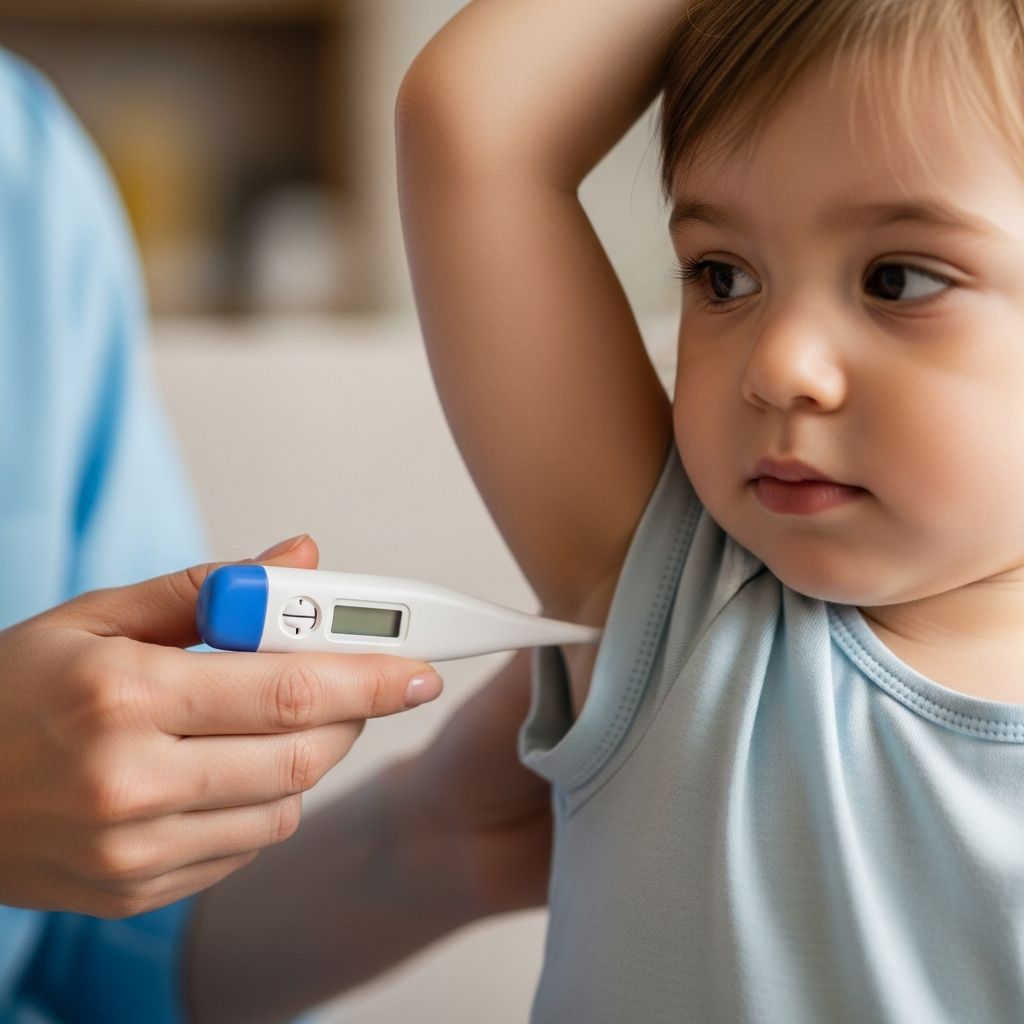
- Position the thermometer correctly: Place the thermometer tip into the center of the axilla, positioning it as high up into the armpit as possible. The probe or sensor should be directed toward the back of the axilla rather than hanging downward.
- Secure the arm: Lower or fold your child’s arm across their chest to hold the thermometer firmly in place. The arm should be positioned so that it presses the thermometer against the ribcage and maintains consistent contact throughout the measurement period.
- Maintain contact during measurement: Keep the thermometer stationary and ensure continued skin contact throughout the measurement duration. Any movement or loss of contact can interrupt the reading and produce inaccurate results.
- Wait for completion signal: Allow the digital thermometer to complete its measurement. Most devices signal completion with audible beeps, a visual display change, or both. Standard mode devices typically require approximately 10 minutes of continuous contact, while predictive mode devices signal completion in 10 to 20 seconds.
- Record the reading: Immediately note the temperature displayed on the screen, including the exact numerical reading and the time at which the measurement was obtained. This information helps establish temperature trends over time and assists healthcare providers in assessment.
Understanding Measurement Accuracy and Necessary Adjustments
Axillary temperature measurement produces systematically lower readings compared to other assessment methods, a characteristic that caregivers and healthcare providers must account for when interpreting results. Research consistently demonstrates that armpit temperatures run approximately 0.5 to 1 degree Fahrenheit (0.3 to 0.6 degrees Celsius) lower than rectal or oral measurements obtained simultaneously.
To obtain a more clinically meaningful assessment, healthcare professionals often recommend adding an adjustment factor to the axillary reading. Adding approximately 0.5 to 1 degree Fahrenheit (0.3 to 0.6 degrees Celsius) to the measured axillary temperature produces a more accurate estimate of the child’s actual core temperature. For example, if your digital thermometer displays 98.5 degrees Fahrenheit in the armpit, the adjusted estimate of core temperature would range from 99 to 99.5 degrees Fahrenheit.
However, this adjustment should be applied consistently and caregivers should inform their pediatrician if they are using this correction method. When there is any uncertainty about the significance of a temperature reading or when clinical judgment suggests more precise measurement is necessary, following up with a rectal, oral, forehead, or ear temperature measurement provides greater diagnostic confidence.
Age Considerations and Method Transitions
The appropriateness of axillary temperature measurement varies by age, and caregivers should understand when to transition to alternative methods as children develop. For infants and very young children, the axillary method remains the recommended standard approach. Its non-invasive nature and ease of implementation make it ideal for children under two years of age, and it continues to be appropriate throughout early childhood.
As children reach school age, typically around five years and older, oral temperature measurement becomes feasible and preferable when the child can cooperate with the procedure. Oral measurement requires the child to keep the thermometer safely under their tongue for the required duration, which demands a level of cooperation and understanding not typically present in very young children. An oral temperature reading of 100 degrees Fahrenheit (37.77 degrees Celsius) or higher indicates fever in older children, a threshold slightly higher than the axillary threshold due to the higher baseline oral temperatures in this population.
Parents should discuss the most appropriate measurement method for their child’s specific age and developmental stage with their pediatrician, as individual circumstances and the child’s temperament may influence which approach yields the most reliable and practical results.
When to Measure Temperature and What Results Mean
Caregivers should measure a child’s temperature when specific clinical indicators suggest illness or when a child reports feeling unwell. Signs that warrant temperature assessment include complaints of feeling hot or cold, visible flushing or pallor, unusual sleepiness or lethargy, irritability, or reports of physical discomfort. Additionally, during illness in other family members or following potential exposure to contagious conditions, periodic temperature checks help detect emerging infection early.
Once you have obtained an axillary reading and applied any appropriate adjustment factor, interpretation depends on age and clinical context. A reading of 99 degrees Fahrenheit (37.2 degrees Celsius) or above at the axilla generally indicates fever. Mild fever in the 99 to 101 degree Fahrenheit range (37.2 to 38.3 degrees Celsius) often represents the body’s beneficial immune response to infection. Higher readings, particularly those exceeding 102 degrees Fahrenheit (39 degrees Celsius), warrant prompt evaluation by a healthcare provider, especially in very young children under three months of age.
Limitations and Factors Affecting Reliability
While the axillary method offers significant practical advantages, caregivers should understand its inherent limitations. Environmental temperature influences the reliability of underarm measurements more significantly than other assessment methods. Rooms that are particularly cold may cool the axillary skin surface artificially, producing falsely low readings, while very warm environments may do the opposite.
The type of thermometer and its operational mode also affects accuracy. Predictive mode thermometers show greater measurement variability and produce lower readings than standard mode devices when measuring the same temperature. Additionally, proper technique is essential—incomplete skin contact, failure to position the thermometer tip appropriately, or premature removal of the device all compromise accuracy.
For children with certain conditions or in specific clinical scenarios, alternative temperature measurement methods may be more appropriate. Children who are unconscious, unable to cooperate, or experiencing severe distress may require different assessment approaches. Similarly, children with skin conditions affecting the armpit area may benefit from measurement sites that avoid affected regions.
Frequently Asked Questions About Axillary Temperature Measurement
Can I use a glass mercury thermometer for axillary temperature measurement?
No. Mercury thermometers pose serious health risks if they break and should never be used, particularly with children. Digital thermometers are the safe, appropriate choice for any temperature measurement.
How much should I add to the axillary reading to get true body temperature?
Most healthcare providers recommend adding 0.5 to 1 degree Fahrenheit (0.3 to 0.6 degrees Celsius) to the axillary measurement. Inform your pediatrician about this adjustment so they understand how you obtained your temperature readings.
Is axillary temperature accurate enough for medical decision-making?
Axillary measurement is generally appropriate for routine temperature screening in children, but for clinical situations requiring precise diagnosis, your pediatrician may recommend supplementing with rectal, oral, or other methods.
What should I do if the thermometer reading seems unusually high or low?
If a reading seems inconsistent with your child’s clinical appearance, wait 20 to 30 minutes, ensure proper preparation (including cooling time if needed), and repeat the measurement. If results remain concerning, contact your healthcare provider.
Can I measure temperature if my child is wrapped in blankets?
No. Remove blankets and wait 20 to 30 minutes before measuring, as blanket insulation artificially elevates skin temperature and produces falsely high readings.
At what age can I switch to oral temperature measurement?
Most children around five years of age and older can cooperate with oral measurement. Discuss the right time for your child with your pediatrician based on developmental readiness and cooperation ability.
Communicating Temperature Information to Healthcare Providers
When consulting with your child’s healthcare provider about fever or other concerns, clearly communicate the method you used to obtain the temperature, the exact reading you recorded, the time of measurement, and whether you applied any adjustment factor. This information enables your pediatrician to interpret your reading in appropriate context and make clinical decisions with full understanding of how the measurement was obtained.
If you regularly use the axillary method with adjustment, your healthcare provider may develop familiarity with your measurement practices and adjust their clinical interpretation accordingly. For urgent concerns or situations where fever is quite high, do not delay seeking immediate care while waiting for measurement confirmation—clinical judgment about your child’s overall appearance and wellbeing should guide decisions about seeking emergency evaluation regardless of the specific temperature number.
References
- Assessment of axillary temperature for the evaluation of normal body temperature — National Center for Biotechnology Information (NCBI/PMC). 2017. https://pmc.ncbi.nlm.nih.gov/articles/PMC5322586/
- Axillary (Armpit) Temperature — Cleveland Clinic. 2024. https://my.clevelandclinic.org/health/articles/axillary-temperature
- Axillary Temperature – Vital Sign Measurement Across the Lifespan — Open Textbook Library (British Columbia). https://opentextbc.ca/vitalsignmeasurement/chapter/axillary-temperature/
- How to Measure an Underarm (Axillary) Temperature — Healthline Media. 2024. https://www.healthline.com/health/underarm-temp
- Fever Temperatures: Accuracy and Comparison — Government of Alberta (MyHealth Alberta). https://myhealth.alberta.ca/Health/pages/conditions.aspx?hwid=tw9223