Navigating Air Travel with Your Infant: Understanding Sleep Concerns
Many parents experience significant anxiety when considering air travel with their infants. The primary concern centers on how flying and time zone changes might disrupt carefully established sleep routines that parents have worked hard to develop. This apprehension is understandable, as infant sleep is crucial for healthy development, and parents naturally want to protect their child’s wellbeing during travel.
The reality of traveling with babies involves multiple stressors: changes in environment, exposure to unfamiliar sounds and lights, alterations to regular feeding schedules, and the physical demands of air travel itself. Understanding these challenges and preparing strategically can significantly reduce the negative impact on your infant’s sleep patterns.
The Physiological Impact of Travel on Infant Sleep
When babies travel across time zones, their circadian rhythms—the internal biological clocks that regulate sleep-wake cycles—become disrupted. Unlike adults who might recover from jet lag within a day, infants require considerably longer to reorient their internal clocks to new time zones. This extended adjustment period occurs because babies’ biological systems are still developing and more sensitive to environmental cues that trigger sleep and wakefulness.
Light exposure plays a particularly critical role in regulating melatonin secretion, the hormone responsible for sleep onset. During travel, especially when crossing multiple time zones, the timing of light exposure relative to your baby’s body clock becomes misaligned. Morning light in your baby’s internal clock might arrive during what is evening in the new location, creating confusion in their sleep-wake cycle.
The overstimulation babies experience during travel compounds these physiological challenges. Airports present constant sensory input: engine noise, bright lighting, unfamiliar people, and movement. This overwhelming sensory experience taxes your baby’s developing brain as it processes vast amounts of new information, leading to exhaustion that paradoxically makes quality sleep more difficult.
Recognizing Post-Travel Sleep Regressions
Parents often encounter unexpected sleep disruptions after returning home from travel. Post-travel sleep regressions represent a temporary decline in sleep quality, characterized by frequent night wakings and difficulty falling asleep, even after adjusting back to the home environment. These regressions typically resolve within days to weeks as your baby’s sleep architecture stabilizes.
Understanding that regressions are normal and temporary helps parents maintain perspective. Rather than representing permanent damage to sleep habits, these regressions reflect your baby’s brain processing the travel experience and re-establishing familiar sleep patterns in the home environment.
Pre-Travel Sleep Schedule Adjustment Strategies
One of the most effective approaches to minimizing jet lag involves gradual adjustment of your baby’s sleep schedule before departure. This gradual method proves more effective than abrupt changes because it allows your infant’s circadian rhythm to shift incrementally rather than experiencing shock adjustment.
Recommended gradual adjustment protocol:
- Beginning 5-7 days before departure, shift bedtime and nap times by 15-30 minutes daily
- Continue adjustments in the direction of your destination’s time zone
- If traveling eastward (earlier bedtime needed), shift sleep times earlier each day
- If traveling westward (later bedtime needed), shift sleep times later each day
- By travel day, your baby’s schedule should closely approximate the destination’s time zone
This approach provides your baby’s physiology time to gradually adapt rather than expecting instant adjustment. Parents report more successful sleep transitions and reduced fussiness when using this pre-travel adjustment method compared to making abrupt changes.
Optimizing Flight Selection and Timing
Strategic flight selection significantly impacts your baby’s sleep during travel. When possible, choose direct flights to minimize handling time and environmental transitions. Direct flights reduce the cumulative stress on your baby’s system by eliminating layover disruptions.
Timing selection also matters considerably. Flights that depart early morning and arrive at your destination early in the day allow your baby to experience natural light exposure at the new location, helping reset their circadian rhythm appropriately. This timing strategy leverages natural light cycles to support faster adjustment to the destination’s time zone.
For babies who typically take multiple naps, coordinating flight times to preserve nap schedules when possible prevents excessive sleep loss. A well-rested baby typically adjusts more readily to time zone changes than an overtired infant struggling with accumulated sleep debt.
In-Flight Sleep Management Techniques
During the flight itself, maximizing your baby’s sleep opportunity supports their overall wellbeing and reduces fussiness during the journey. Creating a conducive sleep environment within aircraft constraints proves achievable with preparation.
Effective in-flight sleep strategies include:
- Bringing lightweight dark blankets or sleep sacks to create visual barriers reducing light exposure
- Using white noise applications or portable sound machines to mask ambient aircraft noise
- Maintaining familiar sleep cues such as a beloved stuffed animal or sleep toy
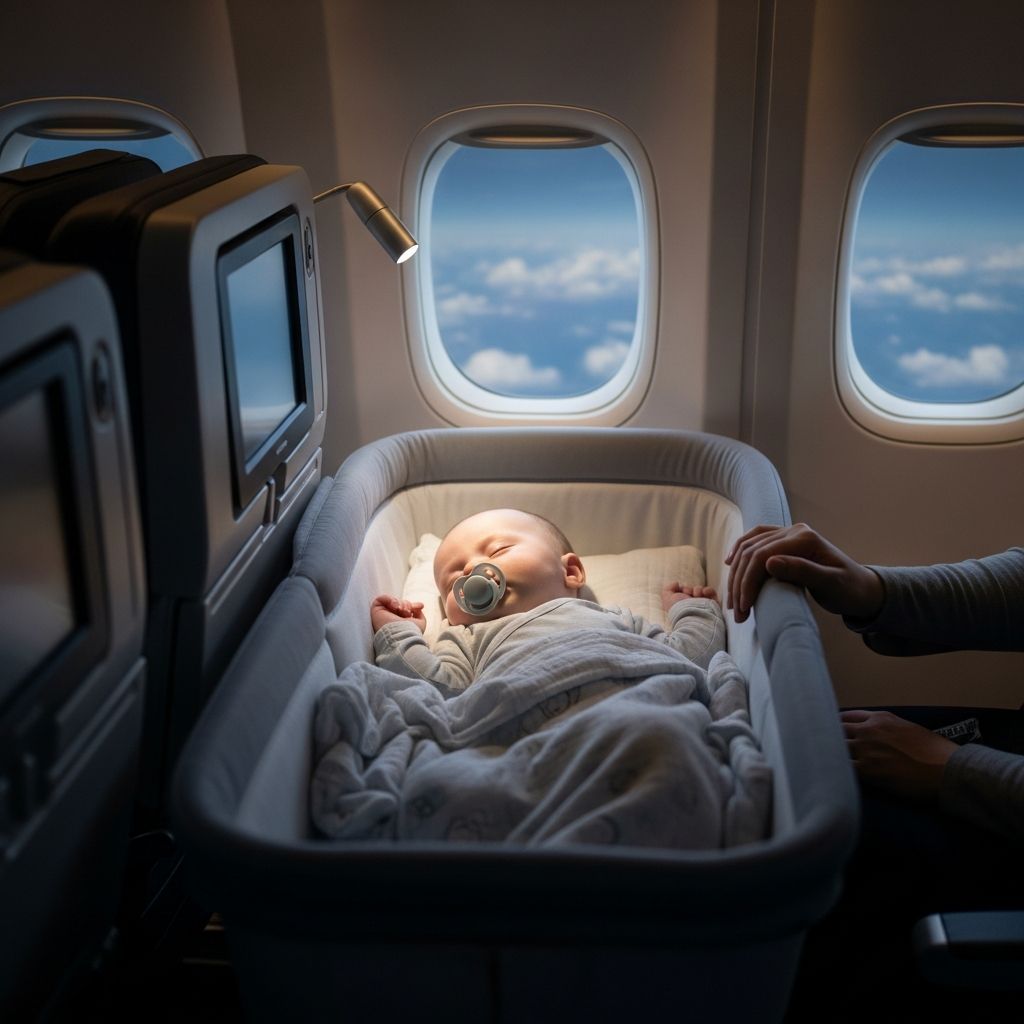
- Utilizing airline bassinets when available for younger infants
- Keeping your baby in familiar pajamas or sleep clothing to reinforce sleep associations
- Avoiding overstimulation by limiting passenger interaction when possible
During longer flights, allow your baby to sleep as much as possible, particularly on the outbound journey. The sleep accumulated during flight provides essential rest that buffers against the stress of travel and supports faster adaptation to the destination’s time zone.
Managing the First Night at Your Destination
The evening of arrival represents a critical juncture in establishing new sleep patterns. While your baby may be exhausted and disoriented, the decisions you make regarding first-night bedtime significantly influence the speed of circadian rhythm adjustment.
Upon arrival at your destination, permit your baby to nap if tired, but cap nap duration to prevent excessive daytime sleep that would result in nighttime wakefulness. If your baby typically naps three hours daily, limit the first-day naps to 3.5 to 4 hours total. This constraint ensures your baby maintains sufficient sleep drive to fall asleep at an appropriate evening hour.
Establish a reasonable bedtime for the first night—between 7 and 9 pm works well for most infants. This initial night’s sleep pattern sets the template for subsequent nights, making proper timing crucial. If your baby woke early from travel, offer an earlier bedtime, such as 6 pm, rather than forcing extended wakefulness waiting for a typical home bedtime.
Light Exposure and Circadian Rhythm Reset
Natural light represents the most powerful tool for resetting circadian rhythms. Light signals to your baby’s brain what time of day it is, allowing their internal clock to synchronize with local time.
Strategic light exposure protocol:
- Expose your baby to bright light immediately upon waking each morning at the destination
- Open curtains and window coverings as soon as your baby wakes
- Take outdoor time in morning sunlight when possible
- Maintain darkness during designated sleep times by using blackout curtains
- Avoid bright artificial light during evening hours before bedtime
This light management approach leverages your baby’s natural photosensitivity to guide circadian rhythm adjustment. Morning light exposure tells your baby’s brain that daytime has begun, while evening darkness signals appropriate sleep preparation timing.
Considering Melatonin Supplementation
For older infants and toddlers, melatonin supplementation may support sleep adjustment during significant time zone changes. Medical professionals typically recommend small doses—0.5 to 1 milligram—administered approximately one hour before desired sleep time. This supplementation approach works best for children age two and older, with parental consultation with pediatricians before implementation.
Melatonin functions as a sleep signal, helping synchronize your baby’s internal clock to the new time zone more rapidly. However, supplementation should complement rather than replace light exposure, schedule adjustment, and environmental management strategies.
Creating Sleep-Conducive Vacation Environments
Vacation accommodations often lack the controlled sleep environment your baby enjoys at home. Compensating for these limitations improves sleep quality significantly. Creative solutions can transform challenging spaces into functional sleep areas.
Space constraints need not prevent establishing a separate sleep environment. Even small spaces—closets, bathroom corners, or bathroom spaces with the door closed—can be transformed into dark, quiet sleep zones when furnished with a portable crib or pack-and-play. This environmental separation from family activity centers reduces stimulation and signals sleep time to your baby.
Maintaining consistent bedtime routines despite vacation settings provides psychological stability. Abbreviated versions of your home routine—bath time, story reading, or lullabies—help your baby recognize approaching sleep and transition mentally to sleep mode regardless of location.
Recovery and Readjustment Planning
After arriving at your vacation destination, build in recovery time rather than immediately filling schedules with activities. Dedicate at least one lighter day post-travel to regularize routines and allow your baby’s internal clock to reset. This buffer prevents accumulated overtiredness that compounds sleep difficulties.
Regular routines and familiar sleep environments facilitate faster circadian rhythm reset. The predictability of consistent wake times, meal times, and bedtimes provides anchors that help your baby’s internal clock establish new synchronization more quickly than would occur with erratic schedules.
Return to Home and Addressing Post-Travel Sleep Issues
Returning home often presents different challenges than the initial destination adjustment. Your baby has adapted to the vacation environment and may resist reverting to home schedules. Gradual reestablishment of home routines, rather than abrupt transitions, minimizes sleep disruption.
Post-travel sleep regressions typically resolve within one to two weeks as your baby resettles into familiar home environments and predictable routines resume. Consistency and patience during this period support faster recovery. Reintroducing home sleep cues—specific bedtime routines, familiar sounds, and established sleep locations—helps your baby remember and reestablish home sleep patterns.
Parental Stress and Infant Sleep Connection
Parental stress about travel significantly influences infant stress responses and sleep quality. Babies are remarkably attuned to parental emotional states, and anxiety about sleep disruption can inadvertently create the very sleep difficulties parents fear. Approaching travel with realistic expectations and management strategies reduces parental stress, which subsequently benefits your baby’s sleep and overall travel experience.
Frequently Asked Questions
Q: How long does it typically take for babies to adjust to new time zones?
A: While the general guideline suggests one day of adjustment per hour of time difference, practical experience shows babies often adjust more quickly—particularly 4 hours or less—when using light exposure, schedule adjustments, and consistent routines. Larger time differences may require 5-7 days of gradual adjustment.
Q: Should I wake my baby during daytime at the destination to prevent nighttime wakefulness?
A: Yes, limiting daytime naps to approximately the same duration as home helps maintain adequate sleep drive for appropriate evening bedtime. However, don’t eliminate naps entirely; instead, cap cumulative nap time to encourage nighttime sleep consolidation.
Q: Can I prevent post-travel sleep regressions entirely?
A: Post-travel regressions are common and reflect normal developmental processes. While you cannot eliminate them entirely, minimizing travel stress, maintaining consistent routines, and preparing your baby before departure reduce their severity and duration.
Q: What is the best flight time for traveling with an infant?
A: Early morning departures with early afternoon arrivals typically work best, allowing your baby to experience natural light at the destination and establish appropriate sleep timing for the evening.
Q: Should I adjust my baby’s schedule before traveling west versus east?
A: Yes. Traveling east requires earlier sleep times before departure, while westward travel requires gradually shifting sleep later. Light exposure strategies also differ: eastward travel benefits from morning light, while westward travel benefits from evening light exposure.
References
- How to Manage a Traveling Baby’s Sleep Schedule on Vacation — Cradlewise. 2024. https://cradlewise.com/blog/how-to-manage-sleep-routine-of-traveling-baby/
- Sleep Schedules for Babies on Travel Days — Oh Baby Consulting. 2024. https://ohbabyconsulting.com/sleep-schedules-for-babies-on-travel-days/
- Your 3 Day Guide to Surviving Baby/Toddler Jet Lag — Baby Sleep Made Simple. 2024. https://www.babysleepmadesimple.com/surviving-baby-toddler-jet-lag/