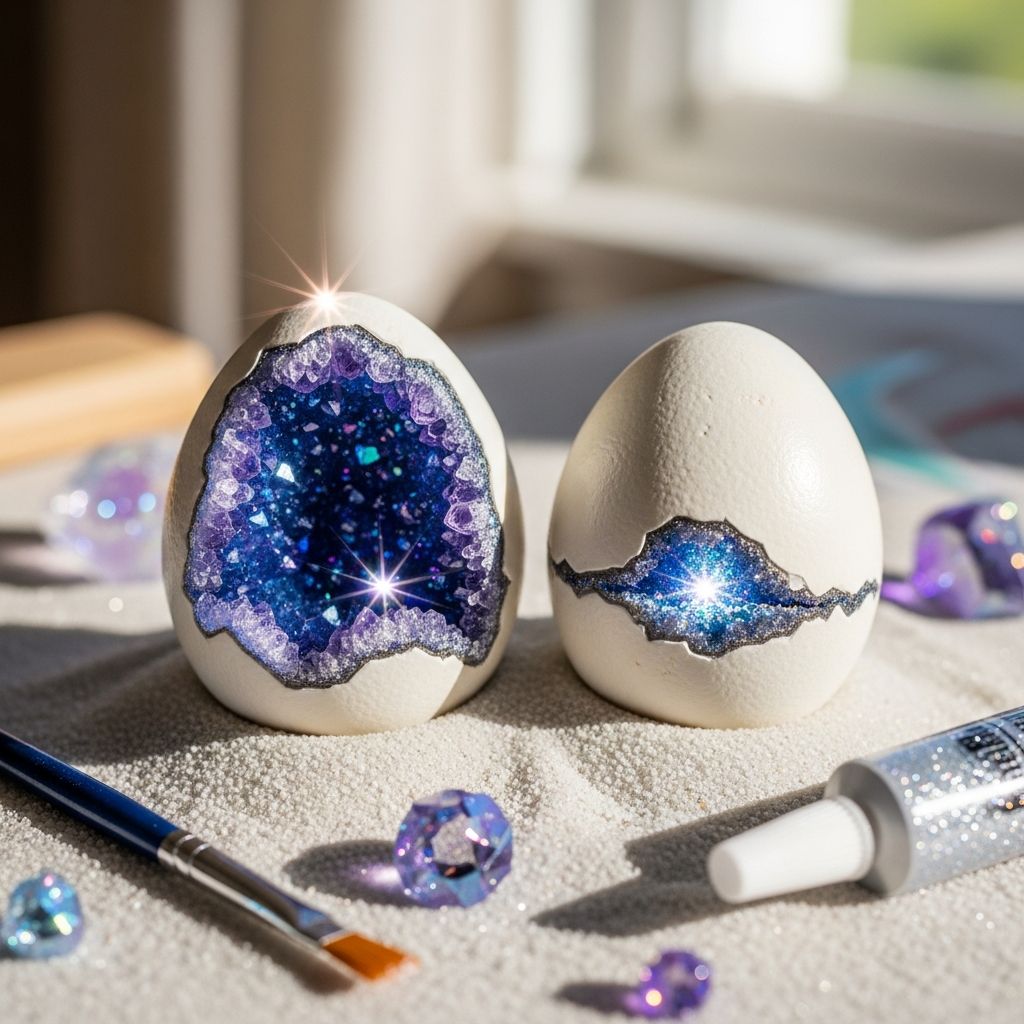
Transform everyday eggshells into breathtaking works of natural art by growing vibrant crystals inside them. This captivating project blends creativity with basic chemistry, allowing children and adults alike to witness the magic of crystal formation up close. Ideal for Easter celebrations, science fairs, or rainy-day activities, these geode eggs mimic the geological wonders found in nature but appear in days rather than millennia.
Why Crystal Geode Eggs Captivate Young Minds
Geodes are hollow rocks lined with stunning mineral crystals, formed over thousands of years as mineral-rich water seeps into cavities and evaporates, leaving behind structured growths. Recreating this in eggshells offers a tangible way to explore supersaturation, nucleation, and recrystallization—key concepts in chemistry. Children love watching colorless solutions burst into colorful, sparkling displays, fostering patience and observation skills.
Unlike real geodes, which can take a million years to develop large quartz crystals, your homemade versions showcase rapid growth using safe solutes like Epsom salt, borax, or alum. This activity encourages experimentation: vary colors, seeding methods, or materials to see how crystals differ in size and shape.
Gathering Your Supplies for Success
Most ingredients are pantry staples or easily sourced, keeping costs low while delivering high-impact results. Here’s a comprehensive list to prepare:
- Eggs: Fresh, raw eggs provide sturdy shells; opt for larger ones for dramatic geodes.
- Solute powders: Borax (sodium tetraborate), alum (potassium aluminum sulfate), or Epsom salt (magnesium sulfate) for crystal growth.
- Water: Distilled preferred to avoid impurities disrupting crystals.
- Food coloring: Gel or liquid for vivid hues in blue, purple, pink, or green.
- Containers: Heat-safe glass jars or cups to hold solutions without leaching chemicals.
- Tools: Paintbrush, white glue, masking tape, drill or needle for shell prep; spoon or tweezers for handling.
- Safety gear: Gloves, adult supervision for heating and drilling.
Pro tip: Test eggshell strength beforehand—healthier eggs yield fewer cracks during cleaning.
Preparing the Eggshell Canvas
The foundation of your geode is a clean, sturdy eggshell cavity. This delicate step requires precision to avoid fractures.
- Create openings: Tape ends for stability, then drill or puncture small holes at both narrow ends. Larger holes ease contents removal but risk breakage.
- Empty the egg: Blow air through one hole to expel yolk and whites into a bowl—save for cooking! A steady stream prevents shell damage.
- Remove membrane: Rinse under gentle warm water, peeling the thin inner lining carefully. Patience here ensures smooth crystal adhesion.
- Dry and stabilize: Air-dry upside down on a towel. For halved shells, tape equatorially before cracking and cleaning edges.
If whole shells prove tricky, crack near the top and use halves directly—versatility keeps the fun going.
Seeding Crystals for Explosive Growth
Seeding provides nucleation sites—starting points where crystals anchor and multiply. Skipping this leads to sparse growth on the jar bottom instead.
Apply a thin layer of white glue inside the dried shell using a brush. Immediately sprinkle solute powder (e.g., alum) generously, rotating to coat evenly. Excess powder creates more sites for smaller, denser crystals; sparse seeding yields larger specimens. Allow 12-24 hours to dry fully, forming a rough, primed surface.
| Seeding Method | Crystal Outcome | Best For |
|---|---|---|
| Heavy powder coat | Tiny, clustered crystals | Vibrant, geode-like sparkle |
| Light dusting | Large, sparse crystals | Studying individual shapes |
| No seeding | Bottom-heavy growth | Quick demos only |
Brewing the Supersaturated Solution
The magic happens in a supersaturated solution: more dissolved solute than cold water can normally hold. Heat unlocks solubility, cooling triggers precipitation.
- Boil 2 cups water, remove from heat.
- Stir in 3/4-1 cup solute (alum/borax/Epsom) gradually until clear—heat longer if needed.
- Divide into jars, add 20+ drops food coloring per jar for rainbow effects.
- Cool 20-30 minutes to room temperature, preventing thermal shock to shells.
Use pure solutes; impurities like ammonium in some alums cause fizzing reactions instead of pure crystallization.
Growing Your Geodes: The Waiting Game
Submerge seeded shells gently into cooled solution using a spoon. Seal jars or cover loosely; position in a quiet, undisturbed spot at room temperature.
- Timeline: Tiny crystals in 2-6 hours; full geodes in 12-72 hours. Larger desired? Re-soak in fresh solution.
- Monitoring: Peek daily—avoid shaking to prevent dislodging.
- Variations: Layer colors by swapping solutions midway for ombre effects.
As solution cools, excess solute molecules bond to seeds, forming geometric lattices. This recrystallization builds visible structures rapidly.
Harvesting and Displaying Masterpieces
Once crystals gleam (1-5 days), spoon out shells. Rinse gently under cool water if sticky, then dry on paper towels. Fragile beauties demand care—handle with tweezers.
Display options:
- Embed in plaster ‘rock’ bases for realism.
- String on wire for hanging ornaments.
- Fill clear eggs with LED lights for glow.
Store in dry environments; humidity dissolves crystals over time.
Sciences Behind the Sparkle
Crystals form when molecules arrange in repeating 3D patterns, creating flat faces and edges. Supersaturation forces excess particles out upon cooling, seeking nucleation sites like your seeded glue. Sedimentation follows: particles settle, then recrystallize on surfaces. Different solutes yield unique habits—alum forms octahedral shards, borax feathery spikes.
Real geodes mirror this: mineral waters deposit quartz or calcite in rock voids over eons. Your experiment accelerates nature’s artistry.
Troubleshooting Common Hiccups
Challenges arise, but solutions abound:
- No crystals: Solution not saturated—add more powder, reheat.
- Shell breaks: Use fresher eggs or switch to halves.
- Fizzy reaction: Impure solute; source lab-grade.
- Cloudy growth: Impure water—switch to distilled.
- Slow growth: Warmer room speeds it; cooler slows for bigger crystals.
Extending the Experiment: Advanced Twists
Elevate from basic to brilliant:
- Test solutes side-by-side: Compare alum vs. borax crystal speed/shape.
- Shape experiments: Grow on shells, rocks, or pinecones.
- Environmental factors: Vary temperature, agitation, or pH.
- Natural dyes: Beet juice or turmeric for organic colors.
Chart results in a journal: Measure growth hourly, hypothesize outcomes.
Safety First in Crystal Crafting
Adult oversight essential: Supervise drilling, boiling, solute handling. Borax/alum irritants—gloves, no ingestion. Work in ventilated areas; discard solutions post-use. Not for very young kids unsupervised.
Frequently Asked Questions
What materials grow the best crystals?
Alum and borax excel for clear, vibrant results; Epsom salt yields softer spikes.
How long until crystals appear?
Initial growth in hours, optimal in 1-3 days.
Can I reuse the solution?
Yes, filter and reheat for multiple batches.
Why use seeding?
It directs growth inside the shell for true geode effect.
Are these edible?
No—crystals are for display only; never consume.
References
- How to Make Crystal Eggshell Geode Chemistry Science Experiment — Home Science Tools Learning Center. Accessed 2026. https://learning-center.homesciencetools.com/article/egg-crystal-geodes/
- Growing Crystals – Egg Geode Science Experiment — Steam Powered Family. Accessed 2026. https://www.steampoweredfamily.com/growing-crystals-egg-geode-science-experiment/
- Egg-citing Science: Crystal Egg Geodes — City of Chandler. 2024-03-01. https://www.chandleraz.gov/blog/egg-citing-science-crystal-egg-geodes
- Egg Geodes | DIY for Beginners — KiwiCo. Accessed 2026. https://www.kiwico.com/diy/stem/crazy-chemistry/egg-geodes
- Grow Crystal Eggs For Easter Science — Little Bins for Little Hands. Accessed 2026. https://littlebinsforlittlehands.com/crystal-eggs-easter-science-borax-crystals-activity/