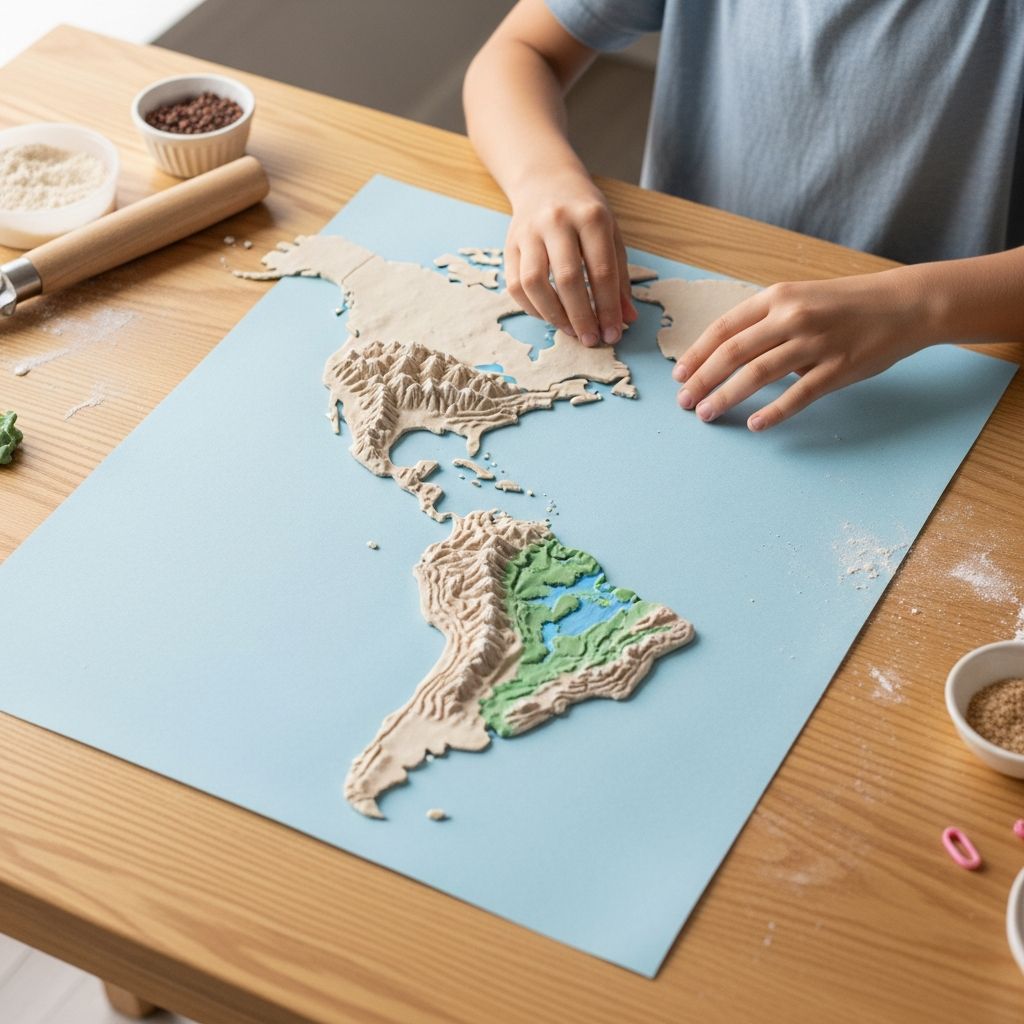
Salt dough maps are a fantastic way to bring geography to life for children. By creating three-dimensional representations of landforms, rivers, mountains, and more, kids can explore the world in a tactile and memorable way. This article covers everything you need to know about making salt dough maps, from recipes and materials to step-by-step instructions and creative ideas for classroom or home use.
What Is a Salt Dough Map?
A salt dough map is a three-dimensional map that allows children to sculpt physical features such as mountain ranges, hills, lakes, rivers, and oceans using a simple mixture of salt, flour, and water. Unlike flat paper maps, salt dough maps help kids visualize elevation and topography, making geography lessons more engaging and interactive.
Benefits of Salt Dough Maps
- Encourages hands-on learning and creativity.
- Helps children understand topographical features and map reading.
- Provides a sensory experience that can be especially beneficial for kinesthetic learners.
- Can be used for various subjects, including science, math, and art.
Materials Needed
To make a salt dough map, you will need the following supplies:
- Flour
- Salt
- Water
- Bowl and stirring utensil
- Pencil
- Acrylic paint
- Paint brushes
- Wood panel or thick cardboard
- Newspaper or tablecloth (to protect your work surface)
Salt Dough Recipe
Here is a simple recipe for salt dough:
- 2 cups all-purpose flour
- 1 cup salt
- 1 cup water
- (Optional) 1 tablespoon cream of tartar (for extra durability)
Mix the ingredients in a bowl until the dough reaches a playdough-like consistency. Add more water or flour as needed to achieve the desired texture.
Step-by-Step Instructions
- Sketch the outline of your chosen region or country on the wood panel or cardboard using a pencil.
- Cover your work surface with newspaper or a tablecloth to protect it from mess.
- Prepare the salt dough using the recipe above.
- Begin adding the salt dough to your panel, starting with flat areas and building up mountains and hills as needed.
- Use a pencil or other tool to etch out lakes, rivers, and other low areas.
- Smooth the map gently with your fingertips.
- Allow the map to dry completely for 1-2 days, or speed up the process by placing it in a low-temperature oven (200°F) for 2-3 hours.
- Once dry, paint the map according to a key you create or copy. Use green for lowlands, yellow for mid-elevation, brown for mountains, and blue for water.
Practical Tips
- Give young children some exploration time with the dough before starting the map to help them focus during the lesson.
- Use online physical maps as references for accurate landforms.
- Label your map with a legend to explain the colors and features.
- Encourage creativity by letting children add their own details, such as cities or landmarks.
Creative Uses for Salt Dough
- Science: Create models of habitats, organs, cells, fossils, or bones.
- Math: Use salt dough as manipulatives for practicing addition, subtraction, and measurement.
- Art: Let children play freely with salt dough for creative expression.
FAQs
Can salt dough maps be eaten?
No, salt dough is not meant to be eaten. Always wash hands after handling raw flour and salt dough.
How long does it take for a salt dough map to dry?
It typically takes 1-2 days for a salt dough map to dry completely. You can speed up the process by placing it in a low-temperature oven.
Can I use food coloring in the salt dough?
Yes, you can add food coloring to the dough for a more vibrant effect. Gel food coloring works well, but liquid food coloring can also be used.
What can I use instead of a wood panel?
Thick cardboard or foam board can be used as an alternative to wood panels.
Can salt dough maps be reused?
No, salt dough maps are not reusable once they have dried and been painted. They are best kept as keepsakes or display pieces.
Conclusion
Salt dough maps are a versatile and engaging way to teach geography and other subjects. With simple ingredients and a few creative ideas, children can learn about the world while having fun and developing their artistic skills. Whether used in the classroom or at home, salt dough maps are sure to make learning memorable and enjoyable.