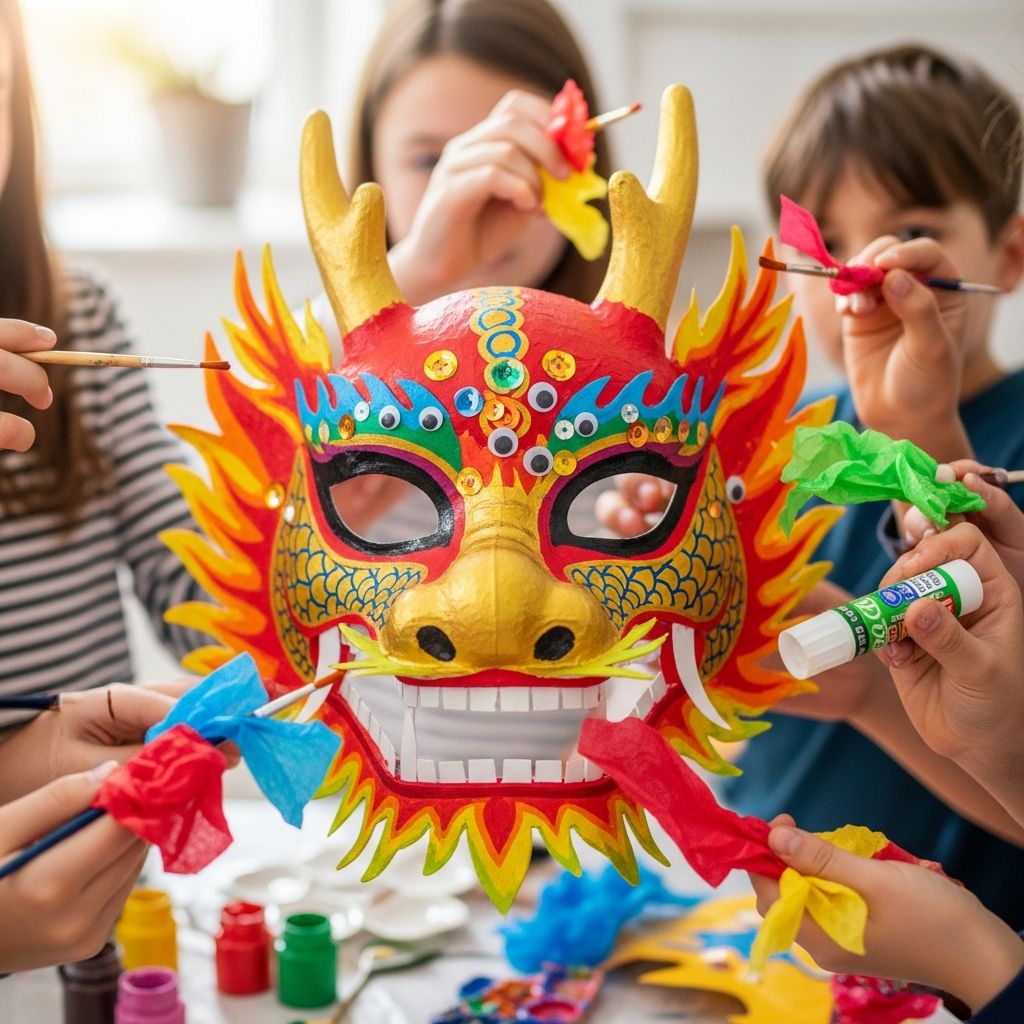
Chinese dragons symbolize power, good fortune, and new beginnings, which makes a dragon mask the perfect hands-on project for celebrating Lunar New Year with children. This guide shows how to design and build a bright, playful mask using kid-friendly materials, while also weaving in cultural meaning and creative play.
Why a Dragon Mask Is a Great Kid Craft
A dragon mask craft combines art, storytelling, and movement in one activity, making it ideal for family nights, classrooms, and holiday parties. Children not only create a decorative object but also step into character as they wear and perform with their masks.
- Encourages creativity through drawing, coloring, and decorating.
- Supports fine motor skills with cutting, gluing, and tracing.
- Opens up conversations about Chinese culture and Lunar New Year traditions.
Understanding the Chinese Dragon Symbol
The Chinese dragon is a legendary creature often associated with rain, rivers, and prosperity, and it is considered a guardian that brings good luck rather than destruction. Unlike Western dragons, which are typically fierce monsters, Chinese dragons tend to be seen as wise protectors and bringers of blessings.
- Dragons commonly appear in New Year parades, dances, and decorations.
- Their long, flowing bodies and expressive faces make them perfect subjects for kid-friendly masks.
Planning Your Dragon Mask Project
Before anyone starts cutting or gluing, it helps to decide on the size, style, and purpose of the mask. You can create a simple face mask that covers only the front of the head or a more elaborate headpiece that feels like a tiny version of a parade dragon.
- Choose whether children will wear the mask on their face with elastic or hold it on a stick like a puppet.
- Decide on a color scheme in advance to keep supplies organized and reduce overwhelm.
Suggested Materials and Substitutions
Most supplies for this project are already in common craft bins, and many items can be substituted with what is on hand. Flexible options mean you can easily adapt the difficulty level for different ages.
| Item | Purpose | Possible Substitutions |
|---|---|---|
| Sturdy paper or light cardboard | Base for the mask | Paper plates, cereal boxes |
| Colored paper | Scales, eyebrows, horns, flames | Old magazines, wrapping paper, painted paper |
| Markers or crayons | Adding patterns and facial details | Colored pencils, soft pastels |
| Glue stick and child-safe liquid glue | Attaching decorations and layers | Double-sided tape for quick attachment |
| Child-safe scissors | Cutting mask shape and decorations | Pre-cut shapes for very young children |
| Elastic cord or ribbon | Wearing the mask | Wooden craft stick for a handheld mask |
| Tissue paper or crepe paper | Whiskers, beard, and flowing flames | Fabric strips, yarn, or string |
| Decorative extras | Adding sparkle and texture | Stickers, sequins, buttons, glitter glue |
Safety Tips for Crafting with Kids
Even a simple paper mask project benefits from a few ground rules to keep children safe and comfortable. Taking time to review safety guidelines also establishes good crafting habits they can carry into other creative experiences.
- Use blunt-tipped, age-appropriate scissors and assist younger children with cutting eye holes.
- Choose non-toxic markers and glue, and protect the table with old newspaper or a plastic cloth.
- Measure elastic carefully so the mask fits snugly but does not pull or press on the face.
Step 1: Design the Dragon Face
Begin by sketching the outline of the dragon face on your base material, keeping shapes simple and bold. Children can look at illustrations of Chinese dragons for inspiration and then create their own version rather than copying a specific design.
- Encourage kids to exaggerate features like eyebrows, nose, and jaw to make the mask expressive.
- Ask them to think about the dragon’s personality: Is it playful, fierce, sleepy, or wise?
Step 2: Cut Out the Mask Base
Once the general face shape is drawn, cut it out from the paper or cardboard, smoothing any extremely pointy corners. Before decorating, hold the blank mask up to the child’s face and lightly mark where the eyes should be so that they can see clearly when wearing it.
- Carefully cut out the eye holes, enlarging them a bit if the child feels their vision is limited.
- If the mask feels heavy, trim unnecessary areas from the sides or bottom to make it more comfortable.
Step 3: Add Color to the Dragon
This is where the mask really starts to come alive. Invite children to color the base with their chosen palette, often reds, golds, greens, and other bright hues that stand out in parades and celebrations.
- Layer markers with colored paper pieces to create a sense of depth and scales.
- Suggest that kids mix warm and cool colors to make the dragon look energetic and magical.
Step 4: Build Up Facial Features
To create a three-dimensional look, layer paper shapes on top of the base for eyebrows, snout, nose ridges, and cheekbones. Overlapping pieces adds visual interest and makes the dragon appear more dynamic than a flat drawing.
- Cut curved paper strips for eyebrows and fold them slightly so that they stand away from the mask.
- Use small rectangles rolled into tubes to create raised nostrils or ridges along the nose.
Step 5: Give the Dragon Eyes Full of Character
The eyes often determine whether the dragon looks friendly or fierce. Children can draw round, oval, or almond-shaped eyes and then outline them in a contrasting color to help them stand out from the rest of the mask.
- Add extra circles or star shapes around the eyes to suggest glowing power or magical vision.
- Encourage kids to experiment with eyelashes, eyebrows, or markings that convey emotion.
Step 6: Create a Flowy Beard and Whiskers
Long whiskers and a wavy beard add movement to the mask, especially when kids dance or run around. Thin strips of tissue paper, yarn, or ribbon can be arranged around the mouth and chin to give the dragon a sense of motion.
- Layer several colors in the beard so that it looks fiery and full when the mask moves.
- Attach whiskers at the sides of the nose, letting them curve outward and downward.
Step 7: Attach Horns and Decorative Details
Horns, frills, and side fins help distinguish dragons from other creatures and turn a simple mask into a special celebration piece. These details can be cut from contrasting paper colors and attached along the top and sides of the mask.
- Try zigzag or flame shapes for horns to suggest power and energy.
- Add dotted lines or tiny cut paper circles to mimic scales along the edges of the face.
Step 8: Secure the Mask for Wearing or Play
When the decorating is complete and the glue is dry, it is time to turn the mask into a wearable or playable prop. The method you choose depends on the age of the children and whether the mask is mainly for display or active play.
- For wearing: punch small holes at the sides of the mask, thread elastic or ribbon through, and tie snugly.
- For handheld play: tape or glue a craft stick to the back center so kids can hold the mask in front of their faces.
Simple Variations for Different Age Groups
One advantage of this project is that it is easy to adapt for a wide range of ages and skill levels. Younger children can focus on coloring and sticking pre-cut shapes, while older kids can take on more complex design tasks.
- Toddlers and preschoolers: Offer a pre-cut base with large eye holes and larger decorations to glue on.
- Elementary-age kids: Let them design their own face shape and experiment with layered textures and patterns.
- Tweens: Encourage them to add cultural motifs, Chinese characters, or even small LED stickers for a glowing effect.
Using the Dragon Mask in Learning Activities
The finished masks can play a role in many educational activities beyond a single craft session. Teachers and caregivers can integrate them into lessons about geography, language, and storytelling connected to Chinese traditions.
- Invite children to perform a short dragon dance around the room while music plays.
- Pair the craft with a simple, age-appropriate book about Lunar New Year customs.
Ideas for Group or Classroom Projects
Making multiple dragon masks at once can transform a classroom or party into a lively festival scene. Planning ahead for drying space and display options helps the project feel organized and celebratory.
- Assign small teams to design different parts of a “dragon family,” each with a unique color theme.
- Hang completed masks on a bulletin board or string them as a gallery across the room before children take them home.
Cleaning Up and Saving the Masks
Once the crafting fun is over, simple cleanup routines keep supplies organized for next time and help the masks last longer. Encourage kids to help gather leftover materials so they feel responsible for the full process.
- Store masks flat in a large envelope or folder so that fragile paper horns and whiskers do not bend.
- Write each child’s name and the year on the back as a keepsake of that New Year’s celebration.
Frequently Asked Questions
How long does it take to make a dragon mask?
Most children can complete a simple version of the mask in about 30–45 minutes, though more elaborate designs with many layers may take closer to an hour. Allow extra time for glue to dry if you plan a group performance or display afterward.
What if a child dislikes loud or intense colors?
While bright reds and golds are common in New Year decorations, a dragon mask can be any color that feels comfortable and fun to the child. Softer shades like blues, greens, or pastels can still carry the same imaginative spirit.
Can this craft be adapted for children with sensory sensitivities?
Yes, you can choose materials that feel smoother or less crinkly, avoid loose glitter, and skip elastic if it bothers the child’s skin. A handheld mask on a stick is often a good alternative for kids who prefer not to wear something on their face.
Is this activity only for Chinese New Year?
Although this project pairs naturally with Lunar New Year celebrations, dragon masks also fit well in mythology units, storytelling camps, and costume parties. The cultural connection adds depth, but the basic idea of a dragon character is flexible and universal.
How can adults enrich the cultural context without overwhelming kids?
Share a few short facts about why dragons are considered lucky and how they appear in holiday parades, then invite kids to reflect that positivity in their mask designs. Keeping explanations brief and age-appropriate lets children absorb meaning while still focusing on hands-on creativity.
Bringing the Dragon to Life
When children put on their dragon masks, they step into a role that blends folklore, celebration, and imaginative play. Whether the mask decorates a wall or leads a mini parade around the living room, it becomes a colorful reminder of creativity and cultural appreciation.