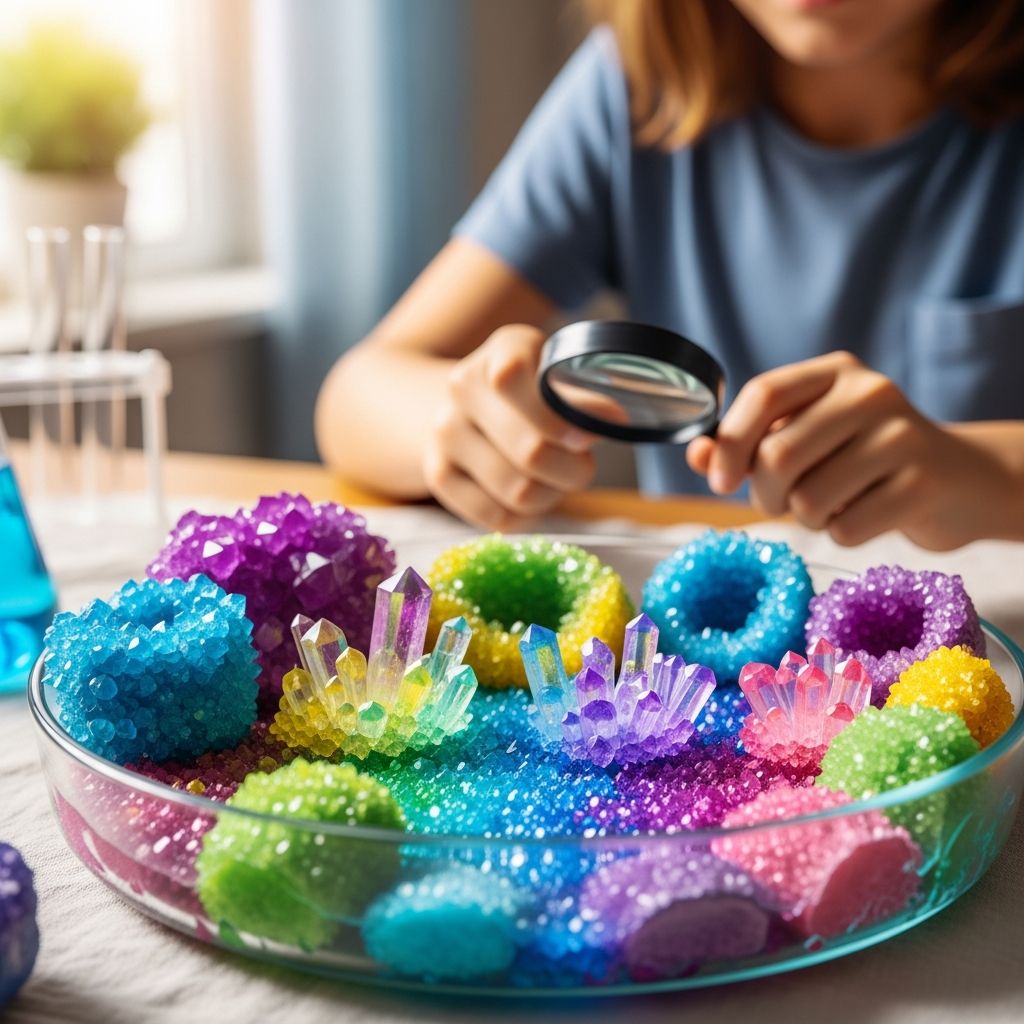
Creating a crystal garden is a fascinating science experiment that allows children to witness the process of crystal formation firsthand. This hands-on activity is not only educational but also visually stunning, making it a favorite for science fairs and classroom projects.
What Is a Crystal Garden?
A crystal garden is a collection of crystals that grow from a solution, often resembling a miniature garden. The crystals form when certain chemicals dissolve in water and then recrystallize as the water evaporates or cools. This experiment demonstrates the principles of solubility, evaporation, and crystallization.
Materials Needed
- Epsom salt (or table salt, borax, or sugar)
- Hot water
- Clear glass jar or container
- Measuring cup
- Spoon
- Food coloring or liquid watercolor (optional)
- Pom-poms, rocks, or sponge (for base)
- Liquid bluing (optional)
- Ammonia (optional)
Step-by-Step Instructions
- Measure 1 cup of Epsom salt and pour it into your glass jar.
- Add 1 cup of very hot tap water to the jar and stir thoroughly until the salt is mostly dissolved. It’s okay if some salt remains undissolved at the bottom.
- If desired, add a few drops of food coloring or liquid watercolor to create colorful crystals.
- Place pom-poms, rocks, or a sponge at the bottom of the jar to act as a base for the crystals to grow on.
- For a more dramatic effect, you can add a small amount of liquid bluing and ammonia (optional, but these help speed up crystal formation and create unique shapes).
- Place the jar in the refrigerator overnight or leave it undisturbed at room temperature for several days.
- The next day, pour off the excess liquid and observe your crystal garden. The crystals will have formed on the base material and may look like delicate coral or snowflakes.
The Science Behind Crystal Gardens
Crystal gardens form due to the process of crystallization. When a solute (like salt or Epsom salt) is dissolved in water, it forms a solution. As the water cools or evaporates, the solute can no longer stay dissolved and begins to form solid crystals. The base material (such as pom-poms or rocks) provides a surface for the crystals to grow on, resulting in the garden-like appearance.
Experiment Variations
You can experiment with different types of salts, temperatures, and base materials to see how they affect crystal growth:
- Try using table salt, borax, or sugar instead of Epsom salt.
- Use different colors of food coloring to create a rainbow garden.
- Change the temperature of the water to see how it affects crystal formation.
- Use different base materials like coal, sponge, or even pipe cleaners.
Crystal Garden Table: Materials and Effects
| Material | Effect on Crystal Growth |
|---|---|
| Epsom Salt | Fast, delicate crystals |
| Table Salt | Slower, chunkier crystals |
| Borax | Large, clear crystals |
| Sugar | Soft, edible crystals (do not eat!) |
| Liquid Bluing | Speeds up growth, unique shapes |
Tips for Success
- Always use adult supervision when handling hot water or chemicals.
- Ensure the jar is clean and free of dust to prevent unwanted crystal nucleation.
- Leave the jar undisturbed for best results.
- Experiment with different combinations to see what works best for your garden.
FAQs
How long does it take for crystals to form?
Crystals typically begin to form within a few hours, but the best results are seen after leaving the jar overnight or for several days.
Can I eat the crystals?
No, the crystals are not edible, even if sugar is used. Always supervise children and avoid ingestion.
Why do crystals form on the base material?
The base material provides a surface for the crystals to nucleate and grow, making them more visible and garden-like.
Can I reuse the solution?
It’s best to start fresh each time, as the solution loses its ability to form new crystals after repeated use.
What safety precautions should I take?
Always use gloves and goggles when handling chemicals, and keep the experiment out of reach of young children.
Conclusion
Making a crystal garden is a fun and educational way to introduce children to the wonders of chemistry and crystal formation. With simple household materials and a little patience, anyone can create a beautiful and unique crystal garden at home.