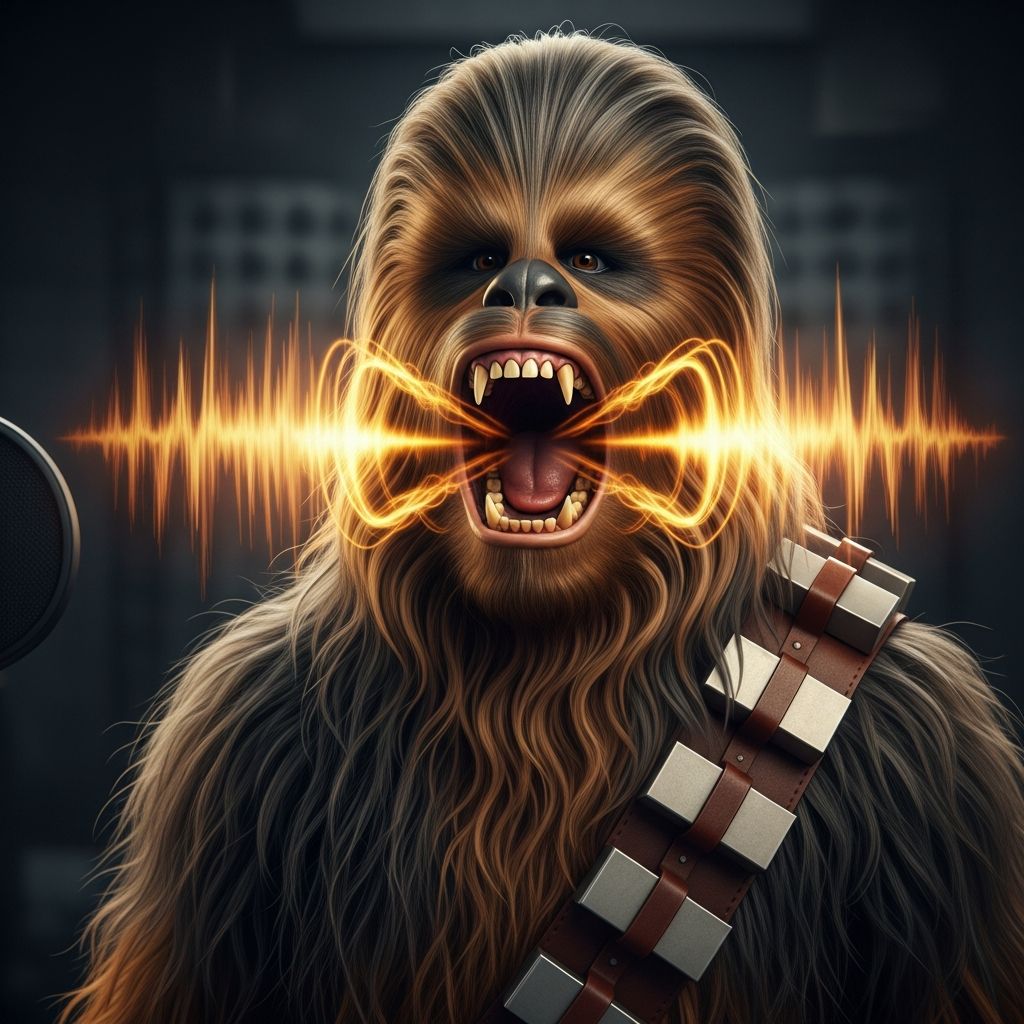
The iconic Chewbacca roar is one of the most recognizable sounds in film history, and recreating it is a fun challenge for Star Wars fans, kids, and aspiring voice actors alike. Behind the scenes, Chewbacca’s cinematic voice was built from layered animal recordings by sound designer Ben Burtt, who drew heavily on bears, walruses, and other animals to create an emotional, non-human language. At home, you obviously do not need a zoo and a mixing studio—you just need your voice, a bit of technique, and a willingness to sound ridiculous while practicing.
This guide walks you through safe, simple vocal techniques inspired by actors and coaches who have demonstrated how to imitate Chewbacca’s call using tongue trills, pitch control, and resonance. You will also learn ways to protect your voice while you play, how to teach the sound to kids, and how to turn your newfound Wookiee skills into games.
Understanding What Makes Chewbacca Sound Like Chewbacca
Before you start roaring, it helps to break down what you are trying to copy. Chewbacca’s voice has several recognizable characteristics:
- Non-human quality: It sounds animal-like and emotional, not like any spoken Earth language.
- Rolling texture: There is a vibrating, warbling quality in many of his calls.
- Wide pitch range: Chewie can sound low and mournful or high and excited, sometimes in one phrase.
- Strong resonance: The sound feels big and chesty, as if it fills his whole body.
- Clear emotions: Even without words, you can tell when he is annoyed, happy, scared, or comforting someone.
Film sound designers achieved this on screen by carefully recording animals and selecting sounds that carried a particular emotional tone, then cutting and layering them to match the performance. You will recreate the overall effect using vocal tricks that approximate that warbling, resonant, emotional roar.
Warm Up First: Protecting Your Voice
Any time you experiment with extreme sounds—roars, screams, growls—it is wise to warm up and stay within safe limits. Vocal health guidelines emphasize that shouting or pushing your voice for long periods can irritate or inflame the vocal folds. A quick warm-up makes the Chewbacca experiment safer and more comfortable.
Quick Vocal Warm-Up Routine
- Hydrate: Sip some water so your throat is not dry.
- Neck and jaw looseners: Gently roll your shoulders, yawn softly, and relax your jaw by opening and closing your mouth without tension.
- Gentle lip trills: Blow air through closed lips to make them buzz (like a quiet motorboat). Keep it soft and easy—no force.
- Light humming: Hum a simple scale or a favorite tune at a comfortable volume, paying attention to a relaxed feeling in your throat.
Stop if you feel pain, sharp discomfort, or persistent hoarseness; guidelines from voice clinics note that ongoing hoarseness longer than about two weeks should be evaluated by a professional.
The Core Technique: Building a Wookiee-Style Roar
There is no single official “right” way to imitate Chewbacca, but many performers use a combination of tongue vibration and pitch control, similar to rolling an R and adding a moaning tone on top. Others rely more on uvular vibration near the soft palate, as seen in some public how-to demonstrations. You can experiment with whichever approach feels more natural.
Method 1: Tongue Trill + Moan
This method imitates Chewbacca using a rolled tongue sound as the base.
- Learn the tongue roll:
Press the tip of your tongue lightly against the ridge just behind your upper front teeth. Blow air out and let your tongue flutter, similar to rolling an R in Spanish or Italian. You should feel a rapid vibration of the tongue. - Add a low pitch:
While keeping the tongue trilling, engage your normal speaking voice and add a low, drawn-out note beneath it. Think of a long, relaxed “ooo” or “uuh” sound. - Shape the vowel:
Alternate between something like “rrrr-ooo-aaaa” while sustaining the roll. Play with different mouth shapes—more open for louder roars, more closed for softer grumbles. - Use your chest:
Imagine the sound resonating in your chest rather than squeezing your throat. This helps create a fuller, Wookiee-like tone and reduces strain.
Method 2: Uvula Vibration Technique
Some tutorials focus on vibrating the uvula—the small soft structure hanging at the back of your mouth—to create a gargling, rolling sound.
- Understand the placement:
Gently slide your lower jaw back so your tongue can rise toward the soft palate. The back of your tongue should lightly contact or approach the uvula. - Blow air gently:
Exhale while keeping that light contact, allowing the uvula to flutter in the airstream. It may feel similar to gargling without liquid. - Add tone:
Once you can get the flutter, layer a voiced sound beneath it, aiming for a rounded “ooo” quality. - Refine the sound:
Adjust how far back your tongue sits and how wide your mouth is until the vibration becomes stable and controllable.
Shaping Emotion: From Growls to Excited Roars
Chewbacca’s charm is not just in the sound, but in the feeling it carries. Sound designers originally sorted animal recordings by emotion—angry, affectionate, distressed—then built his lines around those categories. You can mimic that approach by practicing distinct emotional versions of your roar.
| Emotion | Pitch & Volume | Mouth Shape & Style Tips |
|---|---|---|
| Happy / Excited | Medium to high pitch, louder, bouncy rhythm | Open mouth, quick bursts of sound, slight upward head tilt |
| Annoyed / Grumpy | Medium pitch, moderate volume | Mouth partly closed, tighter lips, shorter “grr”-like bursts |
| Sad / Comforting | Lower pitch, softer volume, slower rhythm | Relaxed jaw, long descending tones, gentle head movement |
| Frightened / Alarmed | Starts low, jumps quickly higher, often louder | Wide eyes, sudden intake of breath, sharp upward inflection |
Practice Drills to Improve Your Wookiee Voice
Like any vocal skill, your Chewbacca impression improves with repetition. The goal is not volume; it is control, variety, and comfort.
Daily Five-Minute Routine
- 1 minute – Rolls only: Practice tongue or uvular rolls without adding pitch, focusing on smooth, sustained vibration.
- 2 minutes – Long tones: Hold a single Wookiee-style tone for 2–3 seconds, rest, and repeat. Vary between low, medium, and higher pitches.
- 1 minute – Emotional phrases: Do three short roars in a row that each represent a different emotion (for example, happy, annoyed, scared).
- 1 minute – Quiet practice: Practice a “whisper Wookiee” at low volume, keeping all the shaping but minimizing loudness to protect your voice.
Body Movement and Performance
Film actors pair the sound with big body language to sell the illusion. You can do the same:
- Head movement: Gently tilt and sway your head as you roar, which subtly changes resonance and adds drama.
- Posture: Stand tall with relaxed shoulders so your lungs and diaphragm can support the sound.
- Face acting: Raise your eyebrows, squint, or widen your eyes to match the emotion; it often influences how your voice comes out.
Kid-Friendly Tips and Play Ideas
Children often want to roar along with their favorite characters, but their voices are still developing, so moderation and gentle volume are important. Pediatric and voice-care resources advise against frequent screaming, as it can cause vocal nodules or hoarseness in young voices. You can keep Chewbacca play fun and safe with these adjustments.
- Use “indoor Wookiee” voices: Encourage kids to practice medium or soft roars instead of shouting as loud as possible.
- Limit roar marathons: Make it a quick game—5 minutes of Chewie play, then switch to another activity.
- Turn it into a story: Let children “translate” what Chewie is saying after every roar, helping them focus on emotion rather than just volume.
- Model safe behavior: Show them how you take breaks, drink water, and stop if your throat feels scratchy.
Common Problems and Simple Fixes
If your first attempts sound more like a broken vacuum than a mighty Wookiee, that is normal. Here are frequent issues and practical solutions.
- “I can’t roll my tongue.”
Some people simply cannot produce a front-tongue trill. Use the uvula vibration method instead, or create a lower, growlier sound by humming into your chest and adding small pitch slides. Focus less on copying Chewbacca perfectly and more on capturing the spirit. - “My throat feels scratchy.”
You are probably pushing too much air or tightening your throat. Reduce volume, return to gentle humming, and try again with less force. If hoarseness lasts more than two weeks, professional voice guidelines recommend seeing a clinician. - “It sounds too small or thin.”
Engage your body—stand up, expand your ribcage on inhale, and let the sound resonate in your chest rather than just the mouth. Slightly lowering the pitch can also make it sound fuller. - “I run out of breath quickly.”
Take slower, deeper breaths into your lower ribs rather than lifting your shoulders. Shorten your roars at first, then gradually extend them.
Fun Ways to Use Your New Chewbacca Roar
Once you are comfortable making the sound, you can weave it into games, creative projects, and social moments.
- Star Wars viewing nights: Time your roar with Chewbacca’s on-screen appearances for a playful audience surprise.
- Party trick: Demonstrate the sound as a quick impression, then teach friends the basic steps and hold a mini “Wookiee-off.”
- Audio projects: Record your roar and layer or pitch-shift it using basic audio software to see how close you can get to the film sound.
- Storytelling with kids: Read a Star Wars book aloud and let kids supply Chewbacca’s lines using their new roars.
Frequently Asked Questions (FAQs)
Is it safe to practice the Chewbacca roar every day?
It can be safe if you keep the volume moderate, avoid throat tension, and stop when you feel discomfort. Voice-care resources emphasize that persistent hoarseness, pain, or voice loss are warning signs and should be assessed by a medical professional or voice specialist.
Do I need special equipment to sound like Chewbacca?
No. The original movie voice used studio recordings of animals mixed by professionals, but for an impression you only need your voice, a quiet room, and possibly a recording app if you want to hear yourself and improve.
Can I sound exactly like the movie version?
Matching the film perfectly is difficult because it was built from layered animal sounds and careful editing. You can get recognizably close by focusing on the rolling texture, low-to-mid pitch, and clear emotional expression rather than chasing a frame-by-frame replica.
How long does it take to learn a decent Chewbacca impression?
Many people can produce a basic, recognizable roar in a single practice session, especially if they already know how to roll their R’s. Refining control, adding emotional nuance, and staying comfortable while doing it repeatedly may take several days or weeks of short, regular practice sessions.
Is there a quiet version I can use in public?
Yes. Use the same tongue or uvula vibration but reduce air pressure and volume, almost like whispering the sound. Keep the mouth more closed and rely on facial expression to sell the joke. This preserves the Wookiee feel without disturbing people nearby.
References
- Sound Engineer Ben Burtt Explains How STAR WARS’ Most Iconic Sounds Were Made — Nerdist. 2018-04-24. https://archive.nerdist.com/sound-engineer-ben-burtt-explains-how-star-wars-most-iconic-sounds-were-made/
- How Ben Burtt made Chewbacca Star Wars Sound Effects — YouTube (Lucasfilm content via Peter Hobbs channel). 2019-01-25. https://www.youtube.com/watch?v=kxl4xnMJgSE
- How to Make the Chewbacca Noise — Howcast (YouTube). 2009-10-16. https://www.youtube.com/watch?v=lWuJZG4GdP0
- How To Make The Chewbacca Sound — YouTube (Joonas Suotamo / YonoWorld). 2020-01-24. https://www.youtube.com/watch?v=ABJGnhkb3aM
- Hoarseness (Dysphonia) — American Academy of Otolaryngology–Head and Neck Surgery. 2022-03-01. https://www.enthealth.org/conditions/hoarseness-dysphonia/