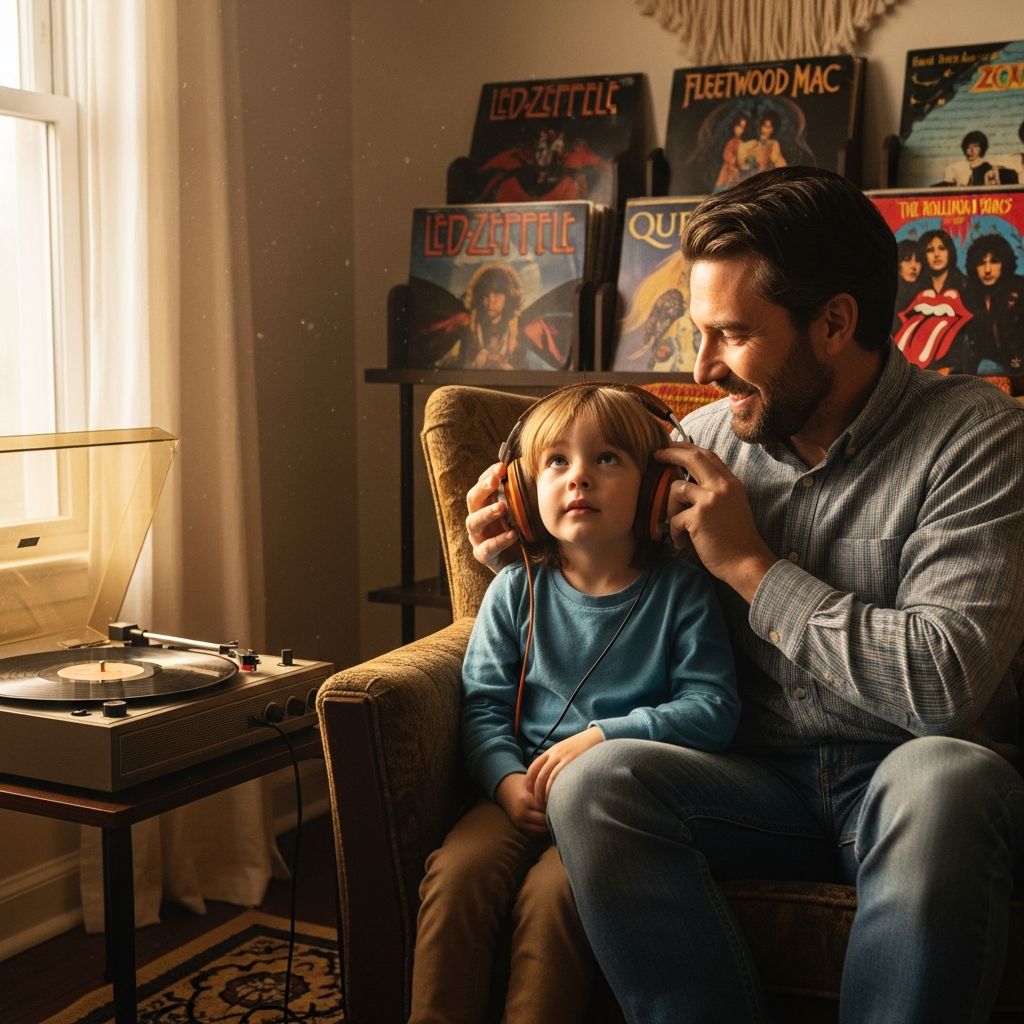
The music of the 1970s was full of big emotions, unforgettable melodies, and stories that still speak to families today. Many parents who grew up with classic rock now want to pass that soundtrack on to their children, but may wonder how to do it in a way that feels fun, age-appropriate, and meaningful.
Why 1970s Rock Still Belongs in a Kid’s World
The 1970s brought together electric guitars, lush harmonies, and heartfelt lyrics in a way that makes those songs surprisingly accessible to kids. Even young children can hum along to simple choruses, recognize repeated melodies, and respond instinctively to rhythms that feel warm and human rather than overly processed. For many parents, it is also a way to share part of their own childhood in a form that feels less like a lecture and more like a shared adventure.
- Many songs from this era focus on clear stories, nature, friendship, and everyday emotions that kids can understand.
- The production style often leaves space between instruments, making it easier for children to hear individual parts and follow along.
- For parents, revisiting these tracks offers a natural starting point for conversations about family history and changing times.
Balancing Nostalgia With Your Child’s Needs
Sharing music from your youth is emotionally powerful, but a child’s tastes and sensitivities should guide the experience. Instead of starting with the loudest, most intense tracks, begin with songs that have gentle verses, clear melodies, and lyrics that are easy to explain. You are not trying to recreate your teenage years; you are building something new between you and your kids.
Think of your old favorites as raw material rather than a fixed playlist. Some songs will translate perfectly to a family setting; others might need to wait until your kids are older. The best measure of success is not whether your child worships the same bands you did, but whether music becomes a shared language between you.
From Lullabies to Road Trips: Matching Songs to Moments
One of the most effective ways to introduce 1970s rock is to match songs to specific family routines. Kids tend to bond with music when it shows up consistently at the same time of day or during the same kind of activity. Instead of overwhelming them with a long playlist, tie a few songs to familiar, comforting rituals.
- Morning routines: Light, upbeat acoustic songs or soft rock can make getting dressed and eating breakfast feel cozy rather than rushed.
- Car rides: Mid-tempo rock tracks with strong choruses give kids something to sing along to while watching the world roll by.
- Bedtime: Slower, gentler 1970s tunes can become part of a wind-down ritual, functioning almost like modern lullabies.
Understanding the Spectrum: Gentle Folk to Stadium Anthems
Rock in the 1970s was not a single sound; it was an entire spectrum. For parents, that variety is a gift. At the softer end, you have acoustic storytellers who sang about landscapes, families, and simple joys, with arrangements that feel almost like folk songs. At the louder end, you have distorted guitars, pounding drums, and lyrics that explore rebellion, heartbreak, and complex adult themes.
For families with young children, it often makes sense to begin at the gentle end and slowly work toward more intense songs as kids grow. That progression mirrors a child’s emotional development: first feeling safe, then curious, then ready to wrestle with heavier ideas and sounds.
| Style | Typical Sound | Best For | Parenting Opportunity |
|---|---|---|---|
| Soft rock / folk-influenced | Acoustic guitars, gentle vocals, storytelling lyrics | Bedtime, quiet play, long drives | Talking about feelings, nature, family memories |
| Classic rock mid-tempo | Electric guitars, strong beat, catchy choruses | Weekend clean-ups, short car rides, dance breaks | Encouraging movement, rhythm, and sing-alongs |
| Arena / hard rock | Loud guitars, dramatic drums, big vocals | Older kids’ jam sessions, special listening sessions | Discussing energy, power, and responsible expression of big emotions |
Building an Age-Appropriate 1970s Playlist
While every family’s boundaries are different, there are some general principles that help keep things kid-friendly. The idea is not to sanitize music until it has no character, but to introduce songs where any tricky themes can be explained with simple, honest language your child can handle. You can always add more complex material as they get older.
When curating, listen to entire tracks rather than relying on memory. Lyrics you barely noticed as a teen may stand out sharply when heard through a parent’s ears. If something makes you hesitate, consider saving it for later—kids are not keeping score on how complete your classic rock education is.
Checklist for Selecting Songs
- Language: Avoid or postpone songs with repeated profanity or slurs.
- Themes: Consider whether references to drugs, self-harm, or explicit sexuality are necessary for this stage.
- Emotional intensity: Some kids are sensitive to screaming vocals or aggressive sounds, even without understanding the words.
- Length: Very long tracks or extended solos can lose younger listeners; start with concise songs.
- Repetition: Kids love choruses they can anticipate and sing back to you.
Using Lyrics as Conversation Starters
One of the richest parts of 1970s rock is its storytelling. Rather than treating songs as background noise, you can invite your child to treat them like musical picture books. Ask them what they think is happening, how the characters feel, or what kinds of places they imagine while listening.
These conversations do not have to be long or formal. A single question—“Who do you think the singer is talking to?” or “Does this sound like a happy song or a sad song?”—can open the door to meaningful reflection. You are gently training your child to be an active listener rather than a passive consumer.
Simple Prompts You Can Use
- “If this song were a movie, what would you see on the screen?”
- “Which line of the song do you like the most, and why?”
- “Do you think the singer feels the same at the end of the song as at the beginning?”
- “Does this music make you want to move your body or sit still and think?”
Making It Interactive: Games and Family Rituals
Kids are far more likely to fall in love with classic music when it becomes part of playful rituals rather than a history lesson. Treat 1970s rock like a toy you share, not a museum piece they are required to admire. Small, repeatable games can turn familiar songs into family in-jokes and treasured memories.
- Air-band night: Hand out toy instruments or kitchen utensils and let everyone “perform” along with a favorite track.
- Lyric swap: Take a familiar chorus and invite kids to rewrite it about their day, pets, or favorite foods.
- Draw the song: Give your child paper and crayons and ask them to draw what the music makes them picture.
- Guess the decade: As kids get older, mix in songs from different eras and let them guess which ones are from “your” decade.
Handling Heavier Themes With Honesty
Many 1970s songs touch on loneliness, loss, war, environmental concerns, and social change. Rather than skipping every track that feels heavy, think of these songs as gentle introductions to complex realities. The key is to stay anchored in your child’s developmental stage and to answer questions with simple, honest explanations instead of elaborate lectures.
If a song references something you would rather explain on your own terms, you have options. You can fade the track out early, save it for solo listening, or frame it in advance: “This song is about people trying to make sense of a hard time in history” or “These words describe grown-up problems, so let’s just enjoy the melody for now.” Your child will take their cue from your calm and clarity.
Creating a Musical Family Story
Introducing your kids to 1970s rock is not only about the songs themselves; it is also about the stories behind how those songs entered your life. Children are often fascinated by hearing how their parents felt as kids—what scared them, what cheered them up, and what they played on repeat when they were having a rough day.
You can weave these memories into listening sessions without turning them into long monologues. A sentence or two—“I remember hearing this in the car with my dad on rainy mornings” or “I used to play this song when I was nervous before a big exam”—is usually enough to help your child connect the music to something deeper than just sound.
Ideas for Connecting Past and Present
- Build a “family favorites” playlist where each person chooses a song and explains why it matters to them.
- Print or draw a simple timeline showing when different songs came into your life and when your child first heard them.
- Record a short audio message for your child explaining what one particular song meant to you growing up, then listen to it together.
Screen Time, Streaming, and Boundaries
Streaming platforms make it easier than ever to explore the 1970s catalog, but they also come with challenges. Autoplay can jump from a gentle track to a much harsher song without warning, and recommendation algorithms may include content you would not have chosen. To keep control, consider using curated playlists, kid-friendly profiles, or manual playback rather than relying on endless radio modes.
It also helps to think about audio time the way you think about screen time: with clear boundaries and intentional choices. Decide in advance when music will be background (during chores, free play) and when it will be the main event (a listening party, a long drive). This teaches kids that music is something to be engaged with, not just a constant digital wallpaper.
Benefits Beyond Entertainment
Bringing 1970s rock into your home can support your child’s development in ways that go far beyond nostalgia. Repeated exposure to varied rhythms and harmonies helps build auditory skills that can support language learning and attention. Singing along improves memory and vocal control, while moving to the beat strengthens coordination.
On an emotional level, songs that describe complex feelings—wistfulness, wonder, hope, regret—give kids a vocabulary for experiences they may not yet be able to name. When they see that their parents rely on music to process emotions, they implicitly learn that feelings are something to explore rather than suppress.
Sample Structure for a Family Rock Night
If you want to make your first deep dive into 1970s music feel special, you can plan a simple “family rock night.” It does not have to be elaborate; a little intentional structure goes a long way. Here is a pattern you can adapt:
- Set the scene: Dim the lights, clear a bit of space for dancing, and put away distracting devices.
- Start soft: Begin with one or two gentle tracks so kids can settle into listening mode.
- Story time: Introduce one song with a brief story about when you first heard it or why you like it.
- Movement break: Play an upbeat track and encourage silly dancing or air instruments.
- Reflection: Ask each family member to pick their favorite song of the night and say one sentence about why.
- Wind down: End with a calm song that signals bedtime or quiet time is coming.
Frequently Asked Questions
Is 1970s rock too old-fashioned for today’s kids?
Children usually care more about melody, rhythm, and emotional tone than about whether a song sounds trendy. If the music feels joyful, comforting, or exciting to you, that energy is likely to carry over. Kids may initially comment that the production sounds “old,” but they often grow past that once a song becomes associated with positive experiences.
How do I handle songs with themes I am not ready to explain?
You are in full control of what you play and when. If a song’s lyrics feel too mature, you can skip it, fade it early, or frame it with a simple explanation like “This is about adult problems, so we’re just listening for the instruments.” As your child matures, you can revisit those tracks and use them to spark deeper discussions.
What if my child does not like the songs I grew up with?
Taste is personal, even in the same family. If your child does not connect with a particular band or style, treat that as information, not rejection. Keep exploring different corners of the decade—softer, louder, faster, slower—until you find overlap between your nostalgia and their curiosity.
Can classic rock coexist with current pop in our house?
Absolutely. Think of your child’s musical world as a large, flexible library rather than a narrow identity. Let them enjoy current hits while you occasionally introduce older songs as special discoveries. Over time, they may surprise you by asking to add one of your beloved 1970s tracks to their own playlists.
How often should we repeat the same songs?
Repetition is a key part of how children bond with music. Hearing the same song at predictable moments—before school, on Sunday drives, after dinner—helps it become an emotional anchor. You can always rotate in new tracks, but do not be afraid to lean into the ones your child keeps requesting.
Letting the Music Grow With Your Child
The beauty of sharing 1970s rock with your kids is that the relationship can evolve over time. What begins as background music for bedtime stories might later become the soundtrack to homework sessions, first crushes, and long talks during late-night drives. You are not just passing down old songs; you are planting seeds for a lifelong connection to music, emotion, and memory.
By starting gently, listening together, and keeping communication open, you give your child permission to explore an entire era of sound on their own terms. In the process, you may rediscover why these songs mattered to you in the first place—and create a new generation of little rockers who see music as a trusted companion, not just noise in the background.