Televised political debates can feel tense, confusing or downright exhausting when you watch them alone. Turning them into a relaxed gathering with friends, neighbors or family can make the experience more meaningful, more social and even entertaining. This guide will walk you through how to host a debate watch party that keeps the mood light while still helping everyone engage thoughtfully with the issues.
Why Turn a Debate into a Party?
Bringing people together to watch and discuss debates can help them better understand the candidates, connect policy ideas to daily life and feel more prepared to vote. It can also reduce the anxiety many people feel when following high-stakes politics, especially if the environment is friendly and well-structured.
- Shared experience: Guests can react together, compare impressions and notice things they might miss alone.
- Civic learning: Conversation after the debate helps people think more critically about what they saw.
- Community building: Parties can strengthen relationships among neighbors, coworkers or extended family.
- Modeling for kids: Children and teens can see adults disagree respectfully, an important civic skill.
Clarify Your Goal Before You Plan
Before you pick snacks or send invitations, decide what you want this gathering to be. Your purpose will guide who you invite, how you arrange the space and what activities you include.
| Party Goal | Best For | Planning Focus |
|---|---|---|
| Light social hangout | Close friends with similar interest level | Comfortable seating, simple snacks, minimal structure |
| Family-friendly civics night | Households with kids or teens | Short explanations, kid activities, early end time |
| Serious issue discussion | Mixed viewpoints and policy nerds | Ground rules, note-taking, structured debrief |
| Club or community event | Book clubs, parent groups, local organizations | Promotion, clear agenda, follow-up actions |
Step 1: Choose the Right Space and Setup
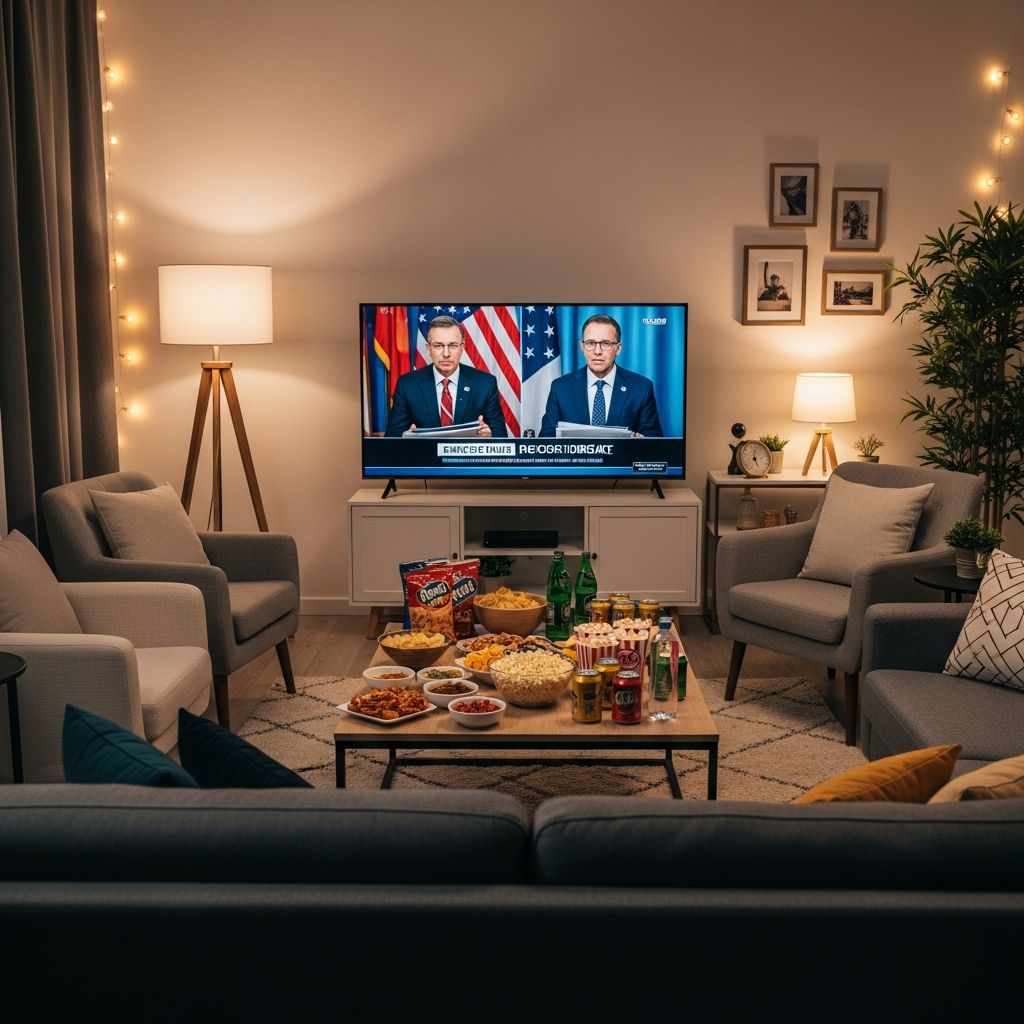
You do not need a huge living room or fancy equipment. What matters most is that people can see, hear and feel physically comfortable.
- Screen: A TV or projector everyone can see clearly. Test the channel or livestream beforehand.
- Sound: Make sure the volume is loud enough but not overwhelming; consider captions for accessibility.
- Seating: Mix of chairs, sofa spots and floor cushions so no one is stuck craning their neck.
- Lighting: Dim enough to see the screen but bright enough for people to take notes or eat without spills.
- Kids’ corner (optional): A side area with quieter activities if you’re hosting families.
If in-person is not possible, consider a virtual watch party. Many groups now use video conferencing and built-in chat features so people can react in real time while watching the same broadcast.
Step 2: Decide Who to Invite (and How)
The tone of your gathering will depend heavily on your guest list. Official civic organizations often recommend inviting a mix of perspectives, as long as everyone is open to listening respectfully.
Consider inviting:
- Friends and neighbors who like discussing current events
- Parents from school or your playgroup who want to learn more about the election
- Members of your book club, volunteer group or faith community
- Family members who live nearby and can handle disagreement kindly
Invitation tips:
- Mention the start and end times, and whether kids are welcome.
- Explain the tone: calm, respectful, not a yelling match.
- Note if you’ll provide snacks or if it’s a potluck-style gathering.
- Ask about accessibility needs (seating, captions, food allergies).
Step 3: Set Simple Ground Rules
Research on political discussion suggests that clear expectations and norms help prevent conversations from becoming hostile. A brief statement of ground rules at the start can keep things positive without killing the fun.
- One person speaks at a time. No interrupting, especially during the discussion segment.
- Critique ideas, not people. Avoid labeling others or assigning motives.
- Assume good faith. Start from the idea that others care about the country, even if their solutions differ.
- Let everyone participate. Encourage quieter guests and ask talkative ones to leave space.
- Respect personal limits. Anyone can step away from a topic that feels overwhelming.
Posting these rules on a sheet of paper or sharing them in your event description helps people know what they’re walking into.
Step 4: Plan Food and Drinks
You do not need elaborate themed food to make your party feel special. In many cases, light snacks actually keep people more alert and comfortable during the broadcast.
- Simple crowd-pleasers: popcorn, chips and dip, veggie trays, crackers and cheese.
- Potluck option: Ask guests to bring a favorite snack or drink to share.
- Label items: Mark dishes that are vegetarian, vegan or gluten-free.
- Alcohol considerations: If serving alcohol, balance with plenty of water and non-alcoholic options so emotions do not get amplified.
Step 5: Give Guests a Way to Follow Along
Many nonpartisan voter education groups recommend that viewers take notes or use simple tools while watching to stay focused on substance over theater.
You can set out:
- Note cards or small notebooks for guests to jot down key moments, questions and issues they care about.
- Issue checklists where people can mark whether candidates addressed specific topics they find important.
- Fact-check reminders encouraging guests to verify statistics afterward using reliable sources such as reputable news outlets or official government data.
These tools help shift attention away from performance and toward the information being shared.
Step 6: Make It Fun Without Losing Respect
Adding light-hearted elements keeps the atmosphere from turning sour, but it is important to avoid anything that mocks or dehumanizes participants in the political process.
- Prediction cards: Before the debate starts, ask everyone to predict one topic that will definitely come up. Compare answers afterward.
- Phrase bingo (carefully designed): Use neutral phrases like “I’ll fight for,” “small businesses” or “across the aisle,” not insults.
- Non-alcoholic toast: Invite guests to raise a glass of water, sparkling juice or tea to the idea of peaceful elections and the right to vote.
- Gentle reaction scale: Give everyone colored index cards (green for “agree,” yellow for “unsure,” blue for “disagree”) and let them silently hold up cards instead of talking over the TV.
Step 7: Lead a Post-Debate Conversation
The most valuable part of a watch party often happens after the cameras turn off. Many organizations suggest structured reflection to help viewers process what they saw and connect it to their values.
Suggested flow for 20–30 minutes of discussion:
- Initial impressions round: Give everyone one to two minutes to share a quick reaction.
- Issue dive: Ask which topics felt most important and whether they were handled thoroughly.
- Clarity check: Invite questions about anything that was confusing or felt incomplete.
- Media literacy moment: Discuss what parts seemed rehearsed, emotional or aimed at sound bites rather than substance.
- Next steps: Encourage guests to verify information, read candidate platforms and check their registration status.
If your party is part of a club, union or community organization, you might also gather anonymous written feedback about which issues members want to learn more about in future meetings.
Making the Event Family-Friendly
For parents, debates can double as civics lessons. Children who see adults following elections and discussing issues respectfully may grow into more engaged citizens.
Ideas for involving kids and teens:
- Let older children keep a tally of how often certain themes appear, like “education,” “environment” or “jobs.”
- Offer coloring pages, map puzzles or quiet games in another corner for younger kids.
- Ask teens for their perspective on one issue that affects their future, such as climate or college costs.
- Debrief briefly afterward at their level: “What did you notice?” or “What do you think a debate is for?”
Encouraging Informed Voting
Nonpartisan groups commonly emphasize that debates are just one piece of a much larger information puzzle. Encourage guests to follow up:
- Look up candidate platforms on their official campaign or government pages.
- Check voter registration details (deadline, polling location, ID requirements) through official state or local election websites.
- Compare independent coverage from reputable news organizations to get context and fact-check major claims.
While you should avoid distributing partisan materials at a mixed gathering, providing general reminders about registration and voting dates is often welcomed as a helpful public service.
Sample Timeline for a Low-Stress Watch Party
Exact timing will vary by debate start time and your guests, but this outline keeps things simple.
| Time | Activity | Notes |
|---|---|---|
| 30–45 minutes before | Guests arrive and grab snacks | Casual introductions; review ground rules briefly. |
| 10 minutes before | Prediction cards or bingo explanation | Hand out note cards or bingo sheets. |
| Debate time | Watch with light reactions only | Limit cross-talk so everyone can hear. |
| 10 minutes after | Stretch and refill drinks | Give people a breather before discussion. |
| 20–30 minutes after | Guided conversation | Use open-ended questions; keep tone calm. |
| Before people leave | Share nonpartisan resources | Remind guests to check registration and read more. |
Frequently Asked Questions (FAQs)
Do I need to be an expert on politics to host?
No. Your role is closer to a facilitator than a teacher. You provide a comfortable space, set some basic guidelines and let people share their own observations. When questions arise that no one can answer, treat them as homework for later research rather than something you must solve in the moment.
How can I keep arguments from getting out of control?
Set expectations early, limit the size of the group and use simple ground rules like taking turns and focusing on issues instead of personal attacks. If conversation heats up, pause for a snack break or gently steer questions back to shared concerns, such as the local economy or schools.
Is it okay to invite people with very different views?
Yes, as long as they are willing to be respectful. Some civic education groups even encourage including a diversity of views because it leads to richer discussion. Make your expectations clear in the invitation so guests know that hostility and name-calling are not welcome.
What if some guests just want to watch quietly?
Let them. Not everyone enjoys group discussion, and listening quietly is still participation. Provide note cards so they can jot down thoughts privately, and invite them (but do not pressure them) to share during the debrief if they feel comfortable.
Can I share information about voting at my party?
Yes. Nonpartisan information about registration deadlines, polling locations and how to vote by mail can be very helpful. Just avoid urging people to support specific candidates or parties if your guest list includes a range of political beliefs.
References
- Host a Debate Watching Party! — League of Women Voters Education Fund. 2016-01-01. https://www.lwv.org/sites/default/files/2018-07/host_a_debate_watching_party.pdf
- Presidential Debate Watch Party Guide — Save the Children Action Network. 2024-06-01. https://savethechildrenactionnetwork.org/general/presidential-debate-watch-party-guide/
- Debate Watching Kit — League of Women Voters. 2020-09-01. https://www.lwv.org/educating-voters/debate-watching-kit
- Debate Watching 101 — League of Women Voters of Pullman. 2019-10-01. https://lwvpullman.org/advocacy/debate_watching/
- Presidential Debate Watch Party Toolkit — American Federation of Teachers. 2019-06-01. https://allin.rtp.aft.org/sites/default/files/article_pdf_files/2019-06/2020_primarydebatewatchtoolkit.pdf