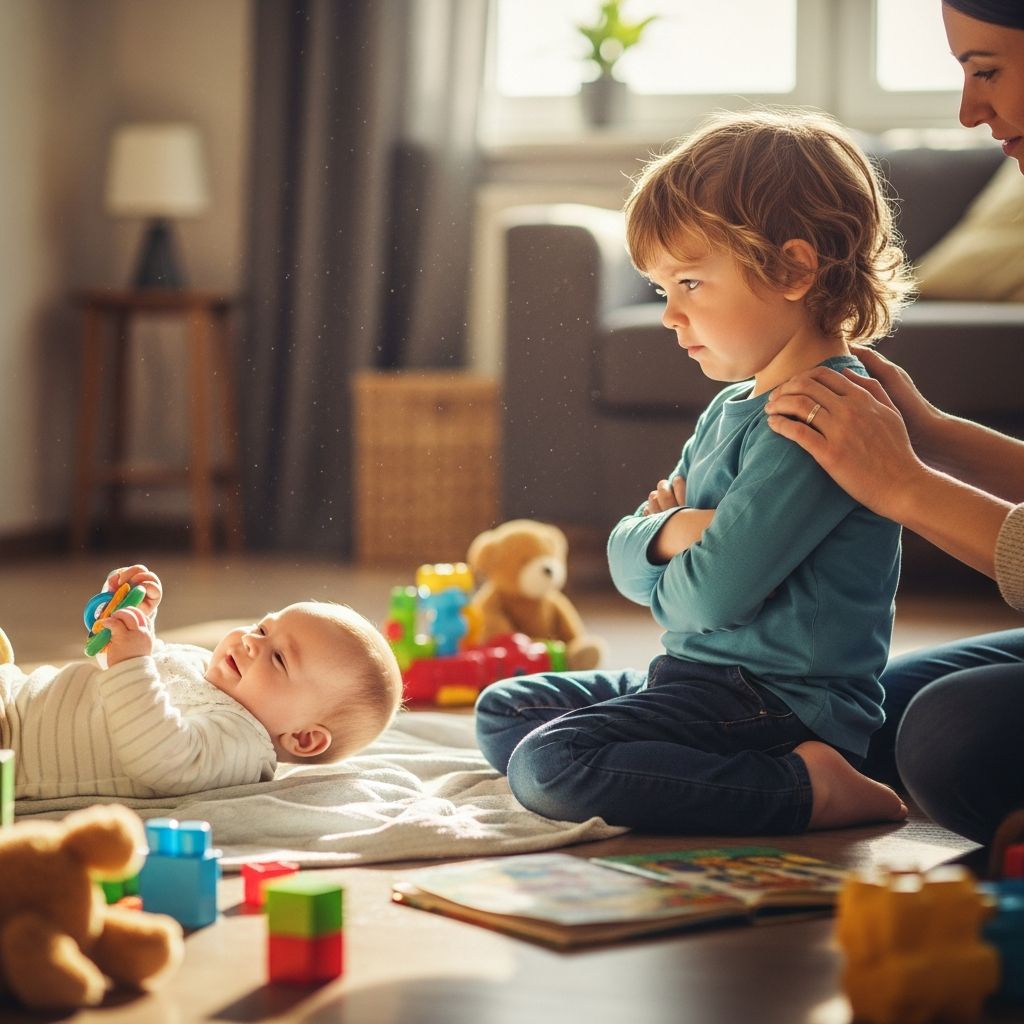
Bringing home a new baby often looks sweet in photos, but real life can be messier—especially when a preschooler suddenly develops a sharp tongue, explosive behavior, or open hostility toward the baby. Many parents worry they’ve “broken” their once-sunny child or that the new sibling has permanently damaged the relationship. In reality, this “attitude” is almost always a sign of emotional overload, not bad character.
This guide explains why preschoolers become jealous, how that jealousy shows up, and what you can do day-to-day to protect both children while strengthening your bond with your older child. You will find practical language, simple routines, and a mindset that makes the transition easier on the whole family.
Why Preschoolers Struggle When a Baby Arrives
From a preschooler’s point of view, a new baby doesn’t just “join the family”—the baby completely rearranges their world. Time, attention, routines, and expectations all shift, sometimes overnight. A child who was the center of attention now hears, “Wait, I’m feeding the baby,” or “You’re a big kid now,” many times a day.
These changes trigger some predictable fears and feelings in a young child:
- Fear of losing your love: The child may interpret your focus on the baby as proof that they are less important.
- Confusion about expectations: They are told to “be a big kid,” yet still feel very small and needy inside.
- Grief for the “old” life: They may miss having your undivided attention and freedom from new rules.
- Alarm about change: Sudden schedule shifts (new daycare hours, night waking, visitors) can overwhelm their nervous system.
Common Signs of Jealousy and “Attitude”
Jealousy doesn’t always look like classic rivalry. Some preschoolers adore the baby and still act out intensely with parents. Others flip between tenderness and aggression within minutes. Watching for patterns helps you respond with empathy instead of anger.
Typical behaviors linked to jealousy and emotional overload include:
- Sudden whining, defiance, backtalk, or “sass” that wasn’t present before.
- Regression: accidents after being toilet-trained, baby talk, wanting bottles or pacifiers again.
- Over-the-top reactions to small limits, such as collapsing in tears over the wrong color cup.
- Physical behavior toward the baby: poking, pushing, squeezing, being too rough while “playing.”
- Clinginess with one parent and rejection of the other, or constant demands while you care for the baby.
These behaviors are communication. The child is essentially saying, “I’m not okay. I don’t know how to handle all these changes. Please help me feel safe again.” Seeing it this way doesn’t mean you allow harmful behavior, but it changes how you set limits and offer guidance.
Understanding the Feelings Under the Behavior
Before deciding how to respond, it helps to name what your child might be feeling beneath the surface. Most preschoolers can’t explain this directly, so the adults must do the emotional translation work.
| Inner Feeling | Typical Behavior | What They Need From You |
|---|---|---|
| “I’ve been replaced.” | Claims to “hate” the baby; demands you send the baby back; ignores the baby entirely. | Reassurance that your love is permanent and that their place in the family is secure. |
| “It’s not fair.” | Constant complaints about rules; comparisons (“You always pick the baby!”); tantrums around sharing. | Validation that life does feel unfair, plus predictable routines that show you notice their needs too. |
| “I’m overwhelmed.” | Meltdowns at transitions, bedtime battles, sudden aggression while you’re distracted. | Extra connection, calm adult nervous systems, and fewer demands when possible during this adjustment. |
| “I’m ashamed of my bad thoughts.” | Hiding after being rough; nervous laughter; extreme denial (“I didn’t do it!”) when caught. | Safe space to admit big feelings without being labeled as mean or bad. |
First Priority: Protecting the Baby Calmly
When a preschooler is rough with a baby, many parents feel instant panic and anger. That reaction is understandable, but explosive responses can actually increase jealousy and sneakiness. The goal is to firmly protect the baby while avoiding shame that drives your older child underground.
Think of yourself as a calm bodyguard. You step in early and physically block unsafe behavior while using simple, steady language:
- Stay physically between the preschooler and baby when you sense tension.
- Use your hands to gently stop hitting, grabbing, or squeezing, saying something like, “I won’t let you hurt the baby. I’ll help you be gentle.”
- Move the baby to a safe space (carrier, crib, playpen) if your older child is very dysregulated, framing it as your job to keep everyone safe, not as punishment.
Over time, calm and consistent protection teaches your preschooler that you take their feelings seriously, but you also take safety seriously. This makes it easier for them to trust you when you invite them to talk about what is really going on inside.
Connecting Before Correcting
When a child is acting out of jealousy, jumping straight to lectures, threats, or consequences usually backfires. Their “emotional brain” is in charge, and logical explanations bounce off. A connection-first approach calms their nervous system so they can absorb guidance.
Try this simple order: Pause → Connect → Limit → Problem-solve.
- Pause: Take one slow breath before reacting. This keeps your own anger from taking over.
- Connect: Get on their level, use a warm tone, and name what you think they feel (“You really wanted my lap and the baby is there. That’s hard.”).
- Limit: State the boundary clearly and briefly (“I won’t let you hit. Hitting hurts.”).
- Problem-solve: Once they are calmer, brainstorm options (“You want time with me. Let’s find a way.”).
This approach doesn’t excuse hurtful behavior, but it teaches emotional skills: noticing feelings, tolerating frustration, and finding better ways to get needs met. Those skills reduce “attitude” in the long run far more effectively than yelling.
Practical Daily Strategies That Help
Small, consistent habits often make a bigger difference than big, dramatic talks. Here are everyday practices that reduce jealousy and defiance over time.
1. Special Time That Truly Belongs to Them
Even 10–15 minutes a day where the older child gets your full, undivided attention can transform their behavior. The key is predictability and presence, not length. During this time, put your phone away, silence notifications, and let your preschooler lead the play.
- Name it something clear and positive, like “Our Play Time” or “You-and-Me Time.”
- Announce when it will happen (“After the baby’s nap, we’ll have our time together.”).
- Follow their lead in play without correcting or teaching unless safety is an issue.
Knowing they will reliably get you to themselves reduces the frantic attention-seeking that often shows up as attitude or defiance whenever you look at the baby.
2. Involving the Preschooler Without Making Them a Mini-Parent
Many children soften toward the baby when they feel useful rather than displaced. But they should not be responsible for the baby’s care. Aim for light, empowering participation.
- Offer simple choices: “Would you like to bring the baby a toy or choose the baby’s socks?”
- Give small helper roles: handing you wipes, picking a lullaby, gently patting the baby’s feet.
- Notice and describe their efforts: “You’re watching to make sure the baby is okay. That’s very caring.”
Framing them as a caring, capable older sibling—without pressure to be perfect—supports a positive identity that competes with the “jealous troublemaker” story they might otherwise adopt.
3. Adjusting Expectations for a While
Parents often expect a preschooler to “step up” when the baby comes, but emotionally they may need you more than ever. Temporarily lowering some expectations makes it easier for everyone to cope.
- Expect some regression and view it as a request for reassurance, not manipulation.
- Limit big changes (new school, potty training, moving bedrooms) in the months right around the baby’s arrival whenever possible.
- Keep routines familiar—same bedtime sequence, same songs, same morning rituals—to give stability amidst all the change.
4. Choosing Words That Don’t Fuel Resentment
Well-intentioned phrases can accidentally pit your children against each other. Simple language shifts lower the sense of competition.
- Avoid: “I can’t play with you because I have to feed the baby.” Try: “I’m going to feed the baby for a bit. After that, it’s you-and-me puzzle time.”
- Avoid: “You’re big; you don’t need help.” Try: “You’re bigger, and you still need help sometimes. I’m here.”
- Avoid comparisons, even positive ones (“You’re my good helper; the baby is the tricky one”). Instead, affirm each child individually without ranking.
When your preschooler doesn’t feel like they are constantly losing to the baby, their need to fight for position decreases.
Handling Disrespect and Backtalk Without Harshness
Many parents report that the biggest change after the baby arrives is not aggression toward the baby but a sharp rise in eye-rolling, shouting, and defiant words. Addressing this respectfully teaches boundaries without crushing your child’s spirit.
Consider this two-part approach:
- Name the feeling and the limit: “You’re furious that I said no to screen time, and you yelled at me. I will listen to your feelings, but I won’t be spoken to that way.”
- Offer a redo: “Try that again with respectful words, and I’ll be happy to talk.”
Offering a “do-over” shows that mistakes are expected and fixable. Over time, this builds self-control and respect based on relationship, not fear.
Repairing When You Lose Your Cool
Exhausted parents with a baby and a preschooler will sometimes shout, threaten, or say things they regret. Repairing afterward does not erase the moment, but it powerfully models how humans handle conflict and guilt.
A simple repair might sound like this:
- “I yelled earlier when you pushed your brother. Yelling isn’t how I want to handle things. Next time I’ll take a breath and help you use gentle hands.”
- “You are not a bad kid. You’re having a hard time and so am I. We’re learning together.”
Repairs rebuild safety. When children feel safe in the relationship, their jealousy and attitude soften because they trust you to stay on their team even when things are hard.
Supporting Yourself While You Support Them
Parenting a preschooler and a baby at the same time is intense. Your capacity to stay patient is directly tied to how supported you feel. It is not selfish to protect your energy; it is essential for everyone’s well-being.
Where possible, look for small ways to refill your tank:
- Trade short breaks with a partner, friend, or relative so you can shower, nap, or walk outside alone.
- Lower the bar on housework temporarily: choose “good enough” meals and a few non-negotiable chores instead of perfection.
- Connect with other parents who have lived through this stage so you feel less alone and less worried that something is “wrong” with your child.
Frequently Asked Questions
Is it normal for my preschooler to say they hate the baby?
Yes. Strong words like “I hate the baby” are usually shorthand for “I hate how my life has changed” or “I hate feeling left out.” You can calmly acknowledge the feeling without agreeing that the baby is bad: “You’re really upset and wish things could go back to how they were. I’m listening. The baby is staying, and my love for you is staying too.” Allowing honest feelings actually makes harm less likely because the child does not have to hide their resentment.
What if my child keeps trying to hurt the baby?
Persistent attempts to hurt the baby call for tighter supervision and more direct support. Keep the baby physically close to you or in safe spaces, stay within arm’s reach when they are together, and intervene early when you see tension building. Later, when everyone is calm, invite your preschooler to talk or play out their feelings with dolls, drawings, or storytelling. If aggression escalates or you feel unable to keep everyone safe, consider reaching out to a pediatrician, child therapist, or parenting support professional for guidance.
How long does the jealousy phase usually last?
There is no single timeline, but many families notice the most intense behavior in the first months after the baby’s arrival or during big developmental leaps (such as starting preschool, moving, or a sleep regression). The more consistently your child experiences connection, predictable routines, and firm but kind limits, the faster the jealousy tends to soften. Even after the intense phase passes, expect occasional flare-ups around birthdays, illnesses, or times when you are especially stressed.
Should I punish my preschooler for being mean to the baby?
It is essential to stop unsafe behavior, but harsh punishments or shaming can make jealousy worse and drive it underground. Instead, focus on three steps: protect the baby, acknowledge the older child’s feelings, and guide them toward safer expressions of anger or frustration. Natural and logical consequences—such as moving your child away from the baby when they are not gentle—can be effective when paired with empathy and chances to try again.
How can I help my preschooler and baby build a positive relationship?
Healthy sibling relationships grow from repeated small moments, not just big “bonding” events. Encourage your preschooler to share special songs, show the baby how toys work, or help with simple tasks while you warmly narrate their care. Protect both children from chronic teasing, roughness, or blame, and make sure your older child gets plenty of attention that is not tied to their behavior with the baby.
Key Takeaways for Everyday Life
Preschooler jealousy and “attitude” after a baby arrives are not signs of failure or proof that you raised an unkind child. They are evidence of a small human facing a huge life change with limited skills and an immature nervous system. Your combination of calm protection, generous connection, and clear limits is what grows those skills over time.
- Your job is not to eliminate jealousy but to make it safe, speakable, and manageable.
- Connection-first parenting does not mean permissiveness; it means guiding behavior while honoring feelings.
- You do not have to get this right every time. Repair, reassurance, and small daily gestures add up to a secure foundation for both siblings.