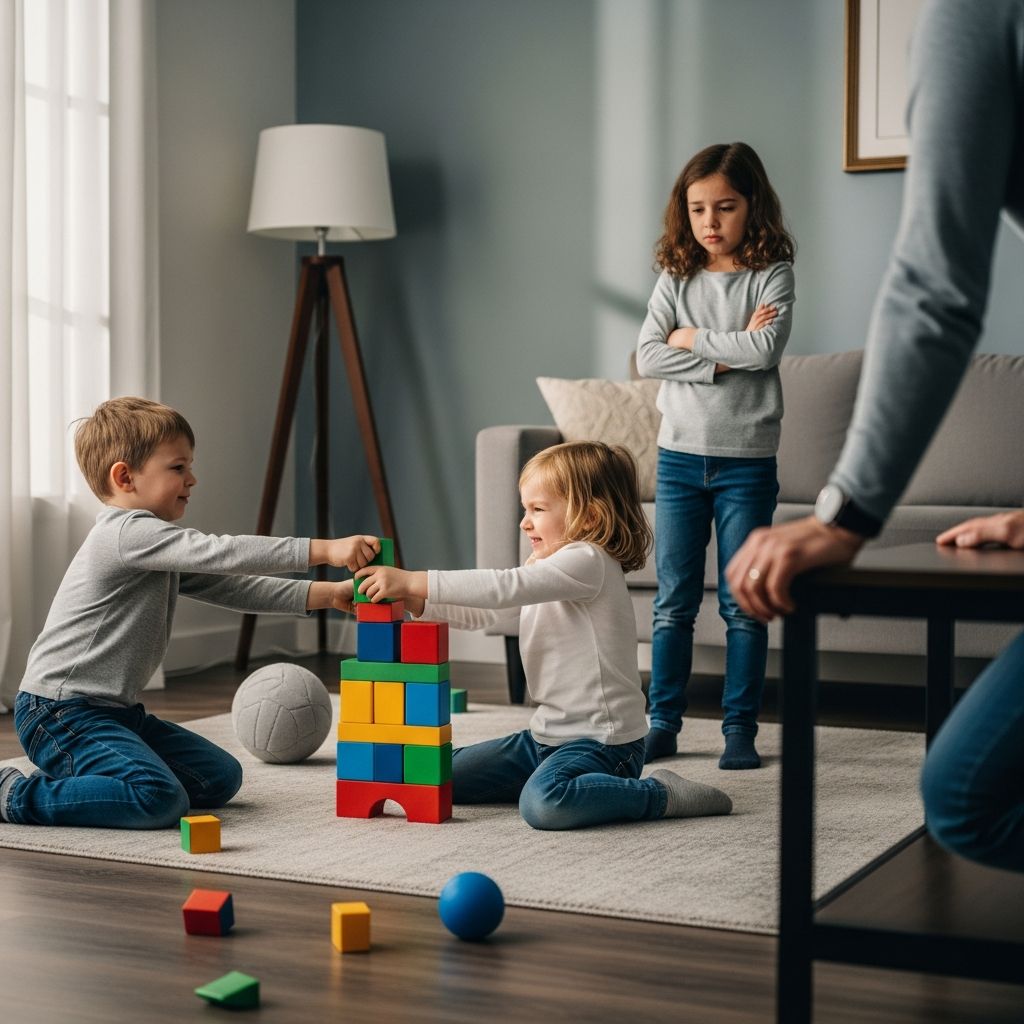
Conflicts between young cousins can be especially stressful: you want to protect your own child, but you also care about extended family relationships. This guide explains why these clashes happen, what is typical vs. worrying, and how to respond in ways that keep everyone safe while preserving family bonds as much as possible.
Why Young Cousins Clash So Often
Frequent arguments and scuffles between young children are common, especially under age 7, when self-control and emotion regulation are still developing. Cousins can behave like siblings when they spend a lot of time together: competing for attention, toys, and space. Understanding the drivers of conflict makes it easier to respond calmly.
Common Triggers for Cousin Conflicts
- Competition for adult attention: Young children are highly sensitive to how much time, praise, and physical closeness adults provide.
- Possessiveness over toys and space: Sharing and turn-taking are learned skills, not natural instincts.
- Differences in temperament: A highly active or impulsive child may overwhelm a more sensitive or cautious cousin.
- Fatigue, hunger, and overstimulation: Crowded family gatherings, late nights, and disrupted routines increase the risk of outbursts.
- Inconsistent rules across households: What is acceptable in one home (rough play, shouting, name-calling) may be strictly off-limits in another.
Disagreements are not always negative. Research on siblings shows that conflict, when guided constructively, can help children practice negotiation, perspective-taking, and problem-solving skills. The key is preventing repeated patterns of harm or fear.
Normal Rough-and-Tumble vs. Concerning Aggression
Not every loud disagreement is a crisis. Many parents find it helpful to distinguish between developmentally typical conflict and patterns that require stronger limits or professional help.
| Typical Conflict | Concerning Patterns |
|---|---|
| Short arguments that resolve with adult help | Repeated hitting, kicking, or chasing with intent to hurt |
| Disputes mostly about toys, turns, or space | Threats, intimidation, or targeting one child repeatedly |
| Both children laugh again soon after a quarrel | One child is consistently fearful, avoids the cousin, or has physical injuries |
| Children respond to adult reminders and calm down | Aggressive child ignores or escalates despite clear, consistent limits |
Children who show persistent, severe aggression may need structured, consistent responses and sometimes professional support. Your first job, however, is always immediate safety.
Your First Priority: Protecting Your Child
If you are worried that a cousin is being physically aggressive or violent, it is appropriate to prioritize your child’s safety, even if that creates tension with relatives. Professional guidance on child aggression stresses firm, consistent and immediate responses to violent behavior.
Safety First: Non-Negotiable Steps
- Stay within sight and earshot when the cousins are together if aggressive behavior has occurred before.
- Interrupt unsafe play immediately: Step between children, use a firm tone, and calmly remove objects that could be used to hit or throw.
- Separate children quickly if one is being hurt or is visibly frightened. Do not require immediate reconciliation or apologies in the heat of the moment.
- Adjust or shorten visits if conflict escalates despite your supervision.
- Consider breaks from joint play or meeting in neutral, structured settings (parks, supervised activities) instead of unstructured, unsupervised free-for-alls at home.
These choices protect your child while also modeling calm, decisive action. They are not punishments of the cousin; they are boundaries you control.
Setting Clear Rules for Play Between Cousins
Consistent, easy-to-understand rules make it easier for children to anticipate what will happen if conflicts arise. Family rules are a well-supported tool for reducing fights and teaching respectful interaction.
Examples of Simple, Effective Play Rules
- No hitting, kicking, or biting. Ever.
- Use words, not hands, to solve problems.
- Ask before touching someone else’s toys or body.
- If an adult says stop, everyone stops immediately.
- When we can’t agree, an adult decides or the toy goes away.
Introduce these rules before play starts, not in the middle of a fight. Ask both children to repeat the rules back in their own words so you know they understand.
Consequences That Support Learning
Consequences should be predictable and calmly enforced, not harsh or shaming. When rules are broken:
- Give one brief reminder: “We don’t hit. Use words.”
- If aggression continues, end the activity or separate the children for a cooling-off period.
- Remove the item they are fighting about instead of trying to decide who is right.
- When children are calm, briefly review what happened and what to try next time.
Repeated patterns of aggression are a sign that a child needs more structure, coaching, or professional support, not just more punishment.
Coaching Kids to Solve Problems Themselves
Over time, your goal is not to referee every disagreement, but to equip children with skills to handle conflict in safer, more respectful ways. Research on prosocial behavior suggests that encouraging empathy, turn-taking, and helping behaviors reduces aggression and supports better relationships.
Simple Scripts Kids Can Use
Teach short phrases that replace hitting or screaming:
- “I don’t like that. Please stop.”
- “Can I have a turn when you’re done?”
- “Let’s ask an adult to help us decide.”
- “I need a break from this game.”
Practice these scripts during calm moments or with role-play, not only during fights. Young children learn better when they are not already upset.
Guiding Conflict Step by Step
When both children are safe and only mildly upset, you can coach them through a short repair process:
- Pause: “Everyone take a breath and step back.”
- Each tells their story briefly, with you translating into simple language if needed.
- Reflect feelings: “You wanted the toy; you felt mad when it was grabbed.”
- Brainstorm options: trade, take turns with a timer, play something else, or ask an adult to keep the toy for now.
- Agree on a plan and check for understanding: “So you’ll use the timer and switch when it rings.”
As children get better at these steps, you can gradually pull back and let them try on their own before you step in.
Working With (or Around) Other Parents
One of the hardest parts of cousin conflict is that you cannot control how someone else parents their child. You can, however, decide what you will allow around your own child.
How to Talk with a Relative About Aggression
Choose a calm, private time, not right after an incident. Keep the focus on safety and on your own responsibilities as a parent, rather than diagnosing or criticizing their child.
Helpful approaches include:
- Use “I” statements: “I’ve noticed that when the kids get excited, my son sometimes gets hurt. I’m feeling anxious about that.”
- Stay specific and concrete: Describe particular incidents briefly instead of making global statements such as “He’s always violent.”
- Propose practical steps: “Could we agree that an adult will be in the room when they’re playing with hard toys?”
- Invite collaboration: “What do you think would help them play together more calmly?”
If the other parent becomes defensive or dismissive, you can calmly restate your boundary: you will be supervising closely, shortening visits, or arranging play in more structured settings.
Adjusting Contact Without Cutting Ties Completely
You may feel stuck between two painful options: tolerating unsafe behavior or cutting off cousin contact entirely. In reality, there is often a middle path that allows some connection while reducing risk.
Practical Ways to Reshape Cousin Time
- Shorter visits instead of whole afternoons or overnights.
- Public or structured locations such as parks, children’s museums, or supervised classes where adults are naturally close by.
- Activity-based gatherings (crafts, board games, outdoor games) that give children a clear focus rather than open-ended, unsupervised play.
- Parallel play for younger or more volatile children, where they play near each other with separate materials.
- One-on-one time between cousins with an adult who is fully attentive, rather than mixing in multiple children with divided supervision.
These adjustments can reduce stress for everyone and may even open the door to more positive experiences together over time.
Supporting Your Own Child Emotionally
Repeated negative interactions with a cousin can leave your child anxious, angry, or confused. You can help your child make sense of what is happening while reinforcing that you are their secure base.
Validating Feelings and Restoring Security
- Name their feelings: “You looked scared when he chased you. That was a scary moment.”
- Affirm safety: “My job is to keep you safe. I will step in if someone hurts you.”
- Avoid blaming your child for being hurt, even if they also misbehaved.
- Offer repair rituals after tough visits: quiet play, extra cuddles, regular bedtime routines.
Children who experience warm, responsive caregiving and consistent boundaries are more likely to develop better self-regulation and social skills over time.
When to Consider Professional Help
Sometimes family efforts are not enough. You might consider seeking professional input from a pediatrician, child psychologist, or family therapist when:
- Your child shows ongoing fear, nightmares, or physical complaints before or after seeing the cousin.
- The cousin’s aggression is severe, frequent, or escalating despite repeated attempts to set limits.
- Conversations with the other parent have broken down completely, and family conflict is intense.
- You find yourself constantly anxious, guilty, or unsure how to respond.
Health and mental health professionals can help you clarify what is typical, design a concrete safety plan, and provide strategies tailored to your child’s temperament and needs.
Frequently Asked Questions (FAQs)
How much fighting between cousins is “normal”?
Occasional arguments, shouting, and brief pushing or grabbing are common in early childhood, especially when children are tired, hungry, or competing for toys. What becomes concerning is repeated, targeted aggression, use of objects to hurt, or a pattern where one child is consistently fearful or injured.
Should I force my child to keep playing after they’ve been hurt?
No. Allowing your child to take a break or stay near you respects their feelings and reinforces that their comfort and safety matter. Over time, this support helps them feel more secure in social situations.
Is it wrong to limit contact with a cousin?
Parents have a responsibility to protect their children from repeated harm. It can be wise to reduce or reshape contact (shorter visits, more supervision, different settings) rather than immediately cutting ties, but in some cases stronger limits are necessary.
How do I talk about the cousin’s behavior without teaching my child to be unkind?
Focus on behavior, not identity. You might say, “Hitting is not okay,” instead of “He’s a bad kid.” You can also emphasize that all children can learn new ways to act, and that adults are there to help keep everyone safe.
My relative refuses to acknowledge there’s a problem. What now?
You still control your own boundaries: where visits happen, how long they last, and how closely you supervise. You can calmly say, “This is what I need to feel comfortable bringing my child,” and follow through on those limits even if they disagree.
References
- Siblings and peers: direct and indirect influences on adolescent adjustment — Feinberg, M. E., Solmeyer, A. R., & McHale, S. M., Clinical Child and Family Psychology Review. 2012-09-01. https://pubmed.ncbi.nlm.nih.gov/22850952/
- Preventing sibling fights: essential tips — Raising Children Network (Australian Government–funded). 2022-06-01. https://raisingchildren.net.au/school-age/behaviour/friends-siblings/preventing-fights
- Conduct Problems in Children and Adolescents: Etiology, Assessment, and Treatment — Frick, P. J., & Nigg, J. T., Journal of Child Psychology and Psychiatry. 2012-01-01. https://pubmed.ncbi.nlm.nih.gov/22856327/
- Aggression in Children — New York University Child Study Center. 2011-05-01. https://med.nyu.edu/departments-institutes/child-adolescent-psychiatry/patient-care/conditions-we-treat/aggression-children
- Parenting for Lifelong Health: Positive Parenting — World Health Organization & UNICEF. 2020-06-01. https://www.who.int/publications/i/item/WHO-UNICEF-parenting-for-lifelong-health