In today’s fast-paced world, families face mounting pressures from work, childcare, and daily chores. Many couples struggle with resentment and burnout when tasks fall unevenly. However, a deliberate approach to splitting responsibilities can transform chaos into calm, drawing on each partner’s strengths rather than rigid traditions. This article delves into why structured role division works, how to implement it, and the science behind its success.
Understanding the Shift in Family Dynamics
Family structures have evolved dramatically over decades. Women now comprise nearly half the workforce, delaying marriage and childbirth while men increasingly share home duties. Yet, disparities persist: women often handle more unpaid labor, leading to stress and inequality. Research shows that when roles align with life history strategies—future-oriented planning in stable environments—egalitarian divisions emerge, reducing gender gaps.
Historically, roles were dictated by physical demands and survival needs, with men as providers in agrarian societies. Modern economies, with service jobs less reliant on strength, allow flexibility. A Pew survey reveals 61% believe shifting roles aid women’s career success, though men perceive less benefit, highlighting perceptual divides.
Why Role Division Beats Egalitarian Chaos
Striving for perfect 50/50 splits often backfires, breeding score-keeping and arguments. Instead, assigning tasks based on aptitude and preference creates efficiency and satisfaction. One partner might excel at finances due to analytical skills, while the other thrives in meal planning. This mirrors prestige hierarchies in low-risk settings, where cooperation trumps competition.
- Reduces Overlap Friction: Clear ownership prevents duplicate efforts or oversights.
- Leverages Strengths: Tailoring roles to natural inclinations boosts productivity and joy.
- Builds Accountability: Ownership fosters pride and reliability.
Studies confirm present-oriented strategies in high-risk contexts reinforce traditional divides, but stable modern life supports customized arrangements.
Practical Strategies for Dividing Responsibilities
Start with open discussions. List all tasks—cooking, cleaning, bills, kid shuttling—and rate enjoyment and skill levels. Create a table like this:
| Task Category | Partner A Strengths | Partner B Strengths | Assigned To |
|---|---|---|---|
| Meal Prep & Grocery | Creative cooking | Budget tracking | Partner A |
| Finances & Bills | Organization | Detail-oriented math | Partner B |
| Childcare Routines | Playful engagement | Discipline & schedules | Split weekly |
| Home Maintenance | Handyman skills | Deep cleaning | Partner A/B alternate |
| Laundry & Folding | Folding precision | Washing cycles | Partner B |
Review quarterly to adjust for life changes. Tools like shared apps track progress without nagging.
Overcoming Common Hurdles in Role Assignment
Societal expectations linger: men may resist “feminine” tasks, women “masculine” ones. Women are more likely to feel society under-accepts men in caregiving (49% vs. 36%). Counter this with education on evolving norms—feminist gains and LGBTQ+ advocacy have broadened definitions.
Resistance fades when benefits show: less bickering, more quality time. Enforce boundaries politely—”I’ll handle dinner if you do bedtime.” In high-conflict homes, trial periods build buy-in.
The Science of Harmony Through Specialization
Life history theory explains why: in controllable environments, future-oriented strategies promote balanced investments, eroding strict roles. Biosocial models note physical differences interact with tech advances, enabling role fluidity. Data shows women earn 65-80% of men’s pay, but shared home loads close lifestyle gaps.
Democrats see more upsides (e.g., 68% say easier for women at work) than Republicans, indicating cultural lenses. Overall, 57% view role shifts positively for family finances.
Real-World Benefits for Parents and Kids
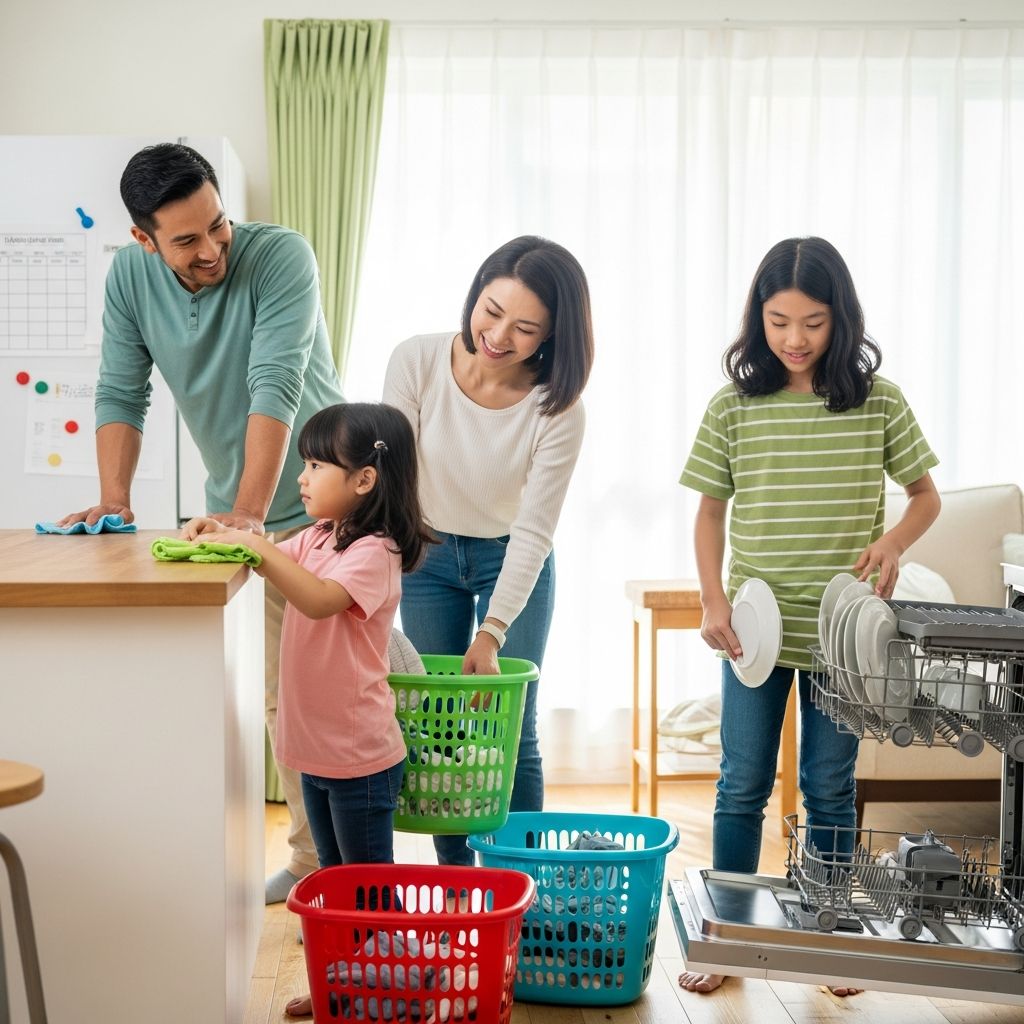
Balanced loads mean rested parents, modeling equity for children. Kids learn skills from specialists—dad’s grilling, mom’s budgeting—avoiding stereotypes. Families report stronger marriages (47% see ease). Long-term, this counters inequality from dominance hierarchies.
- Improved mental health via reduced overload.
- Enhanced couple intimacy from shared relief.
- Teaching kids adaptability over rigidity.
Customizing for Different Family Types
Single parents: Delegate to older kids or services. Same-sex couples: Leverage dual perspectives for innovative splits. Blended families: Prioritize consistency across households.
In matriarchal histories, women led when needs demanded. Today, adapt to your context.
Frequently Asked Questions (FAQs)
What if my partner won’t agree to role division?
Present data on benefits, start small with one task swap, and highlight mutual gains like more free time.
Does this reinforce gender stereotypes?
No—roles stem from strengths, not gender. Research shows stereotypes evolve positively, and custom fits challenge binaries.
How often should we revisit assignments?
Every 3-6 months or after major changes like new jobs or babies, ensuring ongoing balance.
Can this work with young children?
Yes, involve kids in age-appropriate tasks, fostering responsibility while parents specialize.
What about unequal work hours?
Factor in total load (paid + unpaid); off-duty parent takes more home duties for equity.
Long-Term Impact on Society and Equality
As roles fluidize, gender pay gaps narrow, women’s representation rises (e.g., Congress). UN data visualizes slow but steady progress[10]. Custom divisions pave the way for true partnership.
Embrace this: discuss, assign, thrive. Your home can be a harmony haven.
References
- Evolved but Not Fixed: A Life History Account of Gender Roles and Gender Inequality — Chang L, Lu S, et al. Evolutionary Psychology. 2018-07-25. https://pmc.ncbi.nlm.nih.gov/articles/PMC6664064/
- Breaking Gender Stereotypes: Challenging Traditional Roles — Rock and Art. Accessed 2026. https://www.rockandart.org/gender-stereotypes-challenging-roles/
- Gender Roles in Modern Society — One World Education. Accessed 2026. https://www.oneworldeducation.org/our-students-writing/gender-roles-in-modern-society/
- How Women in the Workplace Has Changed Over the Last 50 Years — ProMarket. 2023-03-10. https://www.promarket.org/2023/03/10/how-women-in-the-workplace-has-changed-over-the-last-50-years/
- Evolving Gender Roles Explored at Anne Roe Lecture — Harvard Graduate School of Education. 2008-11-17. https://www.gse.harvard.edu/ideas/news/08/11/evolving-gender-roles-explored-anne-roe-lecture
- Views of the Impact of Changing Gender Roles — Pew Research Center. 2024-10-17. https://www.pewresearch.org/social-trends/2024/10/17/views-of-the-impact-of-changing-gender-roles/
- How has the role of women changed over the last 50 years? — USAFacts. 2023-08-17. https://usafacts.org/articles/how-has-the-role-of-women-changed-over-the-last-50-years/