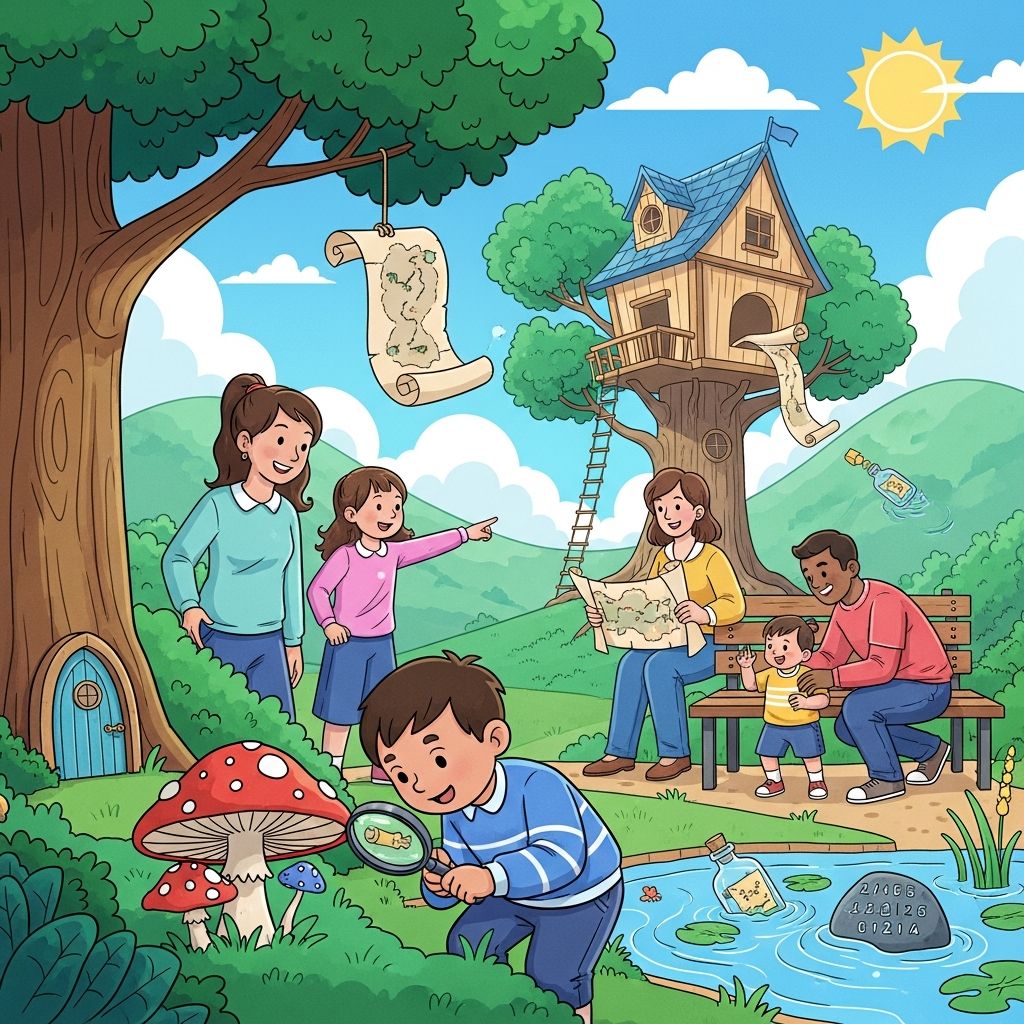
Scavenger hunts are one of the easiest ways to turn an ordinary afternoon into a mini adventure. With a few well-designed clues, your living room, backyard, or neighborhood can become a world of secret codes, mysteries, and discoveries tailor-made for your kids.
This guide walks you through how to create original, age-appropriate scavenger hunt clues, organize them into fun themes, and run a smooth, safe game that kids will want to play again and again.
Why Scavenger Hunts Are Perfect for Kids
Well-crafted scavenger hunts are more than just a way to burn off energy. They can support physical activity, social skills, and problem-solving, all wrapped in play.
- Movement and exercise: Active play helps children meet daily physical activity goals and supports healthy development.
- Thinking and reasoning: Clue-solving encourages kids to make connections, interpret hints, and test ideas.
- Cooperation: Working in teams helps build communication, negotiation, and leadership skills.
- Confidence: Each solved clue gives kids a small success, reinforcing persistence and resilience.
Health organizations highlight that children and teens benefit from regular moderate-to-vigorous physical activity, and playful games like scavenger hunts can help them reach these recommendations in an enjoyable way.
Planning the Perfect Hunt: Start with the Basics
Before writing any clues, decide the core structure of your scavenger hunt. A few thoughtful choices early on will save you headaches later.
1. Choose Your Space
Pick an area where kids can explore safely and independently for their age level.
- Very young kids (3–5): One room, a small apartment, or a fenced backyard.
- School-age kids (6–9): Whole home, yard, or a clearly defined section of a park.
- Older kids and tweens: Several rooms, the full yard, or a short neighborhood loop with clear boundaries.
Make boundaries explicit: “You can search in the living room, kitchen, and hallway, but not in bedrooms or outside.” Visual cues (like a taped line or bright ribbon) help younger children remember where to stop.
2. Decide on Time and Group Size
Adjust the hunt’s length to match kids’ attention spans and your energy level.
- Quick burst: 10–20 minutes with 5–7 clues.
- Medium adventure: 25–40 minutes with 8–12 clues.
- Epic quest: Up to 60 minutes with 12–20 clues and extra challenges.
For group size:
- 1–2 kids: Everyone solves every clue together.
- 3–6 kids: Create teams and give each team its own starting clue to reduce crowding.
- Larger groups: Rotate starting locations for teams or run the hunt in separate rounds.
Designing Clues Kids Will Love
At the heart of any scavenger hunt is the clues themselves. A good clue is understandable, just challenging enough, and leads clearly to the next location once solved.
Core Principles for Kid-Friendly Clues
- Match reading level: Use pictures, symbols, or simple phrases for pre-readers; short riddles and wordplay for older kids.
- One clear answer: Avoid clues that could point to multiple places in your space.
- Visible but not obvious: Kids should have to look, but not dismantle furniture to find the next hint.
- Variety: Mix different types of puzzles so different kids get chances to shine.
Types of Clues to Try
| Clue Type | Best For | What Makes It Fun |
|---|---|---|
| Picture clues | Preschoolers and early readers | No reading needed; kids match photos or drawings to real-world objects. |
| Rhyming riddles | Early elementary | Simple rhymes give gentle hints and feel like mini poems. |
| Direction or map clues | Elementary and up | Kids follow arrows, simple maps, or step-count instructions. |
| Code or cipher clues | Older kids and tweens | Secret codes stretch logic and pattern recognition skills. |
| Action challenges | All ages, with adaptation | Tasks like hopping or singing add silliness and movement. |
Tips for Writing Clear, Clever Clues
- Start from the hiding place backward: Pick where you want to hide the clue, then jot down words associated with that place (shape, color, use, location).
- Use sensory hints: Smell, sound, temperature, or texture can give distinctive cues (“where it hums and stays cold”).
- Limit wordplay for younger kids: Focus on straightforward descriptions; save puns for older children.
- Test your clue: Ask another adult or older child to read it and say where they would look first.
Fun Themes to Shape Your Hunt
A good theme ties your clues together and makes the whole experience feel like a story instead of a series of unrelated tasks.
1. Detective Mystery
Kids become junior detectives solving a household “case.”
- Use magnifying glass icons or pretend “case files” on each clue.
- Include “evidence” items like a sock, a spoon, or a toy footprint along the way.
- End with a “solved the case” certificate or a pretend badge.
2. Explorer Adventure
Turn your space into a map of exciting locations: the mountain (staircase), cave (closet), river (blue blanket), and so on.
- Draw a simple treasure map marking clue zones.
- Invite kids to adopt explorer names and “stamp” their map at each stop.
- Final prize can be a “discovery chest” with snacks or small trinkets.
3. Color or Shape Quest
Great for younger kids who are learning colors and shapes.
- Each clue relates to a particular color or shape in your home.
- Ask kids to bring back one object of that color or shape from the location.
- Finish with a rainbow or pattern-building activity using the items they collected.
4. Reading and STEM Challenge
Build subtle learning into the game without making it feel like schoolwork.
- Include short word problems that reveal locations.
- Add simple science tasks: float/sink tests, sorting by size, or counting steps.
- Use age-appropriate puzzles so the focus stays on fun, not frustration.
Educational games that blend literacy, math, and playful exploration can support learning outcomes, especially when adults offer encouragement and light guidance rather than direct instruction.
Step-by-Step: Setting Up Your Clue Trail
Once you have a theme and clue ideas, put your hunt in order so it flows smoothly and safely.
1. Map the Route
- List all potential hiding spots in your space.
- Avoid fragile, high, or off-limits areas (top shelves, tool drawers, busy streets).
- Arrange locations in a loop that doesn’t zigzag back and forth unnecessarily.
2. Write and Number the Clues
- Number each clue on the back for your own reference.
- For younger kids, consider printing each team’s clues on a unique color of paper.
- Keep one master copy so you can replace any clue that goes missing.
3. Hide with Care
- Place clues where kids can spot them without moving heavy objects.
- Use tape or envelopes when needed so clues don’t blow away outdoors.
- If you’re using a public or shared outdoor area, choose hiding spots that aren’t obvious to passersby.
4. Add Rewards Thoughtfully
Prizes can be small and simple; the real reward is the adventure itself.
- Sticker sheets, bubble wands, or themed bookmarks.
- Privilege coupons (pick tonight’s movie, choose dessert, stay up 15 minutes late).
- Group reward, like a picnic or backyard campout, to emphasize teamwork instead of competition.
Keeping Kids Safe During Scavenger Hunts
Safety should always guide your design, especially during outdoor or neighborhood hunts.
- Set physical boundaries: Clearly define where kids may and may not go (specific blocks, yard, playground perimeter).
- Supervise appropriately: Younger children should be within sight of a responsible adult. For older kids roaming a neighborhood, adults can observe from a distance or accompany them discreetly.
- Traffic awareness: Avoid clues that require crossing busy streets. Talk through road safety rules ahead of time, in line with local child safety guidance.
- Weather-ready: Provide sun protection, water, and appropriate clothing if you are outside for a longer hunt.
- Emergency contact: For neighborhood hunts, ensure at least one adult carries a phone and kids know what to do if they get separated.
Adapting Hunts for Different Ages and Abilities
One of the strengths of scavenger hunts is how easily they can be adapted for a wide range of kids and abilities.
Preschoolers
- Use picture clues or colored arrows instead of text.
- Keep all hiding spots at eye level or lower.
- Limit to 5–7 locations to prevent fatigue.
Early Elementary
- Add simple rhymes, “this or that” questions, and counting tasks.
- Mix cooperative tasks (“high-five a teammate”) with object-finding.
- Allow kids to take turns reading clues aloud for extra practice.
Older Kids and Tweens
- Introduce basic ciphers (letter-substitution, mirror writing) or multi-step clues.
- Use light strategy: optional side challenges worth bonus points.
- Invite them to design the next hunt, which strengthens planning and leadership skills.
Supporting Different Abilities
- Pair strong readers with kids who need more help, and encourage taking turns.
- Keep some clues close together or in easily accessible spots for kids with mobility limits.
- Offer the option to describe answers aloud instead of physically retrieving items when needed.
Rainy-Day Indoor Hunts vs. Outdoor Adventures
Your basic approach to clues stays similar indoors and outdoors, but each environment has its strengths.
Indoor Hunts
- Great for last-minute plans or bad weather.
- Easier to supervise younger children closely.
- Works well with themes involving books, cooking, or cozy mysteries.
Outdoor or Neighborhood Hunts
- Encourage more physical activity and exploration.
- Let you use natural features (trees, benches, signs) as clue anchors.
- Can double as a way to get to know your local area and landmarks.
Outdoor active play has been linked with improved physical fitness and positive mental health in children, especially when it includes free exploration and social interaction.
Common Scavenger Hunt Mistakes to Avoid
Even simple tweaks can dramatically improve kids’ experience.
- Too hard, too soon: Start with one or two easy clues so kids build early momentum.
- Overcrowding one location: Stagger teams or provide alternate paths to reduce bottlenecks.
- Unclear rules: Clarify whether kids can run, whether adults may help, and how to treat other people’s property.
- Ignoring downtime: After the hunt, allow time to share favorite moments and how they solved tricky clues.
Simple Framework to Reuse Again and Again
Once you have run one or two hunts, you can create a reusable framework so future games take less time to prepare.
- Keep a list of your home’s best hiding places and rotate through them.
- Save successful clue formats (riddles, code types) and swap in new words or locations.
- Let kids contribute ideas for new themes, locations, or prizes.
Over time, kids may take the lead in designing hunts for siblings, friends, or even the adults, turning the game into a family tradition rather than a one-time activity.
Frequently Asked Questions (FAQs)
How many clues should I use for a kids’ scavenger hunt?
For young children, 5–7 clues is usually enough. Older kids can handle 8–15 clues, depending on how far they need to travel and how complex the puzzles are.
How long should a typical scavenger hunt last?
Aim for 20–40 minutes of active hunting. Very short games can feel rushed, while hunts that last much longer than an hour may lead to fatigue or frustration unless kids are highly motivated.
Do I need prizes for every participant?
You don’t have to use big prizes. Small treats or a shared group reward work well and shift the focus from winning to playing together.
What if kids get stuck on a clue?
Offer a gentle hint after a few minutes instead of giving away the answer. You can also provide each team with one or two “hint tokens” they can trade in if they are really stuck.
How can I make scavenger hunts educational without spoiling the fun?
Keep learning elements short and playful: quick math questions, reading a sentence to find a keyword, or simple science observations. Focus on curiosity and discovery rather than right-or-wrong tests.
References
- Physical activity facts — World Health Organization. 2022-10-05. https://www.who.int/news-room/fact-sheets/detail/physical-activity
- The Power of Play: A Pediatric Role in Enhancing Development in Young Children — American Academy of Pediatrics. 2018-12-01. https://publications.aap.org/pediatrics/article/142/3/e20182058/38619/The-Power-of-Play-A-Pediatric-Role-in-Enhancing
- Learning through play: strengthening learning through play in early childhood education programmes — UNICEF. 2018-01-01. https://www.unicef.org/documents/learning-through-play
- Child Pedestrian Safety Curriculum — U.S. Centers for Disease Control and Prevention. 2015-03-01. https://www.cdc.gov/motorvehiclesafety/child_pedestrian_safety
- Benefits of Outdoor Play for Children — Harvard T.H. Chan School of Public Health. 2021-06-15. https://www.hsph.harvard.edu/news/features/benefits-of-outdoor-play-for-children