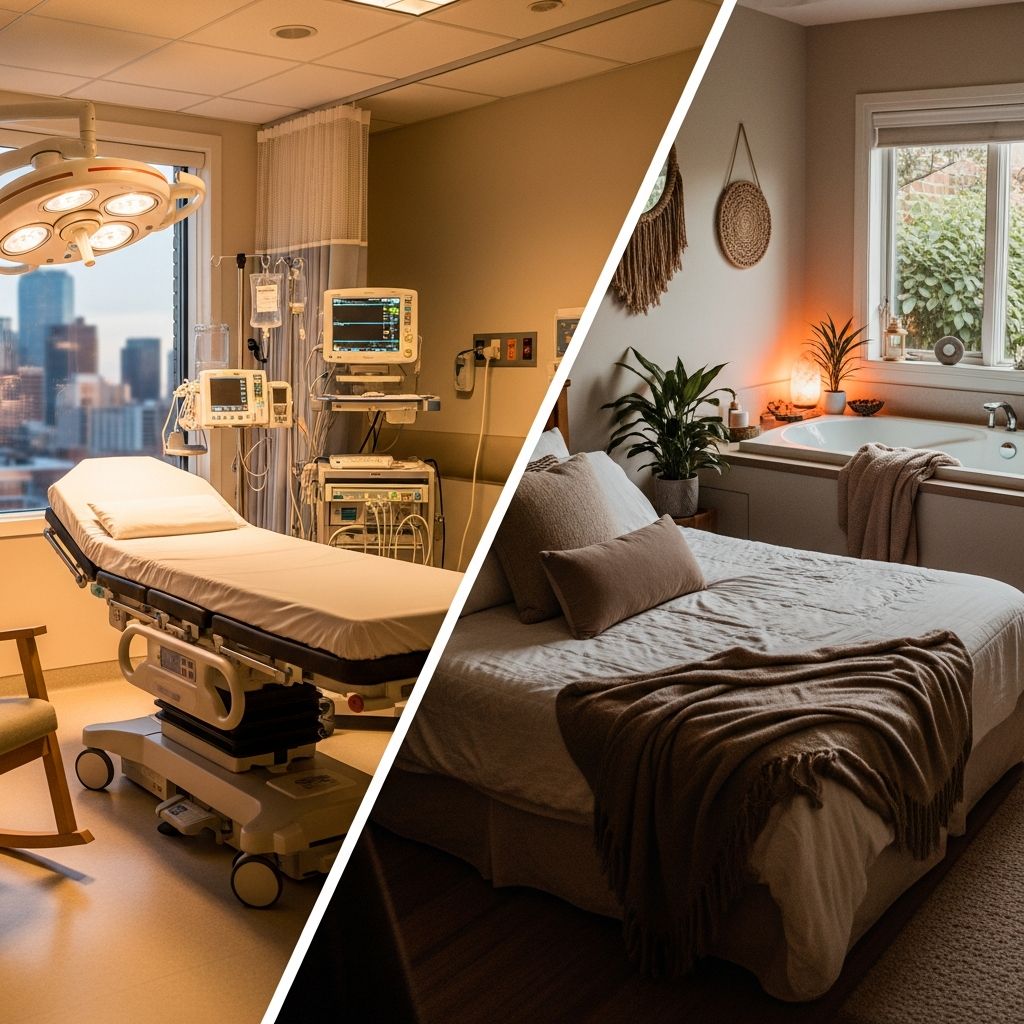
Deciding where to give birth is one of the most important choices you will make in pregnancy, because your setting strongly influences your care, your options, and how you feel during labor. The goal is not to find the “perfect” place, but to choose the setting that best fits your medical needs, values, and vision for your baby’s birth.
Why Your Birth Setting Matters
Your birth setting is much more than a building. It shapes the type of caregivers available, how quickly interventions are used, what happens if there is an emergency, and how supported you feel emotionally.
- Safety: Access to emergency care, newborn support, and monitoring can vary from place to place.
- Experience: Policies and culture affect how much you can move, eat, choose positions, or use non-medical comfort measures.
- Philosophy: Some settings emphasize physiologic (low-intervention) birth, while others are more procedure-driven.
- Support: The environment can either calm and encourage you or leave you feeling rushed and observed.
Understanding Your Main Options
Most expecting parents choosing between out-of-home settings will be looking at hospitals and birthing centers. Both can be safe for the right person when well-staffed and used appropriately. The right choice depends on your health history, pregnancy risk level, and comfort with medical technology.
Hospitals
Hospitals provide the widest range of medical services. They are equipped to handle low-, moderate-, and high-risk pregnancies and can respond rapidly if complications arise.
- On-site operating rooms for cesarean birth.
- Access to blood transfusions and advanced monitoring.
- Specialty teams such as anesthesiologists, neonatologists, and surgical staff.
- Continuous electronic fetal monitoring often readily available.
Birthing Centers
Birthing centers are designed to feel more home-like and are usually geared toward healthy, low-risk pregnancies. They may be located inside a hospital or stand alone in the community.
- Run primarily by midwives, often with a strong focus on physiologic, low-intervention birth.
- Comfort-focused spaces with large tubs or showers, dimmable lights, and minimal visible equipment.
- Emergency equipment for stabilizing mother and baby, but not major surgery.
- Transfer agreements with nearby hospitals if higher-level care is needed.
Key Differences at a Glance
The table below summarizes common differences. Individual facilities vary, so use this as a starting point, not a rigid rule.
| Feature | Typical Hospital Birth | Typical Birthing Center Birth |
|---|---|---|
| Risk level served | Low-, moderate-, and high-risk pregnancies | Primarily low-risk pregnancies with screening and eligibility criteria |
| Pain relief options | Full range, including epidurals, IV medications, nitrous oxide (where available) | Mainly non-pharmacologic methods, sometimes nitrous oxide; epidural not usually on-site |
| Access to surgery | Operating rooms and anesthesia available in the same facility | No on-site surgery; urgent cases require transfer to hospital |
| Monitoring style | More likely to use continuous electronic fetal monitoring and IVs | More reliance on intermittent monitoring and mobility in labor |
| Environment | Clinical, with hospital policies and shift changes; some now offer cozy birth suites | Home-like, quieter atmosphere, often fewer patients at once |
| Staffing model | Care from obstetricians, midwives, nurses, and specialists as needed | Care typically led by midwives, sometimes with consulting physicians |
| Length of stay | Usually 24–72 hours or more, depending on birth type and recovery | Often earlier discharge, sometimes within 6–24 hours after an uncomplicated birth |
Clarifying Your Priorities Before You Tour
Before visiting any facility, spend time reflecting on what matters most to you. Not everyone wants the same kind of birth, and your preferences deserve to be central to the decision.
- Your medical picture: Do you have chronic conditions, prior complications, or multiple babies (twins, etc.)? If so, you may benefit from the resources of a hospital.
- Your feelings about interventions: Are you hoping to avoid induction, continuous monitoring, or cesarean unless clearly necessary, or do you feel safer with early interventions?
- Your approach to pain: Do you definitely want an epidural, want the option, or hope to rely mainly on movement, water, and hands-on support?
- Your emotional needs: Do you feel calmer in a medical environment with advanced backup, or in a quieter, home-like setting?
Writing down your top 3–5 non-negotiables can keep you focused when touring and talking with staff.
Safety: The Non-Negotiable Foundation
Every birth carries some degree of unpredictability. The safest place for you is the one that both matches your risk level and has clear systems for handling emergencies.
Safety Questions to Ask Anywhere
- How do you screen who is eligible to give birth here?
- What level of newborn care is available on-site?
- How often do you need to transfer parents or babies to a higher-level facility, and for what reasons?
- What emergency drills or simulations does your team practice regularly?
- Is there always someone present who can manage an obstetric emergency?
Transfer and Escalation Plans
For birthing centers and smaller hospitals, transfer plans are critical. You should understand how you would be moved if a complication arose during labor or after birth.
- How far is the nearest hospital with surgical and intensive newborn care?
- Who travels with you during a transfer and what equipment goes along?
- How do you keep partners informed during a transfer so we do not feel left in the dark?
The Emotional Environment: How Do You Want to Feel?
Labor is not just a physical process. Your hormones, mindset, and sense of safety all influence how efficiently your body labors. An environment that helps you relax can support progress and comfort.
Elements of a Calming Birth Space
- Privacy: Doors that close fully, minimal people entering, the ability to limit student observers.
- Lighting: The option to dim lights, use soft lamps, or bring your own small light sources.
- Noise level: Hallway noise, overhead announcements, and frequent alarms can be distracting; ask how they are managed.
- Freedom to move: Space for you to walk, lean, use a birth ball, and access a shower or tub.
Whether you choose a hospital or birthing center, ask staff to show you exactly where and how you can move, rest, and labor in different positions.
Interventions, Pain Relief, and Your Birth Plan
Each setting has typical patterns for how quickly interventions such as induction, augmentation, epidurals, and cesareans are used. You deserve transparent information about how your chosen facility tends to practice.
Understanding Common Interventions
- Induction of labor: Using medications or procedures to start labor.
- Augmentation: Strengthening or speeding up contractions using medication.
- Continuous monitoring: Keeping the baby’s heartbeat on a monitor continuously, often limiting mobility.
- Instrument-assisted birth: Using tools like a vacuum or forceps to help the baby out.
- Cesarean birth: Surgical birth when vaginal birth is unsafe or not progressing appropriately.
Questions About Interventions to Ask
- What are your typical rates for induction and cesarean for first-time parents?
- How do you support someone who wants to avoid certain interventions unless medically necessary?
- Can I move and change positions if I have an epidural or need monitoring?
- What is your approach to pushing positions (for example, allowing upright positions instead of only lying on the back)?
Pain Relief Options in Each Setting
If having an epidural available is important, a hospital is usually the most appropriate setting. If you want an unmedicated birth in a very home-like space, a birthing center might be appealing. Either way, make sure the facility actively supports your preferences rather than merely tolerates them.
- Ask whether anesthesiology is available 24/7 (in hospitals) and average response times for epidurals.
- In birthing centers, explore non-medical comfort options: tubs, TENS units, birth balls, heat packs, and massage.
- Clarify whether nitrous oxide is available and what is required to use it.
Policies, Rules, and How They Affect You
Two facilities can look very similar but feel completely different once you learn their policies. Policies influence who can be with you, what you can eat or drink, and how much flexibility you have to personalize your birth.
Visitor and Support Person Policies
- How many support people are allowed during labor and birth? Are doulas counted in that number?
- Are children or other family members allowed to visit shortly after birth?
- Are there any restrictions on overnight stays for partners or support people?
Labor Policies That Shape Your Experience
- Can you eat light foods or drink during labor, or are you restricted to clear liquids or ice chips?
- Are you free to choose birth positions, including squatting or hands-and-knees, if medically safe?
- Is water immersion or water birth available and under what conditions?
- How is continuous monitoring handled if it becomes necessary? Are wireless options offered?
Staffing, Philosophy, and Continuity of Care
Your birth team matters as much as the building. The best setting for you is where you feel heard, respected, and truly partnered in decision-making.
Types of Care Providers
- Obstetricians: Physicians trained in surgical and high-risk care.
- Midwives: Specialists in healthy pregnancy and physiologic birth, often with a low-intervention approach.
- Nurses: Spend much of the time with you in labor, providing monitoring, education, and hands-on support.
- Doulas: Non-medical support people who offer continuous emotional and physical comfort.
Questions About Philosophy and Communication
- How do you involve parents in decisions during labor, especially if a complication arises?
- What does shared decision-making look like on your unit?
- How do your staff feel about birth plans or preferences lists? Do you encourage them?
- Will the person I see during pregnancy likely be present at my birth, or is care shared across many providers?
Cost, Insurance, and Practical Logistics
While safety and comfort come first, cost and convenience also matter. The same birth may carry very different price tags depending on where it happens, even with insurance.
- Contact your insurer and ask which hospitals and birthing centers are in-network.
- Ask each facility for an estimated range of charges for vaginal and cesarean births, both insured and self-pay.
- Clarify which services (such as newborn exams, lactation support, or anesthesia) may generate separate bills.
- Consider travel time to the facility in normal conditions and in traffic, and whether you have a backup plan if labor progresses quickly.
Red Flags to Watch For
Regardless of setting, certain signs suggest a facility may not be aligned with safe, respectful, individualized care. Pay attention to your instincts when visiting and asking questions.
- Staff dismiss your questions or become defensive when you ask about rates of induction or cesarean.
- There is no clear plan for emergencies or transfers, or staff avoid answering questions about them.
- You are told that certain interventions are always required, regardless of your individual situation.
- Your gut feeling after the tour is that you felt rushed, judged, or not truly welcome.
Making the Decision: A Simple Framework
If you are stuck between a hospital and a birthing center, try using a simple three-part framework to guide your choice.
- Health reality: Be honest about your medical needs and risk factors. If your pregnancy requires close monitoring or you have complex health conditions, a hospital with strong maternity services is usually the better fit.
- Personal values: Reflect on what matters most: low-intervention birth, access to epidurals, immediate high-level backup, or a very home-like environment. Rank these priorities.
- Relationship and trust: Consider where you felt most respected and safe when talking with staff. A strong relationship with your care team often matters more than any single feature.
Once you choose, remember that your decision is not a test of how “natural” or “brave” you are. It is an act of care for yourself and your baby, based on your unique situation.
Frequently Asked Questions
Can I have a low-intervention birth in a hospital?
Yes, many people have low-intervention, unmedicated births in hospitals. The key is to choose a hospital and provider team that genuinely supports physiologic birth, clarify your preferences in advance, and bring a support person or doula who understands your goals.
Are birthing centers safe?
Accredited birthing centers that carefully screen for low-risk pregnancies and have strong transfer agreements can be a safe option for many healthy parents. Safety depends heavily on appropriate risk selection, skilled staff, and effective emergency procedures.
What happens if I need a cesarean in a birthing center?
Freestanding birthing centers cannot perform surgery, so if a cesarean becomes necessary, you will be transferred to a hospital. Ask in advance how far away that hospital is, how the transfer works, and how often transfers occur.
Is it too late to change my birth place late in pregnancy?
In many cases, you can still change settings even in the third trimester, particularly if another facility accepts transfers of care. Availability, distance, and insurance can limit options, so reach out as soon as you are considering a change.
What if my preferences change during labor?
It is common for people to change their minds about pain relief or other aspects of their birth plan in the moment. A supportive setting will treat your plan as a flexible guide and will help you adjust course with clear information and respect.
Trusting Yourself in the Process
No birth setting can guarantee a specific outcome, but you do have real influence over the kind of care you receive. Educating yourself, asking clear questions, and choosing a place where you feel respected are powerful steps toward a safe, supported birth—whether you welcome your baby in a hospital, a birthing center, or another appropriate setting.