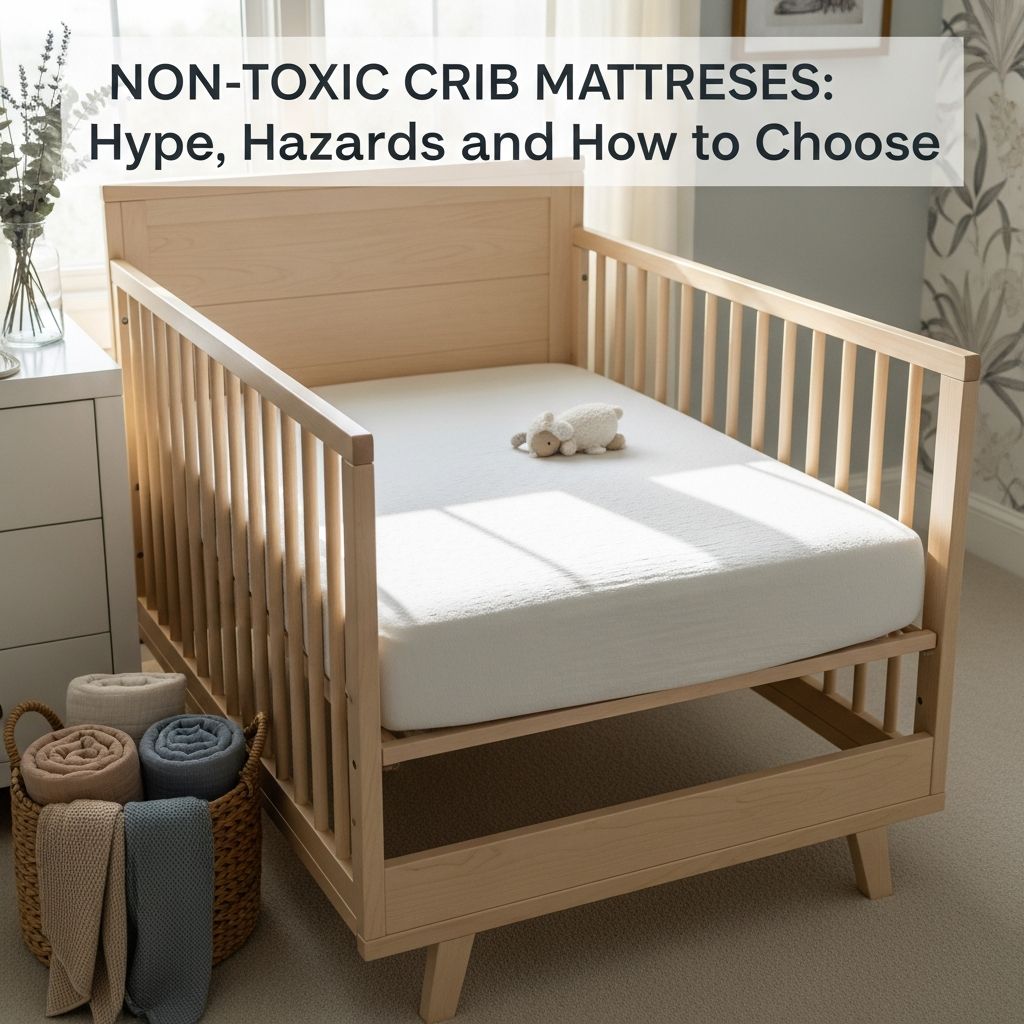
Walk down the baby aisle or scroll through nursery products online and you will see a flood of “green,” “natural,” and “non-toxic” crib mattresses. For expectant parents already navigating endless safety decisions, it is hard to know what is genuinely safer and what is clever marketing. This guide untangles the science, the regulations, and the sales language so you can choose a crib mattress with confidence.
Why Parents Worry About Crib Mattresses
Babies spend an enormous portion of their first year asleep, usually 12–16 hours per day, often on the same crib mattress for months at a time. Their lungs and nervous systems are still developing, and they breathe more air per kilogram of body weight than adults, which means they can be more affected by airborne chemicals and allergens in indoor environments. Babies also sleep in close contact with the mattress surface, making emissions from the mattress more relevant.
Because of this, some families look for mattresses that claim to be organic, eco-friendly, or chemical-free. But not every green-sounding claim reflects a meaningful reduction in risk. Understanding the basics of mattress construction and regulation helps separate genuine health improvements from marketing spin.
How Crib Mattresses Are Typically Built
Most crib mattresses use a combination of three functional layers:
- Core – provides firmness and structure (e.g., polyurethane foam, innerspring coils, natural latex, coconut coir, or cotton batting).
- Cushioning layer – adds comfort and smooths the surface (often more foam, wool, or cotton).
- Outer cover and barrier – fabric plus waterproofing and sometimes fire barrier materials.
In a conventional mattress, these components frequently involve petroleum-based foams, synthetic fabrics, adhesives, and chemical flame retardants, all of which can contribute volatile organic compounds (VOCs) and other emissions to the air.
Real Risks vs. Exaggerated Fears
There is no single, definitive study showing that a conventional crib mattress is inherently toxic or that an organic mattress alone will prevent disease. However, several concerns are supported by broader environmental health research:
- VOC exposure – Certain foams, adhesives, and waterproofing chemistries can emit VOCs, which contribute to indoor air pollution. Babies’ higher breathing rates may increase their relative exposure.
- Flame retardant chemicals – Many traditional polyurethane foam products have historically used halogenated flame retardants. Some of these are persistent, bioaccumulative, and associated with endocrine and developmental effects in animal and epidemiologic studies.
- Plasticizers and phthalates – Waterproof vinyl covers may contain plasticizers. Several phthalates have been restricted in children’s products in the U.S. and EU because of reproductive and developmental concerns, though some newer alternatives are less studied.
- Allergens and irritants – Dust mites, mold, and latex proteins can provoke allergies in susceptible children. Moisture trapped inside mattresses can increase microbial growth risk.
By contrast, some claims about miraculous benefits of specific “green” mattress designs—such as dramatically reduced risk of sudden infant death syndrome (SIDS) solely due to a certain fill material—are not supported by robust evidence. Safe sleep position (on the back), a firm surface, and a clear sleep space without soft bedding remain the established SIDS-reduction priorities according to public health guidelines.
Common Crib Mattress Materials: Pros and Cons
The material mix in a crib mattress influences emissions, durability, cost, and environmental impact. No single option is perfect, but understanding each one helps you make trade-offs that match your priorities.
| Material | Main Benefits | Main Drawbacks |
|---|---|---|
| Polyurethane foam | Lightweight, inexpensive, widely available, easy to meet firmness standards. | Petroleum-based, often requires flame retardants; can emit VOCs and degrade over time. |
| Innerspring (steel coils) | Very firm and durable; steel is inert; often combined with cotton or foam layers. | Heavier; comfort layer and cover materials still determine chemical profile. |
| Organic cotton | Renewable, natural, low inherent toxicity, good for firm surfaces, avoids synthetic pesticides. | Needs other components for waterproofing and fire performance; can absorb moisture. |
| Natural latex (rubber) | Durable, resilient, breathable, and naturally resistant to dust mites and mildew. | More expensive; potential allergen for latex-sensitized individuals; quality varies. |
| Coconut coir (fiber) | Very firm when combined with latex, plant-based, and long-lasting. | Heavy; marketing claims about “breathability” and SIDS reduction are not well supported. |
| Wool | Naturally flame-resistant; can help meet flammability rules without chemical additives; moisture-regulating. | Costly; some babies are sensitive to lanolin or wool fibers. |
What “Green” Often Means—and What It Does Not
Mattress marketing uses a wide vocabulary of eco-friendly language. Some terms have clear definitions; others mean very little without context.
Terms With Clearer Meaning
- Certified organic – When verified by recognized standards such as the Global Organic Textile Standard (GOTS) for textiles or the Global Organic Latex Standard (GOLS) for latex, this indicates that materials meet criteria for organic agriculture, processing, and limited use of certain chemicals.
- Low-VOC or GREENGUARD Gold certified – GREENGUARD Gold certification requires testing for emissions of thousands of chemicals and sets stricter limits suitable for sensitive populations like children.
- Made Safe certified – The MADE SAFE program screens ingredients against a wide list of known and suspected toxicants, carcinogens, endocrine disruptors, and developmental hazards, placing restrictions beyond many regulatory baselines.
Terms That Need More Context
- “Eco foam” or “plant-based foam” – Often still mostly polyurethane foam with a small proportion of plant-derived polyols, not a fundamentally different material.
- “Natural” – Simply means derived from a natural source; plenty of natural substances are allergens or irritants. This term is not regulated in the same way as “organic.”
- “Chemical-free” – Everything is made of chemicals in a scientific sense. This phrase is marketing shorthand and not literally accurate.
Key Certifications That Actually Matter
Third-party certifications provide an independent check on manufacturer claims. No seal guarantees zero exposure, but together they form a more reliable picture than advertising alone.
- GOTS (Global Organic Textile Standard)
Applies to cotton and other fibers. For crib mattresses, a GOTS certification that covers the entire mattress (not just the cover) is stronger evidence that the bulk of fabric components are organic and that processing avoided many hazardous substances. - GOLS (Global Organic Latex Standard)
Ensures that latex is predominantly organic and produced under defined social and environmental criteria. - GREENGUARD Gold
Focuses on indoor air quality by limiting chemical emissions and VOCs to levels suitable for healthcare and educational environments for children. - MADE SAFE
Evaluates ingredients against a list of hazardous chemicals and considers cumulative exposure. Products must also meet or incorporate other organic standards, such as GOTS and GOLS, where applicable. - OEKO-TEX Standard 100
Tests textiles for certain harmful substances at defined limits. A helpful additional signal, especially for covers and quilting, though it does not address all possible chemicals.
Fire Safety, Flame Retardants, and Safer Approaches
Crib mattresses sold in the United States and many other countries must meet flammability regulations. Historically, this has driven the use of chemical flame retardants in foam products. However, exposure to several widely used flame retardant classes has raised concerns, particularly about their potential endocrine, neurodevelopmental, and carcinogenic effects.
Manufacturers can meet flammability rules in several ways:
- Inherently less flammable materials – Wool and some natural fibers char rather than ignite quickly, reducing the need for chemical additives.
- Barrier fabrics – Specially woven or treated fabrics can create a physical barrier to flame without large amounts of additive chemicals, though proprietary treatments vary.
- Chemical flame retardants – Added directly into foam or applied as coatings; these are the ones many families seek to avoid.
Certifications such as MADE SAFE and certain organic programs explicitly prohibit halogenated flame retardants, providing an extra layer of assurance that a purportedly green mattress is not simply conventional foam wrapped in eco-colored marketing.
Breathable and “Airflow” Mattresses: What We Know
Some mattresses emphasize “breathable” designs with open structures or mesh layers, marketed with implications of lower SIDS risk. Research on SIDS consistently emphasizes sleep position, avoiding soft bedding, and maintaining a smoke-free environment as primary strategies. There is limited direct evidence that any particular mattress fill material alone prevents SIDS.
In fact, certain “breathable” products from previous decades that used very soft natural fiber fills were associated with higher risk when infants slept prone, likely because babies could sink into the surface and re-breathe exhaled carbon dioxide. This suggests that firmness and overall sleep environment matter more than any single claim about airflow through the mattress core.
When evaluating breathable features:
- Prioritize a consistently firm sleep surface that does not sag under your baby’s weight.
- Be cautious of products relying on complex structures that can trap moisture or be difficult to clean adequately.
- Remember that safe sleep guidelines still recommend placing babies on their backs on a flat, firm mattress with a fitted sheet and no soft bedding.
How to Read Crib Mattress Labels Critically
Before purchasing, look beyond the front-of-box slogans. A few targeted questions can clarify how truly low-toxicity a product is:
- Which parts are organic? – Is the certification for the full mattress, or only the cotton cover?
- What is the core made of? – A mattress can have an organic cotton cover yet still be mostly polyurethane foam.
- Are flame retardant chemicals used? – Look for explicit statements about not using added chemical flame retardants, supported by relevant certifications.
- Which third-party certifications apply? – Cross-check whether claimed seals are authentic and currently valid.
- How is waterproofing achieved? – Ask whether it uses vinyl (PVC) or alternative materials, and whether any per- and poly-fluoroalkyl substances (PFAS) are used for stain or water resistance.
Practical Buying Guide for Parents
Most families balance health, budget, and convenience. The following framework can help you make a decision without getting lost in details.
1. Set Your Priorities
- Highest priority: safety basics
Firm, flat surface; correct fit in the crib (no large gaps); use with a tight fitted sheet; always follow national safe sleep guidelines. - High priority: reduced chemical exposure
If budget allows, choose a crib mattress that is fully GOTS/GOLS certified, MADE SAFE, and/or GREENGUARD Gold certified for low emissions. - Moderate priority: environmental impact
Look for renewable materials like certified organic cotton or latex, transparent supply chains, and end-of-life considerations such as recyclability where available.
2. Reasonable “Better, Best” Choices
- Better
A conventional mattress with GREENGUARD Gold or OEKO-TEX certification and a clear statement of no added flame retardants can offer a lower-emission option at a moderate price point. - Best
A mattress with primarily organic materials (GOTS textiles, GOLS latex) plus additional certifications such as MADE SAFE and GREENGUARD Gold, and explicit avoidance of chemical flame retardants and certain waterproofing chemicals.
3. Budget-Friendly Tips
- Consider spending more on the mattress and simplifying in other nursery areas where possible; your baby will spend more time on the mattress than in many other products.
- If buying second-hand, prioritize a mattress from a non-smoking home, without visible damage or sagging, and avoid models from eras when now-restricted chemicals were more commonly used.
- Use a high-quality, snug mattress protector to extend mattress life and reduce moisture intrusion.
Care, Cleaning, and When to Replace a Crib Mattress
Even the most carefully chosen mattress can develop problems if it is not cared for. Moisture, bodily fluids, and dust can all accumulate, affecting both hygiene and emissions over time.
- Use a washable, waterproof protector that fits tightly and does not compromise firmness.
- Follow manufacturer instructions for cleaning the surface, rotating or flipping the mattress (if allowed), and drying after accidents.
- Inspect regularly for mold, strong persistent odors, or structural changes. Replace mattresses that are sagging, cracked, or cannot be cleaned effectively.
- Keep the room ventilated when new products are introduced. Allowing a new mattress to air out before your baby sleeps on it can help reduce initial emissions.
Frequently Asked Questions (FAQs)
Q1: Do I need an organic crib mattress for my baby to be safe?
No single feature guarantees safety. Following safe sleep guidelines—placing your baby on their back on a firm, flat mattress with no soft bedding—is the primary protective step. Organic and low-emission mattresses can help reduce certain chemical exposures, but they are one part of a broader healthy home strategy.
Q2: Are breathable crib mattresses safer than regular ones?
Evidence does not currently show that any specific breathable design alone prevents SIDS. A firm mattress and back-sleeping are the key factors. Some breathable covers can improve comfort and temperature regulation, but very soft or overly complex structures may introduce other risks if they allow babies to sink in or are difficult to clean thoroughly.
Q3: How important is a GREENGUARD Gold or similar certification?
Emission certifications like GREENGUARD Gold provide third-party evidence that a product releases very low levels of VOCs, which is especially relevant for babies who spend long hours in close proximity to the mattress. While not mandatory, these labels offer a useful shorthand when comparing products.
Q4: Should I avoid all foam mattresses?
Not necessarily. Foam mattresses that meet safety standards, avoid certain flame retardants, and carry low-emission certifications can be a reasonable option, particularly when budget is limited. However, parents seeking to minimize petroleum-derived materials and certain additives may prefer cores made from organic cotton, latex, or innersprings.
Q5: When is it time to replace a crib mattress?
Replace a mattress if it is visibly sagging, misshapen, cracked, contaminated with mold or odors that do not resolve with cleaning, or if it no longer fits snugly in the crib. A firm, even surface without gaps around the edges is essential for safe sleep.
References
- Safest “Breathable” Crib Mattresses & Marketing Tricks to Look Out For — Mamavation. 2023-07-10. https://mamavation.com/motherhood/safest-breathable-crib-mattresses-marketing-tricks.html
- The Best Natural Materials for a Crib Mattress — LeafScore. 2023-03-15. https://www.leafscore.com/eco-friendly-kids-products/ecofriendly-nontoxic-crib-mattress-materials/
- Finding the Best Organic Crib Mattresses — Hiccapop. 2023-06-01. https://www.hiccapop.com/blogs/blog/best-organic-crib-mattresses
- 11 Essential Certifications Every Safe Crib Mattress Should Have — Avocado Green Mattress. 2023-04-20. https://help.avocadogreenmattress.com/en/articles/12804907-11-essential-certifications-every-safe-crib-mattress-should-have
- Best and Safest Crib Mattresses — Consumer Reports. 2022-11-14. https://www.consumerreports.org/babies-kids/crib-mattresses/best-crib-mattresses-a9683309833/