Building a pillow fort transforms ordinary living spaces into realms of adventure, fostering creativity and hands-on learning for children and adults alike. Drawing from structural engineering principles, these forts emphasize stability, scale, and imagination using common household materials.
Why Pillow Forts Matter for Family Bonding
Pillow forts encourage problem-solving and teamwork as family members collaborate on designs. They provide safe spaces for storytelling, reading, or movie nights, enhancing emotional connections. Research from child development experts highlights how such play builds spatial awareness and fine motor skills in kids aged 3-12.
Essential Planning: Choosing Your Fort’s Foundation
Start with site selection. The living room offers ideal furniture like sofas, chairs, and tables for frameworks. Ensure at least 10×10 feet of clear space to avoid cramped builds. Assess floor type—carpets provide grip, while hard floors may need non-slip mats for safety.
- Indoor vs. Outdoor: Indoors suit weather-proof fun; outdoors allow expansive glamping-style forts on grass.
- Scale Considerations: Small forts for toddlers (4×4 feet); epic ones for groups (15×15 feet).
- Time Estimate: 30-60 minutes for basic; 2 hours for multi-room masterpieces.
Gathering Your Building Arsenal
Stockpile materials before construction to maintain momentum. Prioritize lightweight yet sturdy items for easy assembly and disassembly.
| Category | Items | Purpose |
|---|---|---|
| Framework | Chairs, broomsticks, wooden dowels | Skeleton support |
| Padding | Pillows, cushions, mattresses | Walls, floors, stability |
| Coverings | Sheets, blankets, quilts | Roofs, walls, doors |
| Fasteners | Clothespins, binder clips, tape, heavy books | Securing elements |
| Enhancers | String lights, glow sticks, stuffed animals | Ambiance and decor |
Pro Tip: Memory foam pillows offer superior compression resistance for load-bearing walls.
Core Construction Techniques: From Frame to Fortress
Apply physics basics—compression and tension—for durability. Compression squeezes materials downward; tension pulls them taut.
Step 1: Establish the Base Layer
Lay a mattress, duvet, or layered blankets on the floor for comfort. Position against a wall or sofa for one natural side, reducing material needs.
Step 2: Erect the Structural Supports
Arrange chairs with backs facing inward along the length. Space them 3-4 feet apart to form tunnels or rooms. For height, invert chairs or use broomsticks taped between seats.
- Compression Trick: Stack cushions atop chair seats; legs compress slightly to hold weight.
- Tension Trick: Stretch sheets tightly over frames, securing with clips.
Step 3: Build Resilient Walls
Line chair gaps with upright cushions, ends touching for support. Top with horizontal pillows—the weight compresses walls into firm barriers. Test stability by gently pushing; adjust squishy pillows with firmer ones.
Step 4: Craft the Overhead Canopy
Drape large sheets from chair row to row, pooling on seats. Anchor edges with books or tape. For peaks, tape two dowels into an A-frame and prop centrally.
Advanced: Create multi-level roofs by adding strung dowels across the top sheet, then layering another fabric level.
Physics of Stability: Making Forts That Last
Understand forces to prevent collapses. Soft pillows bend under compression; firm ones distribute weight evenly. Tension in sheets prevents sagging roofs. Experiment: Build a mini prototype to test designs before scaling up.
- Common Pitfalls: Overly soft walls curve; loose sheets cave in.
- Solutions: Reinforce with books at corners; use clips for taut covers.
Elevating Design: Thematic and Multi-Room Layouts
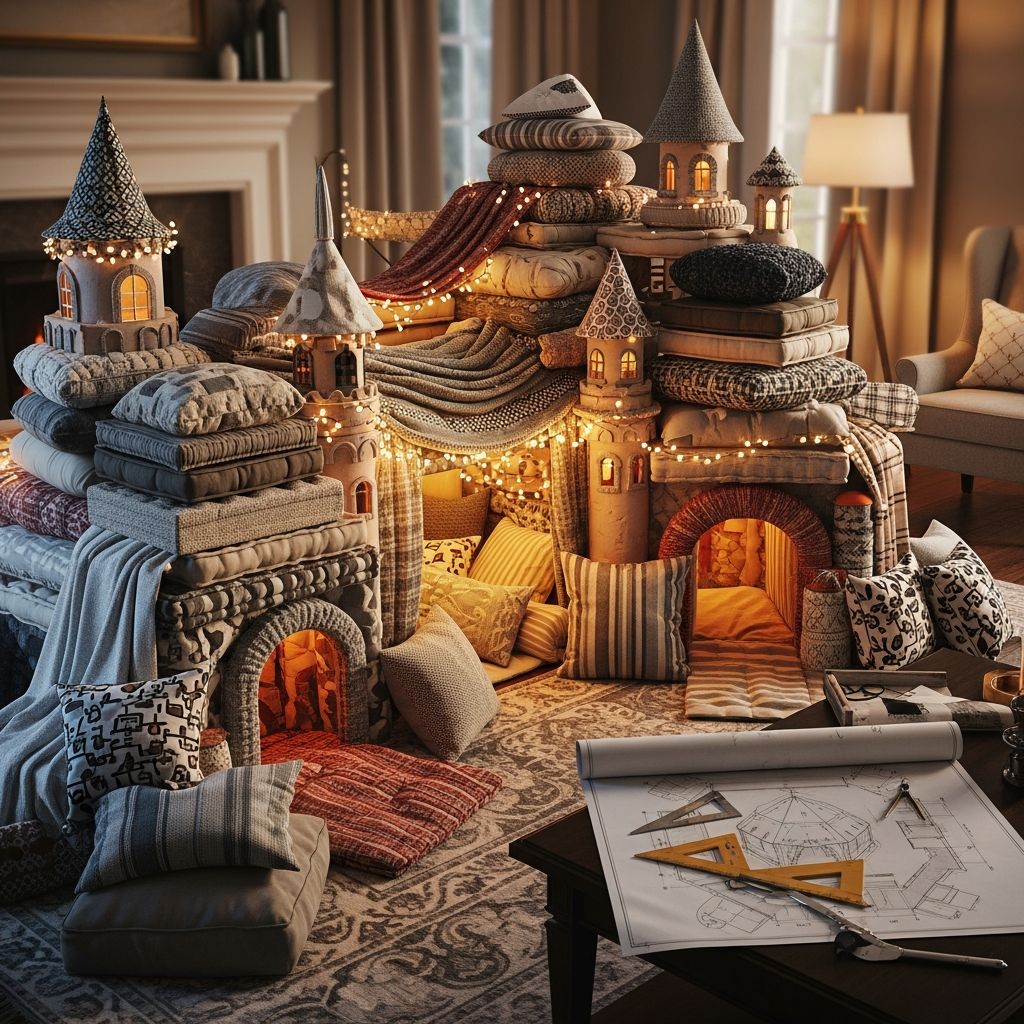
Go beyond basics with themed forts. Castle: Tower-like chair stacks. Spaceship: Foil blankets for metallic sheen. Multi-room: Connect modules via cushion tunnels.
Expansion Table:
| Fort Type | Key Features | Materials Needed |
|---|---|---|
| Tunnel Network | Crawling passages | Extra chairs, long cushions |
| Palace | Throne room, balcony | Sheets for drapes, pillows for seats |
| Glamping Tent | Outdoor-ready | Thick toppers, stakes if possible |
Illuminating and Furnishing Your Sanctuary
Clip string lights along rooflines for magical glow. Scatter stuffed animals, books, and snacks inside. Add a “do not disturb” sign from cardboard. For coziness, layer floor blankets and prop a tablet for fort movies.
Safety First: Protecting Playtime
Supervise young builders to avoid pinches from clips. Ensure clear entrances to prevent trips. Avoid overloading with too many kids at once. Clean up small parts post-build.
- Check for stability before entry.
- Use non-toxic tape; skip sharp objects.
- Allergies: Opt for washable fabrics.
Advanced Variations for Seasoned Builders
Waterproof forts for poolside (towels as covers). Glow-in-dark with phosphorescent tape. Eco-version using recycled boxes for hybrid walls. Scale for sleepovers: Twin mattress bases with ventilated roofs.
Frequently Asked Questions
What if my fort keeps collapsing?
Use firmer pillows for walls and ensure sheets are tightly tensioned. Test incrementally.
Best age for building forts?
Ages 4+ for participation; toddlers enjoy supervised play inside finished ones.
Can I build without chairs?
Yes—stack large cushions against furniture or use book towers for mini forts.
How to store materials neatly?
Designate a “fort bin” for pillows and clips; fold sheets immediately after.
Outdoor fort tips?
Choose dry grass; use rocks instead of books for anchors; add bug nets.
Legacy of Fort Building: Long-Term Benefits
Repeated fort sessions teach persistence and innovation. Document builds with photos for a family album, inspiring future projects. These simple structures spark lifelong love for design and DIY.
References
- Child Development and Play: Spatial Skills — American Academy of Pediatrics. 2023-05-15. https://publications.aap.org/pediatrics/article/151/5/e2022057994/190000/Play-and-Development
- Engineering Principles in Everyday Play — National Science Foundation. 2024-02-10. https://www.nsf.gov/news/special_reports/engineering/
- Indoor Physical Activity Guidelines for Children — Centers for Disease Control and Prevention. 2025-01-20. https://www.cdc.gov/physicalactivity/basics/children/index.htm
- Family Bonding Through Creative Play — Harvard Graduate School of Education. 2023-11-08. https://www.gse.harvard.edu/ideas/usable-knowledge/23/11/creative-play
- Safety Standards for Children’s Indoor Play Structures — Consumer Product Safety Commission. 2024-07-12. https://www.cpsc.gov/s3fs-public/PlaygroundSafety.pdf