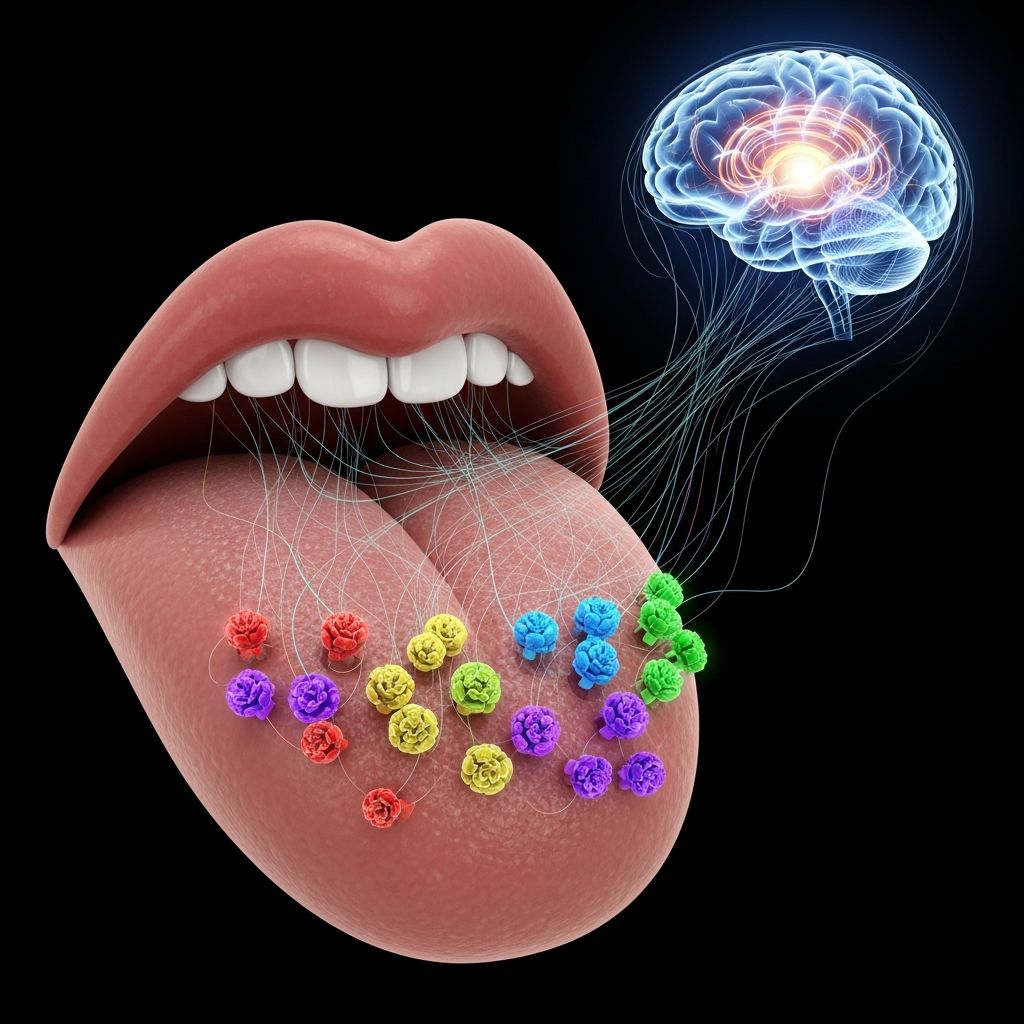
Your tongue is much more than a muscle that helps you talk and chew. It is covered with tiny sensors called taste buds that help your brain decide whether a food is safe, enjoyable, or something you never want to eat again.
Scientists call the sense of taste gustation. Taste works together with smell, touch, and even temperature in your mouth to create what you know as flavor. This mix of senses is why a strawberry candy tastes different from a real strawberry, even if they are both sweet.
Meet Your Taste Buds
Taste buds are small groups of special cells that sit inside tiny bumps on your tongue and in a few other places in your mouth. When food touches these cells, they send messages to your brain so you can recognize different tastes.
Most people have up to a few thousand taste buds, and each bud holds many taste cells. These taste cells do not last forever—your body replaces many of them every week or so. That means your sense of taste is always being refreshed.
- Taste buds are found mostly on the top and sides of the tongue.
- Some taste buds also live on the soft palate (the back part of the roof of your mouth), your throat, and the upper part of the esophagus.
- Each taste bud has an opening called a taste pore where food molecules can reach the taste cells inside.
Tongue Bumps: Papillae, Not Taste Buds
If you look at your tongue in a mirror, you can see tiny bumps all over it. These bumps are called papillae. Many, but not all, papillae contain taste buds.
| Type of papilla | Where it is | Taste buds? |
|---|---|---|
| Fungiform | Front and sides of tongue | Yes, often contain several taste buds |
| Foliate | Back sides of tongue | Yes, many taste buds |
| Circumvallate | Back of tongue in a row | Yes, hundreds of taste buds each |
| Filiform | Cover most of tongue surface | No taste buds; mainly for touch |
The Five Basic Tastes
Even though there are thousands of different foods, scientists group the main taste qualities into at least five basic tastes:
- Sweet – signals energy-rich foods like fruits and sugary treats.
- Sour – often comes from acids in foods like lemons or vinegar.
- Salty – mostly from salt (sodium), important for body functions.
- Bitter – common in some vegetables and dark chocolate; can warn of poisons in nature.
- Umami – a “savory” or “meaty” taste found in foods like cheese, meat, and broth.
For a long time, people believed that different parts of the tongue could only sense certain tastes (for example, sweet at the tip and bitter at the back). Research has shown that all taste qualities can be detected over most of the tongue, although some areas are slightly more sensitive than others.
How Taste Cells Detect Different Tastes
Each taste bud holds many taste receptor cells, and different cells are more sensitive to certain tastes.
- Sweet, bitter, and umami are detected by special proteins on the surface of taste cells. When matching food molecules attach to these proteins, a chain of signals starts inside the cell.
- Salty taste mainly comes from sodium ions entering channels in taste cells.
- Sour is linked to acids. Hydrogen ions from acids can enter channels or affect other parts of the taste cell, making it fire signals.
From Bite to Brain: The Journey of a Taste
Every time you eat or drink, a quick series of steps turns food into taste signals your brain can understand.
- Food breaks down in your mouth. Chewing and saliva help release tiny molecules from food.
- Molecules enter the taste pore. They dissolve in saliva and reach the taste cells inside the taste bud.
- Taste cells are activated. The food molecules change proteins or ion channels in the taste cell, starting an electrical signal.
- Signals move to nerves. The taste cells release chemical messengers that activate nearby nerve fibers.
- Nerves carry the message to the brain. These fibers join three main cranial nerves that go to special taste areas in the brainstem, thalamus, and gustatory cortex.
The brain then combines this taste information with smell, touch, temperature, and even sight to create your full experience of flavor.
Smell + Taste = Flavor
If you have ever noticed that food seems bland when you have a stuffy nose, you have experienced how strongly taste and smell are linked. The nose contains olfactory receptors that react to odor molecules from your food.
Two main paths help your brain smell your food:
- Through the nostrils, when you sniff while looking at or bringing food to your mouth.
- From the back of your mouth, when you chew and odor molecules travel up into your nasal cavity.
In the brain, smell areas and taste areas are closely connected. The brain mixes signals from both senses to produce the rich, detailed feeling you call flavor.
More Than Taste: Other Mouth Sensations
Your mouth senses more than just sweet, sour, salty, bitter, and umami. Other feelings in your mouth also change how you experience food:
- Temperature – hot soup or cold ice cream feels different because temperature-sensitive proteins in nerve endings react to heat or cold.
- Spiciness – chili peppers contain capsaicin, which activates heat-sensitive receptors (TRPV1). That is why spicy food can feel “hot” even when it is not warm.
- Coolness – mint and menthol trigger TRPM8 receptors, giving a cool feeling even at room temperature.
- Texture – smooth yogurt, crunchy chips, or chewy bread are sensed by touch receptors in your mouth and on your tongue.
All of these signals, along with taste and smell, help your brain judge whether food is pleasant, safe, and satisfying.
Why Taste Is Important for Your Health
Taste is not just about enjoying dessert. It also helps keep you safe and supports healthy eating.
- Safety warning: Very strong bitter or sour tastes can signal spoiled or poisonous foods in nature.
- Finding energy: Sweet tastes help you recognize foods that contain sugars and carbohydrates, which provide energy.
- Salt balance: Salty foods provide sodium, which your body needs in small amounts for nerves and muscles.
- Protein detection: Umami taste helps identify protein-rich foods like meat, eggs, and cheese.
Because taste and flavor are so important, scientists study how our senses influence what we choose to eat. Understanding taste can help families and health experts encourage healthier food choices.
Fun Facts About Taste Buds
- Taste buds change over time. Babies and young kids are often more sensitive to bitter tastes than adults, which may be one reason they dislike some vegetables.
- Taste buds can be damaged and regrow. Very hot food, certain illnesses, or injuries can harm some taste cells, but many of them regrow over days to weeks.
- Everyone tastes a little differently. People can have different numbers of taste buds and slightly different taste receptors, so one person’s favorite food can be another person’s least favorite.
Helping Your Taste Buds Stay Healthy
Good mouth care and healthy habits help your taste buds do their job well.
- Brush your teeth and tongue regularly to keep your mouth clean.
- Visit a dentist for checkups, which can help prevent infections that affect your mouth and sense of taste.
- Do not smoke or vape when you are older; these habits can dull your sense of taste and smell.
- Let hot food cool a little so you do not burn your tongue.
- Try many different healthy foods so your brain learns to recognize lots of flavors.
Frequently Asked Questions (FAQs)
Do different parts of the tongue taste different things?A: No. While some areas may be slightly more sensitive to certain tastes, research shows that all five basic tastes can be detected across most of the tongue.
Q: How many taste buds do people have?
Most people have up to several thousand taste buds, with each taste bud containing 10–50 taste receptor cells.
Why does food taste bland when I have a cold?
When your nose is blocked, fewer odor molecules reach your olfactory receptors. Because smell and taste normally work together to create flavor, food can seem dull or tasteless when your sense of smell is reduced.
Can taste buds grow back if they are damaged?
Yes. Taste receptor cells are replaced regularly, often every 9–10 days, so many damaged cells can be renewed over time.
Is spicy food a taste?
Spiciness is mainly a type of pain and temperature sensation, not one of the five basic tastes. Compounds like capsaicin from chili peppers activate heat-sensitive receptors in nerve endings, which your brain interprets as burning or hot.
References
- How Taste and Smell Work — BrainFacts.org (Society for Neuroscience). 2020-01-17. https://www.brainfacts.org/thinking-sensing-and-behaving/taste/2020/how-taste-and-smell-work-011720
- How do our tastebuds work? — Australian Academy of Science. 2017-06-06. https://www.science.org.au/curious/people-medicine/how-do-our-tastebuds-work
- Taste bud — Encyclopedic overview based on primary literature. 2023-05-01 (last updated). https://en.wikipedia.org/wiki/Taste_bud
- In brief: How does our sense of taste work? — InformedHealth.org, Institute for Quality and Efficiency in Health Care (IQWiG). 2016-02-18. https://www.ncbi.nlm.nih.gov/books/NBK279408/
- The Science of Taste — International Food Information Council (IFIC). 2022-10-11. https://ific.org/resources/articles/the-science-of-taste/
- Taste: Anatomy and Physiology — Alila Medical Media (educational animation). 2016-05-26. https://www.youtube.com/watch?v=K9JSBzEEA0o