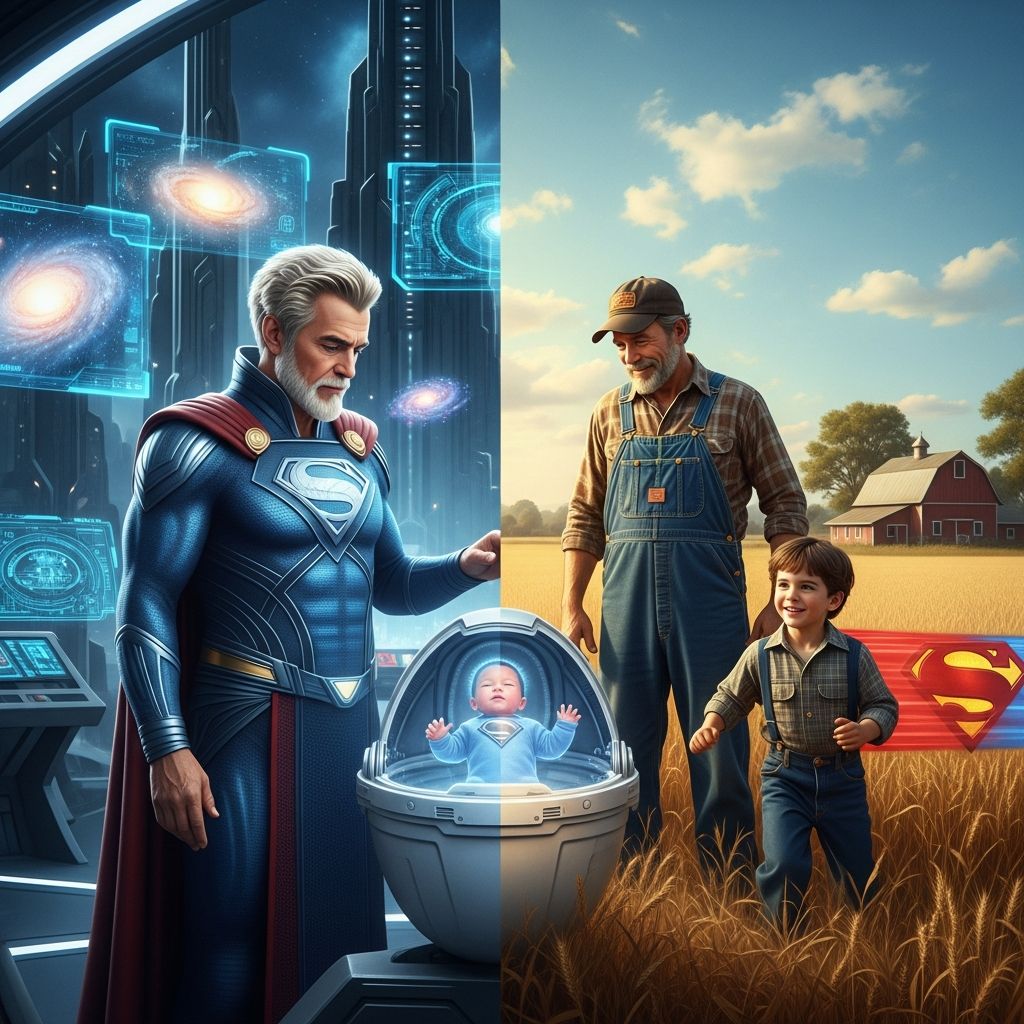
Among superhero stories, few relationships are as powerful as the one between Superman and his two fathers. The 1978 film Superman: The Movie, directed by Richard Donner, foregrounds this dual parentage in a way that deeply shaped how generations understand the character. Rather than choosing between Krypton and Kansas, the film insists that Clark Kent becomes Superman precisely because he is the son of both Jor-El and Jonathan Kent.
This article explores how the movie uses each father to answer a different question:
- Jor-El: Where do my powers and purpose come from?
- Jonathan “Pa” Kent: How should I live with that power among ordinary people?
Together they create not just a superhero, but a moral ideal that still defines Superman more than four decades later.
The 1978 Film’s Vision of Superman
Before looking closely at each father, it helps to understand the film’s overall approach. Donner famously described his guiding principle as “verisimilitude” — treating a comic-book premise with emotional and dramatic seriousness. That seriousness is nowhere clearer than in the way the movie frames Superman’s upbringing and values.
Released in 1978 with a then-huge budget and shot across the United Kingdom, the United States, and Canada, the film set a new standard for superhero cinema. Christopher Reeve’s performance, Marlon Brando’s Jor-El, and the quietly moving scenes on the Kent farm helped convince audiences that “you’ll believe a man can fly” could also mean “you’ll believe his feelings are real.”
Within that grounded approach, the story of two very different fathers becomes the backbone of Clark’s journey from frightened child to confident hero.
Jor-El: The Legacy of a Lost World
Jor-El represents the cosmic side of Superman’s identity: alien heritage, advanced science, destiny, and the weight of a vanished civilization. The film devotes extended early scenes to Krypton, treating it as more than just prologue; it is an emotional farewell from father to son.
Krypton as a Moral Warning
On Krypton, Jor-El is portrayed as a leading scientist who recognizes that the planet is doomed. The ruling council ignores his warnings, clinging to complacency and denial until it is too late. This background does three important things for Superman’s story:
- It establishes Jor-El as ethically serious, willing to stand by difficult truths.
- It shows that knowledge without wisdom leads to catastrophe — a lesson Clark will later apply to his own powers.
- It frames Krypton’s destruction as not just a disaster, but a moral failure, making Jor-El’s hope in his son feel like an attempt at redemption.
Even before Clark understands any words from his Kryptonian father, he is literally launched from a world that ignored moral responsibility.
The Ship as a Classroom
In many descriptions of the film, Superman’s journey to Earth is not simply travel; it is education. The small craft carrying baby Kal-El doubles as a kind of floating classroom, filled with Jor-El’s recorded teachings that continue to shape Clark long after Krypton’s destruction. Though the audience hears only pieces of this, the idea is crucial: Jor-El is present as a voice in Clark’s mind even when he is physically absent.
Those teachings give Clark:
- A sense of cosmic perspective — he is not just a powerful man, but a bridge between worlds.
- An understanding that his abilities are part of a larger design, not random accident.
- An early awareness that his life will involve sacrifice and responsibility.
“They Can Be a Great People, Kal-El”
Although the film uses different exact wording at various points, Jor-El’s message is consistent: humanity has the capacity for greatness, but it needs a living example to help it reach that potential. Jor-El does not send his son to conquer or to rule; he sends him to inspire.
This Kryptonian father, then, gives Clark:
- Purpose — to be a symbol of hope and moral clarity.
- Limits — explicit warnings not to interfere with human history in reckless ways.
- Identity — the name Kal-El, the last son of a lost world whose choices matter for an entire species.
Yet purpose alone is abstract. The film needs someone to show a young boy how to live those ideals in the dusty, ordinary reality of Earth. That is where Pa Kent comes in.
Jonathan Kent: The Everyday Ethics of a Small Town
If Jor-El is the architect of Superman’s cosmic mission, Jonathan Kent is the craftsman of his daily conscience. In the film’s Smallville segment, Jonathan is depicted as a grounded, kind, and quietly firm farmer who loves his adopted son without conditions.
Discovering Power in a Field of Corn
As Clark grows, his powers start to reveal themselves. Rather than reacting with fear or selfish excitement, Jonathan responds with protective curiosity. He knows his son is different, but he refuses to turn that difference into a spectacle.
The Kents’ lessons revolve around three simple rules:
- Do not use your gifts to show off.
- Never use your powers to hurt or humiliate others.
- Measure success not by fame, but by whether you have done what is right.
These are not advanced Kryptonian philosophies. They are the sort of straightforward values a parent in a rural American town might teach any child. Yet, once applied to someone who can outrun a train and lift tractors, they become revolutionary ethical constraints.
Mortality in the Heartland
One of the film’s most important emotional turns is Jonathan’s death. On a narrative level, it pushes Clark toward leaving Smallville. On a thematic level, it does something deeper: it teaches the future Superman that there are limits he cannot cross, no matter how strong he becomes.
By letting Clark fail to save the man he loves most, the story impresses on him that:
- Some losses are built into being human.
- Power cannot fix everything — especially death.
- Grief can become a source of empathy, not bitterness.
Jonathan’s passing means that every future rescue Clark performs is colored by the memory of the one life he could not save. That memory keeps his heroism from becoming arrogant.
Values in Plain Clothes
Jonathan also shapes how Clark thinks about his own identity. He encourages his son to live as an ordinary person as much as possible: going to school, working the farm, and later, stepping into a regular job. It is Jonathan who models the idea that being Superman is something Clark does, while being Clark Kent is who he is among people.
In this way, Pa Kent provides:
- Humility — power does not make you more important than your neighbors.
- Discipline — self-control when it would be easy to dominate.
- Compassion — seeing others as equally valuable, regardless of strength.
How the Two Fathers Complement Each Other
One of the most insightful elements of the 1978 film is that it never asks the audience to choose between Jor-El and Jonathan. Instead, it treats them as two halves of one complete upbringing. Without Jor-El, Clark might never see beyond Kansas; without Jonathan, he might never understand how to walk among humans with tenderness.
| Aspect of Superman | Shaped by Jor-El | Shaped by Jonathan Kent |
|---|---|---|
| Origin | Kryptonian heritage, Kal-El | Adopted son, Clark Kent |
| Purpose | Symbol of hope and moral example for humanity | Helping people one by one, quietly doing what is right |
| Limits | Do not rewrite human history or play god | Do not brag, bully, or use power selfishly |
| Emotional Center | Loss of a world; survivor’s responsibility | Loss of a parent; human grief and empathy |
| Identity Balance | Kal-El, last son of Krypton | Clark Kent, Kansas farm kid turned reporter |
The film suggests that Superman’s real strength is not just physical but integrative: he can hold together the expectations of a lost alien civilization and the everyday decency of a Midwestern family without discarding either.
Fatherhood, Adoption, and Chosen Responsibility
Part of the staying power of the 1978 movie lies in how it reframes fatherhood. Jor-El and Jonathan embody two different but equally valid forms of parenting:
- Biological legacy: Jor-El passes on genes, culture, and a mission.
- Adoptive love: Jonathan (and Martha Kent) provide daily care, affection, and moral formation.
Modern research on adoption and identity highlights how adopted children often draw from both their birth origins and their adoptive environments when constructing a sense of self. Superman is a fantastical extension of that truth: his heroism is literally impossible without both sides of his family story.
The film also subtly challenges the idea that fatherhood is about control. Neither man dictates every choice Clark makes. Jor-El sets broad boundaries; Jonathan offers guiding principles. Both, however, leave space for Clark to choose how to live those values as an adult.
Shaping the Superhero Genre
The emphasis on dual fathers in Superman: The Movie has echoed across later superhero films. The idea that heroes are shaped by layered parental influences became a recurring template, seen in many modern franchises. The film’s combination of grounded family drama with cosmic stakes helped define what a comic-book movie could be.
Historically, the 1978 production was ambitious: it was initially developed alongside its sequel, with a large ensemble cast and complex special effects designed to make flight look believable on screen. Donner’s decision to build the emotional arc around Clark’s parents ensured that all that spectacle had a human core.
Lessons for Modern Audiences
Decades after its release, the portrayal of Jor-El and Pa Kent still resonates, especially around questions of parenting and power:
- Parents cannot control outcomes, but they can offer values that endure beyond their lifetimes.
- Identity is layered; we are shaped by where we come from and where we are raised.
- Real strength is measured not in what we can do, but in what we choose not to do.
Superman’s greatest feats in the film are not just stopping disasters or catching falling objects; they are acts of restraint, compassion, and hope that reflect the combined influence of both his fathers.
Frequently Asked Questions (FAQs)
Why does the 1978 film spend so much time on Krypton and Smallville?
The movie uses extended sequences on Krypton and in Smallville to establish Jor-El and Jonathan Kent as equal influences on Clark’s identity. By giving each father significant screen time, the film makes their values feel lived-in rather than symbolic, grounding the later superhero action in a believable emotional history.
Is Jor-El more important than Jonathan Kent in shaping Superman?
The story presents them as complementary rather than competing. Jor-El provides Clark with his cosmic mission and understanding of his powers, while Jonathan gives him day-to-day ethics, humility, and empathy. Without Jor-El, Clark lacks purpose; without Jonathan, he lacks a human heart.
How did casting affect the portrayal of Superman’s fathers?
Marlon Brando’s star power lent Jor-El a sense of gravitas and authority, while the more understated performance of the actor playing Jonathan Kent emphasizes warmth and ordinariness. This contrast supports the film’s thematic split between cosmic destiny and small-town decency.
Did the focus on family influence later superhero movies?
Yes. The success of Superman: The Movie helped establish family backstory and parental influence as standard elements of superhero origin films. Later movies frequently echo the pattern of combining an extraordinary origin with grounded parental figures who frame how that power should be used.
What can modern parents take from Jor-El and Pa Kent?
The film suggests that effective parenting blends vision with presence: offering children a sense of larger purpose (like Jor-El) while also modeling everyday kindness, humility, and responsibility (like Jonathan). Even without superpowers, those combined gifts can prepare children to handle whatever influence or opportunities they eventually receive.
References
- The Making of Superman: The Movie | 1978 TV Special — Warner Bros. / YouTube description. 1978. https://www.youtube.com/watch?v=vUBR4MAgejg
- How The World’s First Blockbuster Superhero Franchise Fell to Earth — Collider. 2023-04-08. https://collider.com/superman-movie-franchise-history/
- Superman (1978) – IMDb — IMDb. 1978. https://www.imdb.com/title/tt0078346/
- 7 Things You Never Knew About Christopher Reeve’s 1978 ‘Superman: The Movie’ — Remind Magazine. 2023-06-09. https://www.remindmagazine.com/article/33180/superman-the-movie-1978-trivia-fun-facts-behind-the-scenes/
- “Superman: The Movie” (1978) made my generation believe a man could fly — Musings of a Middle-Aged Geek. 2023-12-16. https://musingsofamiddleagedgeek.blog/2023/12/16/superman-the-movie-1978-made-my-generation-believe-a-man-could-fly/
- The Making of Superman: The Movie — Documentary content summarized in multiple retrospectives. 1978. https://www.youtube.com/watch?v=wq3v3irvtn0
- Superman: The Movie — Superman Wiki (fan-maintained, used for plot/character cross-checking). Accessed 2024. https://superman.fandom.com/wiki/Superman:_The_Movie
- Adjustment and Identity in Adopted Children: A Developmental Perspective — Brodzinsky, D. Psychology and Education, various works summarized by academic adoption research communities. Representative overview via Rutgers University resources. https://doi.org/10.1037/0003-066X.44.3.346