For most children, a brother or sister is their first long-term peer: a built-in companion, rival, teacher, and critic all rolled into one. Far beyond sharing toys and bedroom space, sibling relationships leave a lasting imprint on how kids think, feel, and relate to others throughout life.
Research in developmental psychology shows that siblings can influence children’s social skills, emotional regulation, school performance, and even mental health—sometimes as strongly as parents do. Understanding how these relationships work helps caregivers guide them in a healthier direction.
The Hidden Power of Sibling Relationships
Siblings shape development in subtle, everyday moments—during play, arguments, shared chores, and late-night talks. Across childhood and adolescence, this daily contact acts like a social training ground.
- Frequency: Children often spend more hours with siblings than with parents or friends in early and middle childhood.
- Intensity: Interactions can swing quickly from affection to hostility, giving kids practice managing strong emotions in a relatively safe context.
- Longevity: Sibling bonds often outlast almost every other close relationship, continuing to influence well-being into adulthood.
Because siblings share family history, parents, and home routines, they understand each other’s vulnerabilities and buttons. That insight makes both kindness and cruelty more powerful—and the lessons learned more enduring.
Social and Emotional Skills Learned From Siblings
Psychologists describe the sibling relationship as a “natural laboratory” where children experiment with social behavior, perspective taking, and emotional expression. Over time, these experiments turn into lasting skills.
Building Empathy and Perspective Taking
Through daily interactions, siblings help each other learn to read emotions and understand that other people can feel differently than they do.
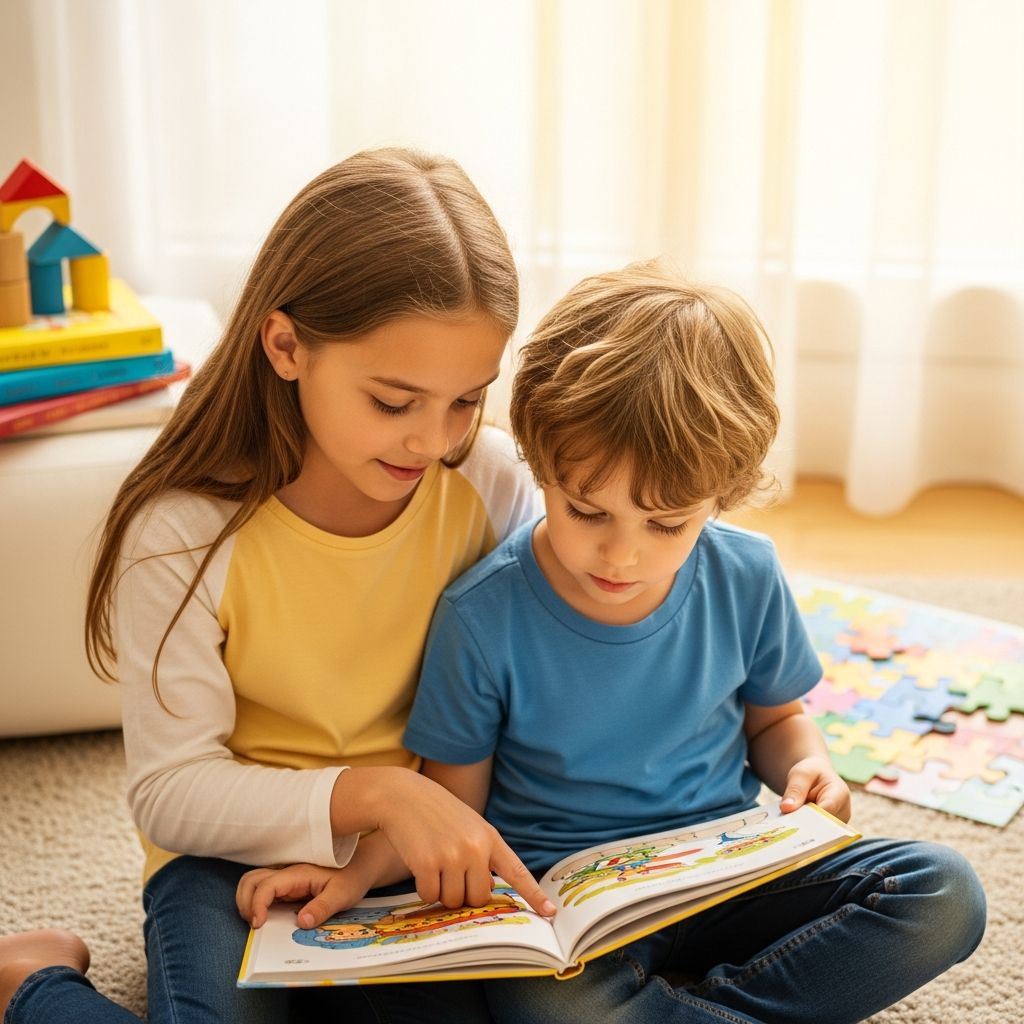
- Older siblings often explain rules, comfort younger children, or coach them through tasks, which requires recognizing the younger child’s needs and abilities.
- Younger siblings watch and imitate, gradually learning how to respond when someone is hurt, frustrated, or excited.
- Pretend play and shared jokes require kids to infer what their sibling is thinking and expecting in the moment.
Studies find that siblings who engage in rich pretend play, shared humor, and back-and-forth conversations show more advanced understanding of emotions and mental states over time.
Practicing Conflict and Repair
Conflicts between siblings can be exhausting for adults, but they are also one of the primary ways children learn to manage disagreements.
- Arguments give kids chances to negotiate, compromise, and stand up for themselves in low-stakes situations.
- Learning to calm down, apologize, or accept a partial win helps children develop emotional regulation.
- Constructive resolution—where both children feel heard—predicts better social adjustment at school and with peers later on.
When parents coach respectful problem-solving instead of immediately taking sides, kids are more likely to carry those conflict skills into friendships and romantic relationships in adulthood.
How Siblings Influence Learning and Thinking
Siblings do not only shape social behavior; they also quietly support each other’s cognitive growth. Older brothers and sisters, in particular, often act as informal tutors.
Everyday Teaching and Cognitive Boosts
From learning how to zip a coat to practicing new words, older siblings introduce younger children to tasks just a bit above their current abilities.
- Older children teach younger ones new vocabulary, rules of games, and problem-solving strategies, which can improve language and reasoning skills.
- Younger siblings often imitate older siblings’ study habits, attitudes toward homework, and curiosity about the world.
- Research indicates that having an older sibling can accelerate development of working memory and cognitive flexibility compared to peers without older siblings.
Some studies find that older siblings influence specific areas of academic performance, such as language or math, by sharing their own strengths and interests.
Learning Flows Both Ways
Although older siblings often appear to be the main teachers, the benefit is mutual.
- Explaining tasks and simplifying concepts for a younger sibling strengthens the older child’s own understanding and perspective taking.
- Younger siblings can nudge older ones toward greater empathy, patience, and flexibility by forcing them to adapt to a less skilled partner.
- As children grow, relationships become more equal, and both siblings contribute ideas, humor, and support.
Over the lifespan, having engaged siblings is associated with stronger overall cognitive functioning, even into later adulthood.
Warmth vs. Conflict: Two Sides of Sibling Influence
The impact of siblings depends heavily on the emotional climate between them. Warmth and support tend to predict positive outcomes, while chronic hostility can increase risk for difficulties.
| Relationship Quality | Common Features | Likely Outcomes |
|---|---|---|
| High Warmth, Low Conflict | Affection, shared activities, collaborative play, emotional support | Better social skills, higher peer acceptance, emotional resilience, academic engagement |
| High Warmth, Moderate Conflict | Frequent play, occasional intense arguments with repair | Good conflict resolution skills, realistic expectations of close relationships, stronger coping abilities |
| Low Warmth, High Conflict | Teasing, exclusion, name-calling, or aggression without repair | Higher risk of behavior problems, anxiety, depression, and modeling of hostile behavior with peers |
Researchers have found that warm, supportive sibling bonds can buffer children against stressors like bullying or parental conflict, reducing the risk of later depression and social difficulties. Conversely, when a sibling relationship is chronically hostile, children may carry those patterns into friendships and romantic partnerships.
Birth Order, Age Gaps, and Gender: Do They Matter?
Not all siblings influence each other in the same way. Family structure, spacing, and gender combinations subtly shape how relationships unfold, but they do not rigidly determine outcomes.
Birth Order and Roles
Birth order is associated with certain tendencies, although there is wide individual variation.
- Firstborns and older siblings are more likely to take on teaching, caretaking, or leadership roles, which can foster responsibility and academic focus.
- Later-born children may become more socially flexible or adept at negotiation from navigating an older sibling’s rules and preferences.
- Both may compete for parental attention or different niches in the family—one becoming the “achiever,” the other the “peacemaker” or “comedian.”
These roles can support growth but can also become restrictive if children feel locked into one identity. Conscious parenting can help kids explore broader strengths.
Age Spacing
The number of years between siblings also influences how they interact:
- Close age gaps (for example, under two years) may produce more intense rivalry but also more shared activities and mutual understanding.
- Larger gaps can reduce day-to-day competition but may create more hierarchical “teacher–student” dynamics.
- As children grow into adulthood, age gaps tend to matter less, and many siblings become more equal companions.
Gender Combinations and Expectations
Some research suggests that sibling gender combinations can shape how children view academic subjects and social roles.
- Older siblings can model gendered interests—such as particular sports or school subjects—that younger siblings either adopt or react against.
- Perceptions of being the “favorite” child, sometimes tied to gender expectations, can increase risk of depression or risky behavior for the less-favored sibling.
- Same-gender siblings may experience more direct comparison, while mixed-gender pairs may have more differentiated roles.
Parents can soften these effects by actively challenging stereotypes, highlighting each child’s individual strengths, and avoiding gendered assumptions about behavior or potential.
When Sibling Dynamics Become Harmful
Disagreement and jealousy are normal. The concern arises when conflict becomes chronic, one-sided, or abusive.
- Persistent name-calling, humiliation, or physical aggression can harm self-esteem and increase the risk of later mental health issues.
- Strong alliances—such as two siblings consistently ganging up on a third—can create long-lasting resentment.
- Large, unaddressed differences in parental treatment can fuel intense rivalry and feelings of rejection.
If a child shows ongoing fear of a sibling, significant behavior changes, or physical injuries, adults should treat it as a serious concern, not “just sibling rivalry.” Professional guidance may be needed to protect all children involved.
How Parents Can Support Healthy Sibling Bonds
Parents cannot (and should not) prevent every argument, but they can shape the overall climate in which sibling relationships develop. Small, consistent choices add up over time.
1. Focus on Fairness, Not Perfect Equality
- Avoid keeping score for every privilege or responsibility; what feels fair may differ by age and needs.
- Explain decisions in age-appropriate ways so children understand the reasoning behind them.
- Be mindful of patterns where one child consistently feels “less favored” and address them directly.
2. Coach, Don’t Just Referee
- Instead of deciding who is right, guide children to use words, take turns, and propose solutions.
- Model calm language: “Tell your brother what you need,” or “Can you both suggest one fair option?”
- Reinforce moments when they solve problems independently and respectfully.
3. Encourage Cooperation and Shared Projects
- Give siblings joint goals, such as building something together, planning a game, or collaborating on a family task.
- Highlight the ways they helped each other: “You showed her how to do that puzzle; that made it more fun for both of you.”
- Rotate pairings in larger families so different siblings spend one-on-one time together.
4. Protect Individual Identities
- Avoid labels like “the smart one,” “the shy one,” or “the troublemaker,” which can box children in.
- Offer each child dedicated one-on-one time with caregivers.
- Celebrate each child’s talents without directly comparing them to siblings.
5. Address Harmful Behavior Promptly
- Set clear family rules against hitting, harsh teasing, or destroying belongings.
- When harm occurs, focus on accountability and repair rather than blame alone.
- If patterns of aggression or fear persist, consider consulting a pediatrician, psychologist, or family therapist.
Frequently Asked Questions (FAQs)
Is it better for children to have siblings or be an only child?
Research shows that siblings offer unique social and emotional learning opportunities, but only children can receive rich social experiences through friends, cousins, and attentive adults. Outcomes depend more on relationship quality and parenting than on family size alone.
Do older siblings always have a positive influence on younger ones?
No. Older siblings can be powerful role models for both helpful and risky behaviors. Warm, supportive relationships are linked to better social and academic outcomes, while hostile or coercive dynamics can increase the risk of behavior and emotional problems.
How much should parents intervene in sibling fights?
Mild conflicts can be learning opportunities if children are safe and able to negotiate. Parents are most helpful when they coach respectful problem-solving rather than immediately choosing sides. Direct intervention is needed when there is aggression, fear, or a clear power imbalance.
Can tense sibling relationships improve over time?
Yes. Studies suggest that as siblings move into adolescence and adulthood, conflict often decreases and feelings of closeness increase, especially when contact is maintained and past grievances are addressed.
What if my children have very different personalities?
Differences in temperament are common and can be an asset. One child might be more cautious, another more adventurous; together they broaden each other’s experiences. Parents can support this by valuing each style and reducing direct comparison.
References
- Impact of Siblings on Child Development — US Nanny Institute / Amy Geller. 2022-05-01. https://usnannyinstitute.com/impact-of-siblings-on-child-development/
- Sibling Relations and Their Impact on Children’s Development — Centre of Excellence for Early Childhood Development (CEECD) / Judy Dunn. 2007-09-26. https://www.child-encyclopedia.com/peer-relations/according-experts/sibling-relations-and-their-impact-childrens-development
- Harnessing the Power of Sibling Relationships as a Tool for Optimizing Children’s Development — Jennifer M. Jenkins et al., Current Directions in Psychological Science. 2016-04-01. https://www.ncbi.nlm.nih.gov/pmc/articles/PMC4801185/
- The Impacts of Siblings on Development Across the Lifespan — University of Tennessee at Chattanooga / Haley Harrod. 2022-01-01. https://scholar.utc.edu/cgi/viewcontent.cgi?article=1606&context=mps
- Sibling Relationships and Development — Susan McHale et al., Emerging Trends in the Social and Behavioral Sciences. 2016-02-15. https://emergingtrends.stanford.edu/files/original/29b58262ad10f38e3d851d17417ee961ec629d84.pdf
- Improving Sibling Relationships — American Psychological Association / Kirsten Weir. 2022-03-01. https://www.apa.org/monitor/2022/03/feature-sibling-relationships
- How Siblings’ Gender Can Affect a Child’s Development — Penn State Social Science Research Institute. 2020-03-10. https://management.ssri.psu.edu/news/2020-2020-03/how-siblings-gender-can-affect-childs-development