Santa Claus, busy elves, and cozy Christmas Eve poems are more than seasonal decorations in kids’ imaginations. They quietly teach children what generosity, magic, fear, and family are supposed to feel like during the holidays. Parents might watch Elf for the laughs or read a rhyming classic by rote, but kids are absorbing lessons about trust, kindness, and what makes the holidays special.
This article explores how modern Santa stories, family movies, and classic Christmas poetry shape children’s expectations and memories, and how parents can use these tales without losing their own voice in the process.
The Many Faces of Santa: More Than One Story
Most children grow up with one dominant vision of Santa: a round, red-suited man who lives at the North Pole and delivers gifts from a flying sleigh. That image is powerful, but it is also the product of centuries of blended stories and images that parents rarely talk about with their kids.
From Saint Nicholas to Santa Claus
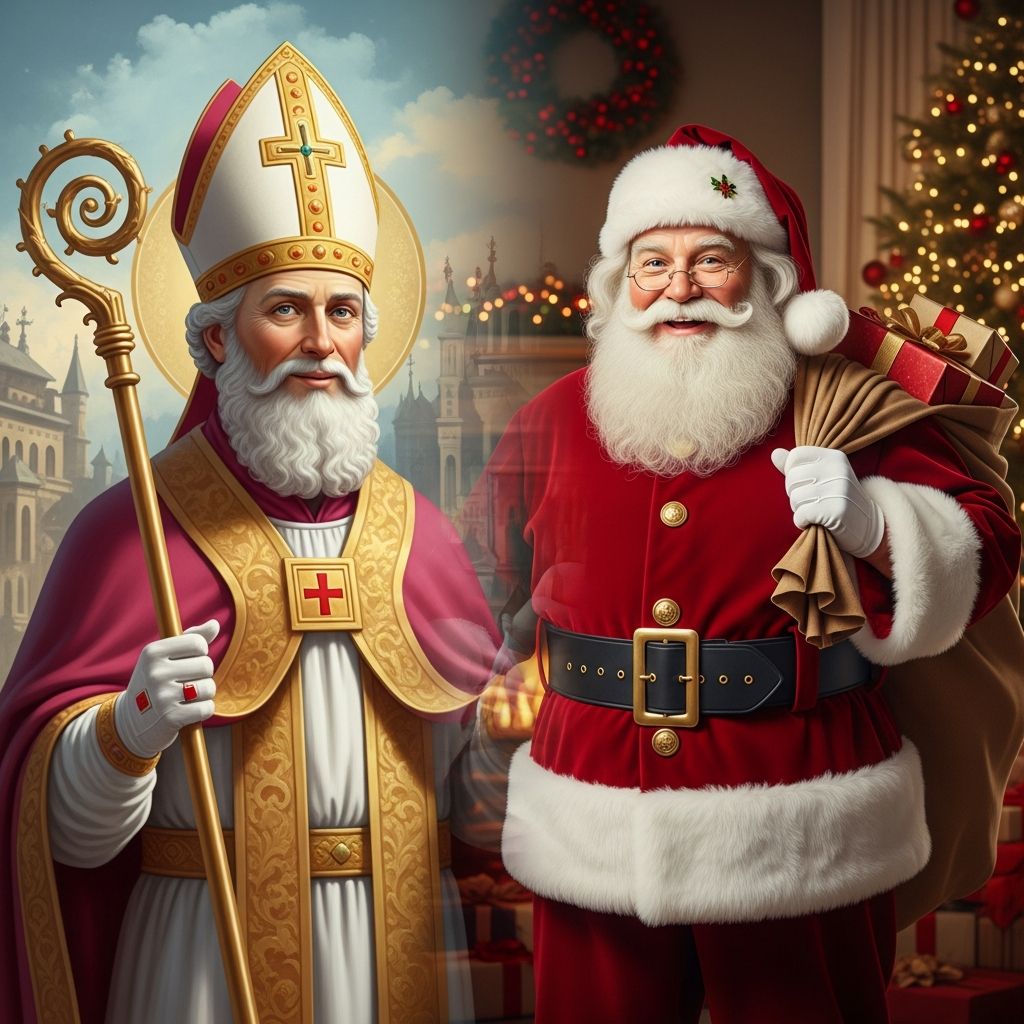
The modern Santa is rooted in the fourth-century Christian bishop Saint Nicholas of Myra, known for generous, often secret, gifts to those in need, especially children and the poor. Over time, his story evolved across Europe into different gift-bringers such as Sinterklaas in the Netherlands and Father Christmas in England before becoming the Santa we know in North America.
- Saint Nicholas: A real bishop in what is now Turkey, celebrated for charity and protection of children.
- Sinterklaas: A Dutch version with a red bishop’s robe and a book of children’s names, including who behaved well.
- Father Christmas: An English figure originally tied more to festive cheer than children’s gifts.
When families immigrated to North America, these figures merged. The name Santa Claus emerged from the Dutch Sinterklaas, and nineteenth-century writers and illustrators fixed his red suit, sleigh, reindeer, and jolly laugh in the popular imagination.
Why Parents Should Care About Santa’s Backstory
Children rarely ask about Saint Nicholas’s Greek heritage or why the holiday gift-bringer has different names in different countries. But understanding this variety gives parents flexibility. Instead of treating Santa as a rigid, all-knowing judge of behavior, parents can choose which elements to emphasize:
- Generosity: Focus on Santa as a symbol of anonymous kindness rather than surveillance.
- Cultural diversity: Introduce other traditions, like the Three Kings in Spain or the Christkind in parts of Europe, to show there is more than one way to do Christmas.
- Family values: Use Santa’s story to highlight your family’s priorities—helping neighbors, sharing, or appreciating what you have.
Christmas Stories as Emotional Scripts for Kids
Holiday tales don’t just entertain; they write emotional scripts children turn to when they think about Christmas. The same set of characters—Santa, elves, reindeer, tired parents—can teach radically different lessons depending on how they are presented.
What Children Learn From Santa-Centered Media
From children’s books to animated specials, Santa stories often revolve around a few recurring themes:
- Reward and punishment: Lists of who is naughty or nice, and gifts as a direct result of moral behavior.
- Belief versus doubt: The child (or grown-up) who no longer believes and must be convinced.
- Saving Christmas: A crisis that threatens the holiday until a child, elf, or misfit character steps up.
Repeated every year, these stories subtly shape how children understand kindness, consequences, and the value of belief—even if they grow out of literal belief in Santa.
Different Kinds of Christmas Movies, Different Messages
Not all Christmas movies talk about Santa the same way. Parents might not notice, but children often pick up on the differences in tone, humor, and morality.
| Type of Santa Story | Key Features | Common Message for Kids |
|---|---|---|
| Magical rescue tale | Santa in danger; kids or elves save the day | You can be brave and important, even as a child |
| Comedic misfit story | An outsider doesn’t fit in at the North Pole or in the city | Being different is valuable and can save the holiday |
| Traditional, reverent story | Warm, gentle Santa; focus on kindness and tradition | Christmas is about family, faith, and quiet generosity |
| Cynical or satirical tale | Adults frustrated with Christmas; Santa is questioned or mocked | Holidays can be stressful or fake—but worth reclaiming |
The Poem That Built the Modern Christmas Eve
When adults think of a perfect Christmas Eve scene—snowy rooftops, reindeer hooves, and a stocking-filled living room—they are often picturing images shaped by a nineteenth-century poem widely known by its opening line, “’Twas the night before Christmas.” That poem, formally titled A Visit From St. Nicholas, gave North America the classic image of Santa as a plump, jolly man in a red outfit flying a reindeer-drawn sleigh and sliding down chimneys.
How One Poem Changed Santa Forever
Before that poem was published in 1823, the gift-bringer’s appearance and habits were fluid; he might arrive on foot, on horseback, or as a more solemn bishop figure. The poem reshaped expectations in several ways:
- Transportation: Santa travels exclusively by sleigh and reindeer.
- Entrance: Santa always comes through the chimney.
- Timing: He visits while children sleep late on Christmas Eve.
- Personality: He is round, jolly, and more like a playful grandfather than a stern bishop.
These details, repeated in countless retellings, make the poem an invisible blueprint for many modern Christmas stories and illustrations.
Reading Classic Rhymes With Modern Kids
Parents who read older holiday poems or stories often encounter dated language, unfamiliar references, or values that do not perfectly match their own. Rather than abandoning these classics, adults can adapt them for today’s children:
- Pause on difficult lines and explain them in simple language.
- Talk openly about which parts are fantasy and which connect to real traditions.
- Invite kids to imagine their own updated verses or illustrations.
This keeps the warmth and rhythm of tradition while allowing room for new perspectives and family-specific values.
Elves, Workshops, and the Hidden Labor of Christmas
Elves are often presented as tireless, smiling helpers, joyfully making toys in an endless workshop under Santa’s supervision. For children, they represent pure magic: tiny beings who exist only to create delight. For adults, they can also highlight the invisible labor behind any holiday celebration.
Why Elves Capture Kids’ Imaginations
Children are drawn to elves because they combine several appealing elements:
- Miniature scale: Small characters feel approachable and relatable to kids.
- Creative work: Making toys aligns with children’s own love of crafts and play.
- Team spirit: A bustling workshop suggests community and shared purpose.
In many stories, elves stand in for kids themselves: energetic, overlooked by the adult world, yet crucial to making things work.
Using Elf Stories to Talk About Real-World Effort
Parents can use the fantasy of magical labor to talk gently about the very real time and effort adults invest in the holidays:
- Explain that, unlike elves, grown-ups get tired and sometimes feel stressed.
- Invite kids to become “family elves” who help wrap, bake, or tidy.
- Show that sharing work can be fun, not just a chore.
This approach turns the elf myth into a bridge between fantasy and practical cooperation.
Belief, Skepticism, and the Moment Kids Start Asking Questions
At some point, most children begin to doubt the literal reality of Santa. Developmental research suggests that as kids’ reasoning skills improve—usually in early to middle childhood—they start to notice inconsistencies between magical stories and everyday experience. Parents often wonder whether to protect belief, encourage skepticism, or let the questions unfold naturally.
How Children Move From Magic to Metaphor
Children do not simply “flip a switch” from believing in Santa to not believing. Instead, they gradually piece together clues: different handwriting on tags, presents from Santa that match items hidden in a closet, or learning about different cultural traditions. Psychologists have noted that children often hold partially skeptical, partially believing positions for a while, treating Santa more as a possibility than a certainty.
Parents can support this transition by:
- Answering questions honestly, at a level adjusted to the child’s age and sensitivity.
- Framing Santa as a shared story about generosity and joy rather than a lie about a specific person.
- Inviting older children to become “helpers” for younger siblings or neighbors once they understand the tradition.
Santa, Behavior, and the “Naughty or Nice” Dilemma
Many Christmas movies and songs repeat the idea that Santa is always watching and that gifts depend on whether a child has been “naughty or nice.” It is a simple moral framework, but it can create anxiety or confusion if children take it too literally.
What the History of Santa Suggests About Morality
The historical Saint Nicholas was associated with generous acts, sometimes toward people who had no way to repay him, emphasizing mercy more than strict justice. Folklore about Santa and related figures has often combined gift-giving with gentle moral guidance, but has not always operated on a rigid reward-and-punishment system.
Parents can draw on that heritage to soften the harshest elements of the “naughty or nice” story:
- Explain that everyone makes mistakes, and kindness does not cancel out a bad day.
- Use Santa as a symbol of forgiveness and fresh starts, not surveillance.
- Focus on specific behaviors (sharing, helping) rather than labeling the whole child as good or bad.
Making Holiday Media a Two-Way Conversation
No matter which movies you watch or which stories you read, children benefit when adults treat holiday media as the start of a conversation, not the end of one. Instead of just pressing play and hoping the message lands, parents can help kids reflect on what they have seen and heard.
Simple Questions to Ask After a Christmas Movie
- “What part of that story felt the most magical to you?”
- “Was there anything that felt a little scary or unfair?”
- “Who changed the most in that story? How?”
- “If you could change one thing about how Christmas worked in that movie, what would you change?”
Questions like these encourage kids to think critically about tradition while still feeling the joy and wonder of the season.
Building Your Own Family Santa Story
Every family eventually pieces together its own version of Santa, elves, and Christmas Eve. You might lean heavily on a favorite film character, keep things almost entirely focused on the religious meaning of the holiday, or treat Santa as a lighthearted game. What matters most is clarity and kindness.
Practical Ways to Personalize the Myth
- Define your message: Decide as adults what you want Santa to stand for—generosity, joy, surprise, solidarity with those in need—and let that guide your choices.
- Adapt traditions: Change the details (Stockings? Shoes? One gift or many?) to match your resources and values.
- Plan for questions: Think in advance about how you will respond when a child asks, “Is Santa real?” so that you are not caught off guard.
Frequently Asked Questions (FAQs)
Is it harmful to let kids believe in Santa?
Most children eventually figure out the truth about Santa on their own, and research suggests that discovering the reality of such cultural myths does not typically cause lasting harm, especially when parents respond honestly and with empathy once questions arise. What matters more is whether children feel tricked or supported when they seek answers.
How can I handle differences between our Santa traditions and those of other families?
Treat other families’ customs as interesting variations rather than threats. You can explain to children that different households and cultures tell the story in different ways—some emphasize Saint Nicholas, others focus more on Father Christmas or the Three Kings—and that all of these are valid ways to celebrate generosity.
What if my child is afraid of Santa or the idea of someone entering the house at night?
Some children are unsettled by the idea of a stranger coming into the home while they sleep. It can help to clarify that Santa is a story, or to adjust the details—perhaps Santa leaves gifts outside the door, or the family symbolically “invites” him. Let your child lead, and never force a visit with a mall Santa if it causes distress.
How do I talk about Santa once my older child no longer believes?
You can invite older children into the adult side of the tradition, explaining that while a single magical person does not deliver all the gifts, the spirit of Santa lives in anyone who gives quietly and kindly. Many families enlist older kids in choosing, wrapping, or delivering small surprises to younger children or neighbors, turning them into co-creators of the magic.
References
- Santa Claus — Encyclopaedia Britannica. 2024-01-05. https://www.britannica.com/topic/Santa-Claus
- The Fascinating Folklore Origins of Santa Claus — Explore the Archive. 2021-12-15. https://explorethearchive.com/where-did-santa-claus-originate-from
- Santa Claus — Wikipedia (citing multiple scholarly and historical sources). 2024-10-01. https://en.wikipedia.org/wiki/Santa_Claus
- The Legend of Santa Claus: The Origin and History of a Christmas Legend — St. Tammany Parish Library. 2019-12-09. https://www.sttammanylibrary.org/blogs/post/the-legend-of-santa-claus-part-1-the-origin-and-history-of-a-christmas-legend/
- Saint Nicholas and the Origin of Santa Claus — St. Nicholas Center. 2023-11-30. https://www.stnicholascenter.org/who-is-st-nicholas/origin-of-santa
- 5 International Origins of Santa Claus — ACIS Educational Tours. 2022-12-06. https://acis.com/blog/the-international-origins-of-santa-claus/