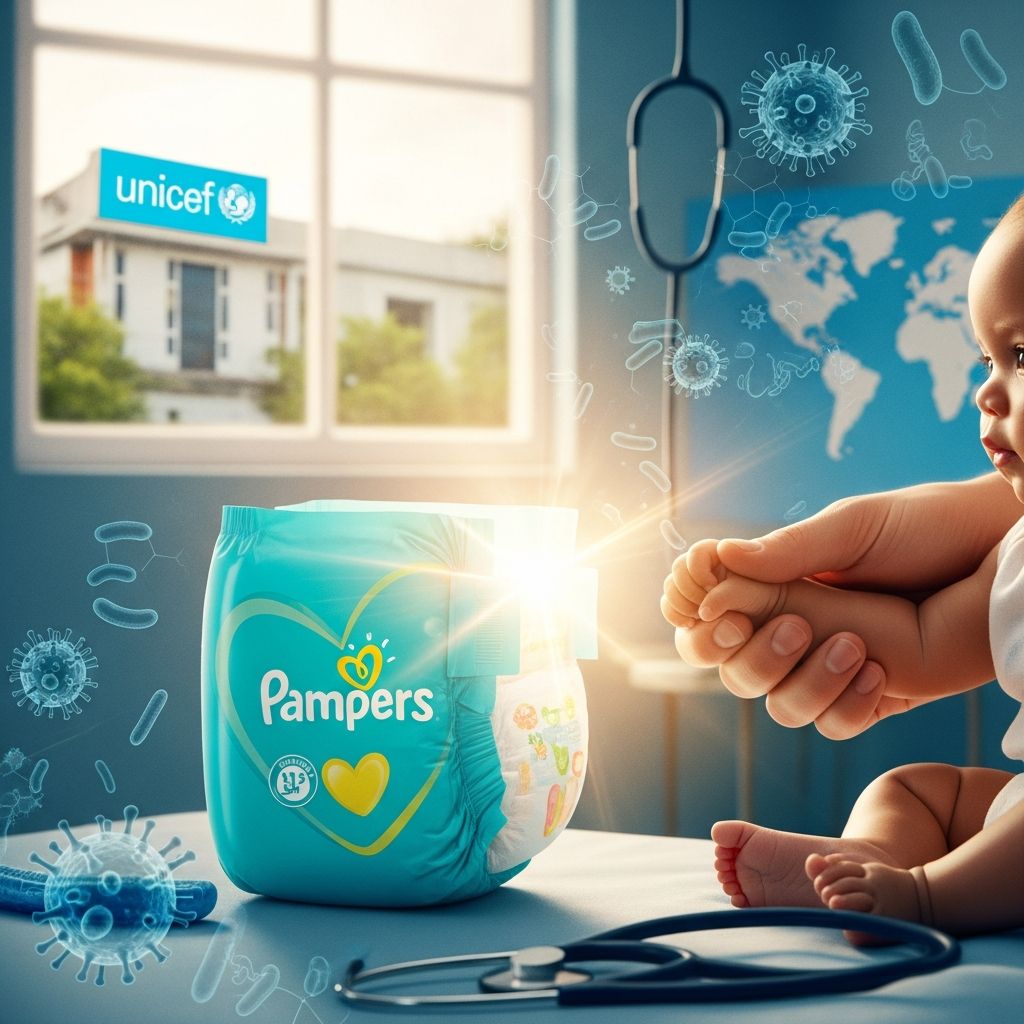
Most parents think about diapers in terms of leaks, naps, and getting through the day. Few realize that a simple pack of diapers can also help protect a mother and newborn on the other side of the world from a deadly but preventable disease. This is the quiet power behind the long-running collaboration between Pampers and UNICEF.
Using the original campaign as inspiration, this article explores how an everyday purchase became a global health tool, what maternal and newborn tetanus really is, and how parents in living rooms and grocery store aisles worldwide are part of a much bigger story.
From Shopping Cart to Shot: How the Partnership Works
The Pampers–UNICEF partnership is built around a simple promise often summarized as “1 pack = 1 vaccine”.When parents buy specially marked packs of diapers or wipes, Pampers funds a maternal or newborn tetanus vaccine delivered through UNICEF’s immunization programs in vulnerable communities.
- Corporate partner: Pampers, a Procter & Gamble baby-care brand available in more than 100 countries.
- Global health partner: UNICEF, the United Nations Children’s Fund, which supports vaccination programs in low- and middle-income countries.
- Mechanism: Eligible product purchases trigger a Pampers donation that helps pay for tetanus vaccines and the systems needed to deliver them.
What began as a marketing idea in 2006 has grown into one of the largest cause-related partnerships in the child health space. Over 15 years, the collaboration has helped finance more than 300 million tetanus vaccine doses and protect an estimated 100 million women and their babies from maternal and newborn tetanus.
Why Maternal and Newborn Tetanus Still Matters
For many parents in wealthier countries, tetanus is something you get a booster for every decade and then forget. But maternal and newborn tetanus (MNT) remains a serious threat where routine vaccination and clean delivery conditions are not guaranteed.
What is maternal and newborn tetanus?
MNT occurs when a woman or her newborn is infected with Clostridium tetani bacteria during pregnancy, delivery, or the weeks just after birth. The spores, found in soil and animal waste, can enter through cuts or the umbilical stump when births take place in unclean environments and traditional practices use non-sterile tools or substances.
Without treatment, tetanus causes painful muscle spasms, difficulty breathing, and often death. Newborns are particularly vulnerable. The World Health Organization (WHO) notes that newborn tetanus is almost always fatal without intensive care, which is often unavailable in the poorest communities.
Where and why the disease persists
- Lack of vaccination: Girls and women may miss out on childhood immunizations and never receive the recommended tetanus toxoid shots before or during pregnancy.
- Home births without skilled attendants: Many births still take place at home without trained health workers or clean delivery kits.
- Poverty and distance: Remote communities may be far from clinics, with limited transport, electricity, or cold-chain capacity for vaccines.
Because tetanus bacteria live in the environment, they cannot be eradicated; prevention relies on immunization of women of reproductive age and clean birth practices. This is exactly where UNICEF-supported programs, strengthened by corporate partners like Pampers, focus their efforts.
What the Pampers–UNICEF Partnership Has Achieved
Over time, the diaper-to-vaccine concept has moved from clever idea to public-health case study. Independent evaluations and UNICEF reports highlight the scale of impact.
| Impact Area | Estimated Results | Source |
|---|---|---|
| Newborn lives saved | Approximately one million newborn lives saved since 2006 | PRNewswire/UNICEF partnership report |
| Women and babies protected | About 100 million women and their babies protected from MNT | UNICEF and Pampers impact summary |
| Vaccines procured | More than 300 million tetanus vaccine doses | Partnership data shared by UNICEF |
| Countries where MNT eliminated | At least 26 countries achieved MNT elimination status with support from this partnership and others | UNICEF and Pampers panel discussion |
UNICEF defines elimination of MNT as fewer than one case of newborn tetanus per 1,000 live births in every district of a country, sustained over time. Reaching that standard demands not only vaccines but also better antenatal care, trained birth attendants, and community education—areas where donor funding helps accelerate progress.
Moms Helping Moms: The Human Side of a Global Campaign
Behind every statistic is a mother making a decision: to seek vaccination, to walk for hours to a clinic, or to deliver at a health facility instead of at home. Another mother, in a different country, is making a much simpler decision in a supermarket aisle. The Pampers–UNICEF campaign bridges these everyday moments.
How parents participate without leaving home
- Choosing eligible products: By selecting specially marked packs during specific campaign periods, parents trigger Pampers’ donations to UNICEF.
- Spreading the word: Sharing campaign information on social media and with parenting groups helps build momentum and awareness.
- Normalizing global giving: The model weaves charitable action into a routine purchase, showing children that caring for others can be integrated into daily life.
For parents who feel overwhelmed by global problems, this kind of built-in giving can be a first step toward broader engagement with maternal and child health issues.
How UNICEF Turns Funding Into Protection
Pampers’ financial contributions are only one piece of a complex system. UNICEF and national health ministries translate that funding into real-world protection through several coordinated strategies.
1. Supplementary immunization campaigns
In high-risk areas, UNICEF and partners organize large-scale campaigns that vaccinate women of reproductive age, often through temporary outreach posts in villages and schools.
- Women typically need a series of two or three doses spaced over time for long-lasting protection.
- Campaigns are often paired with health education on safe delivery and newborn care.
2. Strengthening routine services
To maintain low tetanus rates after campaigns end, countries must reliably offer tetanus-containing vaccines through regular antenatal visits and child immunization schedules. UNICEF supports:
- Cold-chain equipment to keep vaccines at safe temperatures.
- Training for nurses, midwives, and community health workers.
- Data systems to track coverage and identify gaps.
3. Promoting clean birth and cord-care practices
Even vaccinated communities need safe delivery practices. WHO and UNICEF promote simple steps such as clean birth kits, sterile cutting of the umbilical cord, and avoiding harmful substances on the cord stump.
Together, these efforts turn each funded dose into a broader package of protection for mothers and newborns.
Why This Partnership Became a Model for Cause Marketing
Marketing and management experts have studied the Pampers–UNICEF collaboration as an example of how companies and nonprofits can work together for social impact while also serving business goals.
Key features that experts highlight
- Clear, concrete promise: The idea that “one product = one vaccine” is easy to understand and easy to communicate.
- Aligned missions: Pampers focuses on baby care; UNICEF focuses on child health and survival. The partnership feels natural rather than forced.
- Long-term commitment: Sustained engagement over more than a decade allowed the program to reach scale and evolve based on data.
- Shared accountability: Public reporting on vaccines funded, countries reached, and milestones like the number of nations where MNT has been eliminated builds trust.
For parents, this can offer some reassurance that the label on the package reflects a genuine, measurable contribution rather than a one-off publicity stunt.
Looking Ahead: What Still Needs to Be Done
Despite major gains, maternal and newborn tetanus has not disappeared. UNICEF and WHO periodically report on remaining high-risk countries and emphasize the need to keep up momentum in vaccination and safe delivery initiatives.
Challenges that remain include:
- Reaching remote communities: Conflict, natural disasters, and fragile health systems make it hard to reach every woman with the full course of tetanus toxoid vaccines.
- Maintaining coverage: Once a country is validated as having eliminated MNT, it must sustain high immunization rates and clean delivery standards, which requires ongoing funding and political will.
- Competing health priorities: Outbreaks, pandemics, and other urgent needs can pull resources away from maternal and newborn health unless there are dedicated, predictable funds.
This is where durable partnerships—between governments, global agencies, and private-sector actors—continue to play a vital role.
Practical Ways Parents Can Support Global Maternal Health
Inspired by the Pampers–UNICEF model, parents can take a few simple steps to stay engaged with global maternal and newborn health.
- Stay informed: Follow updates from organizations such as UNICEF and WHO on maternal and newborn health initiatives.
- Look for credible campaigns: When participating in product-linked donations, choose brands that publish clear numbers and partner with reputable organizations.
- Teach your children: Use the idea of “your diapers helped another baby” to introduce kids to empathy and global citizenship.
- Consider direct giving: In addition to cause marketing campaigns, direct donations to trusted global health organizations can support broader work, from midwife training to emergency response.
Frequently Asked Questions (FAQs)
What exactly does “1 pack = 1 vaccine” mean?
It refers to a funding mechanism where Pampers makes a donation to UNICEF for each qualifying product purchased during the campaign period. UNICEF then uses pooled funds to procure and deliver tetanus vaccines and support related program costs. It is not a physical vaccine hidden in the package, but a financial contribution linked to that purchase.
Are Pampers and UNICEF still working together on maternal and newborn tetanus?
As of recent public updates, Pampers and UNICEF continue to highlight their joint work on eliminating maternal and newborn tetanus, celebrating milestones such as vaccines procured, countries where MNT has been eliminated, and newborn lives saved.
How does UNICEF verify that maternal and newborn tetanus is eliminated in a country?
UNICEF works with WHO and national health ministries to review surveillance data and coverage indicators. A country is considered to have eliminated MNT when there is fewer than one case of newborn tetanus per 1,000 live births in every district, and this status is validated through a formal process.
Are there any risks to relying on corporate partners for vaccine funding?
Public-health experts often stress that while corporate partnerships can mobilize significant resources quickly, they should complement—rather than replace—long-term government and multilateral funding. Stable domestic financing and international support remain essential to sustain immunization programs once campaign funding ends.
Can similar models work for other global health challenges?
Yes. The Pampers–UNICEF story is frequently cited in business and nonprofit literature as an example of cause-related marketing that delivered measurable health outcomes. Analysts suggest that clear goals, transparent metrics, and strong alignment between brand and cause are key factors if similar models are used for areas like nutrition, water, or education.
References
- Pampers & UNICEF: Pioneering Partnership Helps Save Estimated One Million Newborn Lives — Procter & Gamble / PR Newswire. 2021-05-20. https://www.prnewswire.com/news-releases/pampers–unicef-pioneering-partnership-helps-save-estimated-one-million-newborn-lives-301295685.html
- UNICEF and Pampers: “1 pack = 1 vaccine” partnership — SOFII (The Showcase of Fundraising Innovation and Inspiration). 2018-03-07. https://sofii.org/case-study/unicef-and-pampers-1-pack-1-vaccine-partnership
- Together for better: Reflecting on a pioneering 15 year partnership — Pampers / UNICEF panel, YouTube video transcript. 2021. https://www.youtube.com/watch?v=H__PEixucsQ
- Pampers and UNICEF celebrate a decade of lifesaving partnership — UNICEF Ireland. 2016-10-31. https://www.unicef.ie/story/pampers-and-unicef-celebrate-a-decade-of-lifesaving-partnership/
- Maternal and Neonatal Tetanus (MNT) — World Health Organization. 2023-02-15. https://www.who.int/teams/immunization-vaccines-and-biologicals/diseases/tetanus/maternal-and-neonatal-tetanus
- Lessons From the Campaign That Vaccinated 100 Million Mothers — Time Magazine. 2014-05-02. https://time.com/110833/lessons-from-the-campaign-that-vaccinated-100-million-mothers/
- How Pampers and UNICEF Conquered a Deadly Disease — Harvard Business Review. 2011-10-01. https://hbr.org/2011/10/how-pampers-and-unicef-conquer