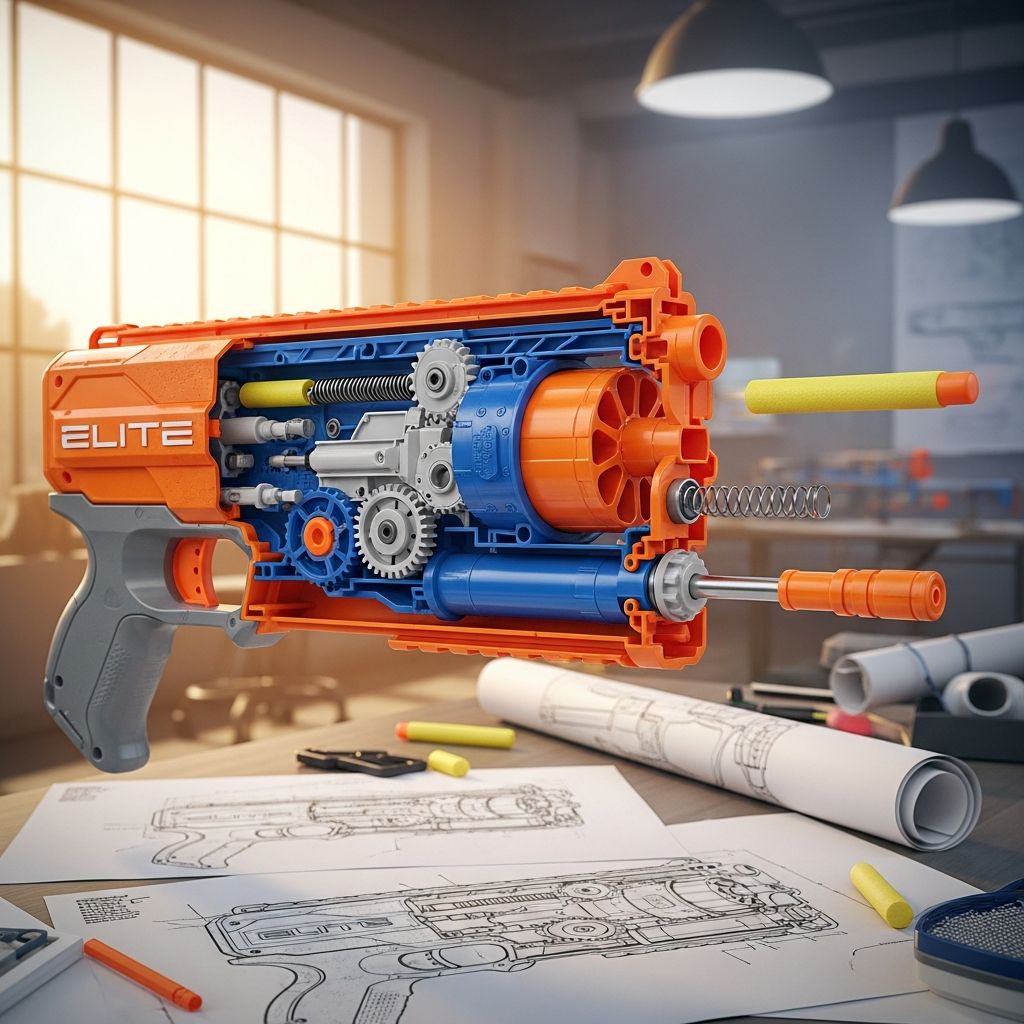
Nerf blasters are more than brightly colored plastic toys that launch foam darts across the living room. They sit at the crossroads of engineering, safety science, psychology of play, and pop culture. This guide pulls back the curtain on how modern foam dart blasters are imagined, built, and tested, and how parents can use them to encourage safe, active fun.
The Journey From Foam Ball to Foam Blaster
Before talking about today’s designers, it helps to know how the category even came to exist. The Nerf brand started in 1969 with a simple, squishy polyurethane foam ball marketed as the first safe indoor ball, created so kids could play without breaking household items or hurting each other. Over the next two decades that soft-ball idea slowly evolved into handheld blasters, with the first Nerf-branded foam launcher arriving in 1989.
That early decision to use soft foam for indoor-friendly play still shapes every design choice today. Blasters must look exciting and powerful, but the projectiles remain light, slow, and carefully controlled to stay within safety limits.
What a Nerf Designer Actually Does
Designing a Nerf-style blaster is a team sport. While one person may be credited as the lead designer, they collaborate daily with engineers, safety experts, model makers, and child development specialists. Their work tends to fall into several overlapping areas:
- Concept and theme creation – deciding what fantasy the toy should tap into: futuristic gear, sports-style launchers, wild sci-fi cannons, or licensed movie tie-ins.
- Form and ergonomics – shaping the blaster so kids with small hands can hold, prime, and reload it without strain.
- Mechanism design – working with engineers to create an internal system that reliably fires foam projectiles while meeting strict power and safety limits.
- Color, graphics, and branding – balancing bold, eye-catching looks with clear visual cues that this is a toy, not a realistic weapon.
- Play testing – watching real kids use prototypes and adjusting anything that frustrates or confuses them.
How a Foam Blaster Is Born: From Sketch to Shelf
Although each company has its own process, most foam dart blasters follow a similar development arc from idea to finished toy.
1. Brainstorming the Big Idea
Everything starts with a question: what kind of play experience are we trying to create? Designers pitch dozens of concepts, from tiny pocket shooters to elaborate motorized launchers. They consider:
- Target age group and skill level
- Where kids are likely to play (indoors vs outdoors)
- Whether it’s a quick-fire blaster or a precision-style toy
- How it fits into existing product lines and themes
2. Early Sketches and Foam Models
Once a concept is approved, designers sketch silhouettes and handle shapes. Instead of obsessing about tiny details first, they focus on how the toy feels in the hand. They might carve rough shapes from foam or 3D print early shells to test grip length, trigger reach, and priming motion with kids of different ages.
3. Engineering the Firing Mechanism
Inside most Nerf-style dart blasters is a very small pneumatic system. Spring-powered designs typically use a plunger and cylinder that compress air behind a dart; when the trigger is released, that burst of air pushes the dart down the barrel. More complex models may add flywheels or motorized systems to spin and launch darts at a controlled speed.
Engineering teams simulate how much force the spring can safely deliver, what dart materials work best, and how to avoid jams when kids inevitably reload under pressure. These calculations are tuned to stay under maximum velocity and impact thresholds recommended for toy projectile safety.
4. Prototypes and Play Sessions With Kids
Early working prototypes are rarely pretty: clear shells, exposed screws, and 3D-printed parts are common. Designers bring these to controlled sessions where kids are invited to:
- Try different priming motions (pull-back, pump, top-slide)
- Fire at soft targets at varying distances
- Reload rapidly to mimic a fast-paced game
The team watches for subtle clues: toys that are technically impressive but tiring to operate, triggers that feel mushy, or mechanisms that jam when handled roughly. Feedback from these sessions often leads to big changes, like simplifying the loading system or enlarging certain grips.
5. Safety Testing and Compliance
By the time a foam blaster looks close to final, it undergoes a battery of safety tests. In many markets, toys must comply with harmonized standards, such as ASTM F963 in the United States and EN 71 in the European Union, which set limits for projectile energy, small parts, sharp edges, and toxic substances.
Independent labs and in-house teams measure:
- Maximum dart speed and impact energy at specified distances
- Durability when dropped or roughly handled
- Choking hazards from small detachable parts
- Chemical safety of plastics, foams, and inks
Only after passing these checks can a blaster be cleared for mass production and placement on store shelves.
Balancing Thrill and Safety
One of the hardest parts of foam blaster design is walking a fine line: the toy must feel exciting without becoming unsafe. Designers and safety experts look at several dimensions:
| Design Goal | What Kids Want | How Designers Keep It Safe |
|---|---|---|
| Power and range | Long-distance shots, satisfying impact | Limit spring strength and dart mass to keep energy below regulated levels. |
| Fast firing | Multiple shots without reloading every time | Use magazine systems or multi-barrel designs that resist jamming and misfires. |
| Cool looks | Futuristic, bold, or “battle-ready” styling | Bright, toy-like colors and exaggerated shapes to avoid realistic weapon appearance. |
| Comfort | Blaster that feels “real” but not heavy | Lightweight plastics, smooth edges, and kid-sized grips tested with real users. |
Why Foam Dart Play Appeals So Much to Kids
Foam blasters draw on several deep currents in children’s play behavior that developmental psychologists have studied for decades. Active, imaginative play involving pretend conflict is a common way children explore rules, teamwork, and emotional regulation.
Some reasons foam dart toys are so compelling:
- Clear goals – hit the target, capture the flag, or outlast opponents.
- Instant feedback – kids immediately see where darts land and can adjust aim.
- Role-play – blasters become props in stories about space exploration, rescue missions, or fantasy battles.
- Social bonding – games often require teams, strategies, and informal rules negotiated among friends or siblings.
When adults set reasonable boundaries, this kind of pretend battle play can remain fun, cooperative, and safe. Researchers note that rough-and-tumble and pretend combat play do not generally increase real-world aggression when embedded in secure, supportive relationships and clear rules.
How Parents Can Choose the Right Blaster
With dozens of models on the market, selecting one can be overwhelming. Instead of focusing on the biggest or flashiest, parents can look at a few practical criteria:
- Age rating – pay close attention to the manufacturer’s minimum age, which reflects both safety and ergonomic considerations.
- Priming strength – younger children may struggle with very stiff springs; look for pump-style or smaller slide actions for them.
- Reload complexity – magazines and drums are exciting but can frustrate kids who have trouble orienting darts correctly.
- Play environment – compact sidearm-style blasters suit indoor spaces, while higher-capacity models work better outdoors.
- Safety gear compatibility – kids who play frequently or competitively benefit from eye protection and clear rules.
Setting Ground Rules for Safe Nerf Battles
Even with well-designed toys, adult guidance is crucial. Agencies such as the U.S. Consumer Product Safety Commission (CPSC) encourage parents to supervise projectile toy play, especially with younger children, and to follow age and use recommendations.
Simple family rules can keep games fun and reduce risk:
- No aiming at faces or heads; targets should be torso or designated objects.
- Wear protective eyewear during high-energy games or large group battles.
- Only use official or recommended darts for the blaster to ensure proper fit and performance.
- Store blasters unloaded and out of reach of very young children.
- Agree on play zones (e.g., no shooting in hallways where adults are carrying hot drinks or fragile items).
Behind the Aesthetics: Why Blasters Look the Way They Do
Modern Nerf-style products are instantly recognizable: bright blues and oranges, stylized barrels, and oversized details. That look is carefully chosen to send a clear message that this is fantasy gear, not a real weapon. Toy industry guidelines and some national regulations discourage realistic replicas, especially for children, to minimize confusion for both the public and law enforcement.
Designers use:
- High-visibility colors for main body parts and tips of barrels.
- Exposed, stylized mechanisms that emphasize the toy nature of the product.
- Fictional logos and symbols instead of realistic military or police markings.
Innovation Trends in Foam Dart Design
Like any technology, foam blasters evolve. Over the years, we have seen the introduction of new ammo types (foam balls, discs, high-impact rounds) and series emphasizing modular attachments and customization. Some current and emerging trends include:
- Modular rails and add-ons – allowing kids to attach scopes, stocks, or barrels to personalize their setup.
- Motorized flywheel systems – giving higher rates of fire while keeping dart energy within safe bounds.
- Improved foam formulas – darts designed to maintain shape longer, resist tearing, and fly more consistently.
- Themed lines – blasters tied to popular films, games, and shows, designed in collaboration with entertainment brands.
Encouraging Healthy Play With Nerf Blasters
Used thoughtfully, foam dart toys can be a gateway to more active and cooperative play. Parents can nudge games away from pure “tag and eliminate” structures toward challenges that emphasize creativity and teamwork, such as:
- Building safe obstacle courses with cushions and cardboard forts.
- Designing target ranges with points for trick shots.
- Creating story-driven missions where players rescue a stuffed animal or deliver a message.
- Rotating roles so one child is a referee, timekeeper, or storyteller instead of always a competitor.
These approaches retain the excitement of blasters while reinforcing skills like cooperation, problem solving, and self-control.
Frequently Asked Questions (FAQs)
Q: Are Nerf-style blasters safe for young children?
Most foam dart blasters are designed and tested to meet strict toy safety standards, but manufacturers set minimum age recommendations for good reasons. Younger children may not follow rules reliably or may mouth darts, increasing choking risk. Always follow the age guidance on packaging and supervise closely.
Q: Why do some darts hurt more than others?
Perceived sting depends on several factors: dart weight, tip hardness, distance, and where the dart hits. Projectiles are designed to stay below specific energy thresholds, but closer shots or hits to sensitive areas like the face can still be uncomfortable. Setting rules about distance and aiming away from faces helps.
Q: Do off-brand darts and accessories make blasters unsafe?
Third-party darts may not match the exact weight, diameter, or foam density of the originals. That can change performance—sometimes making darts fly farther, but also increasing the chance of jams or unexpected impact sensations. For younger players or intense games, sticking with the manufacturer’s recommended darts is usually safest.
Q: How can I reduce arguments and conflicts during Nerf battles?
Agree on rules before the first dart is fired: where hits count, what happens when someone is out, and how long each round lasts. Rotate teams, have clear start and stop signals, and encourage kids to pause if play starts feeling too intense. Adults who join a round or two can model good sportsmanship.
Q: Is it okay if my child prefers pretend battle games?
Research on play suggests that many children naturally explore themes of conflict and bravery in fantasy games, whether through foam blasters, superhero capes, or toy swords. The key factors are context and guidance: when adults set boundaries, emphasize kindness, and pay attention to a child’s overall behavior and feelings, pretend combat can be part of healthy development.
References
- A Brief History of Nerf — The Fact Site. 2021-03-25. https://www.thefactsite.com/nerf-history/
- The History of Nerf — Centives. 2012-03-20. https://www.centives.net/S/2012/the-history-of-nerf/
- Projectile Toys: Safety Information — U.S. Consumer Product Safety Commission. 2019-11-01. https://www.cpsc.gov/Safety-Education/Safety-Education-Centers/Toys
- Nerf Blaster — Hasbro / Encyclopedia entry via Wikimedia sources (technical description of mechanisms). 2023-05-01. https://en.wikipedia.org/wiki/Nerf_Blaster
- How Nerf Guns are Made? — P320 Gel Blaster Blog. 2023-02-10. https://www.p320gelblaster.com/blogs/nerf-blaster-blogs/how-nerf-guns-are-made