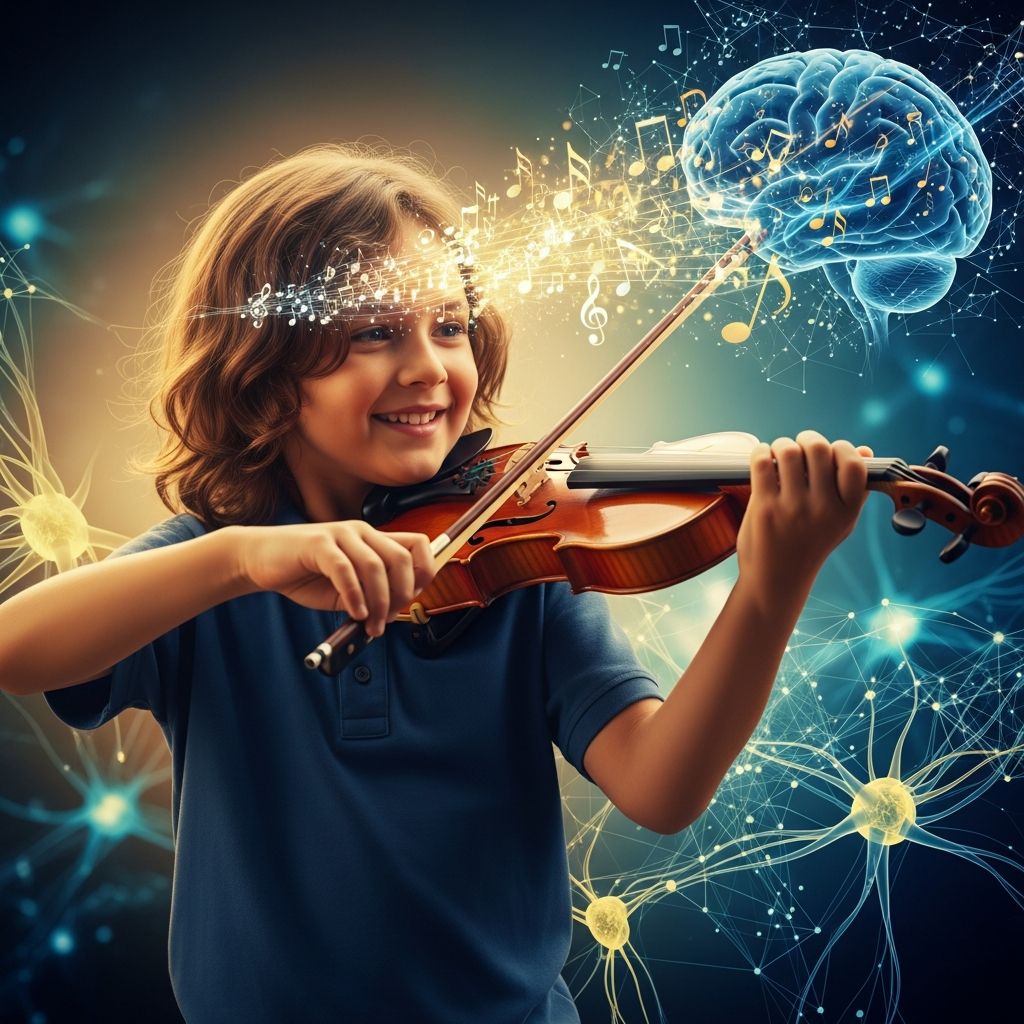
Engaging young children in music education does more than teach them to play notes; it fundamentally reshapes their developing brains. Longitudinal studies demonstrate that consistent music training, particularly over at least two years, accelerates neural maturation, sharpens auditory processing, and boosts cognitive skills essential for learning and academic success.
The Neural Symphony: How Music Rewires Young Minds
Music activates multiple brain regions simultaneously, fostering connections that support broader cognitive functions. When children learn instruments or participate in ensemble playing, their auditory cortex, prefrontal cortex, hippocampus, and cerebellum light up, enhancing everything from memory to motor coordination.
A pivotal five-year study by USC neuroscientists revealed that children receiving music instruction showed faster maturation in the auditory pathway—the brain’s sound-processing highway—compared to peers in sports programs or no structured activities. After just two years, these music-trained kids exhibited smaller P1 potential amplitudes in EEG readings, signaling more efficient neural responses to sound. This efficiency translates to superior pitch discrimination and melody recognition, skills that underpin language acquisition and reading proficiency.
Similarly, research from the University of Graz tracked over 200 children aged 8 to 18, finding that those with ongoing music training outperformed others in distinguishing pitches, timbres, rhythms, and harmonic fundamentals. Notably, greater childhood music exposure correlated with expanded grey matter in Heschl’s gyrus, the primary auditory processing area, independent of innate talent.
Two Years In: The Tipping Point for Lasting Gains
Why two years? Initial exposure sparks interest, but sustained practice drives structural brain changes. USC findings pinpointed this duration as key: within 24 months, music group participants processed sounds more accurately, with accelerated development of the N1 neural component, vital for attention and perception.
Graz researchers echoed this, observing that prolonged engagement enlarges auditory brain volumes and heightens activation, even in children with challenges like ADHD or dyslexia. This neuroplasticity— the brain’s ability to adapt—peaks in early childhood, making consistent lessons a prime window for optimization.
| Study | Duration | Key Brain Changes | Cognitive Outcomes |
|---|---|---|---|
| USC (2012-2017) | 2+ years | Faster auditory pathway maturation; reduced P1 latency | Improved sound processing, language/reading skills |
| University of Graz | Up to 10 years | Increased Heschl’s gyrus grey matter | Better pitch/timbre discrimination; emotional tone recognition |
Cognitive Superchargers: IQ, Memory, and Beyond
Beyond auditory gains, music lessons elevate full-spectrum intelligence. University of Toronto psychologist E. Glenn Schellenberg’s experiments showed children in weekly music programs gained 7 IQ points over controls in drama or no lessons, linking music’s demands on pattern recognition and discipline to broader smarts.
- Memory Boost: Memorizing scales and pieces strengthens hippocampal function, aiding retention in math and languages.
- Spatial Skills: Rhythm and notation training enhances visualization, crucial for geometry and engineering; piano students improved puzzle-solving by 30% after six months.
- Executive Function: Practicing demands focus, planning, and error correction, fortifying prefrontal cortex for self-regulation.
These aren’t fleeting effects. Unlike the temporary ‘Mozart Effect’—where classical listening briefly primes spatial tasks—active instrument training forges permanent pathways. Children in orchestra programs detected subtle pitch shifts others missed, a precision aiding speech perception and literacy.
Overcoming Challenges: Music for All Learners
Music’s benefits extend to neurodiverse kids. Graz’s long-term data included those with ADHD, ADD, and dyslexia, yet music trainees still showed superior auditory discrimination and brain adaptations. This suggests music as a therapeutic tool, stimulating underactive regions while building confidence.
For typical developers, early start matters. Programs integrating singing, rhythm games, and instruments from infancy engage working memory, vocabulary, and number sense simultaneously. Even passive listening paves neural highways, but hands-on creation amplifies them.
Practical Pathways: Integrating Music into Family Life
Parents needn’t be virtuosos to reap rewards. Start with 30-45 minute weekly group lessons, building to private instruction. Choose instruments matching motor skills: xylophones for toddlers, violins for school-age.
Schools cutting arts budgets miss this science—evidence urges reinstating them, as music primes brains for STEM and humanities alike. Home strategies include daily playlists fostering rhythm clapping or air drumming, evolving to apps tracking progress.
- Assess readiness: Begin at age 5-7 for focus-demanding instruments.
- Commit long-term: Aim for 2+ years minimum.
- Monitor joy: Motivation sustains practice; switch if frustration dominates.
- Combine with academics: Link beats to counting, lyrics to reading.
Long-Term Legacy: From Childhood Notes to Adult Brilliance
Adolescent follow-ups reveal enduring impacts. Graz participants with early training retained larger auditory cortices into teens, correlating with musicality and conversational nuance. USC anticipates similar trajectories in language and socio-emotional growth.
Music doesn’t ‘make kids geniuses,’ but it equips them with resilient brains navigating complexity. In an era of screen distractions, this analog pursuit builds attention spans and creativity schools alone can’t match.
Frequently Asked Questions
What age is best to start music lessons?
Ideally 5-7 years, when attention and fine motor skills align, though rhythm exposure from infancy builds foundations.
Do all instruments offer equal brain benefits?
Yes, but strings and winds demand breath/rhythm precision, edging winds for auditory gains; percussion excels in motor-cognitive links.
What if my child lacks talent?
Talent is secondary; Graz proved practice-induced changes surpass innate traits, benefiting all.
How many hours weekly for results?
2-5 hours total, including practice, yielded USC’s two-year shifts; consistency trumps intensity.
Can music help kids with learning disabilities?
Absolutely—enhanced sound processing aids dyslexia/ADHD via better phoneme awareness and focus.
References
- Children’s brains develop faster with music training — USC Today. 2017-approx. (Initial results from 5-year study published in Developmental Cognitive Neuroscience). https://today.usc.edu/childrens-brains-develop-faster-with-music-training/
- Long-term study shows how music lessons shape children’s brains — University of Graz. 2023-approx. (Published in Journal of Neuroscience). https://www.uni-graz.at/en/news/long-term-study-shows-how-music-lessons-shape-childrens-brains/
- The Science Behind Music and Brain Development — Glendora Music and Arts School (citing Schellenberg, U. Toronto). 2023-approx. https://www.glendoramusicandartsschool.com/post/the-science-behind-music-and-brain-development
- The Role of Music in Brain Development — University of Georgia CAES. 2020-approx. https://fieldreport.caes.uga.edu/publications/C1053-06/the-role-of-music-in-brain-development/
- The Science of Sound: How Music Affects Brain Development in Children — Bach to Rock. 2023-approx. https://www.bachtorock.com/blog/the-science-of-sound-how-music-affects-brain-development-in-children-blgpst/