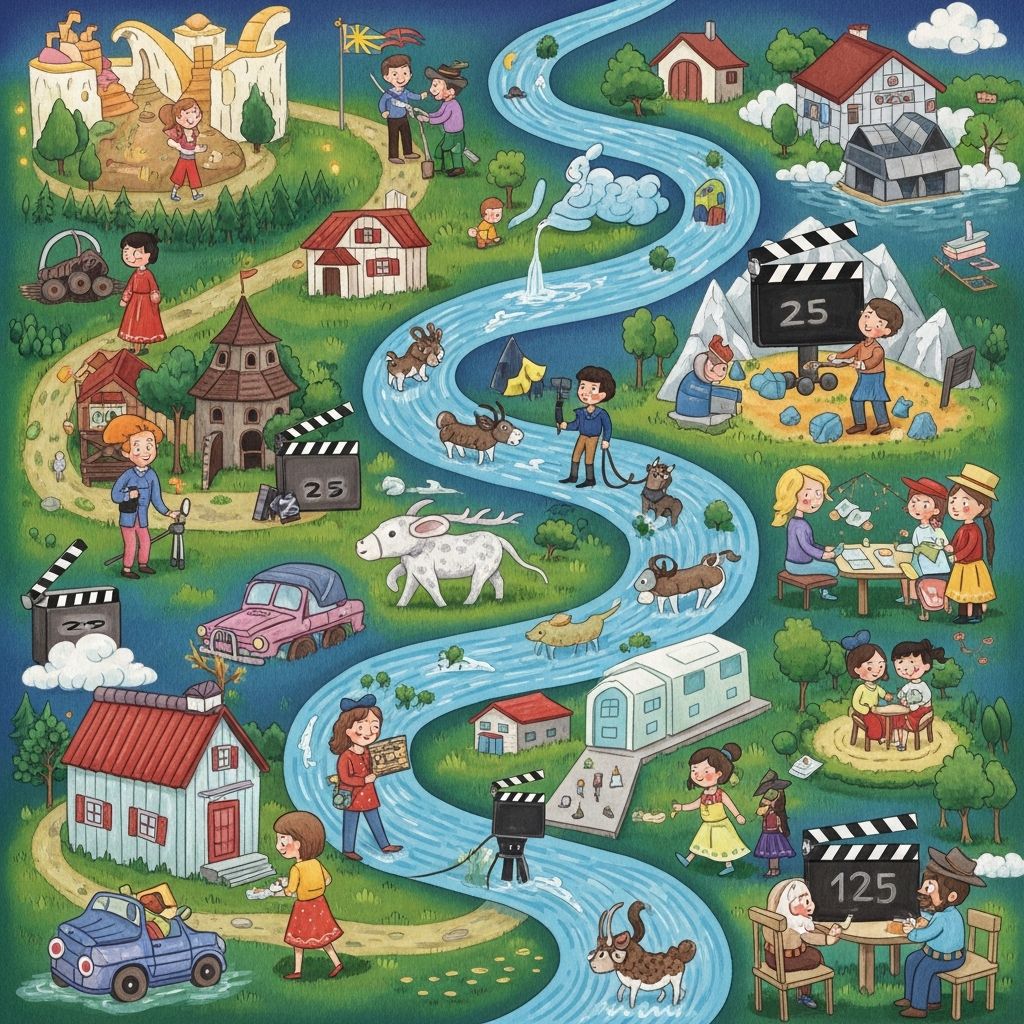
When you sit down to watch a movie, it can feel like magic. But behind that magic is a long, carefully planned process that involves hundreds — sometimes thousands — of talented people. This guide walks you through the movie-making journey in a way that kids and families can understand and enjoy.
From Tiny Spark to Big Story
Every movie starts the same way: with an idea. That idea can come from many places:
- A book, comic, or fairy tale someone loves
- A true story from history or the news
- A daydream or “what if?” thought
- A character a writer imagines first, then builds a story around
Once someone has a strong idea, they usually write a short summary of it, explaining the main characters, the problem they face, and how the story might end. If a studio or producer likes this summary enough, the project moves forward.
Shaping the Story: Scripts, Scenes, and Storyboards
After the basic idea is approved, it has to be turned into something everyone on the team can follow: a screenplay (also called a script) and storyboards.
What Is a Screenplay?
A screenplay is the written blueprint of the movie. It usually includes:
- Dialogue: what each character says
- Actions: what characters do and how they move
- Scene descriptions: where the scene happens and what it looks like
- Scene numbers: a way to organize the movie into smaller parts
Writers often rewrite the script many times. Directors, producers, and sometimes actors give feedback so the story becomes as clear and exciting as possible.
Turning Words Into Pictures: Storyboards
Once the main story is set, artists create storyboards — a kind of comic-strip version of the movie. Each drawing shows a key moment or camera angle. Storyboards help the team:
- Plan where the camera will be
- Decide how characters move through the scene
- Spot scenes that might be too hard or too expensive to shoot
- Coordinate with special effects and animation teams
Animated movies rely especially heavily on storyboards, since nearly everything you see must be designed and created from scratch.
Building the Team: Who Makes a Movie?
Movies are a group effort. Many different jobs come together like puzzle pieces to create the final film.
| Role | What They Do |
|---|---|
| Producer | Finds money for the movie, hires key people, and makes big business decisions. |
| Director | Leads the creative vision, guides actors, and decides how each scene should feel and look. |
| Screenwriter | Writes and rewrites the script, including dialogue and scene descriptions. |
| Casting director | Helps choose which actors should play each character. |
| Cinematographer | Also called the director of photography; decides how scenes are lit and filmed. |
| Production designer | Plans the look of sets, locations, props, and sometimes costumes. |
| Editors | Cut and arrange the filmed scenes into a smooth story. |
This is only a small sample — big films also involve makeup artists, stunt teams, CGI experts, costume designers, sound mixers, musicians, and many more.
Pre-Production: Planning Every Detail
Before cameras roll, there is a long planning stage called pre-production. During this time, the team works out how to turn the script into real scenes.
Choosing Where and How to Film
- Locations: Teams search for real-world places that match the script — a school, a park, a city street, or a farm.
- Sets: If a scene is too hard to film in the real world (like in space or inside a tiny submarine), builders create sets on a soundstage.
- Costumes and props: Designers create clothing and special objects characters need, from magic wands to backpacks.
Scheduling and Safety
Filmmakers create complicated schedules to decide:
- Which scenes will be filmed each day
- When each actor needs to be on set
- How to keep the cast and crew safe, especially during stunts or night shoots
When children are in a movie, there are strict rules about how long they can work and how much rest and school time they must get, based on child labor laws in many countries.
Lights, Camera, Action: The Filming Stage
At last, the team is ready to film. This stage is often called production. It can take weeks or months, depending on how big the movie is.
What Happens During a Typical Scene?
Filming one short scene can require many steps:
- The crew sets up lights, cameras, and microphones.
- The director talks with actors about what the scene means and how their characters feel.
- The team rehearses the scene without recording, to fix any problems.
- When everyone is ready, someone calls out: “Quiet on set!” and then “Action!”
- The scene is filmed from one angle, then repeated from another angle.
Most scenes are filmed many times. Later, editors choose the best takes and angles to create a smooth final version.
Live Action vs. Animation
- Live action: Uses real actors, costumes, props, and often real locations. Cameras capture everything at once.
- Animation: Artists, modelers, and animators create every frame using drawings, clay models, or computers. Voices are often recorded in a studio and matched to the animation later.
Animated movies can take even longer than live-action films, because each movement and expression must be planned and created.
Sound, Music, and the Power of Silence
Movies don’t feel complete without sound. Even during filming, microphones record dialogue and some background noise. But much of the final audio is added or improved later in a process called post-production.
Types of Movie Sounds
- Dialogue: The characters’ spoken words. Sometimes actors re-record lines in a studio if the original sound was noisy.
- Sound effects: Footsteps, door creaks, lasers, animal sounds, and more — many are created or enhanced by sound designers.
- Music: Composers write music to match the mood of each scene. Music can make a moment feel exciting, sad, or mysterious.
- Silence: Quiet moments are carefully chosen too. Silence can build tension or highlight an important emotion.
Researchers have found that audio and music strongly affect how viewers feel and remember scenes, especially in children, who respond strongly to emotional cues from sound.
Editing: Putting the Puzzle Together
After filming, editors and the director work through all the footage to build the final story. This can be one of the longest stages.
What Editors Do
- Choose the best takes of each line and action
- Decide how long each shot should last
- Arrange scenes in the right order
- Blend live-action footage with computer-generated images (CGI)
- Add transitions, titles, and credits
Careful editing can change the pace and mood of the film. A fast series of cuts can make a chase feel exciting; longer shots can make conversations feel more thoughtful or emotional.
Special Effects and Animation Magic
Some things are too dangerous, too expensive, or simply impossible to film in real life. That’s where visual effects (VFX) and animation come in.
- Practical effects: Real explosions, makeup, puppets, and miniatures filmed on set.
- Digital effects (CGI): Computer-made creatures, weather, crowds, and whole worlds added later.
- Motion capture: Actors wear special suits with sensors. Their movements are turned into animated characters.
VFX teams work closely with directors and cinematographers to make sure the digital elements blend smoothly with live-action footage.
Checking for Safety and Age-Appropriate Content
Before a movie is released, it often goes through a rating process to help families decide whether it is right for children of different ages. Ratings boards look at:
- How much violence is shown
- Whether there is strong or scary language
- How intense certain scenes are
- Whether the movie includes content meant for adults
Health and child development experts emphasize that what kids watch — not just how much they watch — can shape behavior and emotions. Movies with positive, prosocial messages may help kids learn kindness, while frequent exposure to violent or frightening scenes can raise anxiety or aggressive behavior in some children.
The Premiere: Sharing the Story With the World
When all the pieces are in place — editing, sound, music, effects, and ratings — the movie is ready to be shared.
- Premieres: Special first showings, often with cast and crew on the red carpet.
- Theaters: The film is shown in cinemas so audiences can enjoy it on a big screen.
- Streaming and home release: After theaters, many movies are released on streaming services, TV, or digital download so families can watch at home.
For kids and adults alike, watching a movie together can be a fun way to relax and talk about ideas, feelings, and choices characters make. Experts recommend that parents co-view with children when possible and discuss what they see to support healthy understanding and media skills.
Watching Wisely: Healthy Screen Habits for Kids
Knowing how movies are made is exciting, but it is also important to use screens in healthy ways. Health organizations studying children’s screen time suggest that:
- Too many hours of daily screen time are linked with sleep problems, lower physical activity, and more emotional difficulties in many children and teens.
- Content matters: educational, age-appropriate movies watched with a parent are very different from violent or frightening shows watched alone.
- Taking breaks from screens to play, read, move, and talk with family is key to healthy development.
Families can create simple rules together, such as no screens during meals, keeping devices out of bedrooms at night, and choosing movies carefully by checking ratings and reviews first.
FAQ: Kids’ Questions About Movie Making
Why do movies take so long to make?
Even a short scene may be filmed many times from different angles, then edited, given sound, music, and special effects. Planning, filming, and post-production can easily take a year or more, especially for animated or effects-heavy movies.
Do actors really do all the dangerous stunts?
Not usually. Many risky actions are done by trained stunt performers or created with special effects. Safety experts and stunt coordinators carefully plan these scenes so no one gets hurt.
Why do some scenes look different from others?
Different lighting, camera lenses, and editing choices can change how a scene feels. For example, bright lighting and steady cameras can make a scene feel safe, while dark lighting and quick cuts can make it feel tense or scary.
How do animated characters talk?
Voice actors record their lines in a sound studio. Animators then match the characters’ mouth shapes and facial expressions to the recorded voices, one moment at a time.
Can kids work in movies?
Yes, but there are strict rules to protect them. Children can only work limited hours, must have breaks, and often need a teacher on set so they can keep up with schoolwork, according to child labor guidelines in many regions.
References
- Media Use and Screen Time – Its Impact on Children, Adolescents, and Families — American College of Pediatricians. 2021-06-01. https://acpeds.org/media-use-and-screen-time-its-impact-on-children-adolescents-and-families/
- Effects of Excessive Screen Time on Child Development — Frontiers in Psychology (via NIH PMC). 2023-06-21. https://pmc.ncbi.nlm.nih.gov/articles/PMC10353947/
- The Effects of Screen Time on Children: The Latest Research Parents Should Know — Children’s Health of Orange County (CHOC). 2023-04-10. https://health.choc.org/the-effects-of-screen-time-on-children-the-latest-research-parents-should-know/
- Associations Between Screen Time Use and Health Outcomes Among Adolescents in the US — Centers for Disease Control and Prevention (CDC). 2025-01-09. https://www.cdc.gov/pcd/issues/2025/24_0537.htm
- Research Spotlight: Study Finds Children Log Excessive Screen-Time — University at Albany, Center for the Elimination of Minority Health Disparities. 2019-03-01. https://www.albany.edu/cihs/news/2019-research-spotlight-study-finds-children-log-excessive-screen-time
- Back to School: How Screen Time Affects Children’s Developing Brains — Cedars-Sinai. 2022-08-22. https://www.cedars-sinai.org/newsroom/back-to-school-how-screen-time-affects-childrens-developing-brains/
- Screen Time and Children — American Academy of Child & Adolescent Psychiatry (AACAP). 2020-03-01. https://www.aacap.org/AACAP/Families_and_Youth/Facts_for_Families/FFF-Guide/Children-And-Watching-TV-054.aspx