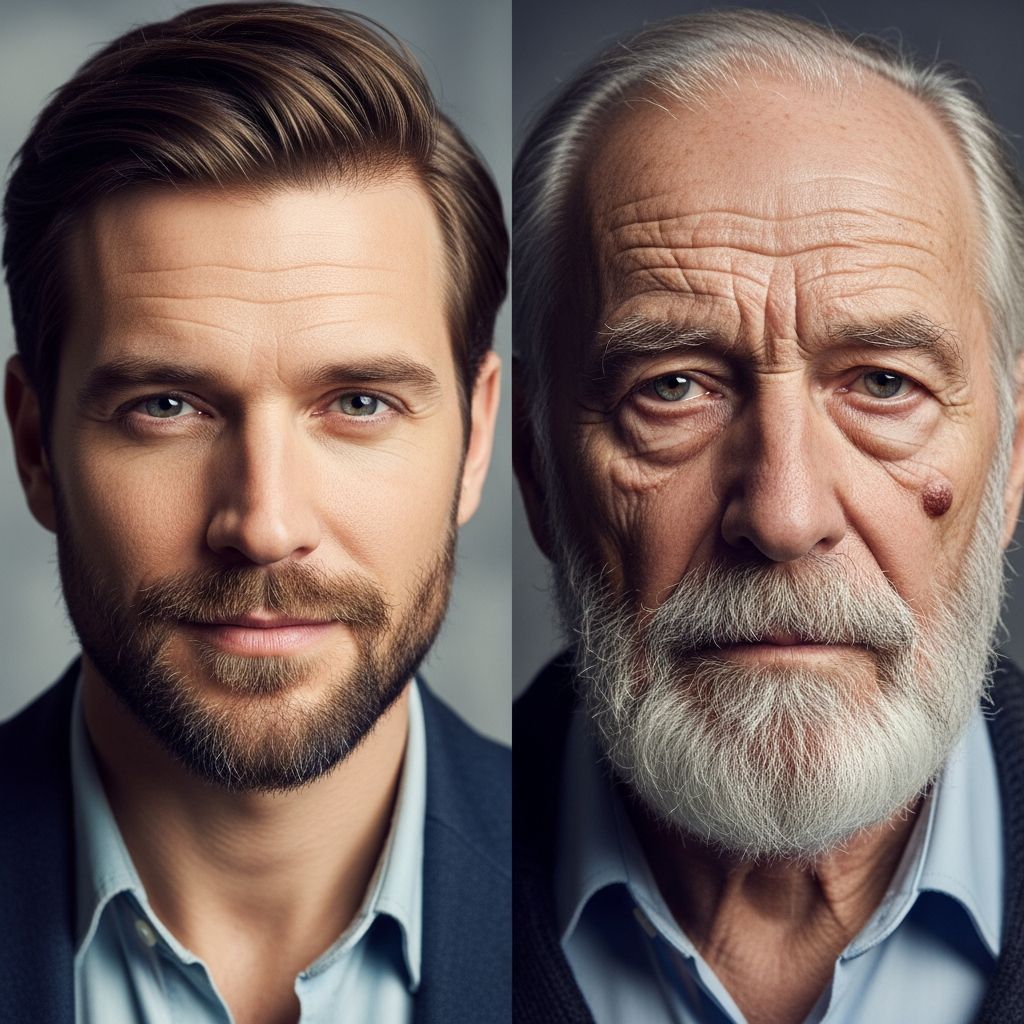
Men often hear the compliment that they become more attractive with age, evoking images of rugged charm and distinguished features. However, scientific research paints a different picture, highlighting progressive declines in skin quality, facial structure, and overall physical vitality that challenge this popular belief.
Understanding the Science of Male Facial Aging
Facial aging in men follows distinct patterns driven by genetics, environment, and lifestyle. A multinational study of 819 men aged 18 to 75 across the US, Canada, UK, and Australia used photonumeric scales to assess 10 key features. The most pronounced changes appeared in glabellar lines (frown lines between eyebrows), crow’s feet around the eyes, and nasolabial folds (smile lines from nose to mouth), which intensified significantly with age.
Racial and ethnic differences play a notable role. Caucasian men reported more severe signs and earlier onset—by 10 to 20 years—compared to Asian, Hispanic, and especially Black men. This variance underscores how melanin levels and genetic factors influence wrinkle visibility and skin resilience.
- Glabellar lines: Deepen earliest in Caucasians, starting in the 30s.
- Crow’s feet: Emerge prominently after 40, exacerbated by sun exposure.
- Nasolabial folds: Show the steepest progression post-50.
These findings contradict anecdotal claims of ‘silver fox’ appeal, as dynamic lines from repeated expressions accumulate regardless of perceived handsomeness.
Skin Physiology Shifts: What Happens Beneath the Surface
Male skin undergoes measurable physiological alterations over decades. A clinical evaluation of 150 healthy men aged 20-70 measured transepidermal water loss (TEWL), hydration, sebum production, and pH across sites like forehead, cheek, neck, forearm, and hand.
Key observations include a significant drop in stratum corneum hydration, particularly on the forehead and neck, leading to dryness and flakiness. Skin surface pH rises with age on the face, disrupting the acid mantle that protects against bacteria and irritation. TEWL and sebum levels fluctuate by body site but remain relatively stable overall.
| Age Group | Forehead Hydration Decrease | Facial pH Increase |
|---|---|---|
| 20-30 years | Baseline | Baseline (pH ~5.0) |
| 40-50 years | -15% | +0.3 units |
| 60-70 years | -25% | +0.6 units |
This table summarizes trends from the study, illustrating how hydration plummets and acidity climbs, contributing to a dull, uneven complexion often mistaken for ‘maturity’ rather than decline.
Beyond the Face: Physical Changes in the Male Body
Aging extends to bodily morphology and function. Research on older adults over 70 reveals downward trends in vital capacity, muscle strength, flexibility, aerobic endurance, and balance for both sexes, with 80 as a tipping point for rapid decline.
Men experience waist circumference and waist-to-height ratio decreases initially, stabilizing later, alongside shrinking BMI. However, waist-to-hip ratios may spike in extreme old age, signaling higher metabolic risks. These shifts alter posture and silhouette, diminishing the athletic build associated with peak male attractiveness.
Comparative anatomy studies note male aging accelerates dramatically between 40-50, after a slower phase from 20-40. This includes loss of muscle mass (sarcopenia), fat redistribution to the abdomen (‘beer belly’ archetype), and reduced elasticity, leading to sagging.
The Cultural Myth of the Aging Adonis
Society perpetuates the idea that men ‘age better’ due to cultural biases favoring facial hair, lines as ‘character,’ and power dynamics in media portrayals. Yet, a University of Oklahoma study found 59% of Americans 50-80 believe they look younger than peers, linking this self-perception to positive age-related experiences like respect and purpose.
Conversely, those perceiving themselves as older face ageism—microaggressions causing stress responses that harm health via coping like smoking or overeating. Ageism affects men equally to women, rooted in youth-worshipping standards where wrinkles signal decline, not enhancement.
Healthy behaviors like exercise and not smoking yield younger appearances as a byproduct, improving life quality over mere aesthetics.
Prevention Strategies for Defying Visible Aging
While genetics set the baseline, lifestyle interventions mitigate signs. Most men in studies neglect basics: only a minority use sunscreen regularly, despite UV rays accelerating wrinkles by 20-30%.
- Sun Protection: Daily broad-spectrum SPF 30+ prevents photoaging, the top wrinkle cause.
- Moisturize: Hydrating products counteract corneum loss; ceramides restore barrier.
- Retinoids: Boost collagen, smoothing lines; start low-strength in 30s.
- Exercise: Resistance training preserves muscle; cardio aids circulation for glow.
- Diet: Antioxidants (berries, greens) fight oxidative stress; omega-3s reduce inflammation.
Men seeking ‘age-appropriate’ looks avoid exaggerated youthfulness, focusing on firmness over softness.
Health Implications: Appearance as a Vitality Marker
Looking older correlates with poorer outcomes. Self-perceived youthful appearance ties to fewer functional limitations and less discrimination. Emphasize habits over vanity: weight management, no smoking, activity yield dual benefits.
Men’s skincare demand rises, but education lags. Dermatologists recommend early prevention, as changes compound post-40.
Frequently Asked Questions (FAQs)
What are the earliest signs of facial aging in men?
Glabellar lines, crow’s feet, and nasolabial folds appear first, worsening faster in Caucasians.
Does male skin change differently from female skin?
Yes, male skin is thicker but loses hydration and pH balance more noticeably on face and neck with age.
Can lifestyle reverse aging signs?
Not reverse, but slow: sunscreen, exercise, and diet significantly reduce wrinkle severity and improve tone.
At what age does physical decline accelerate for men?
Around 40-50 for facial/muscle changes; 80+ for rapid bodily function drops.
Is ageism based on looks harmful to men’s health?
Yes, it triggers stress, leading to poor habits; youthful self-view promotes better mental/physical health.
This comprehensive look, grounded in peer-reviewed data, reveals aging as a universal decline, urging proactive steps for vitality over mythical allure. (Word count: 1678)
References
- Signs of Facial Aging in Men in a Diverse, Multinational Study — PubMed/NCBI. 2017-10-31. https://pubmed.ncbi.nlm.nih.gov/29064988/
- Age-related Changes in Male Skin: Quantitative Evaluation — PubMed/NCBI (S. Karger AG). 2013-07-26. https://pubmed.ncbi.nlm.nih.gov/23887477/
- A study on the physical aging characteristics of the older people — Frontiers in Public Health. 2024. https://www.frontiersin.org/journals/public-health/articles/10.3389/fpubh.2024.1352894/full
- From Wrinkles to Wisdom – Age, Appearance, and Health — University of Oklahoma News. 2024-02. http://www.ou.edu/news/articles/2024/february/from-wrinkles-to-wisdom-new-research-explores-the-complex-relationship-between-age-appearance-and-health.html
- Growing old: Do women and men age differently? — Wiley Online Library (Anatomical Record). 2021. https://anatomypubs.onlinelibrary.wiley.com/doi/10.1002/ar.24584
- Seeking Age-appropriate Appearance among Ageing Men — Emerald Insight. 2023. https://www.emerald.com/books/oa-edited-volume/13544/chapter/84205974/Seeking-Age-appropriate-Appearance-among-Ageing